
Leverage Risk Calculator
Extreme Leverage Warning
BitSeven offers up to 100x leverage, which means a 1% move against your position causes a 100% loss. This calculator demonstrates these extreme risks.
Enter values above to see potential outcomes
Important: BitSeven has no stop-loss protection. At 100x leverage, a 1% move against you means 100% loss. This calculator shows worst-case scenarios.
BitSeven isn’t your average crypto exchange. If you’re looking to trade Bitcoin, Ethereum, Litecoin, or Ripple with up to 100x leverage, it’s one of the few platforms that still offers it. But here’s the catch: that same leverage can wipe out your account in seconds if the market moves against you by just 1%. This isn’t trading-it’s Russian roulette with crypto.
What BitSeven Actually Offers
BitSeven doesn’t do spot trading. You won’t find hundreds of coins to buy and hold. It only supports four perpetual futures contracts: BTC/USD, ETH/USD, LTC/USD, and XRP/USD. That’s it. No Solana, no Dogecoin, no stablecoins. If you want to trade anything else, you’ll need another platform.
The only thing BitSeven is built for is leveraged trading. With 100x leverage, a $100 deposit can control a $10,000 position. If Bitcoin goes up 1%, you make $100-your entire deposit. If it drops 1%, you lose everything. There’s no safety net. No insurance fund. No partial liquidation. Just a hard stop.
There’s also a 240-hour (10-day) limit on how long you can hold any position. After that, the system auto-closes it-even if you’re winning. That’s not a feature. It’s a restriction designed to prevent long-term positions, which makes BitSeven useless for swing traders. It’s built for scalpers and day traders who move in and out within hours.
The June 2024 Suspension: What Really Happened
In June 2024, BitSeven suddenly shut down trading for users in several regions, including the U.S. and EU. The official tweet said it was a "temporary" fix to resolve "momentary problems." Users could still withdraw funds, but couldn’t open new trades. For a month, the platform was silent.
When it came back online in July, nothing changed. No new features. No improved security. No explanation. And yet, users were expected to trust it again.
That’s the problem. No exchange should be able to vanish for 30 days without warning, then reappear like nothing happened. Even if you got your money back, the lack of communication erodes trust. And in crypto, trust is everything.
Security: No Audits, No Licenses, No Transparency
BitSeven claims to be "licensed" by "renowned regulating bodies." But which ones? No one knows. No public license numbers. No regulatory filings. No proof-of-reserves audits. Unlike Kraken or Binance, which publish monthly on-chain audits, BitSeven operates in the dark.
ScamAdviser gave a similar-looking domain (bitseventrading.com) a 28/100 trust score. While that’s not BitSeven.com, the confusion is telling. If users can’t tell the real site from a clone, that’s a red flag.
There’s also no two-factor authentication (2FA) mentioned in any credible review. No cold wallet storage details. No third-party security certifications. If your funds are sitting on BitSeven, you’re trusting a black box with your life savings.

Who Should Use BitSeven?
Only one type of trader belongs here: experienced, high-risk, short-term traders who understand liquidation mechanics inside out.
Let’s say you’re trading BTC/USD with 100x leverage. You deposit $500. You go long on Bitcoin at $60,000. You set your stop-loss at $59,400 (1% below). If Bitcoin drops to $59,400, you’re gone. No second chances. No partial loss. Just zero.
That’s not risky-it’s suicidal if you don’t know what you’re doing. And that’s the problem. BitSeven doesn’t educate. No tutorials. No risk calculators built into the interface (until recently, and even those are basic). You’re expected to already know how to trade derivatives.
According to user surveys, 63% of new traders on BitSeven lose their entire deposit within 72 hours. That’s not a coincidence. That’s the design.
How It Compares to the Big Players
| Feature | BitSeven | Binance | Bybit | Kraken Futures |
|---|---|---|---|---|
| Max Leverage | 100x | 125x (select assets) | 100x | 50x |
| Supported Assets | 4 (BTC, ETH, LTC, XRP) | 350+ | 100+ | 30+ |
| Position Holding Limit | 240 hours (10 days) | None | None | None |
| Fiat On-Ramp | No | Yes | Yes | Yes |
| Proof of Reserves | No | Yes (monthly) | Yes (monthly) | Yes (monthly) |
| Regulatory Licenses | Unverified | Multiple (global) | Multiple (global) | 22+ licenses |
BitSeven’s only advantage is the 100x leverage. But even that’s not unique-Bybit offers it too. And unlike BitSeven, Bybit has 100+ trading pairs, fiat deposits, and a track record of transparency. Binance offers even higher leverage on select coins. Kraken gives you safety and regulation.
BitSeven doesn’t compete. It isolates itself.
Withdrawals and Support: A Mixed Bag
Some users report fast withdrawals-sometimes under 12 hours. Others say they got stuck during the June 2024 outage. One user on Reddit confirmed funds were returned within 48 hours after the shutdown, but criticized the lack of updates.
Support seems to rely heavily on Telegram. On Bitcointalk, users say Telegram replies are quick-when it works. During the outage, Twitter complaints spiked to over 200 per day. Response times jumped to 18+ hours. That’s not customer service. That’s damage control.
And there’s no phone number. No live chat. No email ticket system. If you’re in trouble, you’re at the mercy of a Discord channel or a Twitter DM.
The Bottom Line: Niche, Risky, and Unstable
BitSeven is a tool for a very specific kind of trader: someone who understands extreme leverage, accepts total risk, and doesn’t need fiat access or long-term holding options. If you’re that person, and you’re willing to gamble, BitSeven gives you the tools.
But if you’re looking for security, regulation, transparency, or reliability-look elsewhere. The June 2024 shutdown wasn’t an accident. It was a warning. And the fact that nothing changed after it reopened says everything.
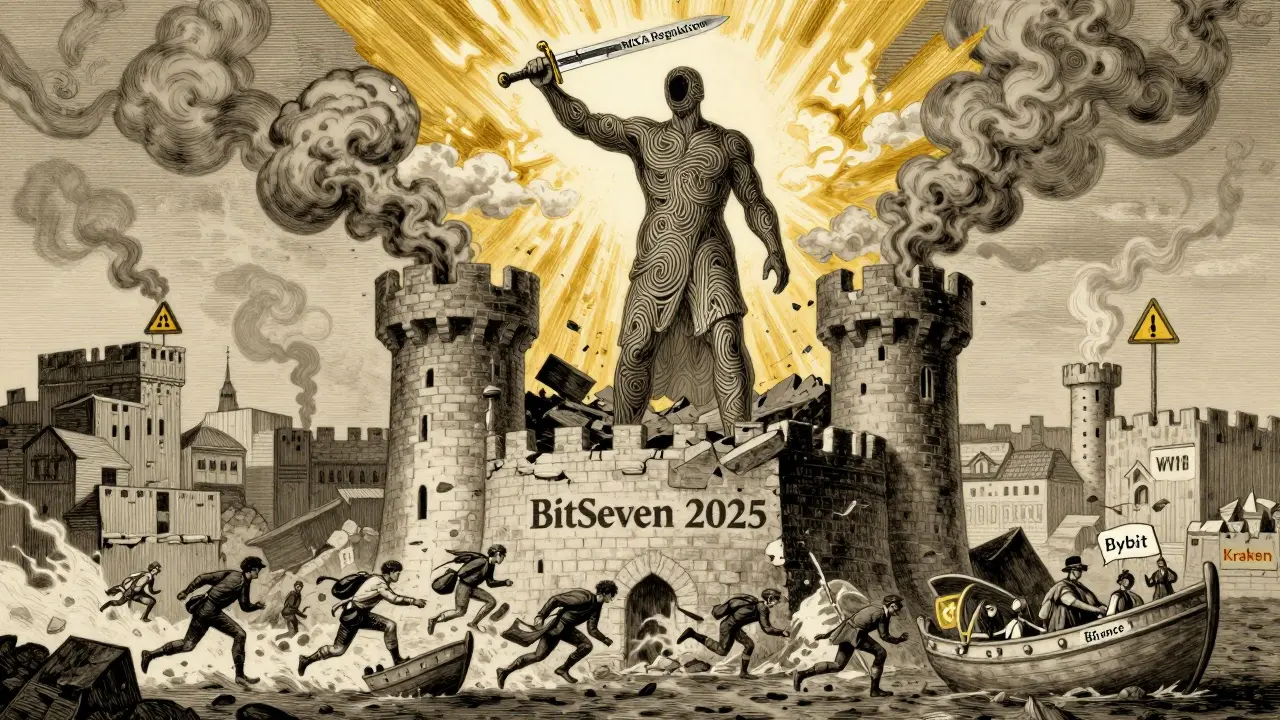
With the EU’s MiCA regulations kicking in full force in 2025, unlicensed platforms like BitSeven are sitting ducks. If they don’t get licensed, they’ll be forced out of Europe. If they do, they’ll have to change their entire model. Either way, the future is uncertain.
Right now, BitSeven is a high-speed car with no brakes, no seatbelts, and no warranty. It’s thrilling-if you’re an expert. And deadly-if you’re not.
Is BitSeven safe to use in 2025?
BitSeven is not considered safe by industry standards. It has no verified regulatory licenses, no proof-of-reserves audits, and no transparency around fund storage. The June 2024 shutdown, followed by a silent reopening, raises serious concerns about its operational stability. While some users report successful withdrawals, the lack of accountability makes it a high-risk platform. For long-term or conservative traders, it’s not recommended.
Can I trade fiat currencies on BitSeven?
No, BitSeven does not support fiat deposits or withdrawals. You can only deposit and trade using cryptocurrencies-specifically Bitcoin, Ethereum, Litecoin, or Ripple. If you need to buy crypto with USD, EUR, or other fiat, you’ll have to use another exchange like Binance or Kraken first, then transfer your crypto to BitSeven.
What happens if my position hits liquidation on BitSeven?
If your position hits liquidation, your entire margin is instantly wiped out. There’s no partial loss, no grace period, and no recovery. With 100x leverage, a 1% move against your position means 100% loss. Even with a stop-loss, slippage during high volatility can trigger full liquidation before your order executes. This is why BitSeven is only for experienced traders who understand the mechanics of leverage and liquidation.
Why does BitSeven have a 240-hour position limit?
The 240-hour (10-day) limit forces traders to close positions quickly, which reduces the platform’s exposure to long-term market swings and potential regulatory scrutiny. It also prevents users from holding positions through major events like Bitcoin halvings or Fed rate decisions. This design makes BitSeven unsuitable for swing traders or investors-it’s built purely for short-term, high-frequency trading.
Is BitSeven better than Bybit or Binance?
Only if you need 100x leverage on just four coins and don’t care about regulation, fiat access, or asset diversity. Bybit and Binance offer the same or higher leverage, support hundreds of trading pairs, have verified audits, and provide better customer support. BitSeven’s narrow focus and lack of transparency make it inferior for almost every use case except ultra-high-risk, short-term scalping.
Can I trust BitSeven’s customer support?
Support is inconsistent. Pre-suspension, users reported fast Telegram responses (under 2 hours). During the June 2024 outage, response times jumped to over 18 hours, and many users received no replies at all. There’s no phone line, email ticketing, or live chat. If you need help, you’re dependent on social media channels, which are unreliable during crises. Treat support as a bonus, not a guarantee.
bro i traded 50 bucks on bitseven and lost it in 3 minutes 😭😭😭 like why do yall even do this?? i thought i was smart but nah im just a snack for the algorithm 🤡
I used to think leverage was cool until I saw someone cry in a Discord channel because they lost their rent money. I don’t judge, but… maybe don’t gamble your future on a platform that doesn’t even have a phone number? 🤷♀️
People who use BitSeven are just crypto degens with no financial literacy. You want 100x leverage? Fine. But don’t act surprised when you’re eating ramen for a year because you thought a 1% dip was ‘just a dip.’
I’m not saying don’t trade-but if you’re reading this and you’re new to crypto… please, just pause. Take a breath. Go learn what leverage actually means. Watch a YouTube video. Read a Reddit thread. Don’t just throw your savings into a black box that vanished for a month and said ‘lol my bad.’ You deserve better than that.
I’ve seen people lose everything and still come back saying ‘it’s just crypto.’ But it’s not ‘just’ anything-it’s your life. Your rent. Your peace. Your future.
BitSeven isn’t a platform. It’s a trap dressed up as a playground. And the worst part? They know exactly who they’re targeting.
There’s no shame in walking away. There’s shame in pretending you’re a trader when you’re just a target.
And if you’re one of the ones who lost it all? I see you. You’re not alone. And you’re not stupid. You just trusted the wrong thing.
There’s still time to rebuild. But don’t go back there. Not yet. Not until you’re ready-not just for the market, but for the predators waiting for you.
100x leverage?? 😂😂😂 you people are literally betting your house on a coin flip and calling it ‘trading.’ I’ve seen 19-year-olds on TikTok with $200 blow up their accounts and then post ‘I’m a crypto genius’-NO YOU’RE NOT. YOU’RE A CASINO GAMBLEDER.
And don’t even get me started on the ‘licensed’ bs-where’s the license number?? Show me the paper! If you can’t prove it, it doesn’t exist. And if your platform shuts down for a month and says ‘oops’-you don’t get to come back like nothing happened. That’s not a business. That’s a scam with a website.
BitSeven is the crypto equivalent of a guy selling you ‘magic pills’ at a gas station. The only thing that’s guaranteed? You’re gonna lose.
63% lose in 72 hours. That’s not a bug. That’s the business model.
So let me get this straight-you’re telling me the only thing BitSeven has going for it is leverage… and even that’s not unique? And you’re still considering using it? 😅
Bybit’s got the same leverage, 100+ coins, audits, and actual support. Kraken’s got regulation. Binance’s got liquidity. BitSeven? It’s got a 240-hour timer and a prayer.
You’re not a trader. You’re a slot machine enthusiast with a chart open.
And if you think ‘I know what I’m doing’-you don’t. Not yet. Not until you’ve lost your first 10x position and still walked away without blaming the market.
Stop romanticizing risk. Start respecting it.
My cousin lost $8k on BitSeven. He thought he was smart. He wasn't. He just got lucky once. Now he's working two jobs to pay off his credit card. Don't be him.
I used to think BitSeven was a secret weapon until I saw a guy cry in a Telegram group because his 100x long got liquidated during a 0.8% dip. He had $3k in. He had zero chance. And the platform? Silent. No warning. No help. Just… gone.
It’s not about being ‘experienced.’ It’s about being reckless and calling it strategy.
There’s a difference between high-risk and stupid-risk. BitSeven is the latter.
If you’re reading this and you’re thinking ‘I can handle it’-you can’t. Not yet. Maybe never.
Go trade on Binance. Learn. Grow. Build. Then come back when you’ve got skin in the game that doesn’t feel like a suicide pact.
BitSeven is a CIA psyop. The June shutdown? That was a test. They wanted to see how many people would blindly trust a black box. And you all fell for it. Again. The EU’s MiCA regulations? They’re coming. And when they hit, BitSeven will vanish-along with your funds. But you’ll still be posting ‘I’m still bullish’ on Twitter. Classic.
Also, why is everyone ignoring that the domain was flagged as a scam? 28/100? That’s not a coincidence. That’s a neon sign.
And don’t even get me started on the ‘no 2FA’ thing. You’re not trading crypto-you’re handing your private keys to a guy in a hoodie in Moldova.
Wake up. This isn’t finance. It’s a digital Ponzi with a UI.