Zero-knowledge proofs (ZKPs) aren’t science fiction. They’re already running real transactions on Ethereum right now-without exposing who sent what, or how much. Imagine verifying you’re over 21 to buy alcohol online without showing your ID. That’s ZKP in action. And it’s not just for crypto nerds anymore. Banks, governments, and developers are betting billions on it because it solves the biggest problem blockchain has faced since Bitcoin: privacy and scalability at the same time.
How Zero-Knowledge Proofs Actually Work
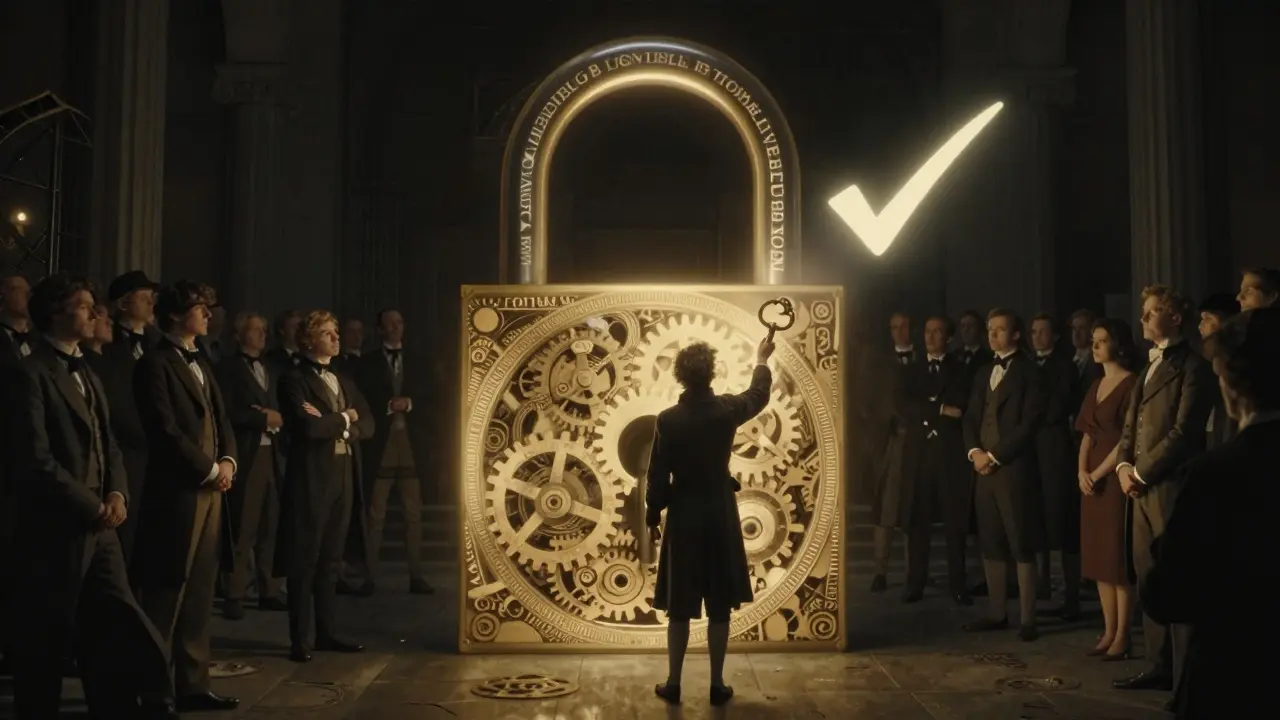
Think of ZKP like a magic lock. You want to prove you have the key, but you don’t want to show the key. The verifier doesn’t learn anything about the key-just that it works. In blockchain terms, this means you can prove you have enough funds to make a payment, or that you’re eligible for a loan, without revealing your balance or identity.
This isn’t theoretical. Zcash launched the first real-world ZKP in 2016 using zk-SNARKs. Today, zkSync Era, Starknet, and Polygon zkEVM are processing over 5 million transactions per month on Ethereum’s mainnet-all while keeping user data private. Each transaction is verified cryptographically, not by a central authority, but by math.
There are two main types: zk-SNARKs and zk-STARKs. zk-SNARKs are smaller and faster-proofs are about 200 bytes-but require a one-time trusted setup, which some find risky. zk-STARKs don’t need that setup, making them more transparent, but their proofs are bigger (around 45KB), which costs more to verify. The trade-off? Trust vs. size. Most major projects use zk-SNARKs today, but zk-STARKs are catching up fast.
Why ZKPs Are Beating Old Privacy Tech
Before ZKPs, privacy on blockchain meant things like ring signatures (Monero) or confidential transactions (Mimblewimble). They worked, but they were slow and didn’t scale. A Monero transaction could take 2-3 times longer than a regular Bitcoin one, and the blockchain grew huge because every detail was hidden but still stored.
ZK rollups changed that. They compress data by 90% compared to optimistic rollups. That means less storage, faster verification, and lower fees. Plus, they don’t rely on a 7-day challenge period like optimistic rollups do. If someone tries to cheat, ZK proofs catch it instantly-no waiting, no guessing.
BlackRock’s BUIDL Fund tokenized $240 million in U.S. Treasuries on Ethereum using ZKPs. Investors were verified as accredited without revealing their names or net worth. HSBC cut settlement times by 73% for gold trading by using ZK proofs to confirm prices privately. These aren’t experiments-they’re live, production-grade systems.
The Hardware Revolution
One of the biggest bottlenecks? Generating ZK proofs used to take minutes. You needed a server with 32GB of RAM and multiple CPU cores. That’s fine for big players, but not for everyday users.
That’s changing fast. NVIDIA announced its ZK Coprocessor, shipping in Q1 2025. It uses tensor cores built for AI to accelerate ZK proof generation-up to 50x faster. Startups like Rumblefish.dev report proving times dropping from 90 seconds to under 2 seconds on new hardware. Visa’s pilot for automated ZK payments cut verification costs by 87%.
By mid-2025, experts predict proving costs will fall below $0.001 per transaction. That’s cheaper than sending a text message. When ZK proofs become this cheap and fast, they won’t be a niche tool-they’ll be the default.

Where ZKPs Still Struggle
Don’t get it twisted-ZKPs aren’t magic. They’re hard. Writing a ZK circuit in Circom or ZoKrates is like learning a new programming language. It’s not JavaScript with a few extra libraries. It’s finite field arithmetic, elliptic curves, and logic gates you can’t test with console.log.
Developer surveys show 68% of ZK startups say the learning curve is their biggest hurdle. Even experienced Solidity devs need 4-6 months to get comfortable. GitHub has over 400 open issues on zkSync’s circuit compiler alone. One Reddit user spent 117 hours debugging a single private DeFi circuit.
And it’s not just code. A 2024 audit by Trail of Bits found 63% of custom ZK circuits had critical vulnerabilities. One tiny mistake in the math, and the whole proof system breaks. That’s why best practices now say: start small. Use templates. Test incrementally. Don’t try to build a full identity system on your first try.
Another limitation? Speed. For high-frequency trading, ZK transactions still take 2-5 seconds. Centralized exchanges do the same trade in 50 microseconds. ZK isn’t for that. It’s for settlements, compliance, and private transfers-not microseconds matter.
Who’s Leading the Pack?
The ZK rollup market is split between three main players:
- Polygon zkEVM-38% market share. Built for Ethereum compatibility. Easy for devs to migrate existing apps.
- Starknet-29% share. Uses zk-STARKs. Strong on scalability, weaker on developer tooling.
- zkSync-22% share. Focuses on usability. Best documentation, most tutorials.
There are 11 new ZK projects that raised funding in Q3 2024 alone. One called ‘Zero Knowledge Proof’ raised $47 million in its private sale. But it’s not just about tokens. Enterprise adoption is growing fast. Gartner reports 83 Fortune 500 companies are testing ZK tech-mostly in finance, healthcare, and supply chains.
Estonia used ZKPs to run its 2024 municipal elections. Over 217,000 votes were cast privately, yet every vote was fully auditable. No one knew who voted for whom. But the system could prove the tally was correct. That’s the power of ZK: privacy without secrecy.

Regulation: The Wild Card
Europe’s MiCA framework officially recognized ZKPs as compliant privacy tech in July 2024. That’s huge. It means banks and asset managers can use them without fear of breaking privacy laws.
In the U.S., the SEC hasn’t been so clear. Their May 2024 guidance raised red flags around anonymous transactions. If you use ZK to hide who’s sending money, regulators might call it a risk. That’s why projects like BlackRock and HSBC design ZK systems to prove compliance-not anonymity. They prove you’re allowed to trade, not that you’re hiding.
The future isn’t about total anonymity. It’s about selective privacy. You prove what you need to prove. Nothing more.
What’s Next? The Next 2 Years
Three trends will define the next phase:
- Cross-chain ZK-zkBridge launched in July 2024, letting users move assets privately between Ethereum and Bitcoin. No bridges. No custodians. Just math.
- Smartphone ZK-If proving costs drop below $0.001 and hardware gets faster, your phone could verify ZK proofs in the background. Imagine paying for coffee with ZK-your balance stays private, but the vendor knows you paid.
- AI + ZK-McKinsey says blockchain infrastructure must handle ZK proofs and generative AI at the same time. ZK can verify AI outputs without exposing training data. That’s a game-changer for enterprise AI.
Vitalik Buterin says ZKPs are the single most important crypto primitive for scaling Ethereum. He predicts 100x performance gains by 2025. Bitcoin.com’s expert panel agrees: ZK won’t be a layer-it’ll be the foundation. By 2027, 70% of blockchain apps will use ZK as standard.
It’s not about replacing Ethereum. It’s about making it work for billions of users-without giving up privacy or security.
Should You Care?
If you’re a developer: Learn ZK. It’s the next big skill. Start with zkSync’s tutorials. Use pre-built circuits. Don’t write your own unless you have to.
If you’re an investor: Look at infrastructure, not tokens. The real value is in the protocols that make ZK work-tooling, hardware, verification layers. Not the meme coins打着 ZK labels.
If you’re just a user: You won’t see ZK. But you’ll feel it. Faster transactions. Lower fees. Private payments. No more sharing your bank statement to get a loan. No more exposing your address to every DeFi app.
Zero-knowledge isn’t the future of blockchain. It’s the present. And it’s only getting faster.
What is a zero-knowledge proof in simple terms?
A zero-knowledge proof lets you prove something is true without revealing any details. For example, you can prove you know a password without saying the password. In blockchain, it means proving you have enough money to pay someone without showing your balance or identity.
Are zero-knowledge proofs secure?
Yes, when properly implemented. ZK proofs rely on mathematical guarantees, not trust. But many projects make mistakes in their code-like flawed circuits or bad randomness. A 2024 audit found 63% of custom ZK circuits had critical flaws. That’s why using well-audited, standardized tools like zkSync or Starknet is safer than building your own.
How are zk-SNARKs different from zk-STARKs?
zk-SNARKs create smaller proofs (200 bytes) but need a trusted setup, which some see as a security risk. zk-STARKs don’t need that setup-they’re transparent-but their proofs are larger (45KB), making them slower and costlier to verify. zk-SNARKs are used more today; zk-STARKs are growing fast as hardware improves.
Can I use zero-knowledge tech on my phone?
Not yet easily, but soon. Today, generating ZK proofs requires powerful hardware. But with NVIDIA’s new ZK Coprocessor launching in early 2025 and proving costs expected to drop below $0.001 per transaction, smartphones will soon handle ZK verification in the background-like checking a digital signature.
Why are banks using zero-knowledge proofs?
Banks use ZKPs to meet privacy regulations without sacrificing compliance. For example, BlackRock verified accredited investors for its $240M tokenized treasury fund without revealing their identities. HSBC cut settlement times by 73% by using ZK to confirm trade prices privately. ZK lets them prove they’re following rules-without exposing sensitive data.
Is zero-knowledge technology regulated?
It depends. The EU’s MiCA framework officially recognizes ZKPs as compliant privacy tech. The U.S. SEC hasn’t given clear guidance yet and has warned against anonymous transactions. The key is intent: ZK for compliance (proving you’re allowed to do something) is accepted. ZK for total anonymity (hiding illegal activity) is still risky.
What’s the biggest challenge for ZK adoption?
The biggest challenge is developer complexity. Writing ZK circuits requires deep math knowledge-finite fields, elliptic curves-that most blockchain devs don’t have. It takes 4-6 months of learning. Poor documentation and fragmented tools make it worse. Until tools become as easy as writing a smart contract in Solidity, adoption will be slow outside big teams.
This is actually wild. I just used a ZK-powered app to verify my age for a cannabis delivery app last week. Didn't show my license. Just a green checkmark. Mind blown.
Man i just learned about zk-starks last week and now im obsessed. The fact that you dont need a trusted setup? That’s huge. I’ve been coding solidity for 3 years and this feels like the next level.
I keep thinking about how this could help people in abusive situations. Imagine being able to prove you have income to rent an apartment without showing your bank details to someone who might track you. It’s not just tech-it’s safety.
The notion that ZKPs are ‘the future’ is laughable. They’re merely a technical workaround for poor architectural design. Real privacy requires decentralized identity-not math tricks dressed up as innovation.
Let’s be real-most devs treating ZK like a plugin are gonna get burned. I’ve reviewed 12 circuits in the last 6 months. 11 had fatal flaws. You don’t just slap together a Circom file and call it secure. The audit numbers aren’t wrong. This isn’t React. You’re working with finite fields, not callbacks.
The bottleneck isn’t the circuit-it’s the proving key distribution. If you’re not using a SNARK-friendly curve like BLS12-381 with batch verification, you’re already 3x slower than optimal. Also, have you considered recursive proof composition?
I find it deeply concerning that society is so eager to embrace cryptographic opacity without demanding accountability. Privacy without transparency is not freedom-it is anarchy wrapped in elliptic curves.
While the technical advancements are undeniable, one must consider the sociopolitical implications of embedding zero-knowledge verification into public infrastructure. The normalization of cryptographic trust over institutional trust may inadvertently erode democratic accountability mechanisms, particularly in contexts where auditability is not merely desirable but constitutionally mandated. One must ask: who holds the verifier?
Stop acting like zkSync is the gold standard. Starknet’s STARKs are the real deal. And don’t even get me started on how Polygon’s zkEVM is just a rebranded Plasma fork with extra steps. Real devs are building on Cairo. The rest are just copy-pasting tutorials.
I work with a nonprofit that helps survivors of domestic abuse. We’re testing ZK to let people prove eligibility for aid without exposing their location or past records. It’s not tech for tech’s sake. It’s dignity.
I’ve seen this before. Remember when ‘blockchain voting’ was going to fix democracy? Now it’s ‘ZK privacy.’ Same hype. Same lack of real-world testing. We’re just replacing one black box with another.
You people are so naive. If governments can’t see your transactions, they’ll just ban it. ZK isn’t freedom-it’s a target. Mark my words: by 2026, ZK tools will be classified as ‘high-risk financial evasion tech’.
ZK is just the new QAnon for crypto bros 😂 We’re all just pretending math is magic. Next they’ll say the moon landing was a ZK proof 🤡
I don’t trust any of this. What if the hardware backdoor is built into NVIDIA’s coprocessor? What if the ‘trusted setup’ was compromised in 2019 and no one’s telling us? I sleep with my laptop in a Faraday cage now. Just in case.
bro i just spent 12 hours trying to get a ZK circuit to compile and now my brain feels like it got run through a blender 🤯 but like... when it finally worked? pure magic. i’m gonna start a tiktok series called 'ZK or Die' lmao
Let me tell you what they’re not saying: ZK isn’t about privacy. It’s about surveillance. The same entities building these systems are the ones who control the verification keys. You think you’re anonymous? You’re just being quietly monitored by a different set of hands.
I love this so much!!! 😍 I just started learning Circom last week and I already feel like a wizard 🧙♂️✨ ZK is the future and I’m so glad I’m here for it!!! Can’t wait to build my own private DeFi app!!! 🚀💖