
Living on an island where banking hours feel like a relic of the past and cash still rules many local shops, you might think cryptocurrency is just a buzzword for techies. But for residents of Cyprus, accessing digital assets is a daily reality shaped by strict EU rules and a surprisingly friendly tax code. If you are trying to buy Bitcoin or trade Ethereum from Nicosia or Limassol, you aren't just clicking a button; you are navigating a specific regulatory landscape that changed dramatically with the arrival of the Markets in Crypto-Assets (MiCA) regulation.
The core challenge for Cypriots isn't legality-crypto is legal here-but rather finding platforms that comply with local supervision while offering the liquidity and features global traders expect. Since December 30, 2024, the transition period for MiCA has ended, meaning any exchange wanting to serve Cypriot clients must hold a valid license or registration recognized across the European Union. This shift has cleaned up the market but also raised the barrier to entry for smaller, unregulated players.
Understanding the Regulatory Gatekeepers
Before you fund an account, you need to know who holds the keys. In Cyprus, the Cyprus Securities and Exchange Commission (CySEC) is the primary watchdog. It doesn't just watch over stocks; it registers and supervises Crypto-Asset Service Providers (CASPs). These are companies offering services like trading, custody, or tokenization. If a platform doesn't appear on CySEC's register or hold a passported license from another EU country under MiCA, it’s operating in a gray zone that puts your funds at risk.
Why does this matter? Because CySEC enforces Anti-Money Laundering (AML) and Counter-Terrorist Financing (CFT) rules strictly. They work closely with MOKAS (the Unit for Combating Money Laundering), which analyzes suspicious transaction reports. When you sign up for an exchange, you aren't just giving them your email; you are submitting to a rigorous due diligence process designed to satisfy both local and EU standards.
The MiCA Transition: What Changed for Users
The implementation of MiCA (Markets in Crypto-Assets regulation) fundamentally altered how Cypriots access exchanges. Before MiCA, you could use various national registrations. Now, the EU aims for uniformity. A CASP licensed in one member state can now "passport" its services into Cyprus, provided it meets the stringent governance and disclosure requirements set out in the regulation.
This means you have two main categories of accessible platforms:
- Locally Registered CASPs: Companies registered directly with CySEC under national laws before the cutoff, or those newly approved under the harmonized framework.
- EU-Passported Platforms: Major exchanges like Binance or Kraken, if they have secured their MiCA license in a hub like Malta or France, can legally serve Cypriot users without needing a separate local entity, provided they adhere to EU-wide consumer protection rules.
The Central Bank of Cyprus (CBC) plays a supporting role here. While it doesn't regulate crypto directly, it issues warnings confirming that crypto is not legal tender. This distinction matters when you try to move money between your bank and your exchange. Banks remain cautious, often flagging transfers to crypto firms as high-risk, even if the firm is fully compliant.
Funding Your Account: The Banking Bottleneck
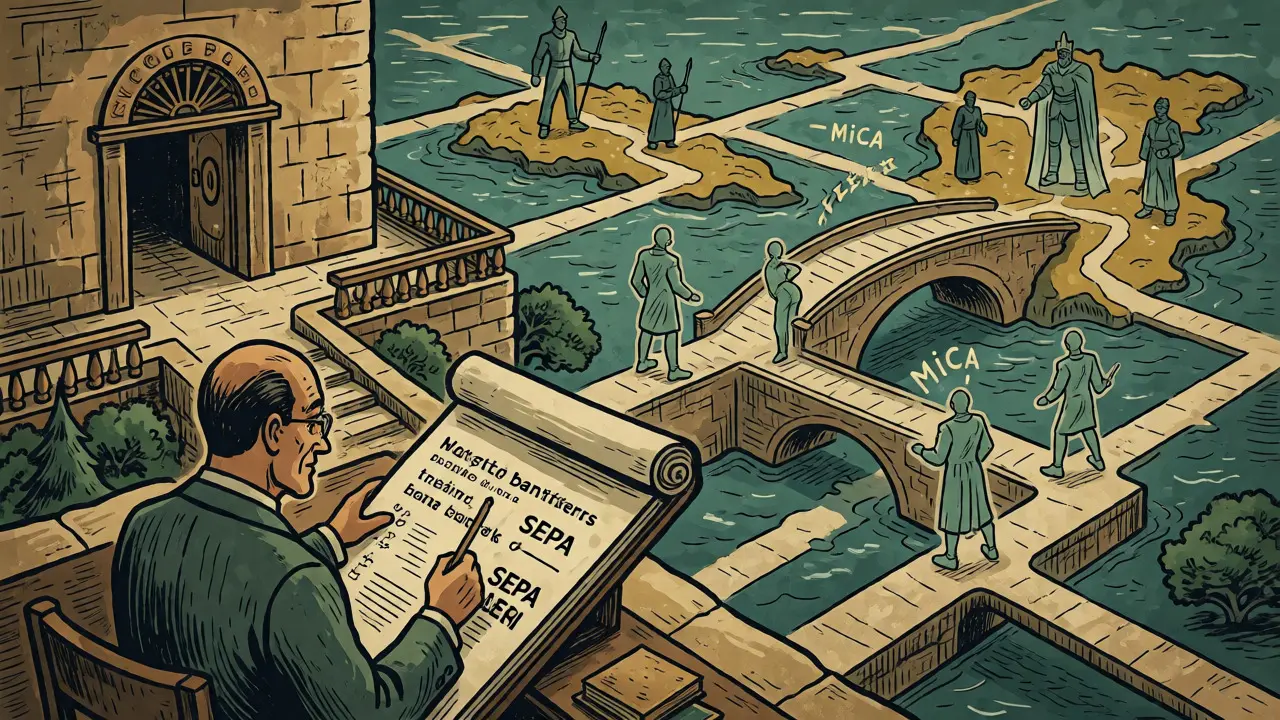
You’ve picked a compliant exchange. Now, how do you get money in? This is where the rubber meets the road for most Cypriots. Direct bank transfers via SEPA (Single Euro Payments Area) are the gold standard because they are cheap and traceable, satisfying the audit trail requirements regulators love. However, local banks like the Bank of Cyprus or Hellenic Bank may scrutinize these transactions heavily.
If your bank freezes a transfer to a crypto exchange, it’s rarely because the exchange is illegal. It’s usually because the bank’s internal compliance algorithms flagged the destination as high-volatility. To mitigate this, experienced traders often use intermediaries or payment processors that specialize in fiat-to-crypto conversions. These services act as a buffer, handling the AML checks so your bank sees a standard merchant payment rather than a direct crypto purchase.
For smaller amounts, credit and debit cards offer instant access, though fees are higher (often 2-3%). Card payments are subject to stricter KYC (Know Your Customer) limits initially. You’ll likely start with a lower withdrawal limit until you provide additional proof of source of funds, a requirement driven by MOKAS guidelines to prevent layering schemes.
Taxation: The Hidden Advantage
Here is the good news that keeps Cypriots engaged in the market despite the regulatory hurdles: taxation. As of 2026, Cyprus does not charge capital gains tax on the sale or exchange of cryptocurrencies for individuals acting outside the scope of business activities. If you bought Bitcoin in 2021 and sold it in 2026 for a profit, that gain is generally tax-free in Cyprus.
However, don’t confuse this with income tax. If you are mining cryptocurrency or running a node as a business, those profits fall under corporate income tax rates (currently 12.5%, one of the lowest in the EU). Furthermore, if you receive crypto as salary, it is taxed as employment income. The key takeaway is simple: passive investing is treated favorably, while active commercial activity attracts standard business taxes. Always keep records of your acquisition costs, even if you don’t owe tax, because future legislative changes could alter this status.
KYC Requirements: What to Expect During Onboarding
When you sign up for a CySEC-compliant or MiCA-licensed exchange, the identity verification process is non-negotiable. Regulators permit the use of ID copies and previously collected information, but the depth of scrutiny increases with your trading volume.
| Tier | Requirements | Limits | Processing Time |
|---|---|---|---|
| Basic | Email, Phone, Selfie with ID | Up to €1,000 lifetime | Instant - 24 hours |
| Standard | Government ID, Proof of Address (utility bill/bank statement) | Up to €50,000 monthly | 1 - 3 days |
| Advanced | Source of Wealth declaration, Video Verification | Unlimited / High Volume | 3 - 7 days |
Note that sanctions screening is automated. Your name is checked against EU and UN sanctions lists instantly. If you share a common name with a sanctioned individual, you might face manual review delays. This is a standard procedure mandated by the European Banking Authority (EBA) guidelines to ensure consistent AML standards across member states.

Choosing the Right Platform
With the field narrowed down to compliant providers, how do you choose? Look beyond the interface. Check if the platform publishes its MiCA license number or CySEC registration reference. Reputable exchanges will display this prominently in their footer. If you can’t find it, ask support. Their response time and clarity are good indicators of their operational maturity.
Consider the range of assets. Some local-focused CASPs may only list major coins like BTC and ETH to minimize regulatory burden. Global MiCA-passported platforms often offer hundreds of tokens but require you to navigate more complex fee structures. For the average Cypriot investor, balancing ease of fiat deposits with asset variety is the sweet spot.
Finally, leverage the CySEC Innovation Hub. While primarily for businesses, its resources and published guidance reflect the regulator’s current stance. If a technology or service model is discussed positively there, it’s likely to be viewed favorably during audits, suggesting a stable environment for users of such platforms.
Common Pitfalls to Avoid
Don’t assume that because an app is popular globally, it’s automatically safe for your specific needs in Cyprus. Check if they have withdrawn from certain jurisdictions due to compliance costs. Also, beware of "off-ramp" scams. When converting crypto back to Euros, ensure the receiving bank account is in your name. Third-party withdrawals can trigger anti-money laundering flags, leading to frozen funds while the bank investigates the relationship between you and the third party.
Keep your communication channels open with your bank. If you plan to make large transfers, notify them beforehand. This proactive step often prevents automatic blocks. Remember, the goal of the regulator is transparency, not obstruction. By following the rules, you maintain access to the global crypto economy while staying protected under EU law.
Is cryptocurrency legal in Cyprus?
Yes, cryptocurrency is legal in Cyprus. It is not classified as legal tender, but owning, trading, and holding crypto assets is permitted within a regulated framework supervised by CySEC and aligned with EU MiCA regulations.
Do I pay taxes on crypto profits in Cyprus?
Generally, no. Cyprus does not impose capital gains tax on the disposal of cryptocurrencies for individuals trading as private investors. However, profits from mining or professional trading activities are subject to income or corporate tax.
Which exchanges accept Cypriot customers?
You should look for exchanges that are either registered with CySEC as a CASP or hold a MiCA license from another EU country allowing them to passport services into Cyprus. Major global exchanges with EU hubs typically serve Cypriot users.
Can I use my local bank card to buy crypto?
Yes, most compliant exchanges accept Visa and Mastercard. However, some local banks may block transactions to crypto merchants due to internal risk policies. Using SEPA bank transfers is often more reliable for larger amounts.
What is the minimum amount for KYC checks?
While basic accounts may allow small transactions with minimal info, full KYC verification is typically required for cumulative transactions exceeding €1,000, in line with AML directives enforced by MOKAS and CySEC.