Every time you send Bitcoin or Ethereum, you’re relying on a mathematical system older than the internet itself - but more vital today than ever. Public key cryptography is the invisible lock that keeps your crypto safe. It’s not magic. It’s math. And if you understand how it works, you’ll never again confuse your public address with your private key.
What Is Public Key Cryptography?
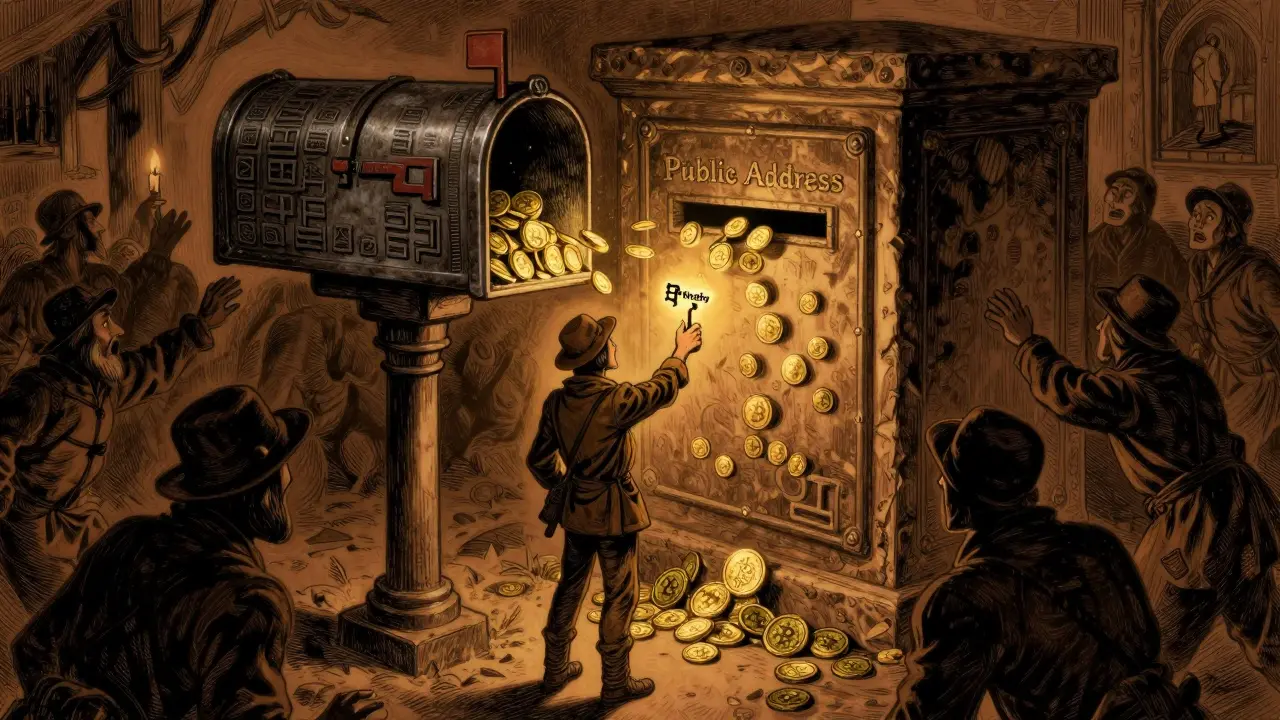
Public key cryptography, also called asymmetric cryptography, uses two mathematically linked keys: one public, one private. Think of it like a mailbox. Your public key is the slot where anyone can drop a letter - a transaction - addressed to you. But only you have the key to open the box and take out what’s inside. That’s your private key. No one else can open it. Not even the person who sent you the money. This system was first described in 1976 by Whitfield Diffie and Martin Hellman. But the real breakthrough came when Satoshi Nakamoto used it in Bitcoin. He didn’t invent it. He just applied it perfectly to money. In crypto, your public key becomes your wallet address after being run through two hash functions: SHA-256 and RIPEMD-160. The result? A 160-bit string, usually encoded in Base58Check or Bech32. That’s the long string of letters and numbers you share to receive funds. It’s safe to post online. It’s meant to be shared. Your private key? That’s the 256-bit number only you should ever see. It’s generated randomly - often from system noise or hardware entropy. If you lose it, your coins are gone forever. If someone else gets it, they own your money. There’s no reset button. No customer support. Just math.How It Secures Transactions
When you send crypto, you don’t hand over your private key. You sign the transaction with it. This creates a digital signature - a unique fingerprint tied to your key and the exact details of the transaction: who you’re sending to, how much, and when. Here’s how it works step by step:- You create a transaction in your wallet.
- Your wallet uses your private key to generate a digital signature using ECDSA (Elliptic Curve Digital Signature Algorithm) on the secp256k1 curve.
- The signature, along with your public key, gets broadcast to the network.
- Miners and nodes verify the signature using your public key - without ever seeing your private key.
- If the math checks out, the transaction is confirmed.
- Authentication - Only the owner of the private key could have signed this.
- Integrity - If even one byte of the transaction changes, the signature becomes invalid.
- Non-repudiation - You can’t later say, "I didn’t send that."
Why Elliptic Curves? Why secp256k1?
Not all public key systems are the same. RSA, the old standard for websites, uses huge numbers and is slow. Bitcoin and Ethereum use elliptic curve cryptography - specifically the secp256k1 curve. Why? Because it’s efficient and secure. A 256-bit elliptic curve key gives you the same security as a 3,072-bit RSA key - but uses far less data and processes faster. Verifying an ECDSA signature takes about 0.5 milliseconds. That’s fast enough for a global network processing thousands of transactions per second. The curve’s design also makes it resistant to certain mathematical attacks. Even with today’s most powerful computers, cracking a single secp256k1 private key would take 2^128 operations. That’s more than the number of atoms in the visible universe. It’s not just hard. It’s practically impossible. NIST, the U.S. government’s cryptography standard body, confirms this. Their 2023 update says elliptic curve cryptography remains secure against all known classical attacks.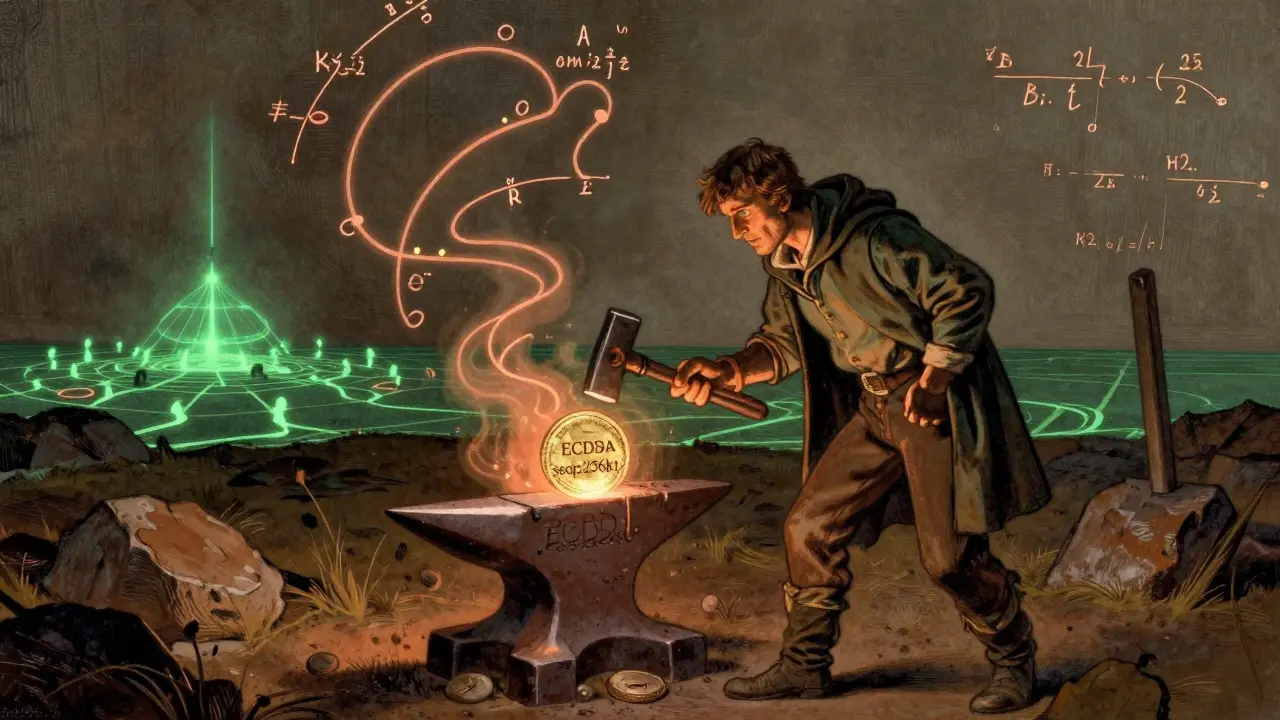
What About Other Blockchains?
Bitcoin and Ethereum use secp256k1. But not all chains do. Ripple uses Ed25519, a different elliptic curve developed by Daniel Bernstein. It’s faster, uses less memory, and is designed for high-speed verification - ideal for Ripple’s payment network. Solana uses a variant too, but combines it with symmetric encryption for bulk data handling. That’s because public key crypto is slow for encrypting large files. Symmetric crypto (like AES-256) is 10x faster - but requires both parties to already share a secret. That’s impossible in a decentralized system. So most blockchains stick with asymmetric crypto for signing, and only use symmetric crypto when they need speed and already have a secure channel. The result? All top 100 cryptocurrencies by market cap (as of January 2026) rely on public key cryptography. No exceptions.The Real Danger: You
The math is solid. The code is open. The networks are decentralized. So why do people lose millions? Because they mess up the key management. In 2025, Chainalysis reported that 92% of crypto thefts came from human error - not hacking. Not broken cryptography. People:- Wrote down their private key wrong.
- Stored it in a cloud folder.
- Uploaded it to GitHub by accident.
- Used a sketchy wallet app that leaked keys.
- Didn’t back up their 12-word recovery phrase.

What About Quantum Computers?
There’s a big fear: quantum computers will break public key crypto. And they might. Shor’s algorithm - if run on a large enough quantum machine - could derive a private key from a public key in minutes. Not years. Minutes. The Quantum Threat Working Group estimates it would take 1,500-2,000 error-corrected qubits to crack Bitcoin’s secp256k1. IBM’s 2025 roadmap says such machines are at least 15 years away. Google, Rigetti, and others are making progress - but not fast enough to panic yet. The crypto world isn’t waiting. Bitcoin’s Quantum Resistance Working Group published draft specs in January 2026 for switching to lattice-based cryptography - specifically CRYSTALS-Dilithium, which NIST is standardizing for post-quantum use. The plan? A soft fork. A gradual upgrade. Wallets will be able to generate new keys using quantum-resistant algorithms. Old ones will still work. New ones will be safer. This isn’t a fix for tomorrow. It’s insurance for the next decade.What You Should Do Today
You don’t need to understand elliptic curves to use crypto safely. But you do need to treat your private key like a nuclear launch code. Here’s what to do:- Use a hardware wallet (Ledger, Trezor, etc.). Keys never leave the device.
- Write down your 12-word recovery phrase. On paper. In a safe. Not in Notes. Not in iCloud.
- Never share your private key. Not with "support," not with "friends," not with "apps."
- Use hierarchical deterministic (HD) wallets (BIP-32). They generate new addresses for each transaction - reducing exposure.
- Test your backup. Send $1 to your wallet using only your recovery phrase. Do this once a year.
Final Thought: The System Works - If You Don’t Break It
Public key cryptography didn’t make crypto possible. It made trustless money possible. You don’t need a bank. You don’t need a middleman. You just need your private key and the math that proves you own it. The system has survived 15 years of attacks, hacks, and crashes. It’s stood up to nation-states, hedge funds, and hackers with billion-dollar budgets. It’s not perfect. But it’s the best we’ve got. And as long as you keep your private key secret, your crypto is safer than cash in a bank.Can someone steal my crypto if they know my public address?
No. Your public address is like your email - it’s meant to be shared. Anyone can send crypto to it, but no one can take anything out without your private key. The blockchain shows your balance and transaction history, but it doesn’t give anyone the ability to spend your funds.
What happens if I lose my private key?
Your crypto is permanently lost. There is no recovery option, no customer service, and no reset. That’s why backups - like your 12-word recovery phrase - are critical. If you don’t have a backup, the coins are gone forever. This is by design. It’s what makes crypto truly yours.
Is ECDSA the only algorithm used in crypto?
No. Bitcoin and Ethereum use ECDSA on the secp256k1 curve, but other chains use different algorithms. Ripple uses Ed25519, which is faster and more efficient. Bitcoin is also upgrading to Schnorr signatures (BIP 340) for better privacy and smaller transaction sizes. The core idea - asymmetric keys - stays the same, but the math improves over time.
Are quantum computers a real threat to crypto right now?
Not yet. Current quantum computers have fewer than 1,000 physical qubits and aren’t error-corrected. To break ECDSA, you’d need around 1,500-2,000 high-quality, error-corrected qubits - something experts estimate is at least 10-15 years away. The crypto industry is already preparing with post-quantum cryptography standards like CRYSTALS-Dilithium, so the transition will be gradual and safe.
Why do wallets ask for a 12-word phrase instead of the private key?
The 12-word phrase is a human-readable backup of your private key, generated using BIP-39 standards. It’s easier to write down, check for typos, and store securely than a 64-character hex string. It also lets you regenerate multiple addresses and keys from one backup - making it far more practical than storing individual private keys.
This is the kind of breakdown I wish I had when I first started. Seriously, if you're still storing your keys in a Notes app, please stop. You're one phishing email away from becoming a cautionary tale.
Public key crypto isn't magic-it's math that doesn't care if you're rich, famous, or just got your first crypto paycheck. Treat it like your last slice of pizza: don't let anyone touch it.
The secp256k1 curve's scalar multiplication properties are optimized for the Koblitz family of elliptic curves, which allows for efficient windowed NAF scalar multiplication. This reduces computational overhead while maintaining provable security under the ECDLP assumption.
Most users don't realize that the 2^128 security margin isn't just theoretical-it's information-theoretic. Even with quantum speedups, the entropy space remains computationally inaccessible.
If you're not using a hardware wallet you're playing Russian roulette with your life savings
Oh wow another crypto guru telling us how safe math is
Meanwhile the FBI just seized $3B in crypto from people who "did everything right" and the exchanges still freeze withdrawals like it's 2018
Yeah the math works great until the system decides to rewrite the rules
Let me guess-next you’ll tell me the blockchain is immutable and decentralized. Yeah, right. The top 10 wallets control 40% of Bitcoin. The "decentralized" network runs on ASICs made in China and mined by state-backed energy monopolies. The math is elegant. The reality? A corporate casino with a fancy whitepaper.
The foundational principles of asymmetric cryptography remain robust, even as implementation paradigms evolve. The transition to post-quantum algorithms must be meticulously coordinated to preserve backward compatibility while mitigating existential threats posed by Shor’s algorithmic breakthroughs.
It is imperative that wallet developers adopt standardized, NIST-certified lattice-based schemes such as CRYSTALS-Dilithium without premature optimization or vendor lock-in.
I used to think I was safe because I had a paper backup. Then I dropped my notebook in the bathtub.
Don’t be me.
Store your recovery phrase in a fireproof safe. In a different state. With a friend who won’t judge you.
You’re not paranoid. You’re prepared.
We live in a world where people trust algorithms more than institutions, yet still hand over their private keys to strangers on Discord.
The real tragedy isn’t the theft-it’s the surrender of agency. We built systems to eliminate intermediaries, then created new ones called "crypto influencers."
Maybe the problem isn’t the math. Maybe it’s us.
Oh sweet jesus another crypto textbook. Let me grab my monocle and my abacus.
So what? The math is perfect? Cool. Meanwhile, my uncle lost $200K because he thought "send to this address" meant he could copy-paste from a meme.
Public key crypto didn’t fail. Human stupidity did. And that’s the only vulnerability that actually matters.
Also, I saw a guy on YouTube use his seed phrase as his Instagram password. I’m not even mad. I’m impressed.
You say "the math is solid" like that’s a virtue. The math doesn’t care if you’re a genius or a fool. The math doesn’t cry when you lose everything. The math doesn’t have a customer service line.
And yet, here we are-people treating cryptographic keys like passwords to their Netflix account.
It’s not a system failure. It’s a cultural one. We’ve turned a revolutionary tool into a lottery ticket with extra steps.
Quantum computers? Nah. They’re not coming for crypto. They’re coming for US.
Did you know the NSA has been hoarding quantum research since 2012? They don’t want to break Bitcoin-they want to break YOU.
They already have the keys. They’re just waiting for the right moment to flip the switch.
That’s why I use Monero.
And I don’t trust any wallet that doesn’t have a kill switch.
They’re watching. Always watching. 😈
I saw a video of a guy getting hacked because he used a QR code from his phone.
Then I saw another guy who lost his wallet because he trusted a "crypto advisor" on TikTok.
Then I saw a guy who thought "private key" meant "private to me and my dog."
None of this is about math.
It’s about people being dumb.
And the system is designed to eat dumb people.
So why are we still surprised? 🤡
I think we need to talk about the psychological burden of holding your own keys.
It’s not just about security-it’s about responsibility.
When your money is in a bank, you can blame them if something goes wrong.
But when it’s in your wallet? You’re the bank. The custodian. The janitor. The accountant. The detective.
And if you forget your key? There’s no one to scream at. No one to sue. Just silence.
That’s why so many people give up. Not because they’re lazy.
Because it’s terrifying.
If you’re reading this and you’re new to crypto, please don’t panic.
You don’t need to memorize ECDSA or understand lattice-based cryptography to be safe.
Just do three things:
1. Get a hardware wallet.
2. Write down your 12 words.
3. Never, ever share them.
That’s it.
You don’t need to be a genius. You just need to be careful.
And if you mess up? That’s okay.
Learn. Try again. You’re not alone.
I used to think Bitcoin was freedom. Now I think it’s a trap for the gullible.
Everyone says "the math is unbreakable." But guess what? The math doesn’t stop the IRS from auditing you. It doesn’t stop your bank from freezing your fiat. It doesn’t stop your landlord from evicting you because you "can’t pay rent in crypto."
So yes, your keys are safe.
But you? You’re still trapped in the same system.
Just with more zeroes.
America invented the internet. America invented cryptography. America built the blockchain.
Now we’re letting foreigners and tech bros tell us how to use it?
Use a Ledger. Write it down. Don’t be a sheep.
Keep America’s crypto secure.
There’s a deeper layer here.
Public key cryptography doesn’t just secure transactions-it enforces individual sovereignty.
It says: you are the center of your own universe. No middleman. No authority. No forgiveness.
That’s terrifying.
Because most people don’t want to be sovereign.
They want a parent. A guardian. A bank.
And so they hand over their keys… and their freedom… without even realizing it.
The real revolution isn’t in the math.
It’s in the courage to be alone with your own responsibility.