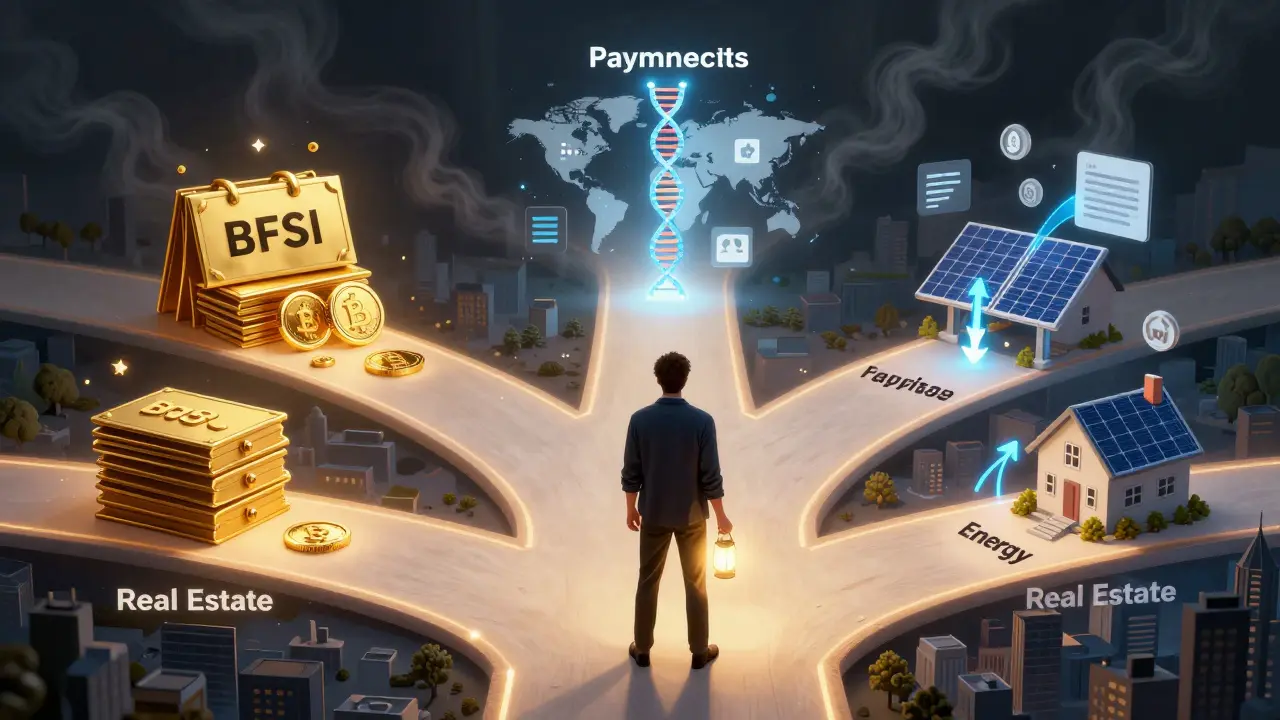
Most people think blockchain is just about Bitcoin and crypto trading. But that’s like thinking the internet is only about email. Blockchain has exploded into dozens of real-world industries - and if you’re only watching one, you’re missing the biggest opportunities.
Why Diversifying Across Blockchain Sectors Matters
Putting all your money or effort into one blockchain sector is risky. What if payments slow down? What if regulations hit crypto hard? What if a new tech steals the spotlight? That’s why smart players spread out.
The blockchain market hit $20.16 billion in 2024. By 2032, it could hit $1 trillion. That’s not one trend - it’s dozens of them growing at different speeds. Some sectors are already mature. Others are just starting. Diversifying lets you ride the wave where it’s strongest, while protecting yourself when one area cools off.
The Big Five Blockchain Sectors Right Now
Not all blockchain uses are equal. Some have real revenue. Others are still experiments. Here are the five sectors with the most traction as of 2026.
- Banking, Finance, and Insurance (BFSI) - This is the biggest piece of the pie. In 2025, it held 24% of the blockchain market share and made up 40% of total revenue. Why? Because it solves real problems: faster cross-border payments, smarter loan approvals, and tamper-proof records. JPMorgan, HSBC, and dozens of fintechs use blockchain to cut settlement times from days to minutes.
- Payments - This is the most visible sector. Bitcoin and Ethereum aren’t just investments - they’re payment tools. Newegg now accepts Bitcoin in 73 countries. Stablecoins like USDC are used daily for online shopping, remittances, and app purchases. Payments make up 26% of the market and are growing fast because they’re simple, cheap, and global.
- Healthcare - This sector is growing the fastest. With strict privacy laws like GDPR and HIPAA, traditional databases are too risky. Blockchain lets hospitals, labs, and insurers share patient records securely - without a central server. MIT and the University of Nicosia already issue diplomas on blockchain. The same tech is being used to track drug supply chains and prevent counterfeit medicine.
- Energy - Think of it as peer-to-peer electricity. If your solar panels produce extra power, you can sell it to your neighbor using blockchain. Platforms like Powerledger let households trade energy in real time. No middlemen. No delays. Just direct, automated transactions. This is huge for renewable energy adoption.
- Real Estate - Property is the world’s biggest asset class. But buying, selling, or even owning a share of a building has always been slow and expensive. Blockchain changes that. Tokenization lets you buy 1% of a skyscraper for $500. Atlant and other platforms are making this real. Sweden and Georgia now use blockchain to record land titles - no more fraud, no more paperwork.
Emerging Sectors You Can’t Ignore
These aren’t mainstream yet - but they’re growing fast.
- IoT (Internet of Things) - Your smart fridge, car, or thermostat could soon pay for its own electricity or data usage. Imagine your electric car charging at a station and automatically paying with crypto. That’s the IoT blockchain market - growing at 46.56% yearly. Tiny devices need microtransactions, and blockchain is the only way to make them secure and cheap.
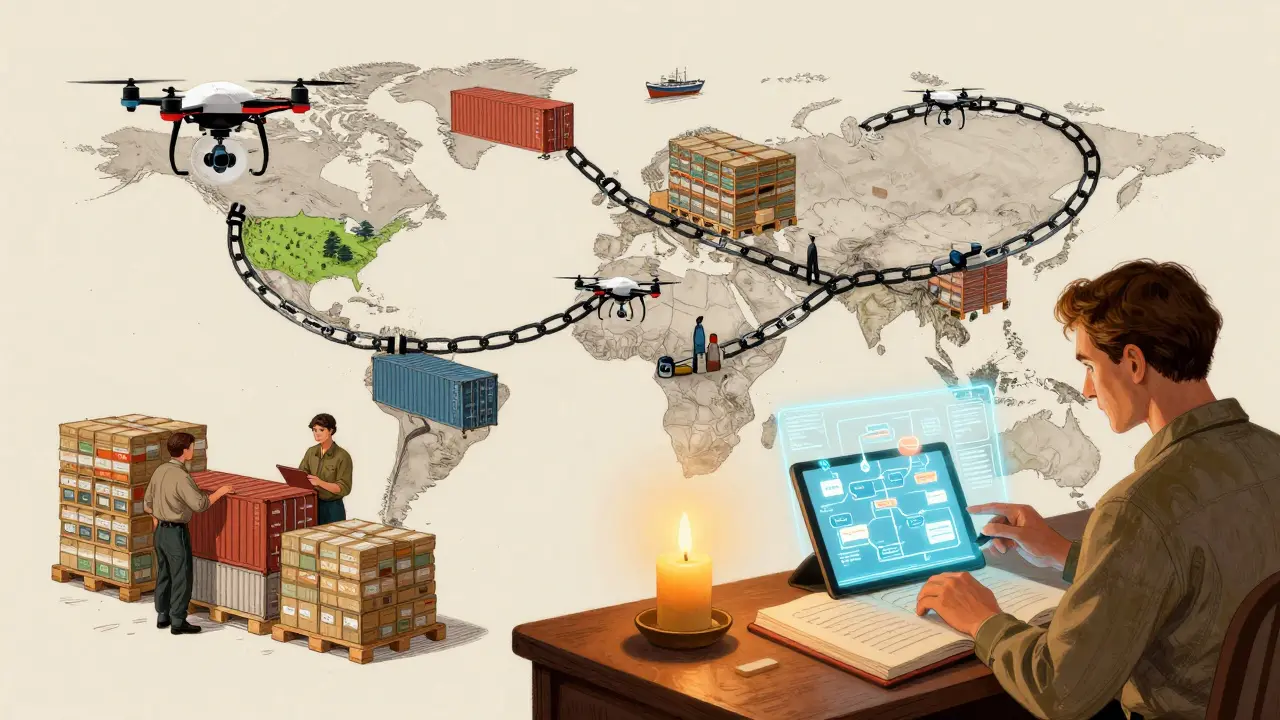
- Supply Chain - Walmart, Maersk, and Nestlé use blockchain to track food from farm to shelf. If there’s a recall, they find the bad batch in seconds, not weeks. It cuts waste, prevents fraud, and builds trust.
- Education - Universities are issuing diplomas on blockchain so employers can verify them instantly. No more fake degrees. No more waiting for transcripts. This isn’t theoretical - it’s happening now.
- Government & Public Services - Estonia has been using blockchain for voting and public records since 2014. Now, over 15 countries are testing digital currencies. China’s Digital Yuan and the EU’s Digital Euro aren’t experiments - they’re the future of money.
How to Actually Diversify - Step by Step
Knowing the sectors is one thing. Acting on it is another. Here’s how to do it right.
- Start with what you know. If you work in finance, look at DeFi or tokenized assets. If you’re in tech, explore BaaS (blockchain-as-a-service) platforms. Don’t jump into healthcare unless you understand HIPAA.
- Allocate by risk. Put 50% in stable, proven sectors like payments and BFSI. Put 30% in fast-growing ones like healthcare and energy. Keep 20% for early-stage bets like IoT or AI-blockchain hybrids.
- Use real tools, not just crypto. Don’t just buy tokens. Invest in companies building solutions: ConsenSys for Ethereum tools, Chainlink for oracles, or Vakt for energy trading. These are businesses with revenue, not just speculation.
- Track adoption, not price. Is a company actually using blockchain to solve a problem? Or are they just slapping the word on their website? Look for case studies, partnerships, and real customer usage.
- Rebalance every 6-12 months. If energy grows 200% in a year, you might be overexposed. Sell a little and move into a slower-growing sector. Diversification isn’t set-and-forget.
What to Avoid
Diversifying doesn’t mean throwing money at everything.
- Avoid “blockchain” hype traps. If a startup says they’re “using blockchain” but can’t explain how it solves a real problem, walk away.
- Don’t ignore regulation. Healthcare and finance have strict rules. If a project can’t comply with HIPAA, GDPR, or KYC, it’s a liability - not an investment.
- Don’t chase trends. AI-blockchain hybrids sound cool. But if no one’s using them yet, you’re taking unnecessary risk.
- Don’t forget the basics. Security, scalability, and user experience matter more than the word “blockchain.” A slow, expensive blockchain solution is worse than a good traditional system.
Real People, Real Results
It’s not just theory. People are already winning with diversification.
A small investor in Germany split her $50,000 across four areas: 40% in stablecoins for daily payments, 30% in tokenized real estate via Atlant, 20% in energy trading platforms, and 10% in healthcare data startups. She didn’t get rich overnight - but she made steady returns, avoided a crypto crash, and even earned passive income from energy sales.
A logistics company in Texas used blockchain to track shipments across 12 countries. They cut delays by 60%, saved $2 million in paperwork costs, and now they’re adding insurance automation - all because they didn’t just try one use case. They layered them.
The Future Is Multi-Sector
Blockchain isn’t going to replace banks or hospitals or power grids. But it’s going to make them better - faster, cheaper, and more secure.
The companies and investors who win will be the ones who see blockchain as a toolset, not a single product. They’ll use it in finance, then in healthcare, then in energy - not because they’re chasing hype, but because each sector has its own problem, and blockchain has its own solution.
By 2030, 80% of Fortune 500 companies will be using blockchain in at least two sectors. The question isn’t whether you should diversify. It’s whether you’re doing it smartly - or waiting too long to start.
What’s the safest blockchain sector to start with?
Payments and financial services are the safest starting points. They have the most mature infrastructure, clear regulations, and proven use cases. Stablecoins like USDC are already used daily by millions for online purchases and remittances. If you’re new, begin by using or investing in established payment platforms rather than speculative tokens.
Can I diversify without buying crypto?
Absolutely. Many companies offer blockchain solutions without touching cryptocurrency. Blockchain-as-a-service (BaaS) platforms like IBM Blockchain or AWS Managed Blockchain let businesses use the tech for supply chain tracking, identity verification, or record-keeping - all without crypto. You can invest in these companies’ stocks or partner with them directly.
Which blockchain sector is growing the fastest?
Healthcare is growing the fastest, with a projected CAGR of over 50% through 2030. Demand is driven by strict privacy laws, the need for secure patient data sharing, and post-pandemic digital health investments. Companies are building permissioned blockchains to let hospitals, insurers, and labs access records without risking leaks.
How do I know if a blockchain project is legit?
Look for three things: real customers, clear use cases, and compliance. If a project says it’s for healthcare but doesn’t mention HIPAA or GDPR, it’s likely not serious. Check if they’ve published case studies, partnered with known organizations, or have audited smart contracts. If the team is anonymous or the whitepaper is full of buzzwords - walk away.
Is blockchain diversification only for big investors?
No. You can start small. Platforms like Atlant let you invest $100 in tokenized real estate. Stablecoin apps let you earn interest on payments. Even buying a fraction of a solar energy token on Powerledger is possible with under $50. Diversification isn’t about how much you have - it’s about spreading risk across different uses of the tech.
Blockchain isn't magic. It's just a ledger. The real value is in who controls it and why they're pushing it. We're being sold a religion disguised as technology.
I started with stablecoins for daily payments last year. Simple. No drama. Just works. Even my grandma uses USDC to send money to family overseas now.
While the article presents a comprehensive overview of blockchain adoption across sectors, it is important to acknowledge that regulatory fragmentation remains a critical barrier. The absence of harmonized international standards impedes scalability, particularly in cross-border applications such as supply chain and energy trading. Investors must prioritize projects with demonstrable compliance frameworks over speculative tokenization efforts.
everyone thinks blockchain is the future but half these projects are just old databases with a buzzword slapped on and a whitepaper written by a guy who dropped out of college to sell NFTs of cartoon apes lmao
Let’s be honest - this is all a distraction. Central banks are rolling out digital currencies to track every transaction, eliminate cash, and ultimately control behavior. The ‘decentralized’ narrative is a smokescreen. They’ve already bought the infrastructure. You’re not investing in tech - you’re funding surveillance.
OH MY GOD I JUST REALIZED - healthcare blockchain isn’t just about records… it’s about saving lives. Imagine a child in rural Kenya getting the right medicine because the supply chain was tracked from factory to clinic with zero tampering. That’s not tech. That’s HOPE. I’m crying. I’m investing in this. RIGHT NOW.
Of course you're going to say 'start with payments' - because that's what the banks want you to think. The real money is in the shadows. Tokenized real estate? Energy grids? Those are the backdoors to systemic control. You think you're diversifying? You're just lining up for the next bail-in.
There’s a critical distinction between blockchain as a technical infrastructure and blockchain as a speculative asset. The former enables efficiency; the latter enables fraud. Focus on use cases with measurable ROI, not market cap.
Why are we giving this platform to China and the EU? We’re letting them build the backbone of global finance while we chase meme coins. This isn’t innovation - it’s surrender. If you’re not investing in U.S.-based blockchain infrastructure, you’re helping the enemy.
One must consider the epistemological underpinnings of decentralized consensus mechanisms in the context of post-capitalist socio-economic paradigms. The ontological security afforded by immutable ledgers, when aligned with sovereign digital identity frameworks, represents a profound ontological shift - not merely a technological upgrade. One wonders whether the average retail participant truly comprehends the hermeneutic implications of tokenized real estate.
I used to think blockchain was just crypto hype - until my sister’s hospital lost a month of patient records to a server crash. Then I saw a demo of a blockchain-based medical archive. No central point of failure. No data leaks. Just quiet, bulletproof trust. That’s not tech. That’s dignity. I’m not just investing - I’m helping rebuild something broken.
Okay, so, like, payments are stable, sure, but have you thought about how IoT devices are gonna need microtransactions? Like, your fridge pays your energy bill? And your car pays for parking? And your smart toothbrush pays for toothpaste? It’s wild. And it’s happening. Like, right now. In Germany. And Japan. And, like, even in my apartment building. It’s not sci-fi anymore. It’s Tuesday.
If you're not thinking about blockchain as a tool to rebuild social contracts - not just financial ones - then you're missing the point. It's not about money. It's about trust without institutions. That’s the revolution.
They say healthcare is growing fast? Cute. Meanwhile, every blockchain health startup I’ve seen has a team of 3 guys who barely passed med school and a whitepaper that says ‘AI + blockchain = magic cure’. You think HIPAA cares about your smart contract? It doesn’t. You’re just another data broker with a fancy name.
Let’s talk consensus algorithms. Proof-of-Stake is a cartel disguised as democracy. The validators are whales. The miners are ghosts. You think you’re decentralized? You’re just renting access from a handful of VC-backed nodes. The entire ecosystem is a pyramid scheme wrapped in open-source code.
Why are you even listening to this? Blockchain is a distraction from the real crisis: inflation. The Fed’s printing money. The dollar’s collapsing. You don’t need tokens. You need gold. Physical. In your basement. Not on a blockchain. Not in a wallet. In a safe. That’s the only diversification that matters.
People think they’re being smart by diversifying across sectors. But they’re still playing the game. The system doesn’t want you to be free - it wants you to be a better investor. Every tokenized asset, every BaaS platform - it’s all designed to keep you inside the cage. You’re not escaping capitalism. You’re just upgrading your cage.
THEY’RE WATCHING YOU. EVERY TRANSACTION. EVERY TOKEN. EVERY CLICK. THE GOVERNMENT ALREADY HAS THE KEYS. YOU THINK YOU’RE INVESTING? YOU’RE GIVING THEM YOUR LIFE DATA. 🚨💔
blockchain is just a way for big banks to control crypto without calling it crypto they want you to think its safe but its still rigged and the real players are always one step ahead
You don’t need to be rich to start. I put $50 into a solar energy token last month. Got paid $3 in passive income this week. Not life-changing - but it felt like I was part of something real. Like I was helping the planet while my money worked for me. That’s the win. Start small. Stay curious. Keep going.