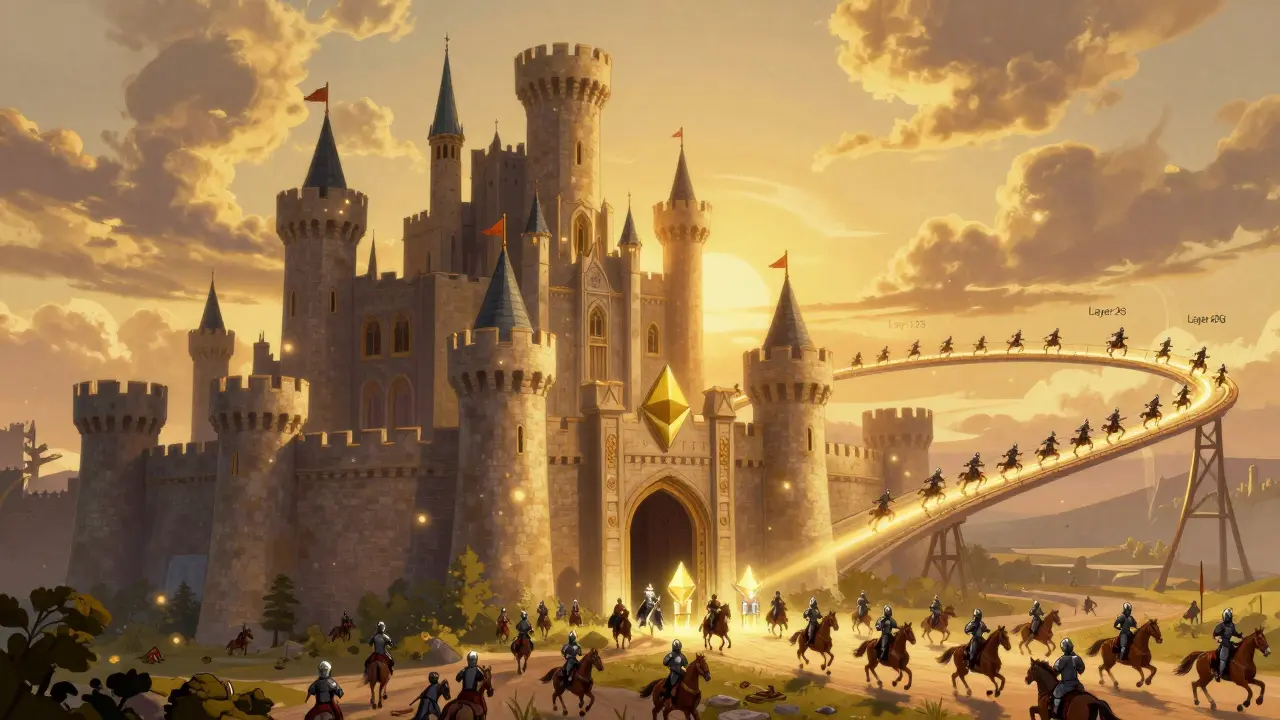
Back in 2017, sending a Bitcoin transaction cost over $55. Ethereum users waited hours for confirmations during peak times. Today, you can send a crypto payment for less than a penny and get it confirmed in seconds. That’s not magic-it’s scalability. Cryptocurrency platforms are no longer stuck with slow, expensive networks. They’ve built ways to handle thousands of transactions per second without giving up security or decentralization. But how? And which solutions actually work in real life?
Why Scalability Matters More Than You Think
Bitcoin was designed to process about 7 transactions per second. Visa handles 65,000. If crypto wants to replace credit cards, bank transfers, or even mobile payments, it needs to close that gap. Early blockchains weren’t built for mass adoption. They prioritized security and decentralization-rightly so-but that came at a cost: speed and price. By 2021, Ethereum’s network was clogged. Gas fees spiked during NFT drops, DeFi trades, or even when a popular meme coin launched. Users paid $50 just to swap tokens. That’s not adoption-that’s exclusion. Scalability solutions weren’t optional anymore. They became the difference between a niche tech experiment and a global financial system.Layer 1: Fixing the Foundation
Layer 1 solutions change the core blockchain protocol itself. These are big, bold moves that require network-wide agreement-hard forks. They’re harder to pull off, but they offer the most fundamental improvements. Ethereum’s shift from Proof-of-Work to Proof-of-Stake in September 2022 was the biggest Layer 1 upgrade ever. It cut energy use by 99.95% and reduced block times from 15 seconds to a steady 12 seconds. That alone made the network faster and cheaper to use. But it didn’t fix throughput. That’s where sharding comes in. Ethereum’s sharding, rolled out in phases since 2020, splits the network into 64 separate chains (shards). Each shard processes its own transactions in parallel. Think of it like adding more checkout lanes at a grocery store instead of making one lane faster. By 2026, Ethereum aims to scale to over 100,000 transactions per second using this model. Cardano uses a different approach with its Ouroboros PoS consensus. It’s designed for high throughput from the start, handling 250 transactions per second with 20-second finality. Avalanche, another Layer 1, uses a novel consensus protocol that achieves 4,500 TPS with sub-second confirmation times. These aren’t theoretical-they’re live, handling real-world transactions daily. But Layer 1 upgrades have downsides. Hard forks split communities (remember Bitcoin vs. Bitcoin Cash?). They require near-unanimous support from miners, validators, and users. One wrong move can break trust. That’s why many projects now look beyond the base layer.Layer 2: Building on Top
Layer 2 solutions don’t change the main blockchain. They build secondary systems on top of it to handle most of the traffic. The main chain becomes a secure settlement layer-like a vault that only settles final transactions. The most popular Layer 2s are rollups. There are two types: Optimistic and Zero-Knowledge (ZK). Optimistic Rollups, like Optimism and Arbitrum, bundle hundreds of transactions into one batch and submit it to Ethereum. They assume transactions are valid unless someone challenges them within a 7-day window. That delay is a trade-off. It’s slower for disputes, but it’s simpler to build on. These networks now process 2,000-4,000 TPS, with fees under $0.10. ZK-Rollups, like zkSync and StarkNet, use advanced cryptography to prove transaction validity instantly. No 7-day wait. Finality is near real-time. They’re more complex to develop, but they’re more secure and faster. zkSync processes over 3,000 TPS with fees as low as $0.001. That’s why DeFi apps and gaming platforms are migrating to them. Then there’s the Lightning Network for Bitcoin. It’s a payment channel system where users open private channels to send instant, fee-free transactions off-chain. Only the opening and closing of channels hit the Bitcoin blockchain. By 2023, it was processing over $10 million in daily volume. But it’s not perfect-routing failures happen when payments need to hop across too many nodes. It works best for small, frequent payments under $100. Polygon is another major player. It started as a sidechain and evolved into a full Layer 2 ecosystem. Its PoS chain handles 7,000 TPS at $0.001 per transaction. Over 87% of top NFT marketplaces now run on Polygon because it’s cheap, fast, and easy to integrate.
Comparing Layer 1 vs Layer 2
| Feature | Layer 1 (e.g., Ethereum 2.0, Avalanche) | Layer 2 (e.g., zkSync, Polygon, Lightning) |
|---|---|---|
| Speed (TPS) | 250-4,500 | 2,000-7,000+ |
| Transaction Cost | $0.10-$2.00 | $0.001-$0.05 |
| Security Model | Same as base chain | Depends on parent chain + additional trust assumptions |
| Implementation Complexity | High (requires hard fork) | Lower (can be deployed without consensus) |
| Finality Time | 12-20 seconds | Instant (ZK) or 7 days (Optimistic) |
| Best For | High-value settlements, long-term security | High-volume apps: gaming, DeFi, micropayments |
Real-World Use Cases and User Experiences
It’s one thing to talk about numbers. It’s another to hear from people using these systems daily. A Reddit user on r/ethereum reported that switching their dApp from Ethereum mainnet to Polygon dropped their transaction costs from $15 to $0.02. But they also noted occasional 4-hour delays during network congestion. That’s the trade-off: cheaper, but not always instant. On r/bitcoin, users praised Lightning Network for buying coffee with crypto-fast and free. But when they tried sending $1,000, routing failed twice. The network works best for small, direct payments. Crypto exchanges like Binance use internal sharding across 10 server clusters. Their order execution speed hits 1.2 milliseconds-even during the 2021 bull run. That’s why they got 4.3/5 stars from over 1,200 reviews. But failures happen. Crypto.com’s 2022 outage affected 1.5 million users. Transactions froze for five hours during market volatility. That’s what happens when scaling systems aren’t tested under real stress.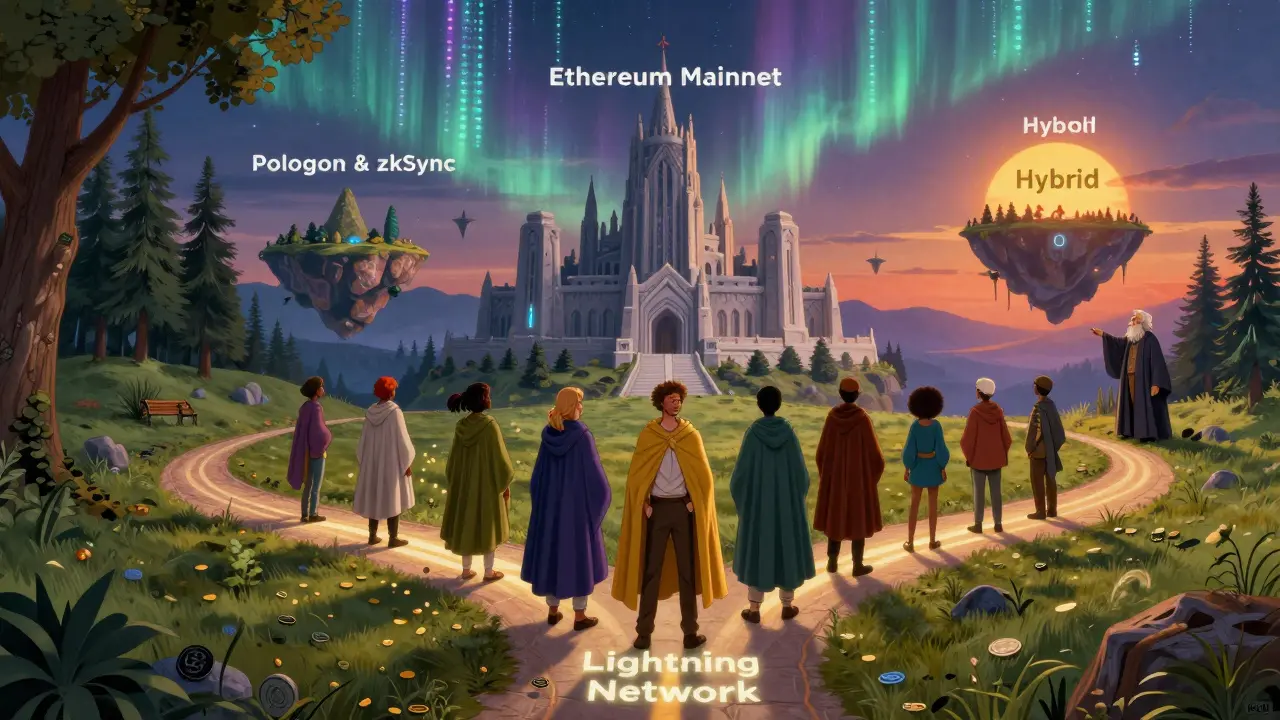
What’s Next? The Hybrid Future
No single solution solves everything. That’s why the future is hybrid. Ethereum’s Dencun upgrade in March 2024 introduced proto-danksharding. It’s not full sharding yet-it’s a stepping stone. It reduces Rollup fees by up to 100x by making it cheaper to store data on Ethereum. This makes ZK-Rollups even more powerful. Polygon’s $1 billion Infinity DAO aims to connect multiple ZK-Rollups into a single interoperable network. Avalanche’s new ‘Avalanche Connect’ lets developers migrate Ethereum dApps with minimal code changes. Even Bitcoin is getting in on the action with Taproot Assets, which lets users issue tokens on-chain with far lower fees. According to a 2023 survey of 50 blockchain architects, 68% believe hybrid systems will dominate by 2026. That means: Ethereum as the secure settlement layer, ZK-Rollups for fast execution, Lightning for micropayments, and sidechains for specialized apps.Challenges Still Ahead
Scalability isn’t just technical-it’s human. Layer 2s add complexity. Users need new wallets, new bridges, new ways to think about security. A Reddit user said switching to Avalanche meant learning a whole new wallet setup. That’s a barrier for non-tech users. Regulation is catching up. The EU’s MiCA law, effective June 2024, requires exchanges to disclose how their scaling solutions work. That’s good for transparency, but it could slow down adoption if platforms can’t prove their security. And then there’s trust. Only 28% of traditional financial institutions feel comfortable with Layer 2 settlement times. They want instant finality. ZK-Rollups are the answer-but audits and certifications take time.Final Thoughts: It’s Not About One Winner
There’s no single “best” scalability solution. The right choice depends on what you’re doing. - Need to send $0.50 to a friend? Use Lightning. - Building a DeFi app? Use zkSync or Optimism. - Issuing a token? Try Polygon or Arbitrum. - Want maximum security for $10M trades? Stick to Ethereum mainnet. The winners won’t be the fastest or cheapest. They’ll be the ones that make scaling invisible to users-fast, cheap, and secure without requiring a PhD in cryptography. By 2026, crypto won’t feel slow. It won’t feel expensive. It’ll just feel normal. And that’s the real win.What is the fastest blockchain scalability solution today?
As of 2026, Avalanche and ZK-Rollups like zkSync and StarkNet are the fastest. Avalanche handles 4,500 transactions per second with sub-second finality. ZK-Rollups process 2,000-4,000 TPS with near-instant confirmation. Both outpace Ethereum’s base layer, which maxes out at 45 TPS.
Are Layer 2 solutions safer than Layer 1?
Layer 1 solutions like Ethereum 2.0 inherit the full security of the main chain. Layer 2s are generally secure too, but they add trust assumptions. Optimistic Rollups rely on a 7-day challenge window to catch fraud. ZK-Rollups use cryptographic proofs, making them closer to Layer 1 security. But if the bridge or operator is compromised, users can lose funds. Always research the team and audit history before using a Layer 2.
Why is Ethereum still the main hub for DeFi if it’s so slow?
Ethereum is the most trusted settlement layer. Even though it’s slow and expensive on its own, it’s where most smart contracts live. Layer 2s like Arbitrum and Optimism connect back to Ethereum for final security. Over 63% of DeFi total value locked (TVL) stays on Ethereum because users trust its track record. Layer 2s are the speed boosters, but Ethereum is the foundation.
Can Bitcoin scale as well as Ethereum?
Bitcoin’s base layer will always be slow-7 TPS is by design. But with the Lightning Network, it can handle micropayments at near-instant speeds and near-zero fees. New upgrades like Taproot Assets now let users issue tokens and NFTs on Bitcoin with lower costs. It won’t replace Ethereum for complex apps, but for payments and value transfer, it’s becoming competitive.
What’s the biggest risk with Layer 2 scaling?
The biggest risk is centralization. Many Layer 2s rely on a small group of operators or sequencers to bundle transactions. If those operators go offline or act maliciously, users can be locked out. ZK-Rollups reduce this risk with cryptographic proofs, but no system is perfect. Always check if the Layer 2 is decentralized enough for your use case.
Will we ever have one universal scaling solution?
Unlikely. Different applications need different trade-offs. Gaming needs speed and low cost. Finance needs security and auditability. Micropayments need instant finality. The future isn’t one-size-fits-all-it’s a layered ecosystem where each solution plays its role. The goal isn’t to replace the base chain, but to make it work better for everyone.
I've been watching this space for years, and honestly? Layer 2s are just band-aids on a broken leg. Ethereum's base layer is a relic, and everyone's pretending zkSync is magic when it's just centralized sequencers with fancy cryptography. Don't get me wrong-I love tech-but this isn't decentralization, it's outsourcing trust to a few devs in San Francisco!!!
Guys we are living in the future!!! The days of $50 gas fees are GONE like dial-up internet!!! Layer 2s are not just working they're THRIVING and if you're still on mainnet for small transactions you're literally choosing pain over progress!!! Let's gooooo!!!
The real scalability story isn't about TPS numbers-it's about trust minimization. ZK-Rollups achieve near-L1 security via cryptographic proofs without requiring consensus changes. That's why they're the only viable path forward for institutional adoption. Optimistic Rollups? Still rely on fraud proofs and 7-day challenge windows-too slow for anything beyond speculative trading. Polygon's PoS sidechain? Not even a Layer 2 by strict definitions-it's a federated sidechain with weaker security assumptions.
I tried using Lightning for a $20 coffee and it worked fine. Then I tried sending $500 to a friend and it failed twice. I just gave up and used PayPal. It’s frustrating when the tech that’s supposed to be ‘the future’ still feels so glitchy.
The hybrid model is inevitable. Ethereum as the settlement layer makes sense because of its auditability and composability. But Layer 2s are where the real innovation is happening-ZK-Rollups are enabling private DeFi, gaming economies, and even identity systems without exposing every transaction on-chain. The key is interoperability. If we can’t move value seamlessly between chains, we’re just building walled gardens with better UX.
Look, I'm all for crypto but let's be real-America built the internet, America built Bitcoin, and America is still leading in blockchain innovation. These European regulators with their MiCA nonsense are trying to stifle progress with bureaucracy. Meanwhile, China is quietly building its own CBDC infrastructure and Russia is using crypto to bypass sanctions. If we don't double down on ZK-Rollups and decentralized sequencers, we're handing the future to someone else. This isn't just tech-it's national security.
Just wanted to say thank you for this breakdown 😊 I’ve been trying to explain Layer 2s to my mom and this is the clearest thing I’ve found. She thought I was crazy for saying I paid 1 cent to swap tokens. Now she gets it. ZK-Rollups are the real MVPs-no 7-day waiting game, just instant proof. Also, if anyone’s looking for a good wallet for zkSync, try Zerion-it’s super intuitive!
Scalability solutions are impressive, but the user experience remains fragmented. Wallets, bridges, gas tokens, chain switching-it’s overwhelming for newcomers. The real win won’t be technical-it’ll be when someone can send crypto to a friend without reading a 10-page guide. Simplicity is the final frontier.
If you're new to this, don't panic. Start small. Use Polygon for NFTs, Lightning for coffee, zkSync for DeFi swaps. You don't need to understand every layer to benefit from them. Think of it like driving-you don't need to know how the engine works to get to work. Just make sure you're using trusted platforms, check audits, and never send funds to a contract you don't understand. You got this 💪
Lmao you all think you’re so smart with your zkSync and avalanche but the truth is 90% of this stuff is just rebranded cloud servers with a blockchain logo slapped on. Bitcoin’s 7 TPS is by design because real money doesn’t need to be fast-it needs to be unchangeable. All these Layer 2s are just casino chips for degens. And don’t even get me started on how they’re all using the same 5 devs from Coinbase to run their sequencers. It’s all a facade.