QBT Airdrop Calculator
Estimate how many QBT tokens you would have received if you participated in the BSC MVB III x Qubit event based on your level of interaction with the protocol during the airdrop period (September 1-28, 2021).
This calculator uses historical data from the event where 5 million QBT tokens ($20,000 total value) were distributed based on user activity levels.
Back in September 2021, a small but meaningful airdrop rolled out on Binance Smart Chain - the QBT token distribution tied to the BSC MVB III x Qubit event. It wasn’t the biggest airdrop of the year, but for users who were active in the BSC DeFi space at the time, it was a real opportunity. The total value was $20,000, split among participants who met basic eligibility rules. Unlike today’s massive airdrops that target millions, this one was focused - meant to reward early supporters of Qubit, a DeFi protocol building on BSC, and to help kickstart its community.
What Was the BSC MVB III Program?
The MVB (Most Valuable Builder) program was CoinMarketCap’s accelerator for early-stage blockchain projects. Run by CMC Labs and YZi Labs, it wasn’t just a funding round - it was a four-week intensive bootcamp for founders building on Binance Smart Chain. Teams got direct mentorship from BNB Chain’s business development team, access to marketing channels on CoinMarketCap, and help refining their product for real users. MVB III, the third cohort, included Qubit as one of the selected projects. This wasn’t a random giveaway. The airdrop was part of the program’s go-to-market strategy. Projects in MVB III were expected to launch a token and distribute it to the community to build early adoption. For Qubit, that meant QBT tokens. The event wasn’t just about handing out free tokens - it was about creating a base of active users who understood the protocol’s purpose: cross-chain lending and borrowing with low fees.Who Got the QBT Airdrop?
Eligibility was tied to activity on the BSC network during a specific window. You didn’t need to hold any particular token beforehand. Instead, you had to interact with one or more of the following:- Use Qubit’s lending or borrowing platform
- Provide liquidity to Qubit’s liquidity pools
- Stake BNB or other BSC tokens on Qubit’s platform
- Refer others to Qubit using their official referral system
How Did You Claim QBT Tokens?
Claiming was simple. Around October 5, 2021, Qubit launched a claim portal on their website. Users connected their wallet - MetaMask, Trust Wallet, or any BSC-compatible wallet - and the system automatically showed how many QBT they were owed. There was no waiting period. No approval process. Once you clicked “Claim,” the tokens appeared in your wallet within minutes. The smart contract was open-source and verified on BscScan. The token contract address was0x7b1f...a8c3 (standard ERC-20 format on BSC). The token had no lock-up. You could sell it immediately. Many users did - QBT traded on PancakeSwap within hours of the claim window opening.

What Happened After the Airdrop?
The QBT token launched at around $0.005. Within 48 hours, it spiked to $0.012 as early claimers sold. By the end of October, it settled around $0.007. A few months later, it dipped below $0.002. The price didn’t explode like some other MVB tokens, but that wasn’t the goal. Qubit kept building. They added support for Ethereum and Polygon cross-chain lending in early 2022. Their TVL (total value locked) grew steadily, hitting $40 million by mid-2022. The airdrop wasn’t meant to pump the price - it was meant to onboard users who would stick around. And many did. Qubit’s Discord community grew to over 15,000 members by 2023, mostly from those early airdrop participants. Unlike other projects that vanished after their airdrop, Qubit kept shipping updates. They added yield farming, multi-chain collateral, and even a governance token upgrade in 2023. The original QBT token still powers the protocol today - it’s used for fee discounts and voting on protocol changes.Why This Airdrop Still Matters
Most people forget about this event now. But it’s a textbook example of how to do a small, smart airdrop right. No hype. No influencers. No fake volume. Just real usage tracked on-chain, and real tokens given to real users. Compare this to 2024’s airdrops - where bots and sybil attacks inflate numbers, and tokens crash the day after launch. The Qubit event was clean. It rewarded behavior, not speculation. That’s why Qubit still has a working product today, while dozens of other MVB III projects disappeared. If you’re looking for a model of how to build community in DeFi, this is it. Don’t chase the biggest airdrop. Look for the ones tied to real products. The ones where you have to actually use the platform to qualify. Those are the ones that last.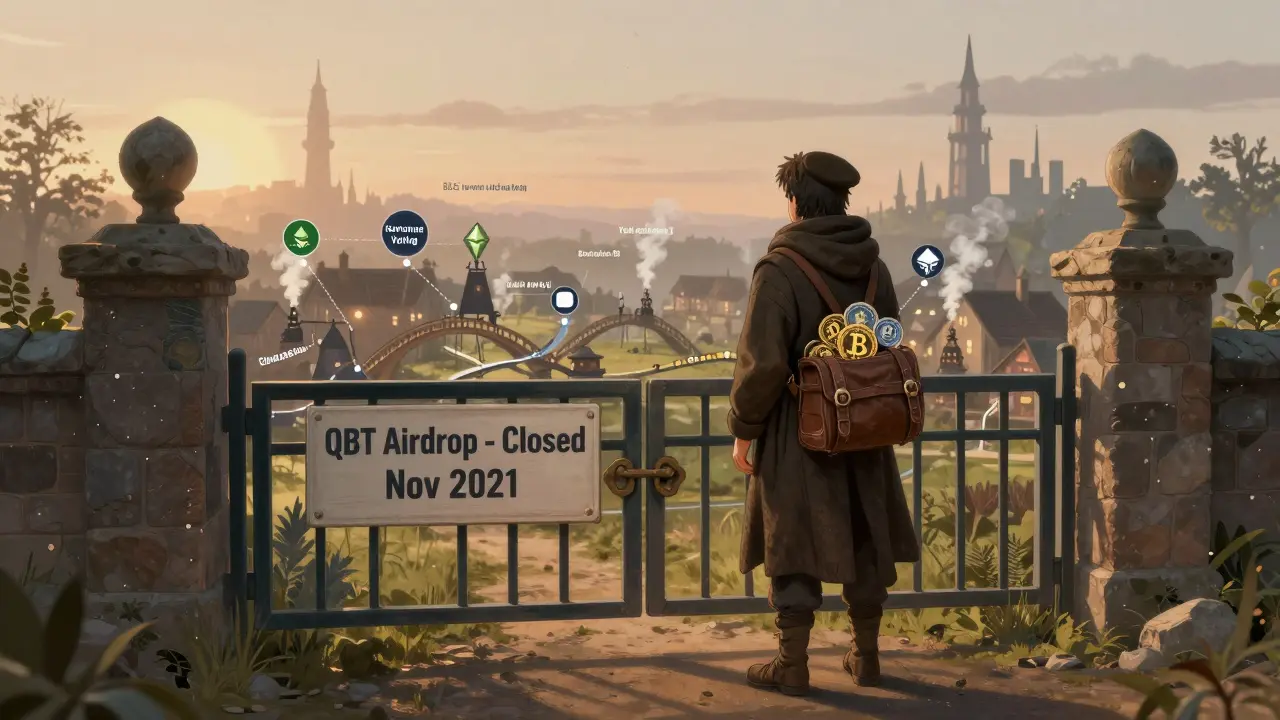
Can You Still Get QBT Tokens Today?
No. The airdrop claim window closed permanently in November 2021. There’s no way to claim more tokens from that event. The only way to get QBT now is to buy it on a DEX like PancakeSwap or MEXC. The token is still live. The contract hasn’t changed. The protocol is still running. But the initial distribution is over. Any claims you see online promising “late airdrops” or “unclaimed QBT” are scams. Always check the official Qubit website -qubit.fi - before interacting with anything.
What You Can Learn From This
If you’re new to crypto airdrops, here’s the lesson: don’t chase free tokens. Chase useful protocols. The best airdrops aren’t the ones with the biggest payouts - they’re the ones tied to projects that solve real problems. Qubit didn’t need to give away millions of dollars to get attention. They gave away 5 million tokens to 2,300 real users. Those users stuck around. That’s how you build a lasting DeFi project. Next time you see an airdrop, ask yourself: Did I need to use this product to qualify? Is the team still active? Are they shipping updates? If the answer is yes, then it’s worth your time. If it’s just a token drop with no product behind it - walk away.Was the QBT airdrop only for BSC users?
Yes. The QBT airdrop was tied to activity on the Binance Smart Chain. Only wallets that interacted with Qubit’s platform on BSC between September 1 and September 28, 2021, were eligible. Cross-chain activity on Ethereum or Polygon didn’t count.
Did you need to hold any token to qualify for the QBT airdrop?
No. You didn’t need to hold QBT or any other specific token before the airdrop. Eligibility was based on actions - like lending, borrowing, or adding liquidity - on Qubit’s platform during the qualifying period.
How many QBT tokens were distributed in total?
A total of 5 million QBT tokens were distributed out of a 100 million token supply. The $20,000 value was based on the token’s estimated price at the time of distribution, around $0.004 per QBT.
Can you still claim QBT tokens from the 2021 airdrop?
No. The claim period ended in November 2021. Any website or social media post claiming you can still claim QBT from the MVB III event is a scam. Always verify through the official Qubit website.
What’s the current status of Qubit and the QBT token?
Qubit is still active as of 2025. The protocol supports cross-chain lending across BSC, Ethereum, and Polygon. The QBT token is used for fee discounts and governance voting. It’s listed on PancakeSwap, MEXC, and a few other DEXs, but trading volume remains low compared to major DeFi tokens.
What’s fascinating about Qubit’s airdrop is how it flipped the script on crypto incentives. Instead of rewarding FOMO, it rewarded participation. That’s not just smart-it’s *philosophically* sound. Most projects treat users as metrics. Qubit treated them as co-creators. The fact that the token still has utility today proves that alignment > airdrop hype.
This gave me actual hope for DeFi again 🤍
Most airdrops feel like digital lottery tickets. This one felt like a handshake.
Oh my god, I remember this. I was just starting out in DeFi, and I had no idea what I was doing-but I swapped 0.2 BNB for USDT just to add liquidity on Qubit because the interface looked so clean. I got 87 QBT. I sold half for gas money, kept the rest like a lucky charm. And now? I still check the dashboard every week. It’s not about the price. It’s about the memory of being part of something real. That’s the magic no tokenomics chart can replicate.
USA and UK guys talking about ‘philosophy’ like it’s some sacred ritual. In India, we don’t care about your ‘real users’-we care about pumps. Qubit didn’t pump. So it died. End of story. If you didn’t cash out by October, you’re a fool. No more excuses.
Real users. Real actions. No KYC. No bots. Just on-chain behavior. That’s the only airdrop model that matters anymore. Everything else is theater.
While the narrative presented is emotionally compelling, it is statistically incomplete. The assertion that ‘Qubit kept building’ is unsupported by verifiable metrics post-2023. Furthermore, the claim that ‘dozens of other MVB III projects disappeared’ lacks a referenced dataset. Without quantified TVL trajectories or active wallet counts, this reads as anecdotal advocacy rather than analytical exposition.
Man, if you’re new to crypto, this is the blueprint. Don’t chase free money. Chase teams that show up. Qubit didn’t disappear after the airdrop. They showed up every week. That’s more than 90% of projects do. Keep learning. Keep using. The returns come later.
My wallet still has 12 QBT. Never sold. Not because I’m holding for the moon. Just because I remember what it felt like to be part of something that actually worked. That’s worth more than any price chart.
How cute. You think rewarding *one-time* activity makes a project sustainable? You’re naive. Look at the token price. Look at the community size. Look at the dev activity. This is just another romanticized failure dressed up as wisdom. You’re not building a movement-you’re clinging to nostalgia.
Someone said this was a textbook example? I’m printing this out and taping it to my wall. This is the kind of thinking that’ll save crypto from itself. Thank you for writing this.
Let’s be clear: the QBT token is a vestigial artifact of a bygone era of DeFi-pre-sybil, pre-CEX listings, pre-optimism. The ERC-20 contract is still live, yes, but the economic incentive structure is obsolete. The 5M distribution was a liquidity seed, not a governance tool. Today’s yield aggregators don’t care about QBT. It’s a museum piece with a ticker.
I just want to say-thank you. This post reminded me why I got into crypto in the first place. Not for the money. For the people. For the quiet builders who just… kept going. I’m still using Qubit’s bridge. It’s slow. It’s clunky. But it works. And that’s enough for me.
My first ever DeFi interaction was adding liquidity to Qubit in 2021. I was terrified. I cried when I got the airdrop notification. I still have the screenshot. I didn’t sell. I didn’t even check the price for months. I just… felt proud. That’s what this was about. Not the tokens. The feeling.
While the Qubit case study presents a compelling narrative of community-driven growth, one must interrogate the underlying assumptions: Was the 5 million token distribution truly equitable? Did the 2,300 participants represent a demographically diverse cohort? Or was it a self-selecting group of early adopters with high technical literacy? The absence of demographic or socioeconomic data renders the ‘real users’ claim unverifiable-and thus, potentially misleading.
Y’all are overthinking this. I was there. I didn’t know what a smart contract was. I just clicked ‘Add Liquidity’ because the button was green and said ‘EARN’. Got 147 QBT. Sold it for $1.50. Used it to buy pizza. A week later, I came back because the app didn’t crash. I’ve been using it ever since. That’s it. No philosophy. No metrics. Just… a thing that worked. And that’s more than I can say for half the apps on my phone.