
When you hear the name Solidly, you might think of a powerful, next-gen crypto exchange. But the reality is far from it. Solidly V2 on Ethereum is a tiny, experimental decentralized exchange that barely registers on the radar of today’s crypto market. It’s not a platform for trading Bitcoin or even popular altcoins. It’s a quiet corner of DeFi where only five trading pairs exist, and the entire 24-hour trading volume adds up to less than $50. That’s not a typo. $49.70. For context, Uniswap does that much in under three seconds.
What Is Solidly V2, Really?
Solidly V2 is a decentralized exchange built on Ethereum, launched in 2022 by Andre Cronje - the same developer behind Yearn.finance and other early DeFi projects. Unlike Uniswap or SushiSwap, Solidly doesn’t aim to be a general-purpose swap platform. It’s a narrow experiment in tokenomics: a way to test how fee distribution and governance work when liquidity providers are forced to pick just one pool to vote for. It supports exactly five coins: WETH, LUSD, DAI, USDC, and USDT. That’s it. And only five trading pairs: LUSD/WETH, DAI/WETH, USDC/WETH, USDT/WETH, and LUSD/DAI. If you want to trade ETH for SOLID, you can’t. If you want to swap AVAX for USDC, forget it. This isn’t a platform for diversification. It’s a lab.The $SOLID Token: A Unique, But Unadopted, Model
Solidly’s only real innovation is its native token, $SOLID. Unlike Curve Finance, where liquidity providers earn a share of all protocol fees, Solidly gives you fees only from the pool you vote for. That means if you vote for the LUSD/WETH pool, you get zero fees from the USDC/WETH pool. It’s a radical shift - and it sounds smart on paper. It should, in theory, concentrate liquidity where users want it most. But here’s the catch: no one votes. Or at least, not enough. The platform’s emissions model is even stranger. The more $SOLID is staked, the fewer new tokens are created. If everyone stakes everything, emissions drop to zero. If no one stakes, the system floods the market with new $SOLID. This was designed to incentivize early participation. But with only $38.53 in daily volume on the most active pair (LUSD/WETH), there’s barely any fee revenue to distribute. So even if you stake your $SOLID, you’re chasing pennies. Staked $SOLID tokens are issued as NFTs. That’s unusual. You can trade them, use them as collateral, or hold them. But again - who’s trading them? With only 4,163 monthly pageviews and 9,199 Twitter followers, the community is microscopic. There’s no liquidity for these NFTs. No buyers. No sellers. Just digital receipts sitting in wallets.Why Liquidity Is the Real Problem
The biggest reason Solidly doesn’t work for anyone but a curious researcher is liquidity. Let’s say you want to swap $100 worth of LUSD for WETH. The entire pool has less than $40 in trading volume over 24 hours. That means your $100 trade would likely move the price by 20%, 30%, maybe more. Slippage isn’t just high - it’s catastrophic. Even small trades become expensive and unpredictable. Compare that to Uniswap V3, where the WETH/USDC pair alone has over $1 billion in daily volume. Or even Curve, where stablecoin swaps are nearly frictionless. Solidly’s liquidity is thinner than a sheet of paper. There’s no depth. No safety. No reason for anyone with more than $10 to trade here.
No Margin, No Features, No Future?
Solidly doesn’t offer margin trading, leverage, staking rewards beyond $SOLID emissions, or even a mobile app. There’s no dashboard. No analytics. No alerts. It’s just a simple swap interface. If you’re looking for advanced DeFi tools, you won’t find them here. If you’re looking for a place to earn yield, you’re better off on Aave or Compound. And there’s no sign of development. No roadmap updates. No new pair announcements. No team tweets. No blog posts. The last major update was in 2022. Since then, it’s been silent. That’s not a sign of a thriving project. It’s a sign of abandonment.Who Is Solidly For?
Honestly? No one. Not retail traders. Not professional liquidity providers. Not DeFi enthusiasts looking to earn yield. Not developers building on Ethereum. The only people who might interact with Solidly are:- Researchers studying tokenomics experiments
- Curious coders testing AMM models
- Historians documenting failed DeFi prototypes
How It Stacks Up Against Other DEXs
| Feature | Solidly V2 (Ethereum) | Uniswap V3 | Curve Finance | MEXC |
|---|---|---|---|---|
| Trading Pairs | 5 | Over 10,000 | Over 1,000 | 200+ |
| 24h Trading Volume | $49.70 | $500M+ | $150M+ | $200M+ |
| Supported Coins | 5 | 1,000+ | 100+ | 200+ |
| Liquidity Depth | Extremely Low | Very High | High (for stablecoins) | High |
| Margin Trading | No | No | No | Yes |
| User Reviews | 0 | Thousands | Thousands | Thousands |
| Monthly Pageviews | 4,163 | 25M+ | 12M+ | 8M+ |
Should You Use Solidly?
If you’re here because you saw a YouTube video calling it "the next big thing," walk away. If you’re thinking of depositing funds to earn $SOLID rewards, don’t. The fees are negligible. The token has no real utility outside of the protocol’s own mechanics. And if the project fades - which it likely will - your staked NFTs will be worthless. If you’re a developer or researcher and want to study how fee voting affects liquidity concentration, Solidly is a fascinating case study. But treat it like a museum exhibit - not a tool.Final Verdict
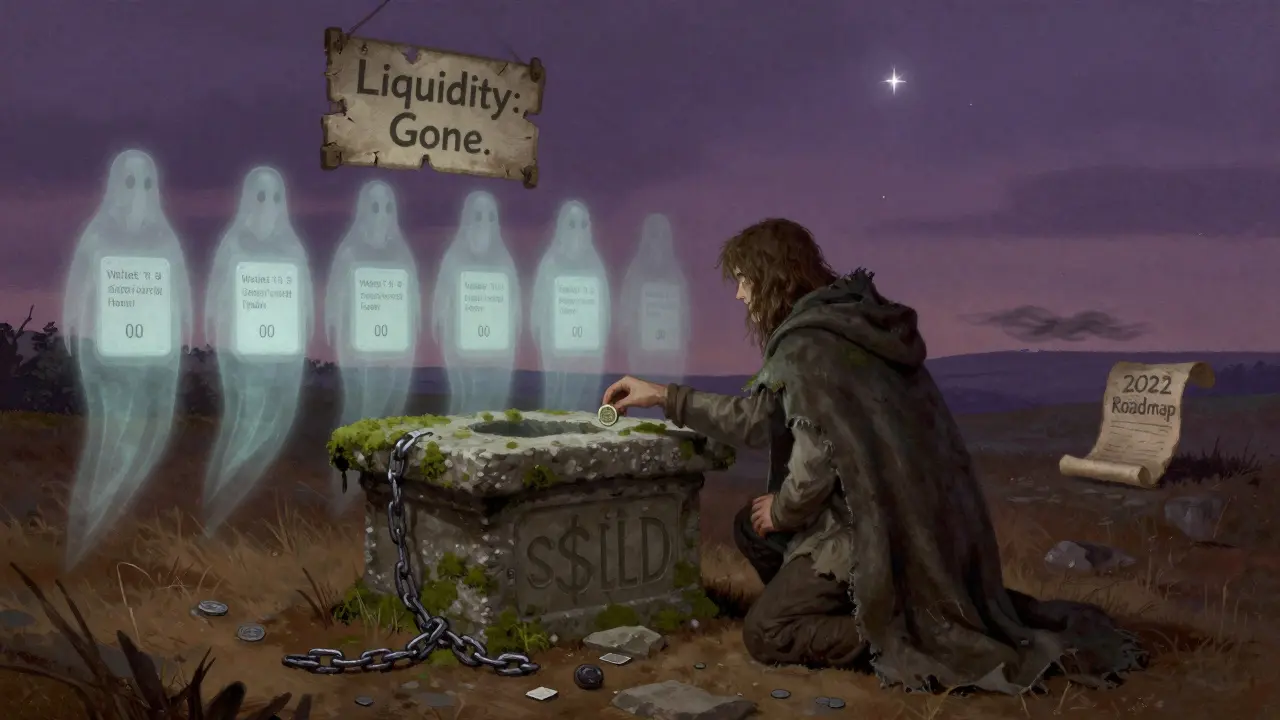
Solidly V2 on Ethereum is a dead experiment. It was an interesting idea, but it failed to attract users, liquidity, or attention. Its tokenomics are clever, but clever doesn’t mean useful. In a market where DEXs compete for billions in daily volume, Solidly operates on a scale so small it’s practically invisible. There’s no future here. No growth. No updates. No community. Just a static smart contract with $50 in trading volume and a handful of people wondering why it still exists. If you’re looking for a decentralized exchange, use Uniswap, Curve, or even MEXC. They’re alive. They’re growing. They have liquidity. Solidly? It’s a ghost.Is Solidly a safe exchange to use?
Solidly’s smart contracts have not been publicly audited by major firms like CertiK or Trail of Bits, and there’s no evidence of formal security reviews. While the code may be technically sound, the lack of audits, combined with minimal usage, makes it a high-risk platform. There’s no insurance, no recovery options, and no user protection. If something goes wrong, you lose everything.
Can I earn real money trading on Solidly?
Almost certainly not. The 24-hour trading volume is under $50, meaning there’s almost no fee revenue to distribute to liquidity providers. Even if you stake $SOLID, the rewards are negligible - likely fractions of a cent per week. The token itself has no market value beyond speculative trading, and there’s no liquidity to sell it easily. You’re better off staking on established platforms like Aave or Lido.
Why does Solidly only have 5 trading pairs?
Solidly was designed as a testbed for a specific tokenomics model - not as a general-purpose exchange. The team limited pairs to focus on stablecoin and WETH liquidity, hoping to study how voting affects concentration. But without enough users or capital, the experiment never scaled. It’s not a strategic choice - it’s a symptom of failure.
Is Solidly still being developed?
There’s no evidence of active development since 2022. No GitHub commits. No team announcements. No new features. The Twitter account has been inactive for over a year. The project appears abandoned. In DeFi, if a protocol stops updating, it’s effectively dead.
What happened to Andre Cronje’s other projects?
Andre Cronje’s earlier projects like Yearn.finance and Fantom’s Ankr had massive adoption before declining. Solidly followed the same pattern: early hype, rapid launch, then quiet collapse. He’s moved on to other ventures, and Solidly has been left behind. It’s not unusual in DeFi - many projects launch with big promises and vanish when liquidity dries up.
This is why American crypto projects die. No real utility, just hype. Solidly was a prototype. Prototypes don't get user bases. Get over it.
LMAO imagine crying over $50 in volume 😂
The elegance of Solidly lies not in its utility, but in its philosophical rejection of mass adoption as a metric of success. It is a quiet rebellion against the performative liquidity of DeFi-where value is measured in volume, not in intention. One cannot measure the profundity of a thought experiment by the number of wallets it touches.
If you're looking for yield, go to Aave. If you're looking for a lab, Solidly's your spot. Simple.
This is just another crypto graveyard dressed up as innovation. Andre left it to rot because even he knew it was a joke. The NFTs are digital tombstones.
Let’s be real-Solidly didn’t fail because of liquidity. It failed because it didn’t cater to the degens. The whole voting mechanism is a beautiful piece of economic theory, but in DeFi, theory without dopamine doesn’t move markets. You need flash, noise, and a 1000x meme coin to survive. Solidly was too smart for its own good. The fact that it still exists as a static contract is almost poetic. It’s the crypto equivalent of a monk meditating in a nightclub.
I respect this. It’s like a library with one book-no one’s reading it, but someone still keeps the lights on. Maybe that’s enough.
Of course it’s dead. No one cares about a DEX that doesn’t let you trade memecoins. This isn’t finance-it’s a philosophy thesis nobody asked for.
Solidly is a trap set by the elite to lure retail into dead protocols so they can pump their real projects in the shadows. You think this is an accident? Think again. The silence is the signal
I just love how some people treat crypto like it’s a museum and not a jungle. Solidly is a weird little plant growing in the cracks. It’s not supposed to be big. It’s supposed to be different
The absence of audits is not merely a technical oversight-it is a fundamental breach of fiduciary trust in decentralized systems. One cannot claim decentralization while operating in cryptographic obscurity. This is not innovation. It is negligence.
Hey, if it helps one person learn about fee voting, it’s worth it. Not everything has to be a billion dollar app.
They just left it there like a forgotten toaster in the attic. I keep checking it every month like it’s gonna wake up. It never does. I miss the hype.
This is what happens when you let a genius build something for himself instead of the masses. He thought he was making art. The world just saw a broken widget.
I still hold my $SOLID NFT. Not because I think it’s valuable. But because I believe in the idea. Maybe one day someone will revive it. Or maybe it’ll just stay as a monument to what could’ve been.
Solidly? More like Solidly irrelevant. The whole thing is a liquidity ghost town with a fancy tokenomics whitepaper. No one’s trading. No one’s earning. Just a bunch of devs talking to themselves.
I think we’re all missing the point. It’s not about volume. It’s about the quiet persistence of an idea that refused to compromise. That’s rare in crypto. I salute it.
This is precisely why retail investors lose money. They chase intellectual curiosities disguised as investments. Solidly is not a product. It is an academic footnote.