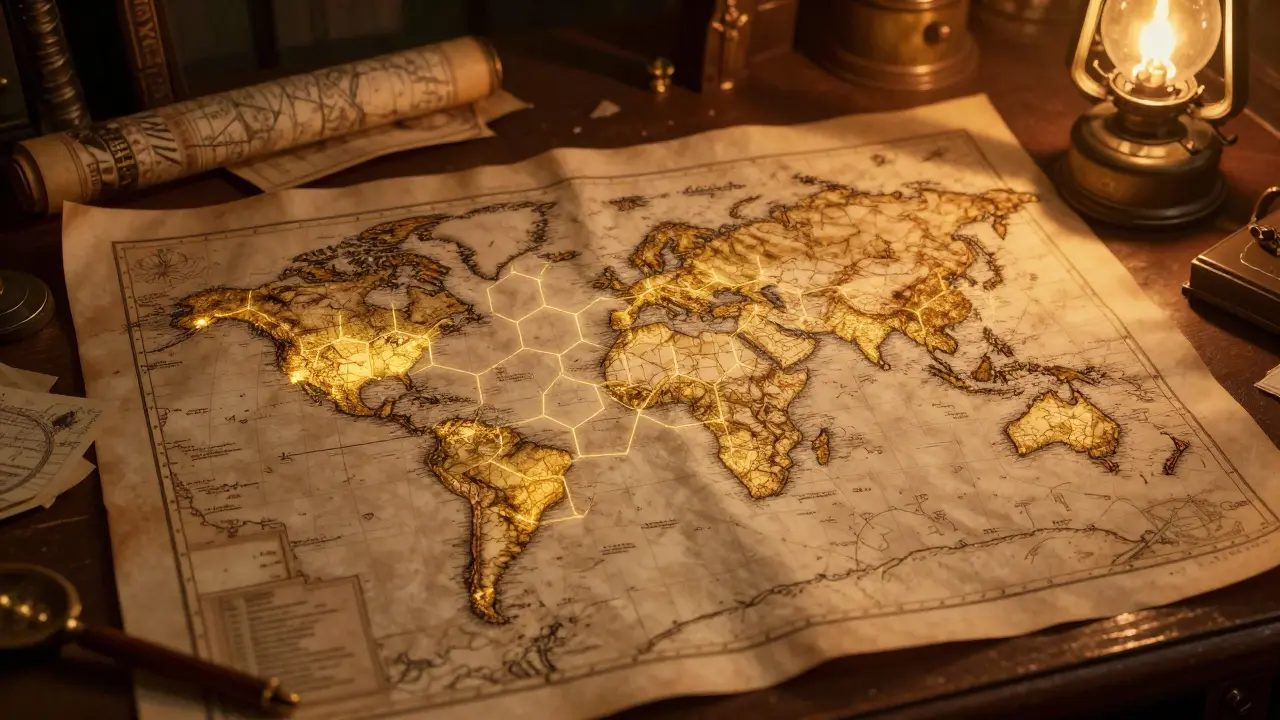
Imagine buying a piece of virtual land that isn't just a random pixel on a screen, but corresponds to your actual hometown. That is the pitch behind Ertha, a cryptocurrency and gaming project built on the Binance Smart Chain. It promises a unique blend of life simulation, geopolitical strategy, and real-world geography. But does it deliver on its ambitious vision, or is it another overhyped project in the crowded metaverse space?
If you are looking for quick answers, here is what you need to know about ERTHA right now:
- Core Concept: A play-and-earn game where players buy hexagonal plots of real-world Earth as NFTs.
- Token Utility: Used for in-game transactions, governance, and resource management within the Ertha ecosystem.
- Current Status: Trading at sub-cent levels with significantly reduced market capitalization compared to launch.
- Risk Level: High. Low liquidity and limited adoption make it speculative.
The Core Concept: Mapping the World onto Blockchain
Most blockchain games throw you into a fantasy world with dragons, spaceships, or abstract grids. Ertha takes a different approach. It uses a hexagonal grid system to divide the entire surface of planet Earth into approximately 350,000 purchasable plots. Each plot is an NFT, meaning you own it on the blockchain.
The idea is simple yet distinct: you pick a location-say, New York City, Tokyo, or a small town in Asheville-and build a virtual nation there. You aren't just decorating; you are managing resources. You hire virtual businessmen to boost your economy, scholars to advance research, and fighters to handle military operations. The goal is to balance these societal elements to dominate your region or collaborate with neighbors.
This geographical tie-in is Ertha's main selling point. Developers claim it is the first NFT game to use the actual planet as its game world. For players who enjoy strategy games like Civilization or Risk, this adds a layer of familiarity and personal connection. Building a virtual empire in your backyard feels different than building one on a made-up island.
How the ERTHA Token Works
The ERTHA token is a BEP-20 utility token operating on the Binance Smart Chain. This technical choice matters because BSC offers lower transaction fees and faster processing times compared to Ethereum, which is crucial for a game requiring frequent interactions.
You will need ERTHA to do almost anything in the game. Here is how the token flows through the ecosystem:
- Purchasing Land: While some initial sales might have used other currencies, ongoing land transactions typically involve the native token.
- Hiring NPCs: Paying for the services of virtual citizens (businessmen, scholars, fighters) costs ERTHA.
- Governance: Token holders can vote on future developments, ensuring the community has a say in the roadmap.
- Trading Assets: If you want to sell your developed land or resources to another player, ERTHA facilitates the exchange.
The tokenomics were designed to support a large-scale economy. At launch, the fully diluted market cap (FDMC) was set at $36 million, indicating a planned distribution for millions of tokens. However, the current circulating supply and market dynamics tell a different story, which we will cover next.
Market Reality: Price, Volume, and Liquidity
Let's talk numbers, because they paint a stark picture of Ertha's current health. As of late 2025, the ERTHA token trades at roughly $0.00025 USD. That is less than a tenth of a cent. While low prices can attract retail investors hoping for a "100x" gain, they also signal significant depreciation from earlier valuations.
| Metric | Value | Context |
|---|---|---|
| Price | $0.0002548 | Sub-penny valuation |
| 24h Volume | $62,352 | Low liquidity risk |
| Market Cap | $791,000 | Down from $1.8M at launch |
| Fully Diluted MC | $791,000 | Significant drop from $36M target |
The most concerning metric here is the trading volume. With only about $62,000 changing hands in a day, the market is thin. If you try to buy or sell a large amount of ERTHA, you could experience high slippage, meaning your trade price will be worse than expected because there aren't enough buyers or sellers at that price level.
Furthermore, the market cap has contracted sharply. Starting with a $1.8 million market cap and dropping to under $1 million suggests that early investors may have exited, or interest has waned. In the crypto world, sustained volume is a sign of life. Ertha's volume is barely keeping the lights on.

Ertha vs. The Giants: How It Compares
To understand Ertha's position, you have to look at the competition. The metaverse and blockchain gaming sector is dominated by titans like The Sandbox ($SAND) and Decentraland ($MANA). These projects have billions in market cap, major brand partnerships, and active communities.
Ertha differs in scope and execution. The Sandbox and Decentraland focus on user-generated content-you create experiences, wearables, and worlds. Ertha focuses on simulation and strategy tied to real geography. It is more akin to a geopolitical board game than a social hangout spot.
However, this niche appeal comes with trade-offs. The Sandbox has a market cap exceeding $1.5 billion. Ertha sits outside the top 2,000 cryptocurrencies. This gap isn't just about money; it reflects user adoption. Without a critical mass of players, the "economy" of Ertha struggles to function. Who wants to build a business if there are no customers? Who wants to fight wars if there are no enemies?
Is Ertha Worth Your Time? Pros and Cons
Before you connect your wallet, weigh the realities against the hype. Here is a breakdown of why someone might get involved and why they should stay away.
Why It Might Interest You:
- Unique Gameplay: The integration of real-world maps is genuinely novel. If you love geography and strategy, the concept is compelling.
- Low Entry Cost: Because the token is so cheap, you can buy a large quantity for a small amount of money. This appeals to speculators betting on a comeback.
- BSC Compatibility: Using MetaMask or Trust Wallet on Binance Smart Chain is easy and cheap for most users.
Why You Should Be Cautious:
- Liquidity Traps: Low volume means you might not be able to sell your tokens or NFTs when you want to.
- Development Uncertainty: There are mixed reports on the roadmap execution. Some sources suggest delays and limited community engagement.
- Competition: Major players have deeper pockets and better marketing. Ertha is fighting an uphill battle for attention.
- Complex Learning Curve: Users report that understanding the economic and military mechanics takes time, which can deter casual gamers.
Future Outlook: Predictions and Risks
Looking ahead, analysts are divided. Some AI-driven forecasting models, like those from CoinLore, suggest long-term potential, projecting ERTHA could reach higher values by 2040 if the project survives and gains traction. These models often rely on historical patterns and assume successful execution of future updates.
Conversely, technical analysis from platforms like TradingBeast predicts further decline, citing weak momentum and lack of buyer interest. The reality is likely somewhere in between, but skewed toward risk. For Ertha to succeed, it needs to solve two problems: attracting new players and retaining existing ones. Without active users, the token has no intrinsic value beyond speculation.
The broader blockchain gaming market is growing, valued at over $4 billion in recent years. However, growth doesn't trickle down to every project. Only those with strong communities, regular updates, and clear utility survive. Ertha currently lacks visible signs of mass adoption.
Getting Started with Ertha
If you decide to take the plunge, here is how you prepare:
- Set Up a Wallet: Install MetaMask or Trust Wallet. Configure it to connect to the Binance Smart Chain network.
- Acquire BNB: Buy BNB (Binance Coin) on a major exchange like Coinbase or Binance, then transfer it to your wallet. You'll need BNB to pay for gas fees.
- Swap for ERTHA: Use a decentralized exchange like PancakeSwap. Connect your wallet, paste the official ERTHA contract address (always verify this on CoinMarketCap or CoinGecko to avoid scams), and swap your BNB for ERTHA.
- Access the Platform: Visit the official Ertha website and connect your wallet to start exploring the map and purchasing plots.
Always double-check contract addresses. Scammers often create fake tokens with similar names. Stick to verified sources.
What is the minimum investment to start playing Ertha?
There is no fixed minimum, but due to the low token price ($0.00025), you can start with very small amounts. However, consider gas fees on Binance Smart Chain, which usually cost a few cents to a dollar depending on network congestion.
Is Ertha a safe investment?
No cryptocurrency investment is guaranteed, but Ertha carries high risk. Its low market cap and liquidity mean the price can swing wildly. Only invest what you can afford to lose entirely.
Can I earn passive income with ERTHA?
The game design encourages active participation. Earnings come from developing land, winning conflicts, or trading assets. There are no widely documented staking mechanisms that generate passive yield without gameplay involvement.
Why is the ERTHA price so low?
The low price reflects low demand and high supply relative to market interest. It also indicates a loss of confidence from early investors, leading to selling pressure and reduced market capitalization.
Does Ertha work on mobile devices?
As a web-based blockchain application, Ertha is accessible via mobile browsers. However, the complex interface may be harder to navigate on smaller screens compared to dedicated mobile apps.