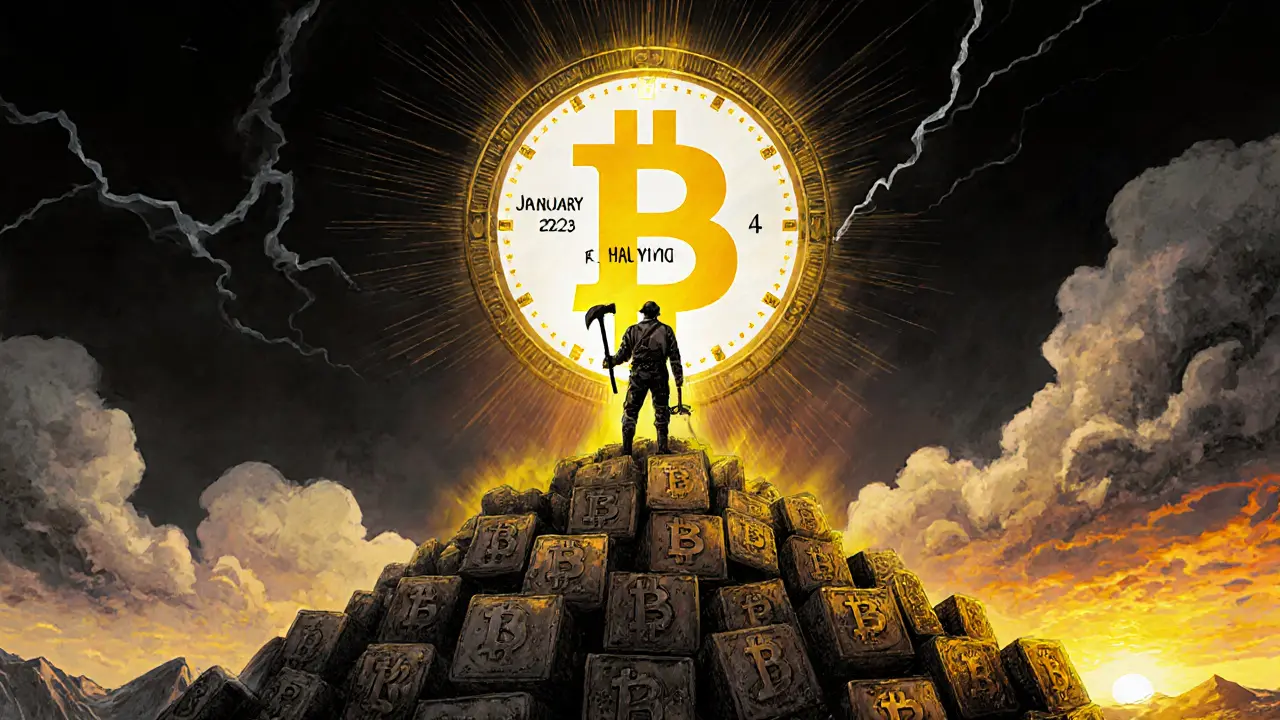
Bitcoin Halving Countdown Calculator
How Close Is the Next Bitcoin Halving?
The next Bitcoin halving is expected to occur at block 1,050,000 (approximately 210,000 blocks after the April 2024 halving at block 840,000). Enter the current block height to calculate the countdown.
Countdown to Next Halving
Bitcoin doesn’t print more coins like a central bank. Instead, it follows a strict, unchangeable schedule built into its code. Every 210,000 blocks, the reward for mining a new block gets cut in half. This is the Bitcoin halving-a core feature designed to limit supply and create scarcity. The last one happened on April 20, 2024. So when’s the next one?
The Next Bitcoin Halving Is Expected in Early 2028
The next Bitcoin halving is projected to occur in the first half of 2028, most likely around January 23, 2028, at 06:54 UTC. This estimate comes from NiceHash’s real-time countdown, which tracks current block production rates. CoinCodex and Binance agree: it’ll happen near block 1,050,000, roughly four years after the April 2024 halving at block 840,000.
But here’s the catch: no one can give you an exact date today. Bitcoin’s block time isn’t perfect. It’s supposed to be 10 minutes per block, but it’s been averaging about 9 minutes and 52 seconds lately. That small difference adds up. Over 210,000 blocks, even an 8-second variance per block shifts the halving date by nearly four days. So while January 2028 is the best guess now, the real date will only become clear in the weeks leading up to it.
How the Halving Works-And Why It Matters
Every time a miner solves a Bitcoin block, they get rewarded with new BTC. When Bitcoin launched in 2009, that reward was 50 BTC per block. It halved to 25 in 2012, then 12.5 in 2016, 6.25 in 2020, and 3.125 in 2024. The next halving will drop it to 1.5625 BTC per block.
This isn’t arbitrary. Bitcoin’s total supply is capped at 21 million coins. The halving ensures those coins are released slowly over time, mimicking the scarcity of gold. By 2140, the block reward will be so small it’s effectively zero. After that, miners will rely entirely on transaction fees to earn income.
The halving is automatic. No vote. No committee. No human decision. It’s triggered by the Bitcoin protocol itself, written in code and enforced by every node on the network. That’s what makes it trustworthy-it can’t be changed, even if everyone wanted to.
What Happened After Past Halvings
History shows a pattern: Bitcoin prices tend to rise after a halving. But not always right away-and never for the same reason.
- 2012 (Block 210,000): Price was $12 before the halving. Six months later, it hit $130.
- 2016 (Block 420,000): Started at $650. Six months later, $2,520.
- 2020 (Block 630,000): Began at $8,600. Six months later, $17,900.
- 2024 (Block 840,000): Started at $64,013. Six months later, $90,446-a 41.2% gain.
Notice something? The percentage gains are shrinking. That doesn’t mean the halving lost power. It means the market changed. In 2024, the launch of U.S. spot Bitcoin ETFs brought in massive institutional demand. BlackRock and Grayscale now hold over 950,000 BTC-nearly 5% of all Bitcoin in circulation. That kind of demand didn’t exist in 2020.
Also, the 2024 halving was followed by a flood of coins from Mt. Gox repayments and seized government holdings. That added temporary supply pressure. The market absorbed it. By early 2025, Bitcoin hit nearly $110,000-nine months after the halving.
Will 2028 Follow the Same Pattern?
Some say yes. Others say no. And both have a point.
ARK Invest believes Bitcoin’s four-year cycle is still intact. They point to strong demand, growing ETF holdings, and institutional adoption as reasons to expect another upward move after 2028. Binance, however, warns: past performance doesn’t guarantee future results. Regulations, macroeconomic conditions, and global events could change everything.
Reddit users are split. One top comment from r/CryptoMarkets says: “The 2028 halving will be different because institutional adoption has fundamentally changed Bitcoin’s market structure since 2020.” That’s the key insight. Bitcoin isn’t just a speculative asset anymore. It’s becoming a reserve asset for funds, corporations, and even sovereign wealth funds.
That means the price reaction in 2028 might not be driven by retail traders chasing hype. It could be driven by long-term investors adjusting portfolios. The halving still reduces supply. But now, demand comes from places it never did before.
How to Track the Next Halving Yourself
You don’t have to rely on guesses. You can track it yourself.
Use tools like NiceHash’s halving countdown or CoinWarz. They update in real time based on actual block production. CoinWarz even uses the average block time over the last 20,160 blocks (about 140 days) to smooth out short-term noise.
Want to go deeper? Check a blockchain explorer like Blockchain.com or Blockchair. Look up the current block height. Subtract 840,000 (the last halving). That gives you how many blocks are left. Divide by 144 (blocks per day, roughly). That gives you days until the next halving.
But remember: block times change. If mining becomes more efficient or network congestion drops, blocks come faster. If miners go offline or difficulty spikes, blocks slow down. That’s why your estimate will drift. It’s not a flaw-it’s how Bitcoin works.
What This Means for Miners, Investors, and Everyone Else
For miners: The halving cuts revenue in half. That’s why many smaller miners shut down after each event. Only the most efficient operations survive. That’s good for Bitcoin-it pushes out low-efficiency mining and concentrates hash power in professional firms like Marathon Digital and Riot Platforms, which now control over 35% of the network.
For investors: The halving doesn’t guarantee a price surge. But it does reduce the rate at which new coins enter the market. If demand stays steady or grows, that imbalance pushes prices up. The ETFs have made demand more predictable. That could make post-halving rallies smoother and less volatile.
For everyone else: The halving is a reminder that Bitcoin isn’t just another crypto. It’s a monetary experiment with a fixed, transparent schedule. You can’t change it. You can’t print more. You can only wait-and watch.
What Comes After 2028?
The next halving after 2028 will be in 2032. Then 2036. Then 2040. Each time, the block reward gets smaller. By 2040, it’ll be 0.390625 BTC. By 2060, it’ll be 0.09765625 BTC. It’ll take decades for the reward to disappear completely.
But Bitcoin doesn’t need to keep printing coins to stay valuable. As transaction volume grows, fees will rise. Miners will earn more from fees than from block rewards. That’s the endgame. And it’s already starting. In 2024, some blocks paid out more in fees than in rewards.
The halving isn’t just a milestone. It’s the heartbeat of Bitcoin’s economic model. And it’s been beating the same rhythm since 2009. It will keep beating-until the last coin is mined.
When is the next Bitcoin halving expected to occur?
The next Bitcoin halving is expected to occur in early 2028, most likely around January 23, 2028, at 06:54 UTC. This estimate is based on current block production rates and the target of reaching block 1,050,000, which is 210,000 blocks after the April 2024 halving. However, the exact date may shift by several days or weeks due to natural variations in Bitcoin’s average block time.
How often does Bitcoin halve?
Bitcoin halves approximately every four years, or more precisely, every 210,000 blocks. This schedule is hardcoded into Bitcoin’s protocol and has remained unchanged since its launch in 2009. Each halving reduces the block reward miners receive by 50%, slowing the rate at which new Bitcoin enters circulation.
What happens to the Bitcoin block reward after the next halving?
After the next halving in 2028, the Bitcoin block reward will drop from 3.125 BTC to 1.5625 BTC per block. This continues Bitcoin’s deflationary model, where the reward halves every 210,000 blocks until it approaches zero around the year 2140. After that, miners will rely solely on transaction fees for income.
Why does the Bitcoin halving affect the price?
The halving reduces the supply of new Bitcoin entering the market. If demand stays the same or increases while supply drops, prices tend to rise. Historically, Bitcoin has seen significant price increases in the months following a halving. However, the magnitude of the price movement depends on broader factors like institutional adoption, ETF inflows, macroeconomic trends, and market sentiment-not just the halving itself.
Can the Bitcoin halving be changed or canceled?
No, the Bitcoin halving cannot be changed or canceled. It is a fixed rule in Bitcoin’s open-source code, enforced by every node on the network. Any attempt to alter it would require consensus from the entire Bitcoin community, which is extremely unlikely due to Bitcoin’s design philosophy of decentralization and immutability. The halving has occurred four times since 2009 without deviation.
How do Bitcoin ETFs impact the halving cycle?
Bitcoin ETFs have significantly changed the demand side of the halving equation. Since their launch in January 2024, ETFs like those from BlackRock and Grayscale have absorbed large amounts of Bitcoin, reducing circulating supply. This institutional demand adds a new layer of price support, making post-halving rallies potentially more stable and less dependent on retail speculation. ETFs are now a key factor in how the market reacts to supply shocks like the halving.
Will miners be okay after the 2028 halving?
Miners will face tighter margins after the 2028 halving, but many are adapting. Large, efficient mining firms with access to cheap energy and advanced hardware are surviving and even expanding. Smaller, less efficient miners often shut down after halvings. The trend toward professionalization continues, with public companies like Marathon Digital and Riot Platforms now controlling over 35% of the network’s hash rate. As Bitcoin’s price rises and transaction fees increase, miners will rely less on block rewards and more on fees-making them more resilient to future halvings.
i always forget how the halving works but like... its just cool that its automatic? no one can change it. even if the gov wanted to. its wild.
also 2028 feels so far away but also like... next week?
The notion that a decentralized protocol can enforce scarcity better than any central bank is not merely impressive-it is revolutionary. The fact that you, a layperson, can understand this at all speaks to the democratization of financial literacy. Still, most fail to grasp the magnitude.
The halving is a key part of Bitcoin's design. It reduces the supply of new coins entering circulation every four years. This creates scarcity, which, combined with increasing demand, historically leads to price appreciation. It's not magic-it's economics.
bro the 2028 halving is gonna be the one where we finally see real institutional FOMO. we’re not talking about some crypto bros with a Binance account anymore. we’re talking pension funds, sovereign wealth, hedge funds stacking sats like they’re trading gold. this ain’t 2020 anymore. this is the real deal.
I TOLD YOU ALL THE ETFs WERE THE KEY!! 🚀💸
2024 was just the warmup. 2028? That’s when the floodgates open. Miners are gonna be begging for fees. Price? 250K minimum. I’m not even being extra.
In India, we’ve watched Bitcoin grow from a curiosity to something people actually talk about at family dinners. My uncle still thinks it’s a scam, but my cousin bought his first 0.01 BTC last month. The halving? It’s not just code. It’s a story that’s reaching places no bank ever could.
I’ve been tracking this since 2020. The halving isn’t a guarantee, but it’s the closest thing Bitcoin has to a calendar event that moves markets. What’s interesting now is that the price reaction isn’t as explosive as before-because the market’s bigger. Less volatility, more steady accumulation. That’s actually healthier.
They say the halving is automatic... but who controls the mining rigs? Who owns the data centers? Who really controls the nodes? The government has been quietly buying up mining licenses since 2022. The halving is just a distraction. The real game is control. You think they’d let a decentralized currency survive if they could stop it?
I can’t believe people still think this is just about money. This is about freedom. The fact that we can have a currency that no president, no central banker, no bureaucrat can print more of? That’s the most powerful thing in human history. And you’re all just talking about price charts like it’s a casino. Pathetic.
2028 feels like the year we stop calling it ‘crypto’ and start calling it ‘digital gold’. the halving is just the heartbeat. the real story? The fact that people are finally starting to treat it like real money. 🤝
I remember when mining was done on a laptop. now its factories with gigawatts of power. the halving forces evolution. the weak get filtered out. the strong get stronger. thats how nature works. thats how bitcoin works. no drama. just math. just time.
You think the halving is the big event? Nah. The real event is when the Fed finally admits Bitcoin is a reserve asset. They’ll try to regulate it into submission. But they can’t. It’s already too late. The code doesn’t care what they say. The nodes don’t care. The people don’t care. They’re already holding it.
Here in South Africa we see this as a way out. inflation is insane. rand is falling. people are turning to btc not because they understand the tech but because they see it holding value. the halving? it just makes it more special. like a rare coin you can’t print. hope it keeps going
ETFs changed everything. no more just speculators. now its institutions buying and holding. the halving still matters but its not the only driver anymore. demand is structural now. not cyclical
It's important to recognize, in a broader context, that the Bitcoin halving is not merely a technical adjustment to the block reward, but rather a profound, philosophical assertion of scarcity in an age of perpetual monetary expansion. The fact that this mechanism has remained unaltered for over fifteen years, despite immense pressure from centralized institutions, speaks volumes about the resilience of decentralized consensus and the enduring human desire for sound money. One might even argue that the halving is a quiet, digital rebellion against the very foundations of fiat-based economic systems.
The halving is just the rhythm. The real question is... are we listening? We’ve been conditioned to chase growth, to consume, to inflate. Bitcoin says no. It says wait. It says be patient. It says scarcity is sacred. Maybe the next halving won’t spike the price... but it might spike the awareness. And that’s scarier than any bull run.
Halving? More like halving of my patience. ETFs are just Wall Street repackaging the same old scam. They’re gonna dump on the next pump. Mark my words. The real miners are getting squeezed. The code doesn’t matter when the system owns the hardware.
in india we dont have btc as easy as usa but still people are buying. my friend who sells chai now has a btc wallet. he says its like saving gold but better. the halving? he dont know the date but he knows its every 4 years. and he waits. he dont care about charts. he cares about value. thats real.
The halving is a predictable event, but its impact is often overestimated. The market has already priced in the reduction in supply. What matters more is macroeconomic conditions, regulatory shifts, and adoption trends. The halving is a footnote, not a headline.