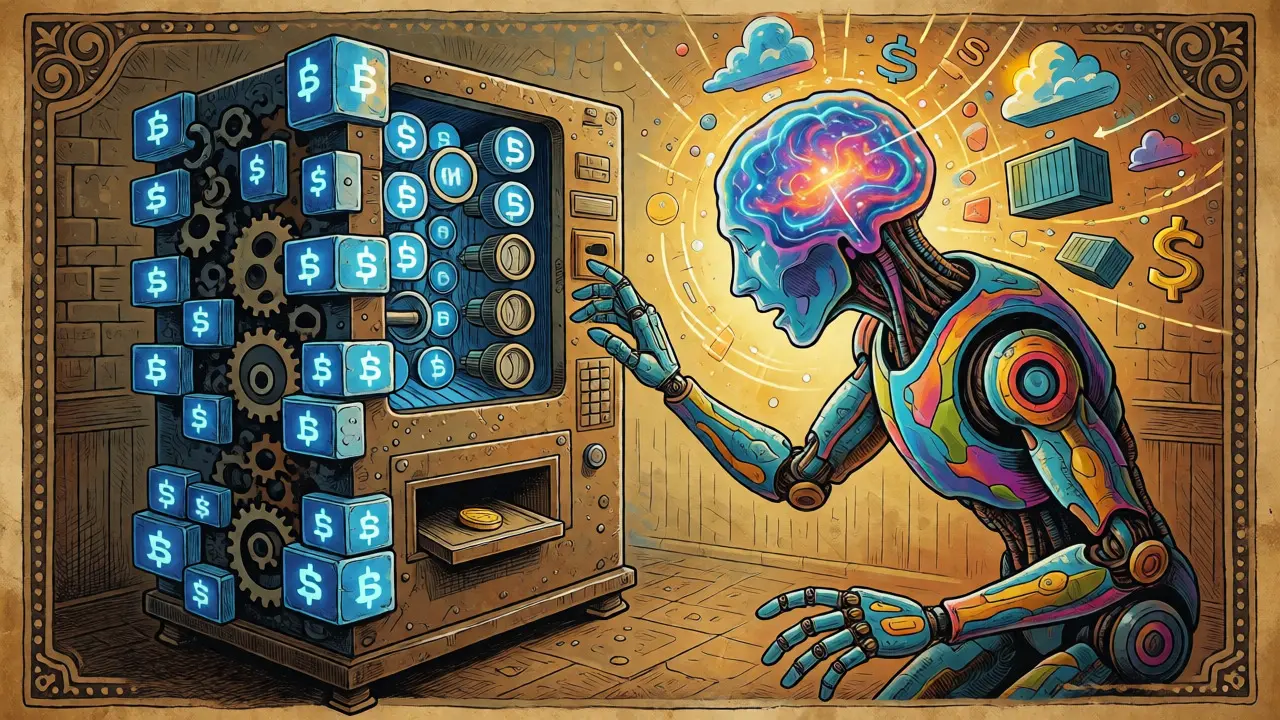
You’ve probably heard the hype about AI-powered smart contracts. But what actually happens when you mix artificial intelligence with the rigid logic of a blockchain? Traditional smart contracts are like vending machines: you put in specific coins (inputs), and they give you a specific snack (output). If the conditions aren’t met exactly, nothing happens. It’s predictable, sure, but it’s also brittle. AI-powered smart contracts change that dynamic entirely by adding a brain to the machine. They don’t just execute code; they analyze data, learn from past transactions, and make decisions on the fly.
This isn’t some far-off sci-fi concept anymore. By late 2025, these hybrid systems moved from experimental labs into real-world enterprise pilots. Companies like Maersk and AXA are already using them to cut costs and speed up processes. But here’s the catch: while they promise efficiency, they also introduce new risks, higher gas fees, and complex technical hurdles. If you’re a developer, investor, or business leader trying to figure out if this tech is ready for your use case, you need to look past the buzzwords. Let’s break down how they work, where they shine, and where they might trip you up.
What Makes an AI Smart Contract Different?
To understand the shift, you have to look at the architecture. A standard Ethereum smart contract runs on deterministic logic. If condition A is true, execute B. Period. There is no nuance. AI-enhanced contracts, however, integrate machine learning models directly into the execution flow or via off-chain oracles. This allows the contract to handle ambiguity.
Think about supply chain logistics. A traditional contract might say, "If delivery time > 3 days, release penalty." Simple. An AI-powered version looks at weather patterns, port congestion data, historical delay rates, and even fuel prices. It calculates the probability of a delay and adjusts the penalty dynamically. According to Komodo Platform’s 2025 analysis, this approach can improve prediction accuracy by 15-22% after processing thousands of transaction records. The contract learns. It self-corrects. Over six months, error rates in Fetch.AI case studies dropped by nearly 37% as the model refined its logic.
The technology stack usually involves three layers:
- The Brain: Machine learning frameworks like TensorFlow or PyTorch process the data.
- The Bridge: Oracles like Chainlink feed external data into the blockchain.
- The Ledger: Solidity or Rust handles the immutable record and final execution.
This separation is crucial because running heavy AI computations directly on-chain is expensive. Most current implementations use a hybrid model, where the heavy lifting happens off-chain, and only the result gets written to the blockchain. This keeps costs manageable while preserving trust.
Real-World Applications: Where Does It Actually Work?
Not every problem needs an AI brain. If you’re sending money between two friends, a simple transfer script is faster and cheaper. AI smart contracts excel in scenarios with high complexity and variable inputs. Here are the sectors seeing the most traction right now.
| Feature | Traditional Smart Contract | AI-Powered Smart Contract |
|---|---|---|
| Logic Type | Deterministic (If-Then) | Probabilistic (Adaptive) |
| Data Handling | Static inputs only | Dynamic external data + historical trends |
| Error Rate | Low (if coded correctly) | Decreases over time (self-learning) |
| Gas Costs | Low (~0.015 ETH) | Higher (~0.045 ETH) |
| Best Use Case | Simple payments, NFT minting | Supply chain, insurance, trading bots |
In insurance, AXA implemented AI contracts for flight delays. Instead of waiting weeks for a human adjuster, the system checks flight data APIs instantly. In their March 2025 case study, claim processing time dropped from 14 days to just 47 minutes, with 99.2% accuracy. That’s a massive win for customer satisfaction and operational overhead.
Logistics is another big winner. Maersk piloted a system using Fetch.AI agents to reroute shipments based on real-time variables. The result? A 22.4% reduction in logistics costs. The AI didn’t just follow a route; it optimized it against weather and congestion data that would have overwhelmed a static rule set.

The Cost of Intelligence: Fees and Complexity
Here’s the friction point: intelligence isn’t free. Running AI models requires computational power, which translates to higher gas fees on networks like Ethereum. Data from Q1 2025 shows that executing an AI-heavy contract can cost roughly three times more than a standard one-averaging 0.045 ETH versus 0.015 ETH. For small transactions, this kills the ROI. You need volume or high-value assets to justify the expense.
Beyond fees, there’s the barrier to entry. Developing these contracts isn’t just about writing Solidity. Developers need skills in machine learning and data engineering. ConsenSys Academy reports that developers require an additional 300-400 hours of training beyond standard blockchain development to build effective AI-integrated systems. Teams typically need a mix of roles: a blockchain architect, two AI specialists, and a domain expert. If you’re a solo dev or a small startup, this talent gap is real.
Also, consider the data requirement. These models aren’t magic; they need fuel. Most basic implementations require a minimum of 5,000 historical transaction records to function decently. Performance improves significantly up to 50,000+ records. If your business doesn’t have clean, abundant historical data, the AI will struggle. Poor data quality is cited in 87% of support threads for platforms like Fetch.AI as a primary cause of performance degradation.
Risks and The Black Box Problem
Trust is the core value proposition of blockchain. But AI introduces opacity. When a neural network decides to reject a claim or reroute a shipment, can you explain why? Often, no. This is known as the "black box" problem. Dr. James Lovejoy from IEEE Spectrum warned in early 2025 that unexplainable AI decisions create legal liability issues, especially in regulated industries like finance and healthcare.
If an AI contract makes a mistake, who is liable? The developer? The oracle provider? The user? Unlike a bug in deterministic code, which is often binary (it works or it breaks), an AI error might be subtle-a slightly wrong prediction that leads to a financial loss. A European bank faced $1.2 million in losses in late 2024 because an AI model misinterpreted market volatility data. The code wasn’t "broken"; it was just wrong. That distinction matters legally.
Security is another layer. AI models can be attacked through adversarial examples, where slightly altered input data tricks the model into making bad decisions. While blockchain secures the ledger, it doesn’t inherently secure the AI model feeding it. New cryptographic solutions are being developed to verify AI decision pathways, but we’re still in the early stages of solving this.

How to Implement: A Step-by-Step Guide
If you’re thinking about adopting this tech, don’t jump straight to production. Follow a structured path to mitigate risk.
- Data Preparation (8-12 Weeks): Gather and clean your historical data. Ensure it’s consistent and relevant. Garbage in, garbage out applies doubly here.
- Model Training (4-6 Weeks): Train your ML model offline using tools like TensorFlow. Validate its accuracy against known outcomes before touching the blockchain.
- Integration (2-3 Weeks): Connect your model to an oracle network like Chainlink. Set up the middleware to fetch data and trigger the smart contract.
- Testing & Deployment (3-5 Weeks): Run extensive tests on testnets. Monitor for latency and gas spikes. Start with low-value transactions before scaling up.
Hybrid architectures are gaining popularity as a workaround for costs. Use AI for the complex decision-making off-chain, then pass the simple result (e.g., "Approve Claim") to a cheap, traditional smart contract for execution. This cuts gas costs by up to 35% according to Chainlink’s recent benchmarks.
The Future Outlook
Where is this heading? Gartner places AI smart contracts at the "Peak of Inflated Expectations," suggesting mainstream adoption won’t hit until 2028-2030. However, enterprise interest is undeniable. 68% of Fortune 500 companies ran pilot projects in Q1 2025, though only 22% made it to production. The gap between pilot and production is largely due to regulatory uncertainty and technical complexity.
Regulations are catching up. The EU’s MiCA framework, updated in January 2025, specifically addresses AI elements in smart contracts, requiring "sufficient explainability mechanisms." This means black-box AI might face compliance hurdles in Europe unless transparency improves. Meanwhile, hardware advancements like NVIDIA’s new inference engines are promising to lower the computational cost barrier.
Forrester predicts that by 2030, AI-powered contracts could handle 40% of global commercial transactions. It’s not a question of if, but when. For now, focus on high-value, complex use cases where the efficiency gains outweigh the higher costs and implementation headaches.
Are AI-powered smart contracts safe?
They are generally safe regarding ledger immutability, but they introduce new risks related to model accuracy and explainability. Unlike traditional contracts, an AI contract might execute based on a probabilistic guess rather than a hard fact, leading to unexpected outcomes if the data is flawed or the model is biased.
Why are AI smart contracts more expensive to run?
Processing complex AI logic requires significant computational resources. Even with off-chain computation, the verification and data retrieval steps consume more gas than simple arithmetic operations. On Ethereum, this can result in fees three times higher than standard contracts.
Do I need a lot of data to start?
Yes. Most AI models require a substantial dataset to learn effectively. A minimum of 5,000 historical records is recommended for basic functionality, with performance improving significantly as you approach 50,000 records. Without sufficient data, the AI cannot make reliable predictions.
Can AI replace lawyers in smart contracts?
Not yet. AI can automate execution and interpretation of data-driven clauses, but it struggles with nuanced legal language and intent. Human oversight remains critical for drafting terms and handling disputes that fall outside the model's training data.
Which blockchains support AI smart contracts best?
Ethereum remains the leader due to its mature ecosystem and oracle support (Chainlink). However, specialized chains like Fetch.AI and Near Protocol are building native infrastructure for autonomous agents and AI integration, offering potentially lower costs and better compatibility for AI-specific tasks.