
You’ve probably seen the headlines or the Discord messages claiming another massive BAKE airdrop is about to drop. It’s tempting. Who doesn’t want free tokens? But here is the hard truth for anyone looking at the BakerySwap ecosystem in mid-2026: the big, official airdrops are mostly history. The major event everyone remembers was the Binance x BakerySwap collaboration, and that ship has sailed.
If you are holding your breath for a new distribution of BakeryToken, you need to know exactly what happened before, why it ended, and where the real value lies today. We aren't just talking about hype; we are talking about the mechanics of how these distributions work, the risks of scams targeting hopeful users, and how the platform actually generates value now through its unique mix of decentralized finance (DeFi) and non-fungible tokens (NFTs).
The Big One: Binance x BakerySwap Collaboration
To understand the current state of BAKE airdrops, you have to look back at the most significant event in the token's history. This wasn't a random giveaway; it was a strategic partnership designed to bridge two major ecosystems. The collaboration between Binance and BakerySwap offered a total pool of $100,000 worth of BAKE tokens.
This campaign was specifically tied to BETH, which stands for Binance ETH 2.0. At the time, Ethereum staking required a massive 32 ETH minimum to become a validator, locking out smaller investors. BETH solved this by allowing users to stake any amount of ETH and receive a tokenized version on the Binance Smart Chain (BSC). The catch? You had to provide liquidity for BETH pairs on BakerySwap to qualify for the BAKE rewards.
Here is how the eligibility worked for those who participated:
- Liquidity Provision: Users had to deposit assets into specific BETH trading pools on BakerySwap.
- KYC Verification: Participants needed completed Know Your Customer verification on Binance to prevent bot farming.
- Time Lock: Positions often needed to be held for a predetermined period to ensure genuine commitment rather than quick sniping.
As of October 2025, this campaign concluded. If you missed it, you missed it. There is no retroactive claim process. This sets the precedent for future events: they are performance-based, not passive. You don't get free money just for having a wallet; you get it for adding value to the protocol.
Current Status of BAKE Tokens in 2026
So, can you still get BAKE tokens? Yes, but you likely won't call it an "airdrop" in the traditional sense. As of July 2026, BAKE is trading around $0.03708 USD. While this might seem low compared to peak bull market prices, the daily trading volume remains healthy at over $2.6 million, indicating active usage rather than stagnation.
The token operates within a capped supply model. The maximum supply is fixed at 731,745,000 BAKE tokens. What makes this interesting from an economic perspective is the initial distribution. Unlike many projects that hand out huge chunks to venture capitalists or insiders, BakerySwap launched with a notably fair model. Only 1% of the total supply went to the development team. There was no pre-mine. There was no presale. This means the circulating supply is largely in the hands of actual users, farmers, and NFT creators.
This scarcity combined with utility creates a different dynamic than pure meme coins. When you buy BAKE today, you aren't just betting on price appreciation; you are buying access to the governance of the protocol and the ability to participate in its yield farming mechanisms.
Beyond Airdrops: How BakerySwap Actually Works
If you are entering the ecosystem now, you need to understand the "food-themed" mechanics that differentiate BakerySwap from competitors like Uniswap or SushiSwap. The platform isn't just a place to swap tokens; it's a hybrid AMM (Automated Market Maker) and NFT exchange.
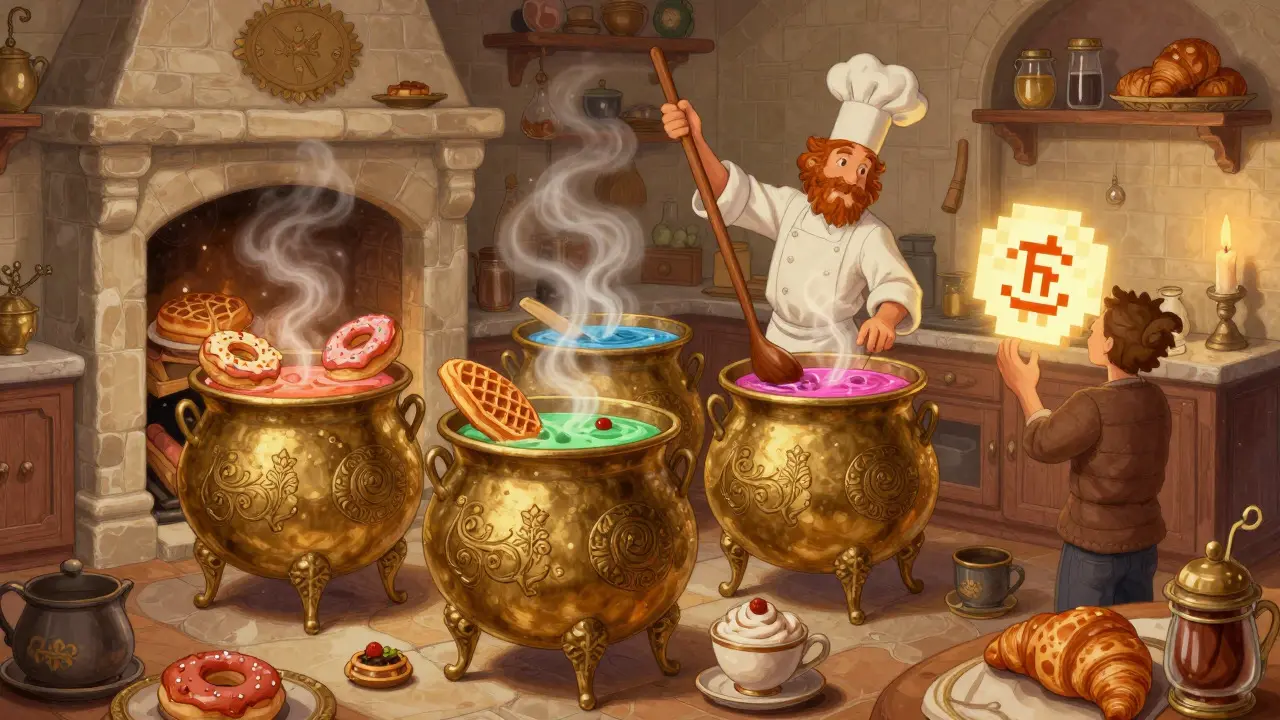
The core activity involves liquidity pools, but instead of boring names, they are themed after breakfast items. You can deposit your assets into pools named Doughnut, Waffle, Rolls, Croissant, and Latte. Each pool offers different return on investment (ROI) percentages based on the risk and demand of the underlying asset pair. For example, providing liquidity for stablecoin pairs might offer lower, steadier returns in the "Latte" pool, while volatile crypto pairs in the "Waffle" pool might offer higher yields with higher impermanent loss risk.
But the real innovation lies in the NFT integration. Here is the workflow:
- Create Food Meals: Users can mint NFTs called "Food Meals" using BAKE tokens.
- Stake for Multipliers: These NFTs aren't just pictures. They act as keys. By staking a Food Meal NFT, you unlock higher multipliers when farming BAKE rewards in the liquidity pools.
- Trade or Burn: You can trade these NFTs with other users on the marketplace, or burn them to retrieve some of the BAKE tokens used to create them.
This creates a circular economy. The NFTs drive demand for BAKE because you need BAKE to make them, and you need them to farm more BAKE efficiently. It gamifies the DeFi experience, appealing to users who find standard yield farming dry and technical.
The NFT Supermarket and Artist Economy
BakerySwap also hosts an NFT Supermarket, which serves as a launchpad for digital artists. This isn't just a secondary market for flipping JPEGs; it's integrated into the broader DeFi strategy. Artists can mint their artwork directly on the platform, and sales are conducted primarily using BAKE tokens.
This integration helps solve a common problem in the NFT space: liquidity. By tying NFT transactions to the native utility token, the platform ensures there is always a ready buyer or seller for BAKE, supporting its price stability. For collectors, it means you can earn BAKE through farming and immediately use it to purchase art, or vice versa. Recent updates in 2025 and 2026 have focused on reducing the gas fees for minting these NFTs, making it more accessible for independent creators without deep pockets.
| Feature | BakerySwap (BAKE) | PancakeSwap (CAKE) | Uniswap (UNI) |
|---|---|---|---|
| Primary Network | Binance Smart Chain (BSC) | Binance Smart Chain (BSC) | Ethereum / Multi-chain |
| NFT Integration | Deeply integrated (Food Meals) | Marketplace only | Minimal / External |
| Governance Model | Community-driven voting | Community-driven voting | DAO Voting |
| Initial Distribution | Fair launch (1% dev team) | Venture Capital backed | Airdrop to past users |
| Unique Mechanic | NFT-staked yield multipliers | Syrup Pools | Concentrated Liquidity |
Watch Out: The Scam Alert
Because the word "airdrop" triggers FOMO (Fear Of Missing Out), scammers love it. If you are searching for BAKE airdrops in 2026, you will encounter fake sites. These phishing pages often mimic the official BakerySwap interface or claim to be authorized partners offering "$15,000 in BAKE" for simply connecting your wallet.
Here is how to spot the fakes:
- Check the URL: Official communications come from verified social media channels or the main bakeryswap.org domain. Suspicious subdomains or slight misspellings are red flags.
- No Wallet Connect Required: Legitimate airdrops usually require proof of past activity (like transaction history) rather than asking you to sign arbitrary smart contract approvals immediately.
- Too Good To Be True: If a site promises thousands of dollars for zero effort, it is a scam. Real airdrops reward labor, liquidity, or early adoption.
The original Binance x BakerySwap airdrop was successful because it was transparent. Users knew exactly what they had to do: provide liquidity, pass KYC, and wait. Today, if you see a site asking you to "claim" BAKE instantly, close the tab. You are likely signing away control of your existing assets.
Future Opportunities and Governance
While large-scale cash giveaways are unlikely to repeat soon, the BakerySwap ecosystem continues to evolve. The development team focuses on expanding cross-chain integrations beyond Ethereum and BSC. This could open doors for new incentive programs where users are rewarded for bridging assets or testing new network features.
As a holder of BAKE, you have a voice. The token is a governance instrument. Holders vote on protocol upgrades, fee structures, and new feature implementations. This decentralization is crucial. It means the direction of the platform isn't dictated solely by the founders but by the community that uses it daily. Recent votes have focused on improving the efficiency of the NFT minting process and adjusting reward rates for specific liquidity pools to maintain balance.
For new users, the best "airdrop" is actually education. Understanding how to manage impermanent loss, how to leverage NFT multipliers, and how to navigate the BSC network safely will yield better long-term returns than chasing ghost drops. The platform ranks #1133 on CoinMarketCap, which indicates it is a specialized player rather than a top-tier giant. This niche positioning offers growth potential for those who believe in the convergence of DeFi and NFTs, but it also carries higher volatility than established giants.
Key Takeaways for Investors
If you are considering entering the BakerySwap ecosystem, keep these points in mind. The fair launch structure means less insider dumping pressure. The NFT integration provides a unique utility loop that supports token demand. However, the competitive landscape on BSC is fierce, with PancakeSwap dominating market share. BakerySwap survives by being different, not bigger.
Monitor the official channels for any new partnership announcements. Future collaborations with major exchanges could trigger targeted reward campaigns similar to the BETH initiative. Until then, focus on the fundamentals: provide liquidity, engage with the NFT marketplace, and participate in governance. That is how you build real value in a decentralized system.
Is there a new BAKE airdrop happening in 2026?
As of mid-2026, there is no major global BAKE airdrop currently active. The largest historical event was the Binance x BakerySwap BETH liquidity campaign, which concluded in late 2025. Any current claims of free BAKE should be treated with extreme caution as they are likely scams.
How did the Binance x BakerySwap airdrop work?
Users qualified by providing liquidity to BETH (Binance ETH 2.0) trading pairs on BakerySwap. Participants also needed to complete KYC verification on Binance. Rewards were distributed proportionally based on the amount and duration of liquidity provided.
What is the total supply of BakeryToken?
The maximum total supply of BAKE is fixed at 731,745,000 tokens. Notably, only 1% was allocated to the development team, with no pre-mine or private sale, ensuring a fair distribution to the community.
Can I use BAKE tokens for anything other than trading?
Yes. BAKE is used for governance voting, paying for NFT minting fees in the BakerySwap Supermarket, and staking in liquidity pools to earn yield. It also acts as currency for purchasing "Food Meal" NFTs that boost farming rewards.
Is BakerySwap safe from scams?
The protocol itself is audited and secure, but users are frequently targeted by phishing sites pretending to offer airdrops. Always verify URLs and never connect your wallet to unverified third-party sites claiming to distribute free tokens.
What are "Food Meals" in BakerySwap?
Food Meals are NFTs created by burning BAKE tokens. They serve as multipliers for yield farming. Staking a Food Meal NFT increases the rate at which you earn rewards when providing liquidity in pools like Waffle or Doughnut.