
Most people think of decentralized exchanges as simple vending machines: you put in Token A and get Token B. But if you've spent any time in DeFi, you know that slippage, gas fees, and MEV bots can eat your profits before you even hit "confirm." That's where Balancer v2 is a sophisticated automated market maker (AMM) and non-custodial portfolio manager that allows for multi-token pools with customizable weights comes in. Unlike the basic pairs you find on other platforms, Balancer acts more like a professional index fund that you can actually trade against.
Integrating with the Gnosis Chain has changed the game for this protocol. By using the Balancer Gnosis Protocol (BGP), users can now execute trades using "solvers." Essentially, instead of fighting the mempool and praying your transaction doesn't fail, you sign a message, and the solver handles the heavy lifting. This means gasless transactions and a massive shield against the bots that usually front-run your trades.
| Feature | Balancer v2 (Gnosis) | Standard AMMs (e.g., Uniswap v2) |
|---|---|---|
| Pool Composition | Multi-token (N-dimensional) | Single token pair |
| Transaction Style | Gasless / Batch via Solvers | Direct on-chain execution |
| Yield Strategy | Boosted Pools (Aave/Lido) | Standard LP fees |
| MEV Protection | High (via BGP/CoWs) | Low (unless using RPCs) |
How the Gnosis Integration Actually Works
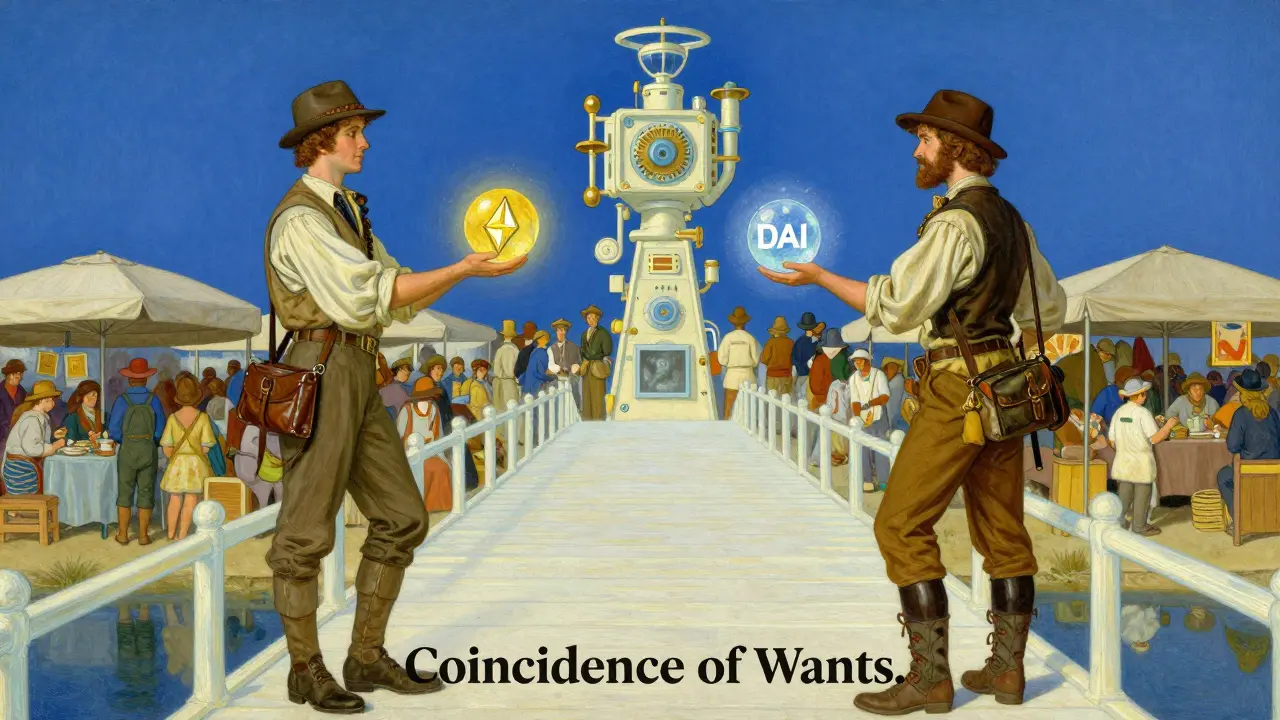
If you're tired of paying gas fees only for a transaction to fail, the Balancer Gnosis Protocol is the primary reason to use this version. It utilizes Gnosis Solvers to batch trades. Instead of interacting directly with the blockchain for every single swap, you communicate your intent to the solver. This architecture enables a concept called "Coincidence of Wants" (CoWs).
Imagine you want to trade ETH for DAI, and someone else wants to trade DAI for ETH. In a normal DEX, both of you would interact with a liquidity pool, paying fees and potentially slipping the price. With CoWs, the protocol matches you two directly. You trade peer-to-peer, skipping the pool entirely, which eliminates slippage and the associated fees. It's a cleaner, faster way to move assets without the typical DeFi friction.
Diversified Liquidity: Beyond Simple Pairs
Most DEXs force you into a 50/50 split. If you provide liquidity for ETH and USDC, you're stuck with that ratio. Balancer V2 breaks this mold. You can create pools with as many tokens as you want, and you can set the weights however you like-maybe 80% WBTC and 20% ETH. This makes the platform a powerful tool for those who want to maintain a specific portfolio balance while still earning trading fees.
Then there are the Boosted Pools. This is where Balancer moves from a simple exchange to a yield engine. These pools don't just let your assets sit idle; they route that liquidity into other protocols like Aave or Lido. You keep the ability to swap instantly, but your assets are working in the background, earning an additional layer of yield through lending or staking. It's essentially a way to get "double-dip" returns on your liquidity.
Trading Performance and the Smart Order Router
Speed and price accuracy are handled by the Smart Order Router (SOR). The latest version (v3) is designed to find the absolute cheapest path for your trade across multiple chains. Whether you're on Gnosis Chain, Arbitrum, or Polygon, the SOR scans the market and can even integrate with aggregators like 1inch to ensure you aren't overpaying.
In terms of actual numbers, the platform handles a diverse range of assets-over 110 coins across 200+ pairs. While the daily volume can fluctuate wildly (sometimes swinging over 70% based on market volatility), the efficiency of the Balancer Vault means that multi-hop trades (trading Token A to B to C) happen with minimal transfers, which keeps the costs down even when the network is congested.

The Cost of Doing Business: Fees and Requirements
Fees on Balancer aren't one-size-fits-all. Depending on the pool, you'll see different ranges. For standard weighted pools, fees can range from a tiny 0.001% up to 10%. Stable pools are even leaner, starting as low as 0.0001%. Because the platform is non-custodial, you don't create an account with an email and password. You just connect your wallet (like MetaMask or Trust Wallet) and you're in.
The minimum to get started is incredibly low-just $1-making it accessible for anyone. However, you'll need to be comfortable with ERC-20 tokens and "wrapped" assets. For example, you won't see native Bitcoin here; you'll see WBTC (Wrapped Bitcoin). If you're new to DeFi, the interface might feel a bit overwhelming because of the different pool types, but once you understand weights and boosts, it becomes a massive advantage.

Governance and the BAL Token
The entire system is steered by the BalancerDAO. If you hold the BAL token, you aren't holding a typical "price-prediction" coin; you're holding a governance tool. BAL holders vote on where liquidity incentives should go and how the protocol evolves. This decentralized approach ensures that the developers can't just change the rules on a whim-the community decides the direction of the project.
Is Balancer v2 safe from MEV bots?
Yes, especially when using the Gnosis Chain integration. The Balancer Gnosis Protocol uses solvers and batch processing, which prevents the typical "sandwich attacks" and front-running that happen on standard Ethereum AMMs.
What is the difference between a Stable pool and a Weighted pool?
Stable pools are designed for assets that should maintain a 1:1 peg (like USDC and DAI), offering extremely low slippage. Weighted pools are for assets that fluctuate in price (like ETH and WBTC), where the liquidity provider can set custom ratios (e.g., 70/30) to manage their exposure.
Do I need to pay gas for every trade on Gnosis Chain?
Not necessarily. By signing a message for the Gnosis Solvers, you can initiate gasless transactions, meaning you don't have to pay the upfront gas fee that usually accompanies a swap.
Can I use leverage or margin trading on Balancer?
No. Balancer is a non-custodial AMM and portfolio manager. It does not offer leverage, margin trading, or PAMM accounts.
What are Boosted Pools?
Boosted Pools are liquidity pools that automatically route idle assets into external protocols like Aave or Morpho. This allows liquidity providers to earn the standard trading fees plus additional yield from lending.
Next Steps for Users
If you're a novice trader, start by simply swapping a few dollars of one token for another using the default interface on Gnosis Chain to get a feel for the gasless experience. Don't worry about providing liquidity until you understand how weights work.
For experienced DeFi users, look into the Boosted Pools. Check the current yield rates on Aave and compare them to the Balancer incentives. Setting up a custom-weighted pool can also be a great way to automate your portfolio rebalancing without having to manually trade every week.
If you encounter a "Transaction Failed" error despite the solver integration, double-check that your wallet has a small amount of the native chain token (Gnosis or ETH depending on the network) to cover any underlying protocol requirements, even if the swap itself is gasless.
This looks like a great way for new folks to get into DeFi without losing their minds over gas fees!
The CoW mechanism is honestly a lifesaver!!! Saves so much on slippage!!!
It is absolutely tragic that we have to rely on these convoluted "solvers" just to perform a basic trade. The sheer inefficiency of the underlying blockchain layer is an affront to anyone with a shred of technical dignity. One would think that in the year 2024, we would have moved past the era of fighting mempool bots like we're in some sort of digital gladiatorial arena. The tragedy here is that the "solution" is just another layer of abstraction that hides the rot of the system.
Sure, the solvers handle the "heavy lifting," but who's actually running these solvers? It's probably just another way for a small group of elites to see your intent before the trade even hits. Everything in this space is a honeypot designed to make you feel safe while they figure out how to liquidate you. Typical centralized-decentralization trap.
OH PLEASE!! Like anyone actually believes the SOR finds the ABSOLUTE cheapest path every single time!!! I've seen it miss the mark so many times its actually hilariuous. The vault is cool and all but the UX is still a total disaster for anyone who isnt a math genius!!!
Imagine thinking a a few solvers will magically stop the MEV apocalypse. Cute.
It's just a glorified index fund anyway. Whatever.
Its a damn shame we dont have these types of technolgies runing strictly by American standards where honesty and true free market value actualy mean somthing instead of these globalist pools that let anyon from any where dilute the value of real hard work and real assets with their fake wrapped tokens and phantom lquidity thats just a scam to steal from the working man!!
The technical superiority of the Gnosis integration is obvious to anyone who actually understands how a vault operates. Most people here are just guessing, but the efficiency of multi-hop trades in Balancer is objectively better than the fragmented liquidity found on lesser platforms.
wrapped assets are just a way for them to control the flow of money lol. probably just another glitchy mess waiting to happen
Only someone with a truly pedestrian understanding of finance would find a 0.001% fee "lean." Please, spare us the amateur hour and let the adults discuss how the BAL token actually affects governance weight. It's almost adorable that you think a $1 minimum is a selling point for an "advanced" DEX.
i feel like we're all just chasing ghosts in the machine anyway, but the idea of a weighted pool is kinda like how life is, just trying to balance different weights of stress and joy while hoping the fees dont eat us alive in the end... though i bet the actual implementation is just a bunch of code that doesnt care about our souls lol.
If you're going to use Boosted Pools, make sure you actually read the risk profile of the underlying lending protocol. Don't just blindly follow the yield; understand where the money is actually sitting.
glad to see more options for portfolios just keep at it and learn the ropes slowly
The CoW logic makes a lot of sense for reducing friction.
I'm curious about the actual downtime of these solvers during high volatility. If the solver network lags, does the transaction just hang or do we revert to standard on-chain execution? That seems like a critical failure point.
One must ponder if the decentralization of governance through BAL is truly an exercise in liberty or merely a facade for the plutocracy of the wealthy 🌐. The moral imperative here is to ensure that the common user is not overshadowed by the whales of the ecosystem ⚖️.