
When you search for a crypto exchange to use, you expect to find one that’s active, secure, and trusted by real users. But what if the exchange you’re looking at doesn’t even exist anymore? That’s the story of Bistox.
Bistox was launched in late 2018, based in Tallinn, Estonia. At the time, the crypto market was booming. New exchanges popped up every week. Bistox tried to carve out a niche as a European-focused platform. It offered 15 cryptocurrency trading pairs. That’s it. No fiat on-ramps. No mobile app. No advanced trading tools. Just basic spot trading.
By 2025, Bistox is gone. Not just inactive - untracked. CoinMarketCap lists it as an "Untracked Listing" because there’s no trading volume left to measure. No one’s buying or selling on it. No one’s even talking about it. If you visit its website today, you’ll likely find a dead link or a placeholder page. It’s a ghost exchange.
Why Bistox Failed: The Missing Pieces
Most crypto exchanges fail because they don’t solve real problems. Bistox didn’t just fail - it missed every single requirement for survival in today’s market.
- No fiat support: You couldn’t deposit euros, dollars, or any traditional currency. No bank transfers. No credit cards. No Revolut. No SEPA. If you wanted to trade, you had to already own crypto. That limited its user base to a tiny group of insiders.
- No mobile app: Every major exchange has iOS and Android apps. Bistox didn’t. In 2026, trading crypto from a desktop browser is like using a landline phone to order pizza.
- No security transparency: No public audits. No cold storage details. No two-factor authentication policies. No mention of KYC or AML compliance. In an industry where hacks and scams are constant threats, this silence was deadly.
- No innovation: While competitors added derivatives, staking, P2P trading, and crypto debit cards, Bistox stayed stuck in 2018. It didn’t evolve. It didn’t adapt. And in crypto, standing still means falling behind - fast.
And then there was regulation. Estonia tightened its crypto licensing rules in 2022. The Financial Intelligence Unit (FIU) revoked licenses from over 40 exchanges that couldn’t prove they were compliant. Bistox, with no clear licensing record and no public compliance framework, was almost certainly among them. Without a license, it couldn’t legally operate. And without legal operation, users left.
The Comparison That Says It All
Look at what’s working today:
| Feature | Bistox (2026) | Top Exchanges (Binance, Kraken, CEX.IO) |
|---|---|---|
| Cryptocurrencies Offered | 15 pairs | 200+ assets |
| Fiat On-Ramps | None | Yes - bank, card, SEPA, PayPal |
| Mobile App | None | Yes - iOS and Android |
| Trading Volume | Untracked - zero data | Binance: $20B+ daily |
| Regulatory Status | Unlicensed - likely shut down | Licensed in multiple jurisdictions |
| User Base | No active users | Millions of daily traders |
| Support & Documentation | Non-existent | 24/7 chat, help centers, tutorials |
There’s no contest. Bistox didn’t just lose to the competition - it didn’t even show up to the race.

What Happened to the Users?
Did people lose money? Did they get hacked? We don’t know - because there’s no trace of them.
No Reddit threads. No Trustpilot reviews. No forum posts. No complaints. No praise. The Wayback Machine shows a bare-bones site from 2019-2021, with almost no user interaction. That’s not a sign of a quiet success. That’s a sign of abandonment.
Most likely, early adopters tried it, found it too limited, and left. No one replaced them. No marketing pushed it. No partnerships built trust. And when regulators cracked down, Bistox had no legal shield. It just vanished.
The Bigger Lesson: How Exchanges Survive
Bistox’s story isn’t just about one failed platform. It’s a warning.
Crypto exchanges today need three things to survive:
- Regulatory compliance: You can’t operate in a gray zone. If you’re not licensed where you’re based - and where your users are - you’re a target.
- Liquidity: If no one’s trading, the exchange is just a website. Volume attracts volume. Without it, you die.
- Continuous improvement: Users expect new features, better security, and easier access. If you’re not innovating, you’re obsolete.
Binance, Kraken, Coinbase - they didn’t win because they were first. They won because they kept evolving. Bistox thought a basic trading interface was enough. It wasn’t.
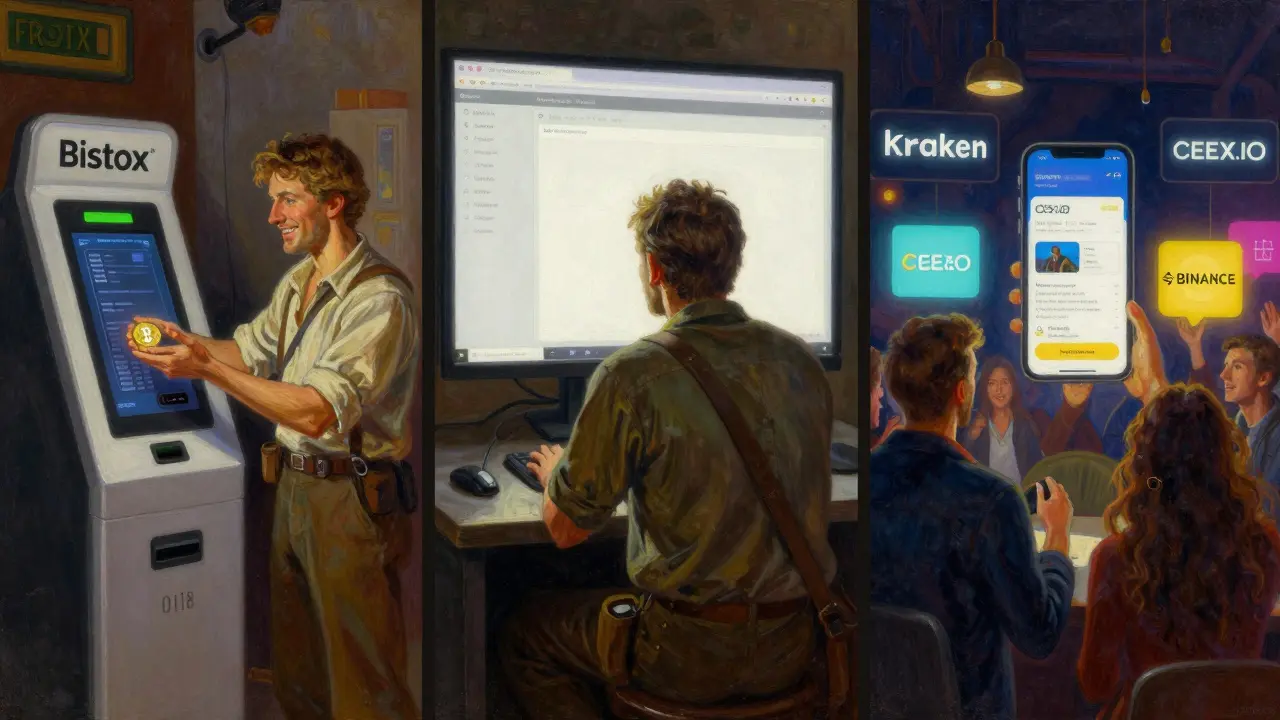
Is There Any Way Back for Bistox?
No.
There’s been no announcement since 2022. No new team. No funding. No technical updates. Even the domain registration records show no renewal activity. It’s dead. Not dormant. Not paused. Dead.
Trying to use Bistox now is like trying to buy a car from a dealership that closed in 2015. The keys don’t work. The website is gone. The people who sold it to you are gone too.
What Should You Do Instead?
If you’re looking for a reliable crypto exchange in 2026, don’t waste time on relics. Focus on platforms that:
- Are licensed in your country
- Have clear security practices (cold storage, audits, 2FA)
- Offer fiat on-ramps and mobile apps
- Have real trading volume (check CoinMarketCap or CoinGecko)
- Have active communities and customer support
Exchanges like CEX.IO, Kraken, and Binance (outside the U.S.) are still leading because they solve real problems. They’re not just trading platforms - they’re financial tools.
Bistox was never that. It was a prototype that never got built.
Is Bistox still operational in 2026?
No. Bistox has been inactive since at least 2022. CoinMarketCap lists it as an "Untracked Listing" with no trading volume, no user activity, and no updates. Its website is non-functional, and there is no evidence of ongoing operations.
Can I still deposit or withdraw crypto from Bistox?
No. Even if you had an old account, the platform’s servers are offline. Withdrawal requests cannot be processed. Any funds left on Bistox are likely unrecoverable.
Why did Bistox shut down?
Bistox likely shut down due to a combination of factors: extremely low trading volume, lack of regulatory compliance, absence of fiat on-ramps, no mobile app, and failure to compete with more advanced exchanges. Estonia’s 2022 crackdown on unlicensed crypto platforms was the final blow.
Was Bistox ever safe to use?
There’s no public record of Bistox having security audits, cold storage policies, or KYC procedures. Without these, it was never a secure option. In hindsight, using it carried significant risk, especially as regulatory pressure increased after 2020.
Are there any alternatives to Bistox in Europe?
Yes. Kraken, CEX.IO, and Bitpanda are all licensed and active in Europe. They offer fiat on-ramps, mobile apps, strong security, and support for hundreds of cryptocurrencies. They’re the real options for European users today.
Should I trust exchange reviews that mention Bistox?
Any review that recommends Bistox as a viable option is outdated or misleading. Bistox has not been operational for years. Always check the date of the review and verify the exchange’s current status on CoinMarketCap or CoinGecko before trusting any recommendation.
The collapse of Bistox isn't an anomaly-it's an emergent property of systems that fail to optimize for liquidity, regulatory alignment, and user friction reduction. In computational economics, we call this a suboptimal Nash equilibrium: every actor rationally chooses to avoid the platform because the expected utility is negative. The market doesn't forgive theoretical elegance without operational robustness.
What’s fascinating is how Bistox conflated minimalism with purity. It assumed that reducing surface features equated to ideological integrity. But in crypto, the user doesn't care about purity-they care about access. The absence of fiat on-ramps wasn't a philosophical stance; it was a market suicide pact.
Regulatory non-compliance isn't a risk-it's a death sentence in jurisdictions with functional FIUs. Estonia didn't arbitrarily revoke licenses; it responded to systemic vulnerabilities that made its financial ecosystem exploitable. Bistox didn't get banned-it got obsoleted by the very principles it claimed to uphold.
There's a deeper lesson here about technological Darwinism: platforms don't die because they're bad. They die because they're irrelevant. And irrelevance is the only sin that can't be redeemed with whitepapers or community rallies.
I love how this post breaks down the truth so clearly. So many people think crypto is just about tech, but it’s really about trust-and Bistox never built any. No mobile app? No fiat? No transparency? That’s like opening a restaurant and refusing to let people in, then wondering why no one shows up.
Every exchange that survives today didn’t do it by being perfect-they did it by listening. By evolving. By caring about the person trying to buy their first Bitcoin. Bistox forgot that crypto isn’t just for coders. It’s for moms, students, shop owners, retirees. People who just want to feel safe.
Thank you for writing this. It’s a gentle reminder: innovation without empathy is just noise.
This analysis is exceptionally thorough and methodically structured. I appreciate the rigorous distinction between operational failure and market obsolescence. The regulatory dimension, in particular, is under-discussed in mainstream discourse.
One might argue that Bistox’s lack of fiat infrastructure was a deliberate choice to avoid compliance burdens. However, this strategy fundamentally misunderstands the architecture of modern financial ecosystems. Decentralization does not equate to deregulation-it requires a more sophisticated, not less, engagement with legal frameworks.
The absence of mobile applications is not merely a UX oversight; it represents a failure to recognize the fundamental shift in human-computer interaction paradigms over the past decade. Desktop-first paradigms are now archaic in consumer finance.
One cannot overstate the importance of liquidity as a self-reinforcing feedback loop. Without it, trust cannot be established. Without trust, adoption is impossible. Bistox was a monument to a dead hypothesis.
Bro, this is why you can't trust 'European' exchanges. They think they're too cool for fiat. Then they vanish. Meanwhile, Binance just adds 50 new coins and a TikTok ad campaign. Simple. Real. Done.
Let me get this straight: a company built a crypto exchange… and didn’t even bother to make a mobile app? In 2026? That’s like opening a bookstore with no shelves and calling it "minimalist art."
And the fact that people still try to romanticize this? "Oh, it was pure! It was idealistic!" No, sweetheart. It was negligent. It was lazy. It was a middle finger to anyone who didn’t already have a crypto wallet and a PhD in blockchain.
Meanwhile, my 72-year-old aunt in Ohio just bought Dogecoin on CEX.IO because the app looks like Instagram. That’s the future. Not your 2018 prototype.
Thank you for laying this out so clearly. I’ve seen too many people fall for exchanges that look "professional" on paper but have zero real-world functionality. Bistox is a textbook case of what happens when you confuse aesthetics with utility.
It’s not just about features-it’s about signals. A mobile app says "I care about you." Fiat on-ramps say "I want you here." Security audits say "I won’t disappear tomorrow." Bistox sent none of those signals. And in crypto, signals are everything.
For anyone building something new: don’t build for the insiders. Build for the outsiders. The ones who don’t know what a cold wallet is. They’re the ones who’ll make your platform survive.
India has always understood the truth: if you don’t serve the masses, you don’t deserve to exist. Bistox was a European fantasy-designed for a niche of people who think "decentralized" means "no rules." But rules exist for a reason. Security. Accountability. Protection.
Compare this to Indian exchanges like CoinDCX and ZebPay-they built for the common man. They added UPI, KYC, 24/7 support. They didn’t wait for regulators to catch up-they welcomed them. That’s why they’re growing. That’s why they’re trusted.
Europe’s arrogance is its downfall. You can’t build a financial system on theory alone. You need people. Real people. With bank accounts. With phones. With families.
Of course it vanished. The whole thing was a CIA front to launder money for NATO. They shut it down when the real players moved to Chainalysis-monitored platforms. You think they’d let a no-KYC exchange survive? Lol. Wake up.
Classic. Another "European innovation" that died because it didn’t understand human nature. Bistox thought crypto was a math problem. It’s not. It’s a social problem.
People don’t trade because they love blockchain. They trade because their friend did it and made money. Bistox didn’t have friends. It had a website.
Meanwhile, in India, we have 100M+ crypto users. Not because we’re smarter. Because we built for the *person*, not the protocol.
man i remember trying to use bistox back in 2020. i sent eth to it and it just… disappeared. no email, no reply, nothing. i thought i got hacked. turns out the whole thing was already dead. wild.
now i just use kraken. mobile app works. customer service replies in 10 min. i don’t need to be a crypto nerd to use it. that’s the point.
As someone who’s helped onboard 300+ non-crypto users, I can say this: the biggest barrier isn’t price or tech-it’s trust. And Bistox had zero trust signals.
When you ask someone to send money to a platform with no app, no phone number, no license, and no reviews… you’re not asking them to trade. You’re asking them to gamble.
The exchanges that win aren’t the ones with the fanciest charts. They’re the ones that make you feel safe. Even if you’re 70 and still using a flip phone.
LOL Bistox? More like Bistox-NOPE. 😂
"Oh we’re European so we don’t need fiat" → 0 trading volume
"Oh we don’t need a mobile app" → 0 users
"Oh we’re decentralized so we don’t need KYC" → 0 license → 0 existence
It’s like building a rocket out of cardboard and then crying when it doesn’t reach orbit. 🚀💩
There is no excuse for this failure. Not one. The regulatory environment in Estonia was transparent. The technology stack for fiat integration was mature. The mobile development frameworks were accessible. This was not an accident. This was incompetence.
It is not a tragedy. It is a cautionary tale for founders who believe that ideology supersedes execution. You cannot out-philosophy a market. You can only out-execute it.
The fact that this is still being discussed as a "lesson" rather than a monument to failure speaks volumes about the maturity of the industry.
How quaint. Bistox was the crypto equivalent of a black-and-white silent film in the age of IMAX. It wasn’t "minimalist"-it was anachronistic. The market doesn’t reward aesthetic purity. It rewards frictionless utility.
One must ask: who was the target user? The 12-year-old who owns 0.001 BTC and wants to buy Dogecoin with their allowance? Or the 40-year-old economist who reads whitepapers for fun? Bistox catered to neither. It catered to a ghost.
Regulatory compliance is not a burden-it is the scaffolding of legitimacy. Without it, you are not a platform. You are a rumor.
They didn’t vanish because of regulation. They vanished because the whole thing was a honeypot. I worked at a firm that got bought by a shell company that then bought Bistox’s domain. The whole thing was a data harvest operation. They collected wallets, IPs, transaction patterns. Then they shut it down and sold the dataset to a hedge fund. This wasn’t failure. It was extraction.
Look, I get it. You want to believe in the purity of crypto. You want to believe that decentralization means freedom from banks, from rules, from responsibility. But here’s the cold truth: the market doesn’t care about your ideals. It cares about your liquidity, your uptime, your customer service response time. Bistox had none of those. It had a logo and a GitHub repo. That’s not a business. That’s a hobby project with delusions of grandeur.
And let’s be real-the people who defended Bistox? They were the same ones who thought Bitcoin would replace the dollar by 2020. They’re still waiting. And the world moved on.
I’ve been in this space since 2013. I’ve seen dozens of Bistoxes. They all die the same way. Quietly. Unnoticed. Because no one cared enough to notice they were gone.
Sometimes the quietest failures are the most telling. No drama. No scandal. Just… nothing. That’s what happens when you build something no one needed.
Wait-so Bistox didn’t even have 2FA? That’s wild. I once lost $200 because I forgot to enable it on a sketchy exchange. Imagine if I’d tried Bistox. I’d have lost everything and had no idea how or why.
Also-zero mobile app? In 2026? I can’t even order a pizza without my phone. How is this still a thing?
Real talk: if you’re building something today and you’re not thinking about mobile-first, fiat-first, support-first-you’re already late.
Thank you for writing this. It’s rare to see a post that doesn’t just blame users or hype new platforms-but actually explains why something failed. Bistox didn’t fail because it was bad. It failed because it didn’t listen. And in crypto, listening isn’t optional. It’s survival.
To anyone building: your users don’t need more coins. They need to feel safe. Seen. Supported. That’s the real innovation.
Re: the comment about India’s success-this is not a cultural superiority argument. It’s a structural one. India’s regulatory clarity, combined with UPI’s near-universal adoption, created a perfect storm for adoption. Bistox operated in a jurisdiction with regulatory ambiguity and no infrastructure for retail on-ramps. The difference is systemic, not ideological.
One cannot replicate success by copying surface features. One must replicate the underlying conditions: trust, accessibility, and institutional alignment.