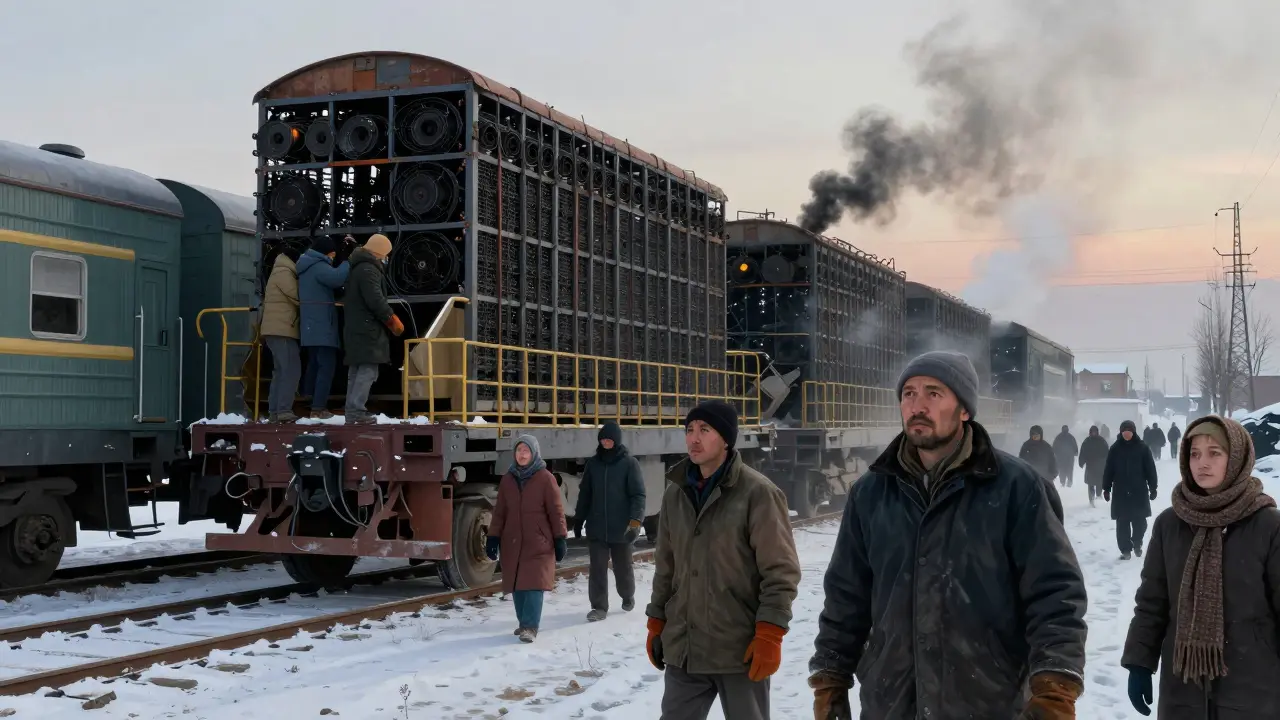
When Kazakhstan was the second-largest Bitcoin mining hub in the world, it looked like a gold rush. Cheap coal-powered electricity, abandoned Soviet infrastructure, and a hands-off government made it the perfect place to run thousands of mining rigs. But by 2025, that story had changed. Miners started packing up. Machines were shut down. And the hash rate - the total computing power securing the Bitcoin network - began shifting away from Central Asia.
What Happened to Kazakhstan’s Mining Boom?
Kazakhstan’s rise as a mining powerhouse wasn’t accidental. After China cracked down on crypto mining in 2021, thousands of rigs moved across the border. The country had surplus power, low taxes, and no real rules. By 2021, it was handling nearly 18% of the global Bitcoin hash rate. But that growth came with a cost. Mining rigs don’t just use electricity - they drain it. Fast. By 2022, Bitcoin miners were using 7% of Kazakhstan’s total power. That’s not a small number. It meant homes and hospitals were losing power during winter peaks. People froze. Businesses shut down. Protests erupted. The government didn’t wait long to respond. In early 2022, miners got cut off from the national grid. Not all at once - but enough to send shockwaves through the industry. Some rigs went offline for weeks. Others were moved. And even after power was partially restored, trust was broken. Miners realized: if the grid can fail because of them, they’re not welcome long-term.The Exodus: Canaan’s Exit and What It Meant
The clearest sign that Kazakhstan’s mining era was ending came in July 2025, when Canaan - one of the biggest Bitcoin mining hardware manufacturers - officially pulled out. The company had been running over 6.67 EH/s of hash rate from its Kazakh operations. By July, that number dropped to 5.56 EH/s. The reason? They moved machines to the U.S. and Canada. Canaan didn’t just shut down. They planned it. They shipped 40% of their Kazakhstan fleet to Texas and Wyoming. They kept 20% running in Kazakhstan, but only because they couldn’t move them fast enough. The rest? Decommissioned or sold. Their July 2025 report said they mined 89 BTC that month - down from 107 BTC in May. The drop wasn’t due to difficulty or price. It was due to lost hardware. Canaan’s move wasn’t unique. Other miners followed. Some quietly. Others through press releases. The message was clear: Kazakhstan had become too risky. Grid instability. Regulatory uncertainty. No long-term energy guarantees. Why risk your machines here when you can lock in 20-year power contracts in Texas or Georgia?Where Is the Hash Rate Going Now?
The Bitcoin network didn’t lose hash rate when miners left Kazakhstan - it redistributed it. In fact, global hashrate hit a record 1.041 billion TH/s in September 2025. That’s up 48% from the year before. More miners. More power. More security. The U.S. now leads with 35.4% of global hash rate. Texas, Georgia, and Pennsylvania are the top three states. Why? Reliable power. Clear rules. Grids built for industry, not just homes. Canada is close behind at 9.6%, thanks to hydroelectric power and stable regulations. Even Germany and Malaysia are gaining ground. Kazakhstan still holds 14.8% - not nothing. But it’s down from 18% in 2021. The gap between the U.S. and Kazakhstan is wider than ever. And it’s not closing.
Why Kazakhstan Still Matters - Just Not Like Before
Kazakhstan didn’t disappear from the map. They’re still mining. But now, they’re trying to do it differently. In early 2025, the government introduced a 70/30 energy rule: 70% of new thermal power plant output goes to the grid. Only 30% is left for crypto. It’s a compromise. A signal. We’re not shutting you down. But we’re not letting you take our lights. They’ve also cracked down on illegal transactions. In Q1 2025 alone, Kazakh banks blocked over 15,800 unauthorized crypto transfers worth $3.07 million. That’s not a sign of hostility - it’s a sign of control. They want mining to be legal, tracked, and taxed. Not wild and chaotic. Some miners still like Kazakhstan. The power is cheap. The land is big. The government talks about becoming Central Asia’s crypto hub. But talk doesn’t power a rig. Reliable electricity does. And that’s still the problem.What This Means for Bitcoin’s Security
The Bitcoin network doesn’t care where miners are. It only cares how much power is protecting it. And as miners left Kazakhstan, others stepped in - mostly in the U.S. That’s actually a good thing. Bitcoin is more secure when its hash rate is spread across multiple countries. If one region collapses - like China in 2021 or Kazakhstan in 2022 - the network keeps going. The migration from Kazakhstan didn’t weaken Bitcoin. It strengthened it. By moving to jurisdictions with better infrastructure and clearer rules, the network became more resilient. More decentralized. More trustworthy. Miners aren’t abandoning Kazakhstan because it’s bad. They’re leaving because it’s unpredictable. And in mining, predictability is everything. You don’t invest millions in hardware if you think the power might go out next week.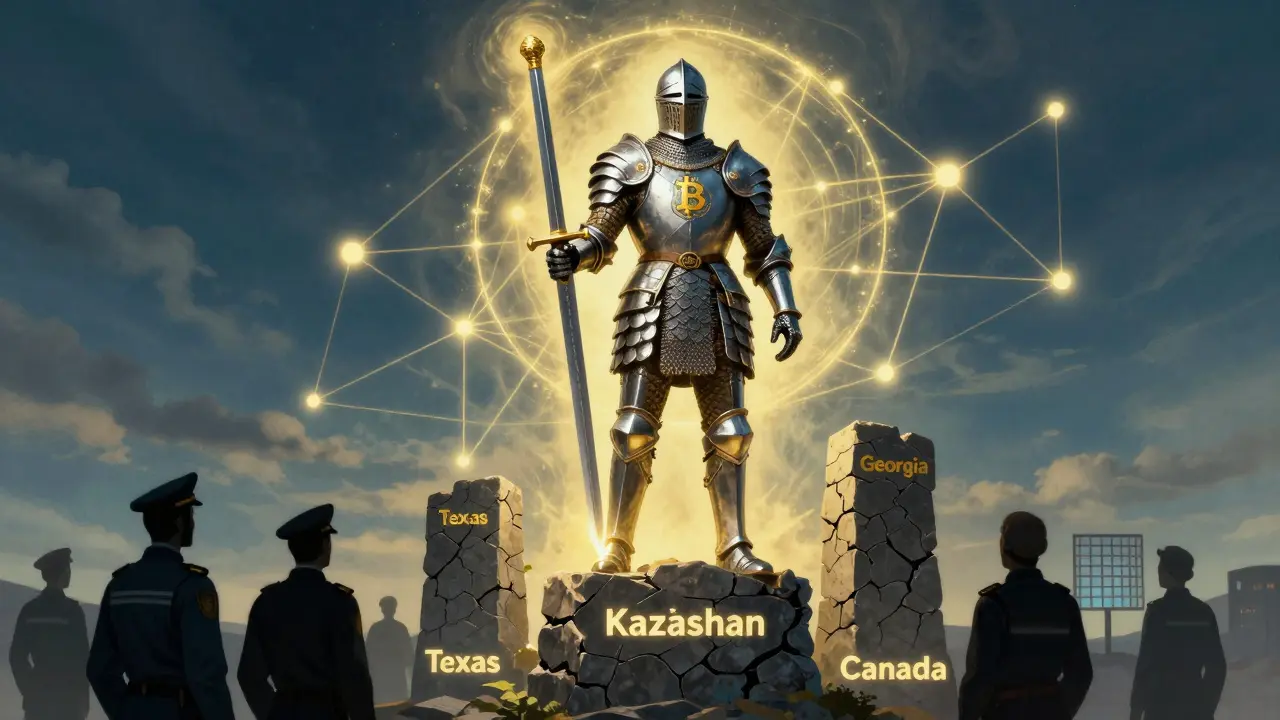
The Bigger Picture: Geopolitics and Mining
This isn’t just about electricity bills. It’s about power. The kind that shapes economies. Countries like Iran and Russia are trying to attract mining with state-backed power. The U.S. is doing it with private contracts and deregulation. Kazakhstan is stuck in the middle - trying to control a force it can’t fully contain. Institutional investors are watching. They don’t care if a miner is in Kazakhstan or Texas. They care if the network stays secure. And the data shows: as long as hash rate keeps rising, Bitcoin’s security does too. The migration isn’t a crisis. It’s evolution.What’s Next for Kazakhstan?
The country isn’t giving up. They’re adapting. New power plants are being built. Some are designed with crypto in mind - but only after the grid is covered. They’re working on licensing, taxation, and even crypto mining zones. But here’s the truth: if you want miners to stay, you need more than promises. You need 24/7 power. You need legal clarity. You need long-term contracts. Kazakhstan has the raw materials. But they haven’t built the system yet. For now, miners are voting with their machines. And they’re choosing places where the lights stay on.Bitcoin’s network is stronger than ever. The hash rate is at an all-time high. The migration from Kazakhstan didn’t hurt it - it helped. And that’s the real story.
Let’s be real - Kazakhstan didn’t fail because it was bad. It failed because it tried to be everything at once: energy exporter, crypto haven, and social welfare state. You can’t run a mining empire on a grid built for Soviet-era apartment blocks. The moment miners started using 7% of the country’s power, they became public enemy #1. Not because they were evil - because the infrastructure was never designed for this.
Meanwhile, Texas just said, ‘Here’s a 20-year contract, here’s a substation, go wild.’ No guilt trips. No protests. Just power. And that’s why the hash rate didn’t drop - it migrated to where the lights stay on.
Bitcoin’s security isn’t about geography. It’s about predictability. And right now, predictability has a zip code: 75001.
bro honestly i thought kazakhstan was gonna be the new el paso lmao
turns out u cant mine btc when ur neighbors are freezing in december 😂
Simple truth: miners move where power is reliable, not where it’s cheap. Kazakhstan had cheap. Texas has both. That’s all.
you people are so naive lmao
the us is just using miners to drain the grid faster and control bitcoin
they dont care about decentralization
they want to own it all
its all a trap
trust the plan
OH MY GOD. I JUST REALIZED THIS IS THE GREATEST SHIFT SINCE CHINA BANNED MINING. IT’S LIKE WATCHING A TIDE TURN - BUT THIS TIME, THE TIDE ISN’T JUST MOVING. IT’S EVOLVING.
Think about it: when miners left Kazakhstan, they didn’t just pack up. They upgraded. They moved to places with grid stability, legal clarity, and long-term contracts. That’s not a retreat - that’s a strategic upgrade.
The Bitcoin network is now stronger because it’s not clustered. It’s distributed. It’s not dependent on one country’s winter outages or political whims. It’s resilient. It’s beautiful.
And honestly? I’m tearing up. This is what decentralization looks like in action. Not chaos. Not panic. Evolution. Quiet. Calculated. Unstoppable.
Interesting how the narrative shifts from ‘miners are stealing power’ to ‘miners are stabilizing the network.’ The same machines that caused blackouts in Almaty are now securing $1 trillion in market cap in Texas. It’s not hypocrisy - it’s adaptation.
The real story isn’t where miners went. It’s why they left. And the answer is simple: institutions don’t fear disruption. They fear unpredictability.
There’s a reason why the U.S. is pulling ahead: private power contracts. No bureaucracy. No politicized grid. Just a company saying, ‘We’ll sell you X MW for Y years.’ That’s the gold standard.
Kazakhstan’s 70/30 rule? A decent compromise - but it’s still a compromise. Miners need certainty, not negotiation. And certainty is what Texas and Georgia deliver.
Also, worth noting: the global hash rate increase post-migration proves the network absorbed the shock. That’s resilience. That’s Bitcoin.
Just want to say - this is one of those moments where crypto actually *grows up*. No drama. No panic. Just smart operators moving their assets to better infrastructure.
It’s like when your ISP keeps throttling your Netflix - you don’t yell. You just switch providers.
Miners did the same. And honestly? That’s kind of beautiful. No rebellion. Just rationality.
you think the usa is better? lol
they have 20 year contracts? sure
but they also have blackouts in texas during heatwaves
and the grid is owned by private monopolies
its not decentralization its corporate capture
you’re being played
How quaint. The notion that Bitcoin’s security is enhanced by relocation to jurisdictions with regulatory clarity is almost… bourgeois. One might argue that true decentralization is achieved not by optimizing for grid stability, but by persisting through entropy. Kazakhstan was the last bastion of organic, unmediated mining. Now? We’ve commodified resilience.
so basically we’re just moving mining to texas because it’s warmer? that’s it? no one else see how dumb this is?
It’s fascinating to see how a technical shift - miners relocating hardware - became a geopolitical realignment. Kazakhstan didn’t lose its role because it was hostile. It lost it because it couldn’t reconcile its public needs with private demand. That’s not a crypto failure. It’s a governance lesson.
The U.S. didn’t win because it’s ‘better.’ It won because it allowed market forces to operate without political interference. That’s the real takeaway: predictable policy > cheap power.
Miners didn’t leave Kazakhstan because they were scared. They left because they’re businessmen. You don’t build a $500M rig on a grid that might cut you off next week. That’s not ideology. That’s accounting.
And yes - the hash rate went up. Because better infrastructure = better efficiency. More uptime. Less downtime. More BTC mined. Simple math.
you think this is just about mining? NO. THIS IS A WAR. THE U.S. IS USING BITCOIN MINING TO FLOOD THE MARKET WITH ENERGY-INTENSIVE DEMAND SO THEY CAN CONTROL THE PRICE OF ELECTRICITY. THEY WANT TO MAKE EVERYTHING DEPEND ON BTC. THEN THEY CAN CONTROL THE WORLD. THEY’RE USING MINERS AS PUPPETS. DON’T BE DUMB.
So let me get this straight - we’ve turned Bitcoin into a real estate game?
Wherever the power is cheapest and least likely to be cut off… that’s where the ‘decentralized’ network lives?
How poetic. The most decentralized system in history is now a product of zoning laws and power purchase agreements.
God help us all.