
Trying to launch a crypto business in New York? You might feel like you’re hitting a brick wall. The state’s regulatory framework, known as the BitLicense, is a strict business license issued by the New York State Department of Financial Services (NYDFS) that regulates virtual currency activities, remains one of the toughest in the world. It isn’t just a formality; it’s a comprehensive overhaul of how your company operates, spends money, and protects customers.
If you are reading this, you probably want to know if you can actually get approved, how much it will cost, or why competitors like Kraken left the market entirely. The short answer is yes, you can operate here, but only if you have deep pockets and a robust compliance team. This guide breaks down exactly what the NYDFS expects from you in 2026, so you don’t waste time on an application destined for rejection.
What Exactly Is the BitLicense?
The BitLicense isn’t a new invention. It was created by former Superintendent Benjamin Lawsky and came into effect on August 8, 2015. Its purpose was simple: treat digital assets with the same seriousness as traditional financial instruments. At the time, Bitcoin was often dismissed as "internet funny money," but NYDFS wanted to ensure consumer protection and prevent money laundering.
To understand if you need this license, look at the definition of Virtual Currency Business Activity. It includes five specific actions: transmitting virtual currency, storing or holding custody for others, buying/selling as a customer business, performing exchange services, or controlling/administering/issuing a virtual currency. If your startup does any of these things involving New York residents, you fall under Part 200 of the NYCRR regulations. Ignoring this doesn’t make you invisible; it makes you illegal.
The High Price of Entry: Capital and Bonds
Let’s talk numbers first because they are the biggest filter. The NYDFS doesn’t give licenses to hobbyists. Under 23 NYCRR 200.8, which covers capitalization requirements based on business model and risk profile, you need significant liquidity.
- Minimum Capital: Typically ranges from $1 million to $5 million depending on your scale. This isn’t cash you can spend on marketing; it’s reserve capital meant to absorb losses.
- Customer Protection Fund: Per 23 NYCRR 200.9(a), you must maintain a surety bond or funded account of at least $500,000. For larger operations, this figure jumps substantially based on transaction volume.
When you add legal fees, compliance software, and the application fee itself, Brico.ai’s 2025 analysis puts the upfront cost at over $150,000. Annual maintenance runs between $15,000 and $80,000. These aren’t estimates; they are the reality for companies trying to stay compliant. If you are a bootstrapped startup with $50k in the bank, New York is likely not your beachhead.
Compliance: AML, KYC, and Cybersecurity
Money is just the ticket to enter the room. Staying in the room requires rigorous operational standards. The NYDFS demands protocols that rival major banks.
Your Anti-Money Laundering (AML) and Know-Your-Customer (KYC) programs must meet Bank Secrecy Act standards. This means you cannot rely on generic third-party tools alone. You need a dedicated program tailored to your specific risks. Furthermore, cybersecurity is non-negotiable. You must implement military-grade protocols, including regular penetration testing, and adhere to NYDFS Cybersecurity Regulation 500.
In November 2023, NYDFS released guidance on coin-listing and delisting. This added another layer of complexity. You now need a framework to evaluate new tokens for legitimacy, market manipulation risks, and securities law compliance before listing them. As of 2025, the NYDFS Industry Letter expanded blockchain analytics expectations to all Covered Institutions, meaning you must actively monitor transactions for suspicious patterns using advanced analytics tools.

The Application Process: What to Expect
Don’t expect a quick turnaround. The process typically takes 12 to 18 months. During this time, you will need to submit extensive documentation, including detailed business plans, AML program descriptions, cybersecurity frameworks, and capitalization plans.
You will also need a dedicated team. Successful applicants like Coinbase employ 20 to 30 professionals solely for New York compliance. Most startups hire specialized consultants charging $200 to $500 per hour to navigate the nuances of the application. The NYDFS provides guidance documents, but they offer limited direct assistance to applicants. You are largely on your own to interpret the rules correctly.
| Feature | BitLicense | Limited Purpose Trust Charter |
|---|---|---|
| Regulatory Body | NYDFS | NYDFS |
| Capital Requirement | $1M - $5M+ | Higher (Trust Company Standards) |
| Approval Time | 12-18 Months | 18-24+ Months |
| Ongoing Oversight | High (Quarterly Reports) | Very High (Banking Level) |
| Best For | Exchanges, Custodians | Custody-focused Firms |
Why Did Major Players Leave?
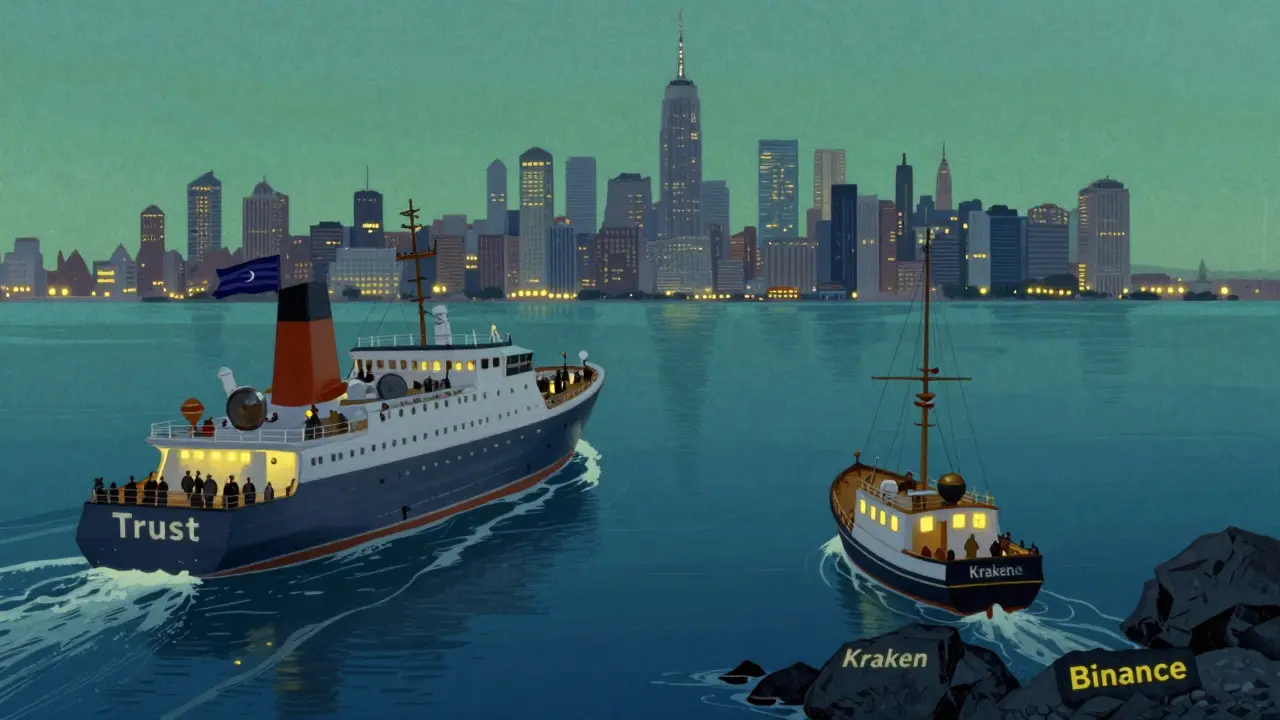
If the license offers access to New York’s lucrative market, why did giants like Kraken and Binance exit? Kraken famously called the BitLicense "a creature so foul, not even Kraken would face it." The issue wasn’t just cost; it was operational constraint.
The BitLicense requires individualized reporting on transaction volumes, customer complaints, and security incidents. For global exchanges running standardized platforms, building a separate, compliant infrastructure just for New York residents is inefficient. Binance prohibited NY users entirely in its terms of service. However, companies like Coinbase and Gemini stayed. They leveraged their licenses as a marketing advantage, telling users, "We are safe because we are licensed." This trust premium allows them to dominate the local market despite the high costs.
Who Actually Holds a BitLicense in 2026?
The barrier to entry has created an oligopoly. As of early 2026, only about 1.2% of U.S. cryptocurrency businesses hold a BitLicense, yet they process roughly 35% of all crypto transactions involving U.S. residents. The major players include:
- Coinbase: One of the earliest adopters, leveraging the license for mainstream credibility.
- Gemini: Founded by Winklevoss twins, holds both a BitLicense and a Trust Charter.
- Circle: Received the very first BitLicense in September 2015.
- MoonPay USA LLC: Granted full approval in June 2025, showing the door is still open for fintech innovators.
- eToro and Uphold: Entered or expanded operations recently via various charters.
For consumers, this means fewer choices but potentially higher security. Reddit discussions from March 2025 show mixed feelings: traders miss the advanced tools of banned exchanges but appreciate the safety net provided by regulated entities after events like the FTX collapse.
Future Outlook: Will the Rules Change?
New York is not loosening up. In March 2025, Senate Bill S4728A established a cryptocurrency and blockchain study task force. While this sounds exploratory, Gibson Dunn analysts predict the BitLicense will serve as a template for potential federal regulation. The focus is shifting toward decentralized finance (DeFi) protocols and central bank digital currencies (CBDCs).
The 2025 Industry Letter reaffirmed prior approval requirements. You must seek NYDFS approval at least 90 days before commencing any new or significantly different virtual currency activities. This proactive stance means you can’t just pivot your business model without regulatory sign-off. The framework is evolving from reactive enforcement to proactive risk management.
How long does it take to get a BitLicense?
The application process typically takes 12 to 18 months. This timeline includes document preparation, review by NYDFS, and potential requests for additional information. You should plan for this duration when budgeting and staffing.
What is the minimum capital required for a BitLicense?
Under 23 NYCRR 200.8, minimum capital requirements vary by business model but typically range from $1 million to $5 million. Additionally, you must maintain a customer protection fund of at least $500,000 via a surety bond or funded account.
Can I operate a crypto exchange in New York without a BitLicense?
No. If you engage in Virtual Currency Business Activities involving New York residents, you must have a BitLicense or an equivalent charter like a Limited Purpose Trust Company. Operating without one is illegal and carries severe penalties.
Why did Kraken leave New York?
Kraken cited the prohibitive costs and operational constraints of the BitLicense. The requirement to build separate compliance infrastructure for New York made it economically unviable compared to other states with more innovation-friendly regulations, like Wyoming.
Does the BitLicense cover DeFi protocols?
Yes. The NYDFS has clarified that decentralized finance protocols offering services to New York residents fall under the BitLicense framework. The 2025 Industry Letter specifically expands oversight to include emerging technologies like DeFi and CBDCs.
What happens if I list a new token without approval?
Since the November 2023 guidance, you must evaluate new tokens for legitimacy and compliance. Listing assets without proper due diligence or prior approval where required can lead to fines, suspension, or revocation of your license.