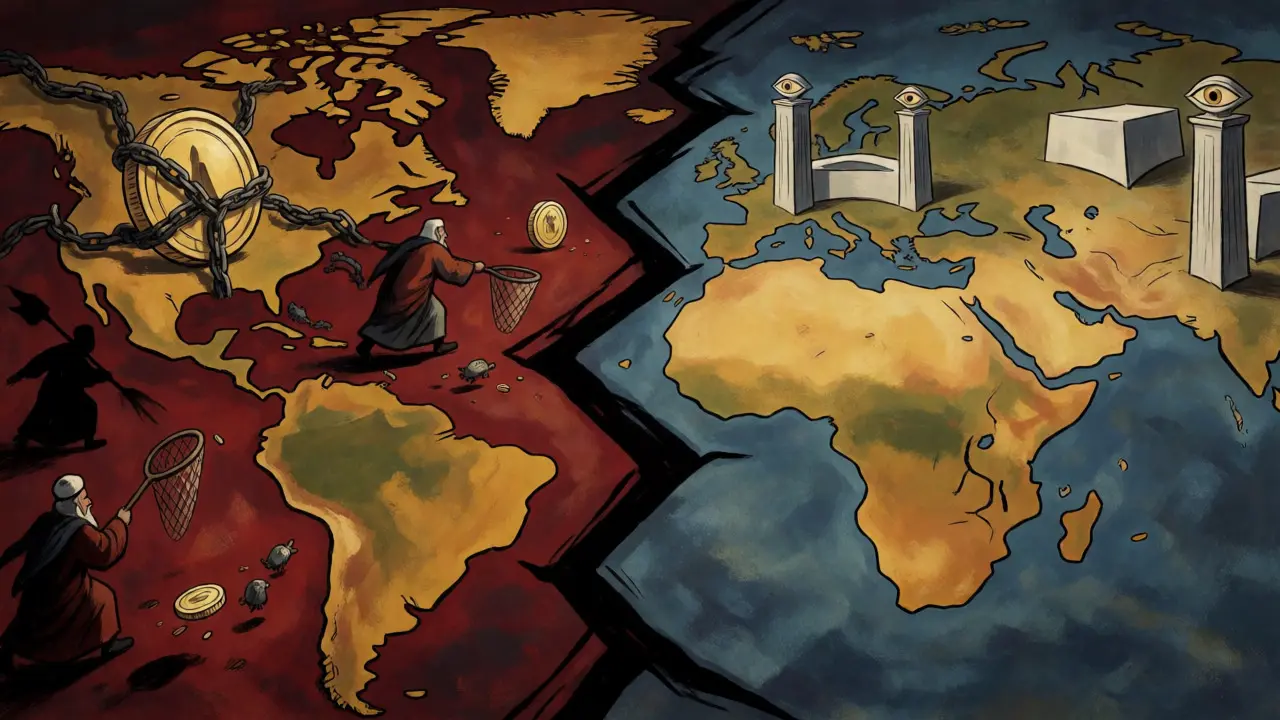
Imagine waking up in a country where checking your Bitcoin balance is technically a crime. For millions of users worldwide, this isn't a hypothetical nightmare-it's the legal reality. As we move through 2026, the global map of cryptocurrency enforcement has fractured into distinct zones. Some nations treat digital assets like radioactive waste, banning them outright and prosecuting holders. Others treat them like traditional finance, focusing on tax compliance and institutional oversight. If you hold crypto, your location matters more than your strategy.
The difference between a fine and a prison sentence often comes down to geography. While the U.S. and Europe chase whales and money launderers, countries like China and Algeria are actively hunting individual traders. This article breaks down exactly who is getting prosecuted, why, and what it means for your portfolio. We aren't just listing laws; we're looking at who actually gets arrested.
The Hardline Enforcers: Total Bans and Active Prosecution
If you want to know where the heat is highest, look no further than China. It remains the gold standard for aggressive state-led prohibition of cryptocurrency activities. Since banning exchanges and Initial Coin Offerings (ICOs) in 2017, Beijing hasn't just stopped trading; it has criminalized the infrastructure. The government systematically dismantled mining operations, forcing hash power offshore. But the crackdown didn't stop there. Chinese authorities actively pursue individuals engaged in peer-to-peer (P2P) trading, viewing it as a backdoor for capital flight. In China, holding or trading crypto isn't just unregulated; it's a violation of financial order that can lead to account freezes and legal trouble for ordinary citizens trying to move value out of the yuan system.
Following closely behind are Algeria and Bolivia. These nations have implemented complete bans on holding, using, or trading cryptocurrencies. Algeria declared all crypto-related activities illegal under strict financial crime statutes. Bolivia’s Central Bank cited concerns over financial stability and fraud to justify its total prohibition. In these jurisdictions, you don't need to be running a scam to face penalties. Simply owning a wallet could theoretically expose you to fines or prosecution under existing anti-money laundering laws. The risk here isn't regulatory ambiguity; it's explicit illegality.
Bangladesh takes a similar approach, classifying crypto use as illegal under its anti-money laundering and counter-terrorism financing laws. Authorities have issued clear warnings that involvement in crypto transactions can lead to criminal prosecution. Unlike countries that simply ignore the sector, Bangladesh actively enforces these prohibitions, creating a hostile environment for any local trader attempting to bypass the ban.
The Tax Trap: India’s De Facto Enforcement
India presents a different kind of threat. You won't go to jail for buying Bitcoin in Mumbai, but you will feel the pinch. India applies a 30% flat tax on all crypto gains, with no option to offset losses against other income types. Additionally, a 1% Tax Deducted at Source (TDS) applies to every transaction above a certain threshold. This structure acts as de facto enforcement. By making high-frequency trading financially painful, the state discourages adoption without needing to deploy police officers to raid homes.
The Supreme Court overturned a banking ban in 2020, allowing banks to serve crypto firms again. However, the tax regime serves as a barrier to entry. For Indian users, the "prosecution" is economic rather than criminal. You keep your freedom, but you lose nearly half your profit margin to the treasury. This model contrasts sharply with the outright bans in North Africa and Asia, offering a middle ground that still severely limits utility.
Institutional Hunters: The US and EU Approach
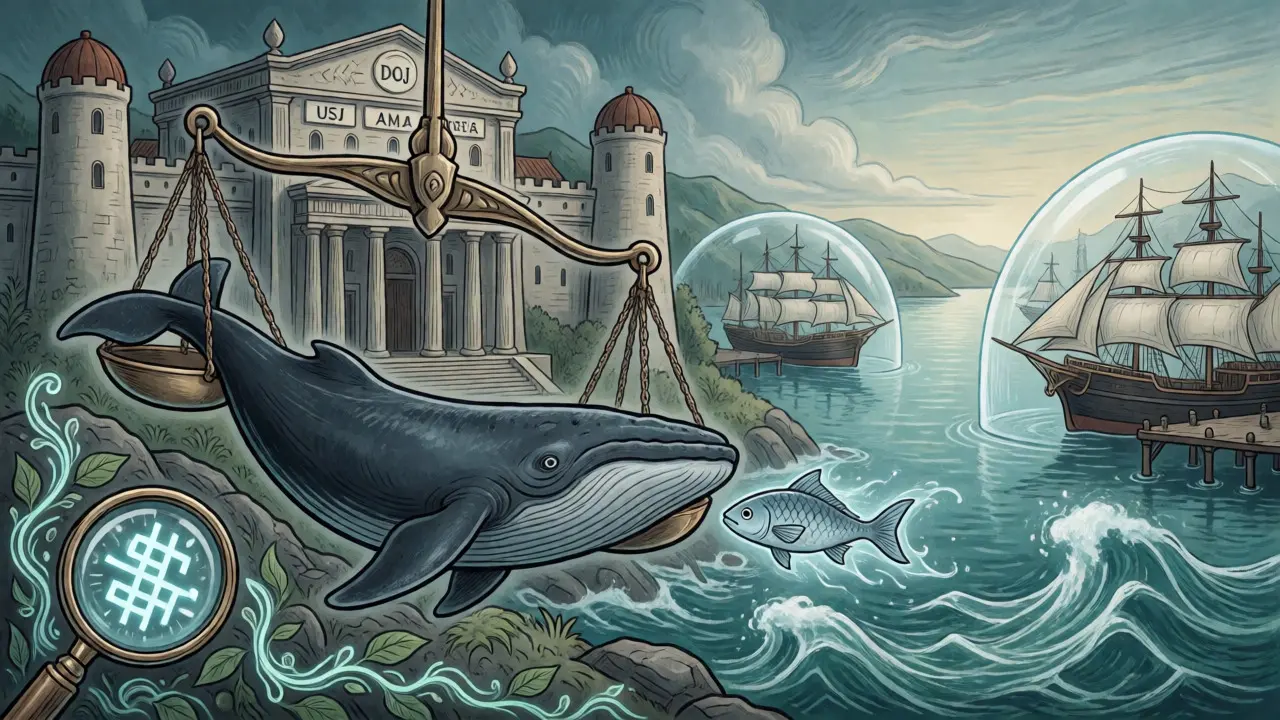
In the West, the narrative shifts from punishing users to policing institutions. The United States adopts a selective enforcement strategy. The Department of Justice and the Office of Foreign Assets Control (OFAC) target major criminal enterprises, not the person buying $50 worth of Ethereum on Coinbase. A prime example occurred in September 2024, when OFAC sanctioned the Russia-based exchange Cryptex and its operator, Sergey Sergeevich Ivanov. They were accused of laundering funds linked to ransomware and darknet markets. Cryptex had processed over $5.88 billion since 2018. The State Department offered a $10 million reward for information leading to Ivanov’s arrest.
This scale highlights the focus: big fish. Individual users rarely face federal prosecution for simple ownership or trading. However, the Trump administration’s recent pro-crypto stance has reduced regulatory pressure on average users, shifting the burden even further toward institutional compliance. Meanwhile, Operation Endgame, a coordinated effort between U.S. and European authorities, demonstrates how cross-border cooperation targets financial enablers of cybercrime. Dutch law enforcement, supported by Chainalysis and Tether, seized €7 million in funds related to payment processors funneling money to illicit actors.
Europe has ramped up its own machinery with the launch of the Anti-Money Laundering Authority (AMLA) in July 2025. Starting with 30 employees, AMLA plans to expand to over 400 staff by 2028. This body oversees compliance across the bloc, ensuring that exchanges adhere to the Fifth Anti-Money Laundering Directive (AMLD5). The goal isn't to ban crypto but to ensure that every transaction is traceable and every customer is known. For European users, this means stricter KYC (Know Your Customer) checks but minimal risk of personal prosecution for lawful trading.

The Regulatory Havens: Singapore and South Korea
If you prefer rules over raids, look to Asia’s financial hubs. Singapore operates under the Payment Services Act (2020), managed by the Monetary Authority of Singapore (MAS). The MAS focuses on consumer protection and market integrity. In August 2023, they introduced a stablecoin framework requiring full reserve backing. Singapore doesn't prosecute users; it regulates providers. If an exchange fails, the regulator steps in to protect client assets. This creates a safe harbor for investors who value clarity over anonymity.
Similarly, South Korea implemented the "Act on Protection of Virtual Asset Users" (VAUPA) in July 2024. This law mandates that exchanges segregate client assets from their own operational funds and maintain insurance. The Financial Services Commission ensures that exchanges report suspicious activity. Korean users enjoy robust protections against exchange insolvency, a common fear in the crypto world. The enforcement here is administrative, focused on keeping the platform honest rather than policing the trader.
Comparison of Global Enforcement Models
To visualize these differences, consider how each jurisdiction treats the average holder versus the institution.
| Jurisdiction | Legal Status for Users | Primary Enforcement Target | Risk Level for Individuals |
|---|---|---|---|
| China | Prohibited | All participants (miners, traders) | High (Fines, Account Freezes) |
| Algeria/Bolivia | Illegal | Holders and Traders | Very High (Potential Criminal Charges) |
| India | Legal but Heavily Taxed | Tax Evaders | Moderate (Financial Penalties) |
| United States | Legal | Criminals, Sanctioned Entities | Low (Unless involved in illicit flows) |
| European Union | Legal | Non-compliant Exchanges | Low (Compliance-focused) |
| Singapore | Legal | Service Providers | Minimal |
Why Geography Dictates Your Risk
You might wonder why the gap is so wide. It boils down to control. Authoritarian regimes like China and Algeria view decentralized currency as a threat to monetary sovereignty. If people can opt out of the national currency, the state loses leverage over inflation and capital controls. Therefore, they prosecute to maintain order. Democratic nations, conversely, see crypto as an asset class. Their concern is systemic risk-preventing another FTX collapse-not stopping individuals from speculating.
Sanctions play a huge role too. In 2024, sanctioned jurisdictions received $15.8 billion in cryptocurrency, accounting for 39% of all illicit crypto transactions. This concentration drives Western enforcement. When you send coins to a wallet associated with a sanctioned entity, you inherit their risk profile. Tools like Chainalysis allow authorities to tag these addresses. If you interact with them, your funds can be frozen, even if you live in a friendly country like Portugal.
Portugal remains one of the most lenient spots in Europe. Despite potential future changes, current enforcement is minimal for legitimate users. Brazil, meanwhile, passed a national crypto law in 2023, dividing implementation into phases. Its Central Bank focuses on creating a framework rather than cracking down, signaling a path toward regulated acceptance rather than prohibition.
What This Means for You
If you are reading this from Asheville or anywhere else in the U.S., your primary job is record-keeping. The IRS wants its share, and blockchain analytics make hiding difficult. If you are in India, factor that 30% tax into every trade. If you are in China or Algeria, understand that your holdings exist in a legal gray zone that could turn black overnight.
For expats and digital nomads, choosing a base is now a regulatory decision. Moving to Singapore or Switzerland offers peace of mind. Staying in a jurisdiction with active prosecutions requires constant vigilance. The era of "move fast and break things" is over for regulators. Now, they are moving fast and breaking wallets.
Do I need to pay taxes on crypto in every country?
Not necessarily, but most developed nations do. The U.S., UK, Germany, and Australia tax crypto gains. Countries like Portugal and Singapore have historically offered favorable or zero-tax regimes for long-term holders, though rules are tightening globally. Always check local residency rules.
Can I get arrested for holding Bitcoin in China?
While private ownership isn't always explicitly criminalized in text, the practical enforcement makes it risky. Trading and P2P transfers are banned. Authorities frequently freeze bank accounts linked to crypto transactions. It is safer to say that active participation carries significant legal and financial risk.
How does the EU's new AMLA affect me?
The Anti-Money Laundering Authority (AMLA) increases oversight on exchanges. For you, this means stricter identity verification (KYC) and potentially longer withdrawal times as exchanges comply with new reporting standards. It reduces the chance of fraudulent projects operating within the EU.
Is India banning crypto?
No, India has not banned crypto. However, it imposes a harsh 30% tax on profits and a 1% TDS on transactions. This makes trading expensive but keeps ownership legal. The government aims to regulate the market rather than eliminate it.
Which country is safest for crypto investors?
Singapore, Switzerland, and Portugal are often cited as top choices due to clear regulations and low prosecution risks. The UAE also offers a business-friendly environment. These jurisdictions prioritize investor protection over punitive measures.
Man, reading about China makes me feel so lucky just to be able to check my balance without sweating bullets. It is genuinely terrifying to think that in some places you could get your bank account frozen just for trying to move your own money around. I remember when the news broke about those P2P crackdowns and people were literally scared to use their phones. It feels like we are living in two completely different worlds depending on where you draw a line on the map. Like, imagine waking up and finding out your savings are technically illegal because of some policy change overnight. That level of uncertainty would drive anyone crazy, honestly. We take our financial freedom for granted sometimes, especially here in the US where it's mostly just annoying tax forms. But knowing that somewhere else someone is getting arrested for holding Bitcoin really puts things into perspective. It’s not just about profit margins; it’s about basic property rights being stripped away by state control. The emotional toll must be insane for those traders living under constant threat. You can't even plan for the future if you don't know if your assets will exist tomorrow. It makes me appreciate the stability we have, even with all its flaws. The divide between the West and these hardline states is getting wider every year. I hope more countries realize that banning doesn't stop innovation, it just pushes it underground. But yeah, checking that green candle is way less stressful when you aren't looking over your shoulder.
The hypocrisy of the Western narrative is absolutely staggering here!! They claim to love freedom while they hunt whales and fine regular folks into oblivion... meanwhile India treats us like criminals for wanting to invest?? 30% flat tax is theft plain and simple!! No offsetting losses means the government eats whatever little profit we make while punishing us for market volatility... It is morally bankrupt to tax capital gains at such rates when inflation is eating our principal!! And don't get me started on the TDS... it chokes liquidity and kills small traders who are just trying to survive... The West pretends to be the beacon of liberty but they are just regulating the big guys to keep them compliant while ignoring the systemic issues... It is all about control isn't it?? Always has been... People need to wake up to the fact that geography is destiny in this game and the moral high ground is an illusion sold to us by regulators who fear losing power... 🤬🤬🤬
I appreciate the breakdown of the different enforcement models. It helps to see the landscape clearly without too much noise.
it’s funny how we think money is real but it’s just belief right? if the state says your belief is illegal then does your money still exist? i think we’re all just playing pretend until someone with a gun tells us otherwise. the map isn’t just borders it’s permission slips for existence. china knows this better than anyone. they understand that value is a social contract and they hold the pen. we in the west think we’re free but we’re just paying higher fees for the privilege of pretending we aren’t watched. it’s all a grand theater. the blockchain is just a mirror reflecting our collective anxiety about trust. do we trust code or do we trust men in suits? maybe neither exists anymore. maybe we’re just ghosts in the machine trading tokens for validation. the void stares back when you look at your portfolio. lol. anyway. nice post i guess.
This analysis provides a crucial framework for understanding the current geopolitical climate regarding digital assets. It is highly beneficial for individuals to recognize that regulatory environments are not static but rather dynamic tools of state policy. For those residing in jurisdictions with aggressive enforcement, such as China or Algeria, the risk profile extends beyond mere financial loss to include potential legal repercussions. It is advisable for investors in these regions to consult with local legal counsel to fully comprehend the nuances of their specific situation. Furthermore, the distinction between institutional oversight and individual prosecution in the United States and Europe highlights a sophisticated approach to market regulation. This model aims to mitigate systemic risks while preserving individual agency within defined boundaries. Understanding these differences allows for more informed decision-making regarding asset allocation and geographic diversification. One might consider how these policies evolve over time, as political shifts can rapidly alter the regulatory landscape. Maintaining awareness of international developments is therefore essential for any serious participant in the crypto economy. Thank you for sharing this comprehensive overview.
Hey everyone, great read! Just wanted to add a bit of context from the compliance side. When we talk about 'institutional hunters' in the US and EU, it’s important to note that this isn't just about catching bad guys; it’s about creating a paper trail. For example, the AMLA in Europe is going to standardize reporting across member states, which reduces arbitrage opportunities for exchanges trying to shop for lighter regulations.
For users, this generally means smoother operations once the initial KYC hurdles are cleared. In Singapore, the MAS approach is actually quite user-friendly because it focuses on consumer protection funds. If an exchange goes bust, there’s a mechanism to help recover assets, which isn't always the case elsewhere. South Korea’s VAUPA is similar, ensuring client assets are segregated. These frameworks reduce the 'exchange risk' component significantly. So while taxes might be higher or compliance stricter, the underlying safety net is stronger. It’s a trade-off: less anonymity, more security. For most retail investors, that’s probably the right deal. Keep an eye on how Brazil implements its new laws too, as they could become a major hub if they get the details right. Stay safe out there!
I felt a pang of sympathy reading about the users in Bangladesh and Algeria. It must be so isolating to want to participate in the global economy but be locked out by your government. The psychological burden of hiding your activities just to protect your livelihood sounds exhausting. I hope they find a path toward acceptance soon.
lol typical western bias assuming everything is about 'freedom' vs 'control'. :/ basically saying 'our rules are good, theirs are bad' without acknowledging that maybe centralized systems offer stability for non-tech-savvy populations? :/ also 'geography dictates risk' is obvious duh. no one needs an article to tell them moving to a country with rule of law is smart. :/ waste of space imo. :/
I agree with the sentiment that location matters. However, I believe we should focus on the philosophical aspect of ownership. If the state controls the medium of exchange, do we truly own anything? In India, the tax structure forces us to acknowledge the state's role in our wealth creation. It is a formal relationship. Perhaps this clarity is better than the ambiguity found in other nations. We must accept the rules of the game to play it. :) Let us remain respectful of different approaches. :) Thank you for the insight. :)
Singapore is definitely the best spot for clarity. 🇸🇬 Clear rules = happy investors. No drama. 📉📈 Simple as that. 👍
omg yes the india part hits home 😭 its so frustrating watching ur profits get eaten alive by tds before u even cash out... feels like u r working for the gov not urself... but hey at least u dont get thrown in jail right? silver linings i guess 🙄 its wild how different it is everywhere though... china peeps prob wish they had our 'problems' lol
Reading this made me realize how much I take for granted! 🥺 It’s scary to think that in some places you could lose everything just for using tech that others use daily. ❤️ Sending good vibes to all the traders fighting these battles! ✨
What a beautifully woven tapestry of global perspectives! 🌍 It’s fascinating to see how each nation paints its own shade of legality onto the canvas of finance. For those navigating the stormy seas of enforcement, remember that community support is key. Whether you’re dodging fines in Mumbai or freezing accounts in Beijing, your resilience shines through. 💪 Let’s embrace the diversity of approaches and learn from one another. After all, the beauty of crypto lies in its borderless nature, even if our laws are stubbornly territorial. 🕊️ Keep shining, friends!
Wow... just wow... 😩😩😩 Another day, another reminder that we are just pawns in a global game we didn't choose to play... 😔 The stress is unreal... especially for us in India... 😞 Every transaction feels like walking on eggshells... 🥚💔 Will I pay enough tax? Will they audit me? Will I lose my shirt? 😰 It’s exhausting... 😮💨 And now they say the West hunts 'whales'... easy for them to say... 🐋 We are the minnows getting crushed by the tide... 🌊🌊🌊 It’s not fair... it’s never fair... 😢😢😢
Oh please. This entire article is just regurgitated mainstream media propaganda designed to scare retail investors into accepting tighter surveillance. 🙄 Do you really think 'compliance' isn't just a fancy word for total data harvesting? The EU's AMLA is a Trojan horse for mass tracking. Every transaction tagged, every wallet profiled. They call it 'security', I call it the end of privacy. And don't get me started on the 'pro-crypto stance' in the US – it’s purely performative until the next election cycle flips. We are being farmed, folks. The blockchain isn't freeing us; it's making us easier to count. Wake up. 🛑
This is such an encouraging read! It shows that despite the challenges, there are pathways forward for everyone. Even in tough spots, adaptation is possible. I believe in the resilience of the crypto community globally. We will find ways to thrive regardless of the borders drawn around us. Stay positive and keep learning! 🌟🚀
Fair points all round. :) I suppose the middle ground is tricky. You want the benefits of decentralization but also the safety of regulation. Hard to balance. :/ Hope it works out for the best. :)