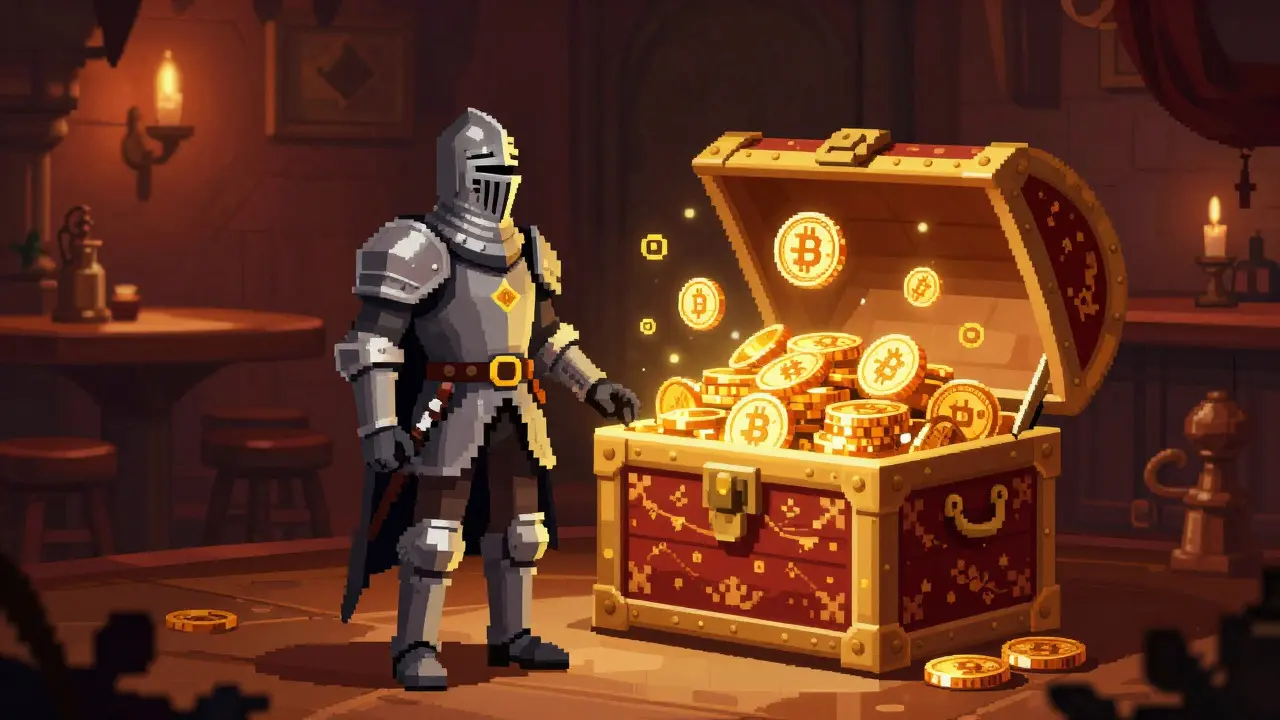
Most people think of a crypto exchange as a place to buy Bitcoin or swap Ethereum for stablecoins. You log in, check the charts, and trade. But DeFi Kingdoms is a hybrid platform that blends decentralized finance (DeFi) with play-to-earn fantasy RPG gaming mechanics. It looks like a retro video game from the 1990s, complete with pixel art heroes and quests. Under the hood, however, it runs a fully functional automated market maker (AMM). This duality makes it confusing for newcomers. Are you here to trade tokens, or are you here to slay dragons? The answer is often both.
If you clicked on this title looking for a standard Binance-style trading interface, you might be disappointed. DeFi Kingdoms does not offer advanced order books, limit orders, or professional charting tools out of the box. Instead, it offers an immersive experience where your financial activities are wrapped in a narrative layer. To understand if this platform is right for you, we need to peel back the layers of its ecosystem, examine the risks of its high-yield pools, and look at the reality of its native token, JEWEL.
The Core Concept: A Game That Pays You
Launched initially on the Harmony Protocol blockchain, DeFi Kingdoms revolutionized the space by proving that utility tokens could drive engagement in a game. The platform later expanded to its own Layer-1 solution, the DFK Chain, which enables cross-chain bridging and lower transaction fees specifically optimized for the DeFi Kingdoms ecosystem. This move was critical. High gas fees on Ethereum would have made micro-transactions in the game impossible. By building its own chain, the team ensured that swapping tokens or claiming quest rewards remained cheap and fast.
The central entity here is the JEWEL token. Unlike Bitcoin, which is a store of value, JEWEL is a utility token. It powers everything in the ecosystem. You use it to buy Hero NFTs, pay for healing potions, upgrade your equipment, and vote on governance proposals for the decentralized exchange. If the game dies, the demand for JEWEL drops. If the DeFi protocols fail, the economy collapses. This interdependence is the defining characteristic of the platform.
- Hero NFTs: These are non-fungible tokens representing characters. Each hero has stats like Strength, Agility, and Intelligence. These stats determine how much gold they mine or how well they fight in PvP battles.
- Crystalvale: The primary realm where most economic activity takes place. It serves as the hub for the DEX, staking, and initial hero recruitment.
- Gardens: The yield farming pools where users provide liquidity to earn rewards in JEWEL and other tokens.
How the Decentralized Exchange Works
At its technical core, DeFi Kingdoms operates on the UniswapV2 protocol. This means it uses an Automated Market Maker (AMM) model rather than an order book. There are no buyers and sellers matching orders. Instead, there are liquidity pools. When you want to swap Token A for Token B, you interact with a pool containing both assets.
For this system to work, you need liquidity providers. These are users who deposit pairs of tokens (for example, JEWEL and USDC) into the pool. In return, they receive LP tokens that represent their share of the pool. As traders swap tokens, they pay a small fee (usually 0.3%). This fee is distributed to the liquidity providers. This is the "banking" aspect of the platform. However, because it is integrated into a game, the interface doesn't look like a spreadsheet. It looks like a wizard casting a spell to transmute gold.
| Feature | Traditional DEX (e.g., Uniswap) | DeFi Kingdoms DEX |
|---|---|---|
| User Interface | Clean, data-heavy, charts | Pixel-art, gamified, narrative-driven |
| Primary User Goal | Efficient token swapping | Earning yield + gameplay engagement |
| Underlying Tech | UniswapV2/V3 Fork | UniswapV2 Fork on DFK Chain |
| Risk Profile | Smart contract risk, impermanent loss | High volatility, gaming economy dependency |
| Native Token Utility | Governance, fee discounts | In-game currency, hero purchases, staking |
The key difference is motivation. On a traditional DEX, you provide liquidity to earn fees. On DeFi Kingdoms, you might provide liquidity because the "Gardens" offer massive incentives in JEWEL tokens, which you then plan to use to buy better swords for your hero. This creates a circular economy, but it also introduces significant risk. If players stop playing the game, the demand for JEWEL plummets, potentially wiping out the value of your liquidity provision faster than the fees can compensate you.
Yield Farming and the Reality of APRs
One of the biggest draws for new users is the Annual Percentage Rate (APR) displayed in the Gardens. Early on, these rates were astronomical, sometimes exceeding 10,000%. Today, while more moderate, they remain high compared to traditional finance. Simple deposits might offer around 24.59% APR, which beats any savings account. But the real money-or the real risk-lies in the liquidity farming pools.
You might see an APR of 250% or higher. Here is the catch: these rates are dynamic. They depend on the total value locked (TVL) in the pool and the amount of JEWEL being emitted as rewards. If everyone rushes to farm that 250% rate, the reward per individual user drops instantly. Furthermore, these high yields are paid in JEWEL. If the price of JEWEL crashes by 50%, your 250% gain becomes a 125% gain, which might still be a net loss when accounting for impermanent loss.
Impermanent loss occurs when the price ratio of the two tokens in your liquidity pool changes compared to when you deposited them. In volatile gaming tokens, this happens constantly. For example, if you provide liquidity for JEWEL and ETH, and JEWEL’s price tanks while ETH stays steady, the AMM will sell your JEWEL for ETH automatically to maintain the pool balance. You end up with more JEWEL (which is now worth less) and less ETH (which held its value). You are left with a diversified bag of depreciating assets.
The JEWEL Token: Value and Volatility
To evaluate DeFi Kingdoms as an investment vehicle, you must understand JEWEL. It is not a passive asset. Its value is derived entirely from its utility within the ecosystem. Price prediction models suggest a wide range of outcomes. Some analysts project a minimum value of roughly $0.03 by 2025, while longer-term forecasts through 2030 hover between $0.04 and $0.05. These numbers sound small, but given the token's low unit price, percentage swings are massive.
The token faces inflationary pressure. New JEWEL is minted daily to reward farmers, stakers, and miners. If the supply grows faster than the demand (from new players buying heroes or traders needing swaps), the price falls. This is a classic problem in GameFi. Platforms like Axie Infinity faced similar issues when the influx of new players slowed down, causing the native token (AXS) to drop significantly despite strong fundamentals.
However, DeFi Kingdoms has introduced mechanisms to combat this. Burning mechanisms, where a portion of transaction fees or specific in-game actions destroy JEWEL tokens, help reduce supply. Additionally, the introduction of new realms and partnerships aims to sustain user growth. The key metric to watch is not just the price, but the active daily users (DAU) and the Total Value Locked (TVL) in the DEX. If TVL is rising while price is falling, it might indicate accumulation. If both are falling, the ecosystem is losing momentum.
User Experience: The Learning Curve
Getting started is not as simple as signing up with an email address. You need a Web3 wallet, such as MetaMask, configured for the Harmony network or the DFK Chain. You need to bridge funds from a centralized exchange like Binance or KuCoin to get ONE tokens (for Harmony) or ETH (to bridge to DFK). This process alone filters out casual investors.
Once connected, the interface is intuitive for gamers but alien to traditional traders. You don't click "Buy." You talk to a character. You don't check a portfolio balance; you look at your inventory. This design choice is deliberate. It encourages emotional connection to the platform. Users who feel attached to their Hero NFTs are less likely to abandon ship during a market dip. This psychological lock-in is a powerful tool for retention.
However, the complexity adds friction. Understanding hero stats-Strength for mining efficiency, Dexterity for fishing success, Intelligence for magic damage-requires reading documentation. If you are purely interested in yield farming, you can ignore the RPG elements. But if you want to maximize returns, you need to optimize your hero builds to generate resources that can be sold or used to boost your farming efficiency. This dual skill set requirement (financial literacy + gaming strategy) narrows the potential user base.
Risks and Regulatory Landscape
No discussion of DeFi is complete without addressing risk. DeFi Kingdoms operates in a gray area. Is JEWEL a security? Is it a commodity? Regulators worldwide are still figuring this out. The SEC has scrutinized various DeFi protocols, and the classification of gaming tokens remains uncertain. If JEWEL is deemed a security, it could face restrictions on trading in certain jurisdictions, impacting liquidity.
Beyond regulation, there is smart contract risk. Although the code is audited, bugs happen. A vulnerability in the DEX contract could lead to drained pools. The multi-chain approach via DFK Chain mitigates some single-point-of-failure risks associated with Ethereum congestion, but it introduces bridge risks. Bridges are historically the weakest link in crypto security, frequently targeted by hackers.
Finally, there is the risk of obsolescence. The GameFi sector is trendy. Trends fade. If a newer, shinier game captures the imagination of crypto natives, capital flows away quickly. DeFi Kingdoms has maintained relevance longer than many peers due to its strong community and continuous updates, but longevity in crypto is never guaranteed.
Who Is This For?
DeFi Kingdoms is not for everyone. If you are a day trader looking for tight spreads and deep liquidity on major pairs like BTC/USDT, stick to centralized exchanges or larger DEXs like Uniswap or PancakeSwap. You will find DeFi Kingdoms lacking in depth and speed.
It is ideal for:
- DeFi Degens: Users comfortable with high risk and high reward who enjoy hunting for yield opportunities.
- GameFi Enthusiasts: Players who want to monetize their gaming time and enjoy collecting NFTs.
- Community Builders: Individuals interested in governance and shaping the future of a niche ecosystem.
For these users, the platform offers a unique blend of entertainment and finance. The high APRs are real, but they come with the caveat of extreme volatility. The gaming element provides a buffer against the boredom of watching charts, turning portfolio management into an adventure.
Is DeFi Kingdoms a safe place to store my crypto?
No, it is not a storage solution. It is a decentralized application. Your funds are held in smart contracts on the DFK Chain or Harmony network. While audits are conducted, smart contracts can have vulnerabilities. Always use a hardware wallet for large amounts and only allocate funds you can afford to lose.
Can I make money without playing the game?
Yes. You can provide liquidity to the DEX pools and stake JEWEL tokens to earn rewards. However, understanding the game mechanics helps you manage risk, as the value of your rewards is tied to the health of the gaming economy.
What is the minimum investment to start?
There is no strict minimum, but you need enough funds to cover gas fees and provide meaningful liquidity. Buying a starter Hero NFT requires JEWEL, which costs money. Start small, perhaps with $50-$100, to learn the interface before committing larger sums.
How do I withdraw my earnings?
You can swap your earned JEWEL or other tokens for stablecoins like USDC or USDT on the DEX. Then, you bridge these stablecoins back to Ethereum or another mainnet and withdraw to a centralized exchange to cash out to fiat currency.
Is DeFi Kingdoms better than Axie Infinity?
They serve different niches. Axie Infinity focuses heavily on battling and breeding. DeFi Kingdoms integrates deeper DeFi mechanics like liquidity provisioning and staking directly into the UI. DeFi Kingdoms may appeal more to users who understand yield farming, while Axie appeals to pure gamers.
Oh, the sheer audacity of calling this a 'game' while it functions as a predatory liquidity trap wrapped in pixelated nostalgia. It is not merely a hybrid; it is a hydra. You think you are slaying dragons, but the dragon is your own impermanent loss, gnawing at the flesh of your portfolio while you sleep. The narrative layer is just sedative for the masses, lulling them into a false sense of security before the rug pull. We are all just NPCs in their grand experiment on human greed and attention spans.
the dichotomy between utility and speculation is blurred here. it forces us to confront the nature of value itself. if the game dies does the token cease to exist or does it become pure fiction? i find the philosophical implications of gamified finance fascinating yet terrifying. we are assigning worth to digital whimsy.
Hey there! Don't let the jargon scare you off too much :) The key is really understanding that risk management is your best friend here. Start small, maybe just dip a toe in with some stablecoin pairs first to see how the AMM works without worrying about JEWEL volatility crashing your head. You got this!
Wake up sheeple!! 🚨 They want you distracted by cute pixels while they drain your wallets through bridge exploits. The SEC isn't coming to save you because THEY ARE THE PROBLEM. This whole ecosystem is built on quicksand. Trust no one, verify everything, and keep your coins in cold storage until the matrix collapses. 👁️👄👁️
One must consider the ontological status of the Hero NFTs. Are they assets or liabilities masquerading as companionship? The interface is deliberately obfuscated to prevent rational economic decision-making. It is a psychological cage. Furthermore, the reliance on a single chain introduces a monolithic point of failure that contradicts the very ethos of decentralization. How quaint.
Lets be real though the APRs are insane but only if u dont panic sell when the chart dips red. I've been farming since day one and its wild watching the economy shift. Just make sure ur hero stats are optimized or ur wasting gas fees bruh. Keep grinding and stay hydrated 💪
Stop dreaming. TVL is dropping. DAU is stagnant. The math doesn't lie. Inflationary pressure on JEWEL is crushing holders. Exit now. Preserve capital. Do not be a bagholder for a dying trend. Simple.
i mean its kinda cool that u can play and earn at the same time right? dont overthink it guys. just have fun with it. if u lose money well thats crypto for ya lol. chill out.
Oh wow, another 'innovative' DeFi project trying to reinvent the wheel with cartoon graphics. 🙄 How original. Tell me, does the wizard cast spells faster than Uniswap processes transactions? Probably not. But hey, if paying extra gas fees makes you feel like a medieval adventurer, go ahead. I'll be here making actual profits on serious platforms. 😂
there is a certain beauty in the attempt to merge leisure with labor. however one must remain vigilant. the emotional attachment to the hero is a double edged sword. it binds you to the platform even when logic dictates departure. observe the patterns do not become the pattern.
man this thing is confusing af. tried to connect my wallet and felt like i was solving a puzzle from an archeology dig. why cant they just make a button that says buy?? anyway im outta here gonna go mine bitcoin instead. easier to understand.
why is everyone so negative? i love my heroes. they are my friends. the losses dont matter because i enjoy playing. you people just dont get the spirit of the game. sad.
This is American innovation at its finest!!! 🇺🇸 Who needs boring banks when you have pixelated freedom?! The DFK chain is superior to all other chains because it is BUILT FOR US! Embrace the future or get left behind in the dust of progress! Hail the Kingdom!
You are all missing the moral decay inherent in this system. Turning children's fantasy games into high-stakes gambling dens for adults is grotesque. The 'yield' is just a carrot on a stick to keep the dopamine addiction feeding. It is selfish, it is volatile, and it lacks any real societal value. Pathetic.
@Joy Kwant Oh, spare us the moralizing lecture from someone who likely holds zero exposure to the market. Your 'societal value' argument is a hollow shield for your own fear of missing out. The grotesque part is your inability to comprehend that value is subjective and constructed. We are building our own reality, darling. Try to keep up.