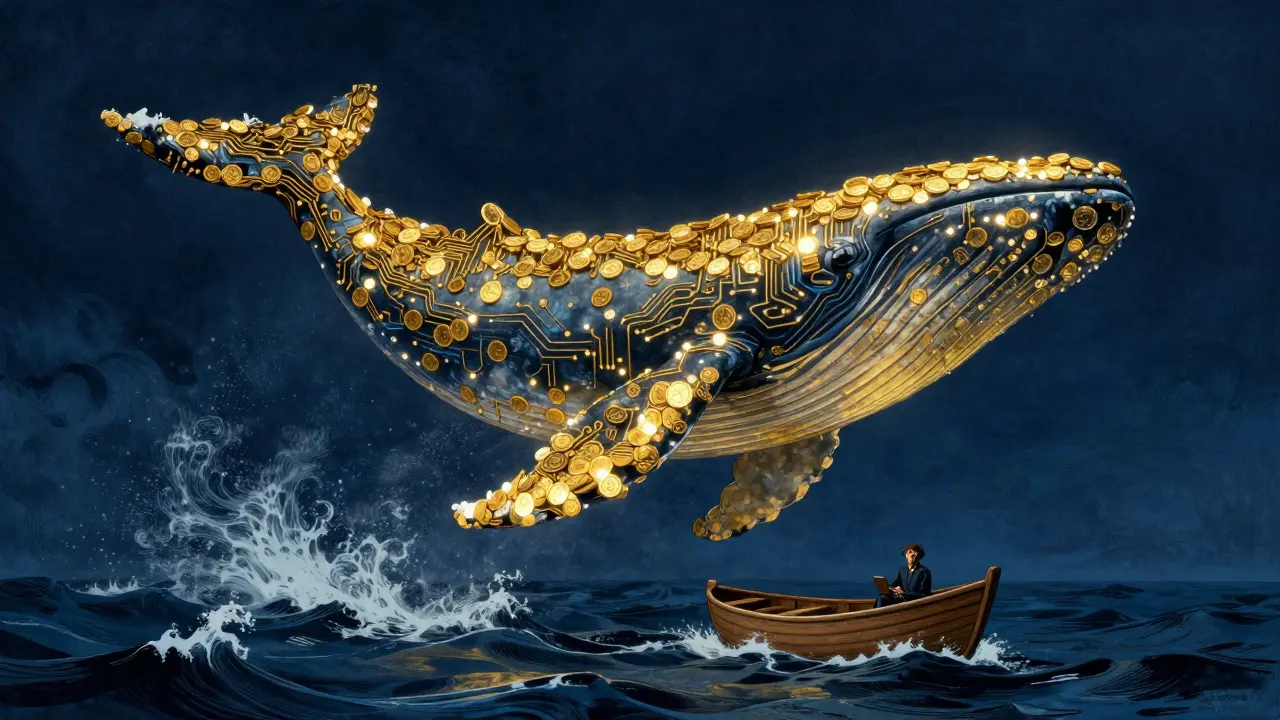
The Real Power of Whale Concentration
To understand why whales have so much power, you have to look at the distribution of coins. It's a common misconception that cryptocurrency is perfectly decentralized. In reality, the concentration of wealth is staggering. For instance, data from Bitstamp shows that as much as 40% of all Bitcoin is held in fewer than 2,000 separate wallets. When such a small group controls nearly half the supply, a single decision to move funds can trigger a massive price swing. This concentration creates a structural vulnerability. In larger assets like Bitcoin, it takes a monumental amount of capital to move the needle. But in smaller, low-cap tokens, the effect is amplified. A whale moving just $1 million worth of a token can cause a 10-15% price shift in minutes if the daily trading volume is low-typically under $50 million.Common Manipulation Tactics Used by Whales
Whales don't always just "buy low and sell high." Many use technical tricks to trick other traders into doing what they want. If you see a sudden, massive wall of orders appearing and disappearing, you're likely witnessing one of these strategies.- Spoofing and Order Walls: This is where a whale places a massive limit order (a "wall") to buy or sell, but they have no intention of actually executing it. A "sell wall" makes the market feel heavy, scaring retail investors into selling their coins cheaper. Once the price drops, the whale cancels the fake sell order and buys the dip at a discount.
- Wash Trading: To make a token look popular or liquid, whales might buy and sell to themselves rapidly. This artificially inflates the volume, tricking others into thinking there is high organic demand, which often draws in unsuspecting buyers.
- Coordinated Dumps and FUD: Whales often combine their trades with social media campaigns. By spreading FUD (Fear, Uncertainty, and Doubt), they can trigger a panic sell-off, allowing them to accumulate more tokens at a lower price.
| Tactic | Primary Goal | Typical Market Reaction | Risk Level for Retail |
|---|---|---|---|
| Buy Walls | Support price / Induce buying | Price floors, fake stability | Medium |
| Sell Walls | Suppress price / Induce selling | Price ceilings, panic selling | High |
| Wash Trading | Fake volume/liquidity | Illusion of organic growth | High |
| Spoofing | Manipulate sentiment | Rapid, erratic price swings | Very High |
How to Track Whales Before They Strike
Since blockchains are public ledgers, whales cannot hide their movements-they just hope you aren't looking. By using on-chain analytics, you can see exactly when millions of dollars are moving from a private wallet to an exchange. Usually, when a whale moves coins to an exchange, it's a signal they are preparing to sell. If they move coins from an exchange to a cold wallet, they are likely "hodling" for the long term. Professional tools like Nansen allow you to classify wallets and track inflows and outflows in real-time. For those on a budget, services like Whale Alert provide Telegram notifications for massive transactions. However, a word of caution: not every big movement is a market signal. Many "whale alerts" are actually just exchanges moving funds between their own internal wallets to manage liquidity, which has zero impact on the price.To effectively watch whales, try this three-step approach:
- Monitor Exchange Inflows: Use an explorer like Blockchain.com to see if large amounts of a specific token are hitting exchange addresses.
- Check the Order Book: Look for unusually large limit orders that appear and disappear quickly (spoofing).
- Verify with Context: Cross-reference a big movement with social media sentiment. If a whale is dumping while "influencers" are pumping, the dump is likely the real story.
The Human Element: When Whales Lose Big
It's easy to think of whales as omnipotent gods of the market, but they make mistakes too. Take the case of Huang Licheng, who reduced his XPL token holdings by 700,000 tokens in August 2023. While he caused the price to fluctuate wildly between $1.12 and $1.50, the move didn't go perfectly. He ended up with an estimated $8 million unrealized loss. This proves that even with massive capital, timing the market is difficult. Many whales are simply institutional investors rebalancing their portfolios or legitimate long-term holders who aren't trying to manipulate anyone. The key is distinguishing between a "strategic dump" and a "forced liquidation" or a simple portfolio adjustment.
Risk Management for the Small Investor
If you can't stop the whales, your best bet is to make sure you aren't the one providing the liquidity for their exit. The most dangerous place for a retail trader is in a low-cap token with a high whale concentration. In these markets, a single transaction can trigger a "stop-loss cascade," where one whale's sell order hits a series of retail stop-losses, causing the price to crater far beyond the original trade. To protect yourself, consider these rules of thumb:- Avoid Over-Leveraging: High leverage makes you an easy target for whale-induced volatility. A 10% swing can wipe out a 10x long position instantly.
- Use Strategic Stop-Losses: Don't place your stop-loss exactly where everyone else does (e.g., exactly at a round number like $1.00). Whales know where these clusters are and will often "hunt" those levels to trigger liquidations.
- Diversify Across Market Caps: Balance your portfolio between high-liquidity assets like Ethereum and smaller tokens. Large-cap assets require significantly more capital to manipulate, providing a safer harbor during storms.
The Future of Whale Influence and Regulation
As the market matures, the era of the "all-powerful whale" may start to fade for major assets. Increased institutional participation brings more liquidity, meaning it takes a much larger trade to move the price of Bitcoin today than it did in 2017. Some analysts predict that by 2025, whales controlling less than 0.5% of a token's supply will have almost no impact on assets with daily volumes over $100 million. However, the battle has shifted to DeFi (Decentralized Finance). In DeFi, we've seen a rise in "rug pulls," where whales concentrate tokens in a new project only to dump them all at once, stealing liquidity from everyone else. This has caught the eye of regulators. The U.S. Commodity Futures Trading Commission (CFTC) has already increased its scrutiny of spoofing and wash trading in derivatives markets, signaling that the "wild west" days of blatant manipulation may be coming to an end.What exactly is a crypto whale?
A crypto whale is an individual or entity that holds a massive amount of a specific cryptocurrency. Because they own such a large percentage of the supply, their trading activity-whether buying or selling-can significantly shift the market price and influence the behavior of other investors.
How can I tell if a whale is about to dump a coin?
The most reliable sign is a large increase in exchange inflows. When you see huge amounts of tokens moving from private "cold" wallets into exchange addresses, it usually means the holder is preparing to sell. You can track this using on-chain tools like Nansen or Whale Alert.
Is all whale activity malicious?
No. Many whales are institutional investors, hedge funds, or early adopters who are simply managing their portfolios. Some whales actually provide stability to the market by buying massive dips, preventing a total price collapse during panic sells.
What is a "sell wall" and how does it work?
A sell wall is a massive limit order to sell a coin at a specific price. It creates a psychological barrier for other traders, who see the huge supply and believe the price cannot possibly go higher. This often leads retail investors to sell their own holdings, allowing the whale to buy them back at a lower price.
Can I make money by following whales?
Some traders use "whale watching" to time their entries, but it is risky. Many whales use spoofing (fake orders) to mislead others. To make a profit, you must verify on-chain data and understand the broader market context rather than blindly following a single transaction alert.
Exactly!!! On-chain data is the only way to stay ahead...’ Use Whale Alert for basics, but Nansen is where the real alpha is!!!
It is absolutely laughable that people still believe in the 'decentralization' myth when the data clearly shows a handful of wallets controlling the supply. I have been analyzing these patterns for years and the retail crowd is just exit liquidity for the smart money. You all are just gambling while the real players are playing a completely different game of chess. Honestly, if you cannot read a simple order book and identify spoofing, you deserve to be liquidated in this market.
Great breakdown! For anyone just starting out, remember that it's all about the long game. Don't let a few red candles freak you out if you believe in the project. Just keep learning and stay curious!
Honestly, who even cares about whales? I love the volatility! The more they manipulate, the more chaotic it gets and that's where the real fun is. Why be a boring 'long-term holder' when you can ride the wave of a massive dump just for the thrill of it?
Oh sure, because blindly following a Telegram bot is a foolproof strategy for wealth. I'm sure the whales are just waiting for you to see the alert so they can move the price in the opposite direction just for a laugh.
It really is stressful watching the dips happen so fast.
Its funny how we think we have kontrol over these digital assets when in realaty its just a mirror of the old financial systems where the rich get richer and we just dance to there tune... i feel like the whole concept of a whale is just a metaphor for the cosmic imbalance of power that exists in every society regardless of whether we use gold or code, and maybe we should just accept that the flow of money is like a river that we can't really swim against anyway, so why stress over a few percent here or there when the universe is so vast and our portfolios are so tiny in comparison to the void of space.
We need to be very clear about the risks here. Many new investors get swept up in the hype without checking the whale concentration. If the top 10 wallets own 80% of the supply, that project is a ticking time bomb. Do your due diligence and don't let FOMO cloud your judgment.
totally agree with kaitlyn. staying diversified is the only way to sleep at night. just keep it simple and dont go all in on one low cap coin
One must contemplate the moral bankruptcy of such manipulation. 🧐 It is a tragedy that the purity of blockchain technology is stained by the greed of these so-called 'whales' who treat the livelihoods of others as mere playthings in their pursuit of vanity and wealth. We seek liberation from centralized banks only to find ourselves enslaved by centralized individuals. 😔
I'm curious if anyone has tried combining order book analysis with sentiment analysis tools to see if there's a measurable lag between the FUD and the actual dump. It seems like the social media side is often a lagging indicator, but I'd like to know if there's a way to quantify that better.
The liquidity depth in high-cap assets significantly mitigates the impact of large-scale slippage, making it far more difficult for a single entity to induce a flash crash. When we analyze the order book, the delta between the bid and ask price often reveals a level of stability that simply doesn't exist in micro-cap environments.
This is simply exhausting. The sheer predictability of these 'tactics' makes the whole market feel like a choreographed dance for the gullible. It is absolutely tragic that we call this innovation when it is essentially just a digital version of the 1720 South Sea Bubble.
This whole thing is just a plot by the globalists to make us think we have a choice in how we hold our money while they secretly control every single wallet through backdoers in the code!! I've seen the patterns and it's’ all just a way to lure americans into a fake economy so the real power can be consolidated by the elites who dont even care about the price of bitcoin as long as they own the infrastructure!!
Exactly. The 'whale alert' bots are probably just part of the same system to keep us distracted while the real movements happen in off-chain settlements. Nothing is actually random.
It is an absolute travesty that such volatility is tolerated in a professional financial environment! I find it utterly reprehensible that individuals can simply decide to erase 30% of another's wealth in a matter of minutes. This is not 'trading'; it is financial terrorism of the highest order and the lack of immediate regulatory intervention is a disgrace to the industry!