
When you try to withdraw cryptocurrency to fiat currency in India, you’re not just making a simple bank transfer. You’re stepping into a gray zone where legality clashes with institutional caution. Even though owning and trading crypto is legal in India since the Supreme Court struck down the RBI’s 2018 ban in 2020, banks still treat crypto-related transactions like they’re risky outliers - and they often make it hard to move money out.
Why banks hesitate to process crypto withdrawals
Banks in India don’t outright refuse crypto withdrawals - but many make it difficult. The reason isn’t because it’s illegal. It’s because the Reserve Bank of India (RBI) keeps sending strong signals that it doesn’t want banks anywhere near cryptocurrency. Even after the 2020 court ruling, the RBI never changed its internal guidelines. It still views crypto as a threat to monetary policy, financial stability, and the rupee’s integrity.Former RBI Governor Shaktikanta Das called crypto a potential disruptor to India’s financial system. Current Governor Sanjay Malhotra has doubled down, saying the central bank would rather promote its own digital rupee (CBDC) than support private cryptocurrencies. This institutional stance trickles down. Banks fear regulatory backlash if they’re seen as supporting crypto. So even if a customer has a clean KYC record and proof of tax payment, some banks will still freeze, delay, or question crypto-to-fiat withdrawals.
What actually happens when you cash out
If you’re using a compliant Indian crypto exchange - one registered with FIU-IND and following full AML/KYC rules - the process should work. But it’s not smooth. Here’s what typically happens:- You sell your Bitcoin, Ethereum, or Solana on the exchange for INR.
- The exchange sends the INR to your linked bank account via NEFT, IMPS, or UPI.
- Your bank receives the transaction and flags it as ‘suspicious’ because the sender is a crypto platform, not a traditional business.
- The bank may hold the funds for 3-7 days while they review the source.
- You might get a call from your bank asking: ‘Where did this money come from?’
- If you can’t provide transaction history, tax filing proof, or KYC records from the exchange, the bank may reject the deposit.
Some users report that their bank accounts got frozen after just one crypto withdrawal. Others say their UPI payments to crypto exchanges were blocked entirely. It’s not consistent - one bank might accept it without question, while another with the same branch network refuses. This inconsistency comes from the lack of clear national guidelines. Each bank makes its own call.
The role of FIU-IND and PMLA compliance
Since March 2023, every crypto exchange operating in India - even offshore ones serving Indian users - must register with the Financial Intelligence Unit (FIU-IND) under the Prevention of Money Laundering Act (PMLA). This means they must:- Collect full identity documents from every user (Aadhaar, PAN, address proof).
- Track every deposit and withdrawal with timestamps and IP logs.
- Report any transaction over ₹10,000 as a ‘suspicious activity’ - even if it’s not.
- Follow the FATF Travel Rule: every crypto transfer must include sender and receiver details, even for small amounts.
These rules exist to prevent money laundering. But they also make banks more nervous. When a bank sees a deposit labeled as ‘Crypto Exchange A - INR Withdrawal’, it doesn’t see a legitimate user. It sees a potential regulatory risk. That’s why even compliant exchanges sometimes get their bank accounts shut down. In 2024, the FIU-IND issued notices to 25 major offshore exchanges - including BingX, LBank, and CoinW - demanding they stop serving Indian users. Fourteen of them held over $9 billion in assets. The government didn’t just ask them to comply - it ordered app stores to remove them and blocked their websites.
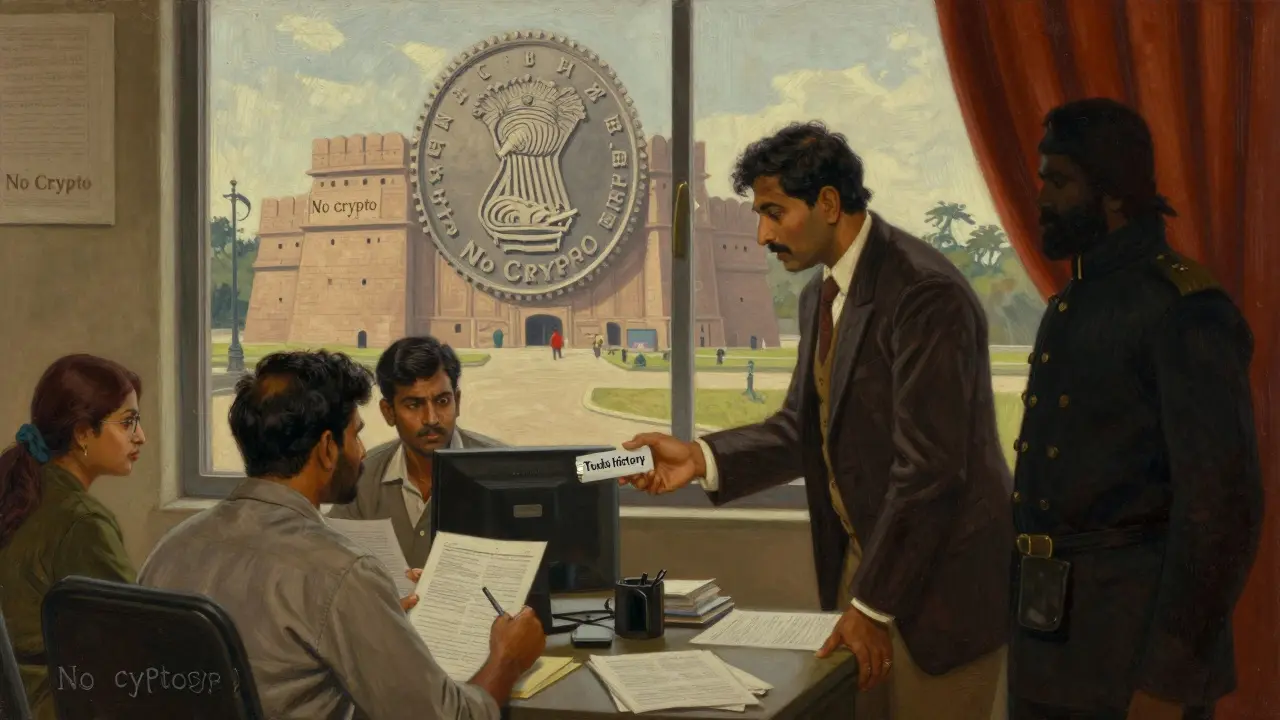
What banks expect from you
If you want your crypto withdrawal to go through without hassle, you need to be ready. Banks don’t ask for much - but what they do ask for, they demand in writing:- Your exchange’s KYC records: Screenshots or PDFs showing your verified identity on the platform.
- Transaction history: A detailed export of your sell order, including timestamp, amount, and fee.
- Income tax filing: Proof you paid 30% tax on crypto gains (required since April 2022).
- Source of funds: If you bought crypto with cash or from another exchange, be ready to explain how you got the original funds.
Some users keep a folder with all this ready. When a bank calls, they send it instantly. That’s how they avoid delays. Others don’t bother - and end up with frozen accounts for weeks.
The tax trap
India taxes crypto gains at 30% - no deductions, no losses offset. If you made a profit selling Bitcoin, you owe tax. If you didn’t file, the bank might report your deposit to the Income Tax Department. The IT department now cross-checks bank deposits with crypto exchange data. If you withdrew ₹5 lakh from crypto and didn’t declare it, you could get a notice. Banks are required to report transactions over ₹10 lakh annually under the Income Tax Act. So even if your withdrawal clears, it might still trigger an audit.
What’s changing in 2026
Parliament is working on new legislation that could change everything. The draft bill, expected to pass in late 2026, would give SEBI primary control over cryptocurrencies - not the RBI. That could mean:- Banks get clearer rules on handling crypto transactions.
- Exchanges become licensed financial entities, like brokers.
- Withdrawals get treated more like stock sales - regulated, but not feared.
But until that law passes, banks operate in the dark. They follow RBI’s cautious tone. They don’t want to be the next institution fined for helping crypto users. So they err on the side of rejection.
What you can do right now
If you’re withdrawing crypto to fiat in India, here’s how to avoid trouble:- Use only FIU-IND registered exchanges - check their website for the registration number.
- Keep all KYC documents, trade history, and tax filings organized.
- Withdraw in smaller amounts if possible - ₹2-5 lakh at a time avoids automatic reporting.
- Use a separate bank account just for crypto withdrawals - don’t mix it with salary or business income.
- Don’t use UPI for crypto deposits or withdrawals - many banks block it.
- Be ready to explain your transaction if your bank calls.
The system isn’t designed to make it easy. But it’s not impossible. Millions of Indians still cash out crypto every month. They just do it smarter than most.
Can banks in India legally block crypto-to-fiat withdrawals?
Yes. While owning and trading crypto is legal, banks aren’t required to provide services for it. The RBI hasn’t mandated that banks accept crypto transactions, so individual banks can refuse, freeze, or delay withdrawals without breaking any law. Many do so out of caution to avoid regulatory scrutiny.
Why do some banks accept crypto withdrawals while others don’t?
It depends on the bank’s internal risk policy. Public sector banks tend to be more cautious due to direct RBI oversight. Some private banks with crypto-friendly leadership allow it, especially if the customer has a long-standing relationship and clear documentation. There’s no national standard - each branch or regional office can make its own decision.
Do I need to pay tax even if I withdraw crypto to fiat at a loss?
Yes. India taxes crypto gains at 30% regardless of whether you made a profit or loss. If you bought Bitcoin at ₹40 lakh and sold it at ₹35 lakh, you still owe tax on the ₹35 lakh. Losses can’t be offset against other income. The tax is applied on the total value withdrawn, not the net gain.
Can I use a foreign crypto exchange to withdraw INR to my Indian bank account?
Technically yes - but it’s risky. If the exchange isn’t registered with FIU-IND, your bank may reject the deposit or report it as suspicious. In 2024, the government blocked 25 major offshore exchanges for non-compliance. Even if the transfer goes through, you risk future audits or account freezes. Using a registered Indian exchange is far safer.
What happens if my bank account gets frozen after a crypto withdrawal?
You’ll need to contact your bank’s compliance department and provide documentation: KYC from your exchange, trade history, and proof of tax payment. Many users resolve this within 7-10 days. If the bank refuses, you can file a complaint with the Banking Ombudsman. But delays are common - and some accounts stay frozen for months if the bank suspects money laundering.
Banks aren't blocking crypto withdrawals because they're evil. They're doing it because they're terrified of getting fined by the RBI. It's not about legality-it's about liability. If your account gets frozen, don't blame the bank. Blame the regulatory fog.
I've had three withdrawals go through without a hitch-just because I kept my KYC, tax receipts, and trade history in a single Google Drive folder. When the bank called, I sent it in 30 seconds. No drama. Simple as that.
I get why banks are nervous, but it's insane that we're treated like money launderers just because we use crypto. I pay my taxes. I have ID. I use registered exchanges. Why does my money get held for a week? This isn't 2018 anymore.
Let's be real-the whole system is a farce. India taxes crypto gains at 30% with no loss offset, banks freeze accounts for no clear reason, and the government is still trying to kill crypto while pretending to regulate it. It's like they want to scare people away but don't want to admit they're scared too. We're stuck in bureaucratic purgatory.
I withdrew ₹4.5L from Solana last month. My bank called me three times. They asked if I was a miner. I said no. They asked if I sold it to a friend. I said no. They asked if I had a notarized letter from Satoshi. I hung up. Two days later, the money cleared. I didn't send a single document. Sometimes, silence is the best compliance.
You're not alone. I've helped five friends get their crypto withdrawals cleared just by showing them how to organize their docs. Keep a folder. Label everything. Save screenshots. Send it before they ask. It takes 10 minutes once a month. No frozen accounts. No panic calls. You got this.
Stop acting like this is a technical problem. It's a power play. The RBI doesn't want crypto because it threatens their control. Banks are just the enforcers. If you think compliance will fix this, you're delusional. The system is designed to make you give up. Don't. Keep pushing. File complaints. Use smaller amounts. Stay loud.
Use a separate account. Seriously. I opened a new savings account just for crypto. No salary deposits. No EMIs. Just crypto cashouts. Zero issues. Banks don't flag what they don't see.
The 30% tax on withdrawals? That's not taxation. That's extortion. You pay tax on the full amount even if you lost 70% of your investment? And you can't offset losses? That's not policy-it's a punishment for daring to invest. The government wants crypto to die quietly. Don't let them win.
I just got a call from my bank after a ₹2.8L withdrawal. I sent them my FIU-registered exchange receipt, my IT return PDF, and a screenshot of my trade history... all in one email. They replied in 4 hours: 'Funds cleared.' Simple. Clean. Done. You don't need a lawyer. You just need to be organized.