
Ever wondered why fiat-backed stablecoins like Tether (USDT) or Circle's USD Coin (USDC) stay glued to $1.00 even when Bitcoin is swinging wildly? It’s not magic; it’s a mix of banking infrastructure, legal contracts, and simple market psychology. These digital tokens represent the largest slice of the stablecoin market, valued at over $150 billion as of recent data. But how do they actually hold their value? The answer lies in a straightforward but heavily regulated system where every token issued is matched by real cash or cash equivalents sitting in a bank account.
The Core Mechanism: Reserves and Issuance
To understand the peg, you first have to look at what backs the coin. A fiat-backed stablecoin is essentially a digital IOU for a specific amount of currency, usually the US Dollar. When you buy one USDT, the issuer, Tether, takes your dollar and puts it into a reserve fund. This fund isn't just idle cash; it’s typically invested in short-term, low-risk assets like US Treasury bills, commercial paper, and money market funds. For every million USDT tokens in circulation, Tether must maintain roughly one million dollars in these reserves. This one-to-one backing is the foundation of trust. If the reserves disappear, the peg breaks. So, the entire system relies on the issuer having enough liquid assets to cover every single token held by users.
How Arbitrage Keeps the Price at $1
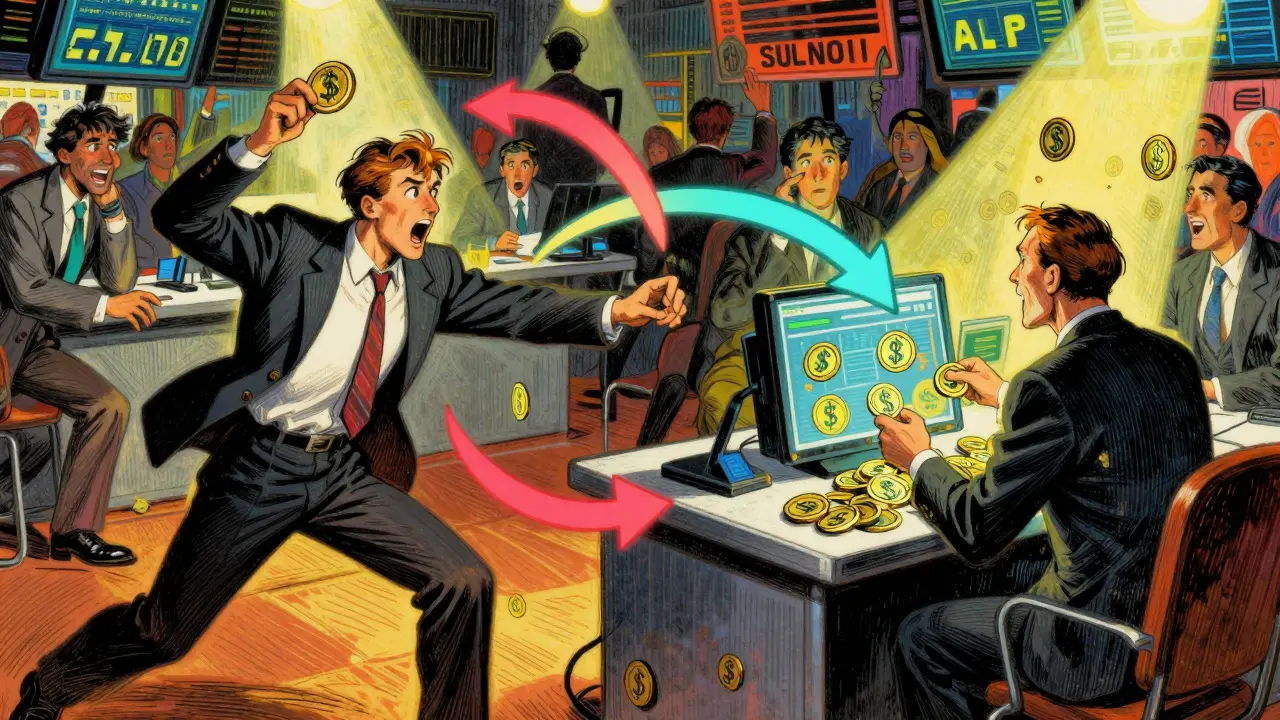
You might think issuers actively manage the price, but the real work is done by traders. The peg is maintained through a process called arbitrage, which is the natural correction mechanism of the market. Imagine USDT is trading at $0.98 on an exchange because there’s high demand for it during a crypto crash. Rational traders see a free lunch: they can buy the discounted token for $0.98 and redeem it directly with the issuer for $1.00 worth of cash. By doing this, they remove USDT from circulation (reducing supply) and get paid out in dollars. This contraction in supply pushes the price back up toward $1.00. Conversely, if USDT trades at $1.02, traders will deposit $1.00 with the issuer to mint new USDT and sell it immediately for a profit. This increases the circulating supply, pushing the price back down to parity. This constant flow of minting and burning keeps the price locked in place without needing complex algorithms.
The Role of Audits and Transparency
If arbitrage handles the daily price fluctuations, audits handle the long-term credibility. Since you’re trusting a company to hold your money, you need proof that the money is actually there. Third-party accounting firms conduct regular attestations or audits of these reserves. For example, Circle, the issuer of USDC, publishes monthly attestation reports showing exactly what assets are backing the coins. While full audits are more rigorous, attestations provide a frequent snapshot of the reserve composition. In the past, opacity was a major criticism of stablecoins like Tether, leading to skepticism about whether reserves were fully backed. Today, transparency is a competitive advantage. Investors and institutional users prefer stablecoins with clear, frequent reporting because it reduces the risk of a surprise depeg. If an audit reveals that reserves don’t match circulation, confidence plummets, and the peg can break until the discrepancy is fixed.
Fiat-Backed vs. Other Stablecoin Models
Not all stablecoins work the same way. Understanding the difference helps explain why fiat-backed models dominate. There are three main types: fiat-backed, crypto-backed, and algorithmic. Fiat-backed coins use real-world cash. Crypto-backed coins, like DAI, use volatile assets like Ethereum as collateral, often requiring over-collateralization (putting up $150 worth of ETH to back $100 of DAI) to absorb price swings. Algorithmic stablecoins try to use smart contracts to adjust supply based on demand, with no physical reserves. The failure of TerraUSD (UST) in 2022 showed the danger of the algorithmic approach; when panic hit, the mechanism couldn't keep up, and the peg collapsed completely. Fiat-backed stablecoins avoid this volatility risk by relying on stable government debt rather than speculative crypto assets. They trade decentralization for stability, meaning you have to trust the central issuer, but in return, you get much lower volatility.
| Type | Backing Asset | Decentralization | Risk Profile | Example |
|---|---|---|---|---|
| Fiat-Backed | US Dollars / Treasuries | Low (Centralized) | Regulatory/Custodial | USDT, USDC |
| Crypto-Backed | Ethereum / BTC | Medium-High | Collateral Volatility | DAI |
| Algorithmic | None (Smart Contracts) | High | Mechanism Failure | TerraUSD (Failed) |
Systemic Risks: What Can Go Wrong?
Even with strong mechanisms, fiat-backed stablecoins aren't immune to trouble. The biggest risk is counterparty risk. If the bank holding the reserves fails, access to those funds could be frozen. We saw this play out in March 2023 during the Silicon Valley Bank collapse. USDC briefly traded below $1.00 because a significant portion of its reserves was stuck in SVB. It wasn't that the money was gone, but that it was inaccessible. The peg recovered quickly once regulators stepped in and diversification strategies were adjusted, but it highlighted a critical vulnerability: reliance on traditional banking infrastructure. Another risk is regulatory intervention. If a government decides to freeze a stablecoin due to legal issues, holders can't redeem their tokens. This centralization means that while the technology is blockchain-based, the control remains in the hands of a few corporate entities and governments.
Regulatory Landscape and Future Outlook
As the market matures, regulation is becoming the primary driver of stability. Laws like the EU's Markets in Crypto-Assets (MiCA) regulation explicitly favor fiat-backed models by requiring strict reserve management and licensing for issuers. This creates a higher barrier to entry for new players, consolidating the market around established names like Tether and Circle. For users, this means less choice but potentially higher safety standards. Looking ahead, the rise of Central Bank Digital Currencies (CBDCs) poses a long-term challenge. If governments issue their own digital dollars, private stablecoins will need to offer unique benefits, such as faster cross-border settlement or better integration with DeFi protocols, to justify their existence. However, for now, fiat-backed stablecoins remain the bridge between the old financial world and the new crypto economy, providing a reliable unit of account in a volatile market.
Frequently Asked Questions
What happens if a fiat-backed stablecoin depegs?
A depeg occurs when the trading price deviates significantly from $1.00, usually due to panic selling or reserve uncertainty. Traders can exploit this by buying cheap tokens and redeeming them for full value, which helps restore the peg. If the depeg persists, it may signal deeper issues with the issuer's reserves or banking partners.
Are fiat-backed stablecoins safer than crypto-backed ones?
Generally, yes, in terms of volatility. Fiat-backed coins rely on stable government debt, whereas crypto-backed coins depend on volatile assets like Ethereum. However, fiat-backed coins carry higher centralization and regulatory risks, meaning you trust a company and a bank, not just code.
Who holds the reserves for USDT and USDC?
The reserves are held in custody accounts at major banks and invested in short-term instruments like US Treasury bills. Custodians like BNY Mellon or JPMorgan often manage these assets, ensuring they are segregated from the issuer's operational funds.
Do stablecoin holders earn interest?
Usually, no. While the reserves earn interest from investments like Treasury bills, issuers typically keep this revenue to cover operational costs. Some newer platforms allow users to stake stablecoins to earn yield, but this introduces additional smart contract risks.
Can I redeem any stablecoin for cash instantly?
Redemption processes vary. Some issuers allow direct redemption via their official portals, which can take days. Others require you to sell on an exchange first. During times of stress, redemption queues can form, delaying access to cash, as seen during the SVB crisis.
Finally some decent writing on this topic. Most of the time these articles are written by people who have never even touched a bank account, let alone a reserve fund. The US dollar is the backbone of this whole system and anyone who thinks otherwise is either an idiot or trying to sell you something else. We should be proud that our currency is so strong it can back digital tokens while their local currencies are just printing money for fun. It's all about strength and stability, folks.
You are all missing the point entirely. This isn't about 'stability' in any meaningful sense; it is about control. The arbitrage mechanism described here is merely a facade for what is essentially a massive, centralized credit risk event waiting to happen. I have seen this pattern before in every financial instrument that claims to be 'risk-free.' They always say 'trust the process,' but the process is designed to benefit the issuer, not the holder. The real question is not how the peg holds, but how long until it breaks, and who gets paid when it does. Enjoy your little digital IOUs while they last.
Ah, the classic 'trust us because we're big' argument. Very refreshing to see someone explain the mechanics without assuming we've all lost our minds. Though, I must say, the part about 'rational traders' doing the heavy lifting is a bit optimistic. In my experience, rationality goes out the window the second Bitcoin drops 5%. But hey, at least it's better than the algorithmic nonsense from 2022. Keep up the good work explaining the basics to the masses.
This is such a helpful breakdown! 🙌 I always get confused by the difference between crypto-backed and fiat-backed, so seeing the table really helped clarify things for me. Thanks for making it easy to understand! 😊
well actually its not that simple. you are ignoring the fact that the banks holding the reserves are also playing games with the fed. the whole system is a house of cards built on sand and everyone knows it but nobody wants to admit it because they are too busy buying more tokens. its like watching a train wreck in slow motion and pretending the tracks are solid.
Wait wait wait. You think the reserves are safe? Have you checked where Tether actually keeps its cash? I read somewhere they use offshore accounts that don't follow normal rules. It's all a front for the deep state to track our spending. The peg only holds because they force it through regulation, not because the math works. Wake up sheeple!
Oh wow, this is actually pretty scary when you think about it. Like, what if the bank freezes the funds again? I remember SVB was such a mess. It makes me feel a bit safer knowing there are audits, but still... trust is a fragile thing. Just glad we have options now.
One must consider the philosophical implications of relying on a centralized entity for monetary stability. Is this truly freedom, or merely a new form of feudalism dressed in blockchain clothing? The arbitrage mechanism is elegant in its simplicity, yet it presupposes a level of market efficiency that rarely exists in times of genuine crisis. We are building castles on the sands of institutional trust. How long will the tide hold?
Let’s be precise here; the term “arbitrage” is often misused in this context. It is not merely trading; it is a fundamental correction of supply and demand driven by the redeemability of the asset. Furthermore, the reliance on “cash equivalents” is a euphemism for interest-bearing debt instruments, which carry their own duration risks. One would expect a higher standard of analysis from a post claiming to explain the mechanics. Do not conflate liquidity with solvency.
I just want to say, reading this made me feel like I'm losing my mind a little. Like, why do we need all this complexity? Can't we just use cash? But then again, cash doesn't travel fast enough. So I guess we're stuck with this weird hybrid world. Anyway, thanks for the info, I feel both smarter and more anxious now.
Nice explanation. I didn't realize the role of audits was so critical for long-term credibility. Good to know.
The distinction between attestations and full audits is a crucial one that many overlook. An attestation provides a snapshot, yes, but it lacks the depth of a full audit which tests internal controls over financial reporting. For an institution managing over $150 billion in reserves, the difference between a 'snapshot' and a 'deep dive' can be the difference between confidence and catastrophe. It is precisely this nuance that separates informed investors from those who simply follow the herd. The infrastructure is robust, but the oversight must be equally rigorous to maintain the integrity of the peg.
Great article. It helps to see the comparison table clearly. Thanks for sharing.