
Imagine sending money to a friend abroad. In the old days, you’d use a bank wire. The bank knew who you were, where they lived, and how much you sent. Today, you might send Bitcoin or Ethereum from your phone. For years, that felt like slipping cash into an envelope-no name, no trace, just code moving across the internet. But as of 2026, that anonymity is rapidly disappearing.
International authorities have closed the gap between traditional finance and digital assets. If you are running a business, managing large assets, or even just moving significant sums across borders, you need to understand how governments are watching. The era of 'wild west' crypto transfers is over. Regulators from Washington to Brussels to London are now coordinating to ensure that every transaction leaves a paper trail, even if it happens on a decentralized blockchain.
The Core Mechanism: The Travel Rule Goes Global
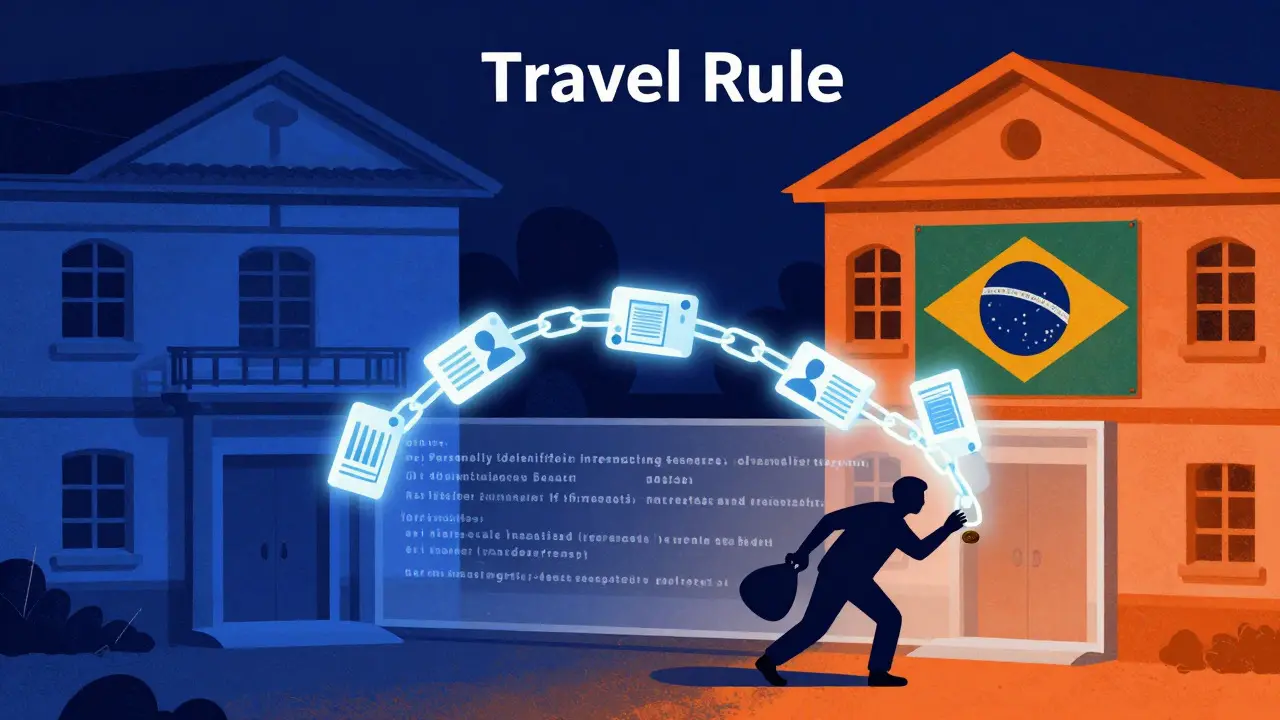
At the heart of cross-border crypto monitoring is a concept called the Travel Rule, which is a regulatory requirement mandating that financial institutions share sender and receiver information for transactions above a certain threshold. Originally designed for banks by the Financial Action Task Force (FATF), this rule has been aggressively applied to cryptocurrency businesses.
Here is how it works in practice. When you transfer crypto worth $3,000 or more to another wallet or exchange, the platform you use (known as a Virtual Asset Service Provider, or VASP) must collect specific data. They aren’t just looking at the wallet address anymore. They need your full name, physical address, account number, and sometimes even your national ID number. This same data must be attached to the beneficiary’s details on the receiving end.
If you send funds from an exchange in Japan to one in Brazil, both platforms must exchange this Personally Identifiable Information (PII). It sounds simple, but the technical implementation is complex. Exchanges use intermediary message systems to securely pass this data without exposing it to the public blockchain. If the receiving platform doesn’t comply or isn’t registered, the sending platform often blocks the transaction entirely. This creates a walled garden of compliant exchanges, making it harder to move money outside the regulated system.
US Oversight: FinCEN and the End of Unhosted Wallets
In the United States, the Financial Crimes Enforcement Network (FinCEN) has taken a particularly hard line. Under the Bank Secrecy Act, crypto businesses are treated exactly like banks. But the rules go deeper than just exchanges.
A major shift in 2025 and 2026 involves unhosted wallets, which are self-custody digital wallets not controlled by a third-party service provider. Previously, if you moved Bitcoin from your own hardware wallet to someone else’s, it was largely invisible to regulators unless it hit an exchange. Now, proposed rules require banks and Money Service Businesses (MSBs) to report transactions involving these unhosted wallets if they exceed certain thresholds.
This means if you deposit crypto from your personal Ledger or Trezor into a US bank-linked account, or vice versa, the scrutiny increases. FinCEN classifies cryptocurrencies like Bitcoin and Ether as 'monetary instruments' similar to cash. This classification triggers existing anti-money laundering (AML) recordkeeping requirements. You can no longer treat self-custody as a blind spot. The moment your crypto touches the traditional financial system, the identity verification nets tighten.
European Union: MiCA and Risk-Based Compliance
Across the Atlantic, the European Union has implemented the Markets in Crypto-Assets (MiCA) regulation. While the US focuses heavily on enforcement through agencies like FinCEN, the EU has built a comprehensive legislative framework. MiCA is viewed as more risk-averse and structured.
Under MiCA, any Crypto-Asset Service Provider (CASP) operating in the EU must maintain robust financial crime controls. This includes enhanced due diligence for high-risk customers and real-time transaction monitoring. The key difference here is the passporting system. A company licensed in one EU member state can operate across all 27 countries. This standardizes compliance, preventing companies from shopping for the laxest regulator within Europe.
For users, this means higher friction. KYC (Know Your Customer) checks are stricter. Suspicious activity reports (SARs) are filed more frequently. If you are using a DeFi protocol that interfaces with an EU-regulated bridge or gateway, you are subject to these rules. The EU approach ensures that while innovation continues, the infrastructure supporting it is clean and transparent.
UK-US Cooperation: The Transatlantic Task Force
Perhaps the most significant development for global monitoring is the UK-US Transatlantic Task Force. This bilateral initiative recognizes that criminals don’t respect borders, so neither should regulators. The task force focuses on aligning licensing, custody standards, and stablecoin regulations.
Why does this matter to you? Because it sets the global standard. The UK and US represent the deepest capital markets and the most advanced fintech ecosystems. By coordinating their approaches, they create a de facto global norm. Other jurisdictions, from Singapore to Dubai, often look to these two frameworks when drafting their own laws. This cooperation reduces 'regulatory arbitrage,' where bad actors simply move their operations to a country with weaker oversight.
The task force also addresses cross-border compliance directly. They share intelligence on sanctioned entities and emerging threats. If a wallet is flagged as suspicious in London, New York knows about it quickly. This shared database makes it exponentially harder to hide illicit funds by bouncing them between jurisdictions.
Evasion Tactics: How Bad Actors Try to Hide
Despite these tight nets, evasion attempts continue. Understanding these tactics helps you recognize what regulators are looking for. One common method is the use of VPNs to obscure location. If you connect from a jurisdiction with weak KYC laws, you might think you’re safe. But regulators now analyze IP addresses alongside transaction patterns. Discrepancies between your stated location and your digital footprint raise red flags.
Another tactic involves centralized exchanges linked to designated persons. Some platforms may share infrastructure with sanctioned exchanges. They use intermediary wallets to separate incoming deposits from outgoing withdrawals. To the naked eye, it looks like normal trading. To compliance software, it looks like layering-a classic money laundering technique. Regulators are now mapping these infrastructural links, banning entire clusters of related entities rather than just single companies.
Mixers and privacy coins remain a target. Services that pool funds from multiple users and redistribute them to break the link between sender and receiver are under intense pressure. Many major exchanges have already delisted Monero and Zcash, or restricted access to Tornado Cash-like protocols. Using these tools can flag your account for enhanced review or even freezing of assets.
| Region | Key Regulation/Agency | Travel Rule Threshold | Focus Area |
|---|---|---|---|
| United States | FinCEN / BSA | $3,000+ | Unhosted wallets, MSB reporting |
| European Union | MiCA | Varies by Member State | Risk-based CASP licensing |
| United Kingdom | FCA / OFSI | £1,000+ (often lower) | Sanctions evasion, transparency |
| Global Standard | FATF | $1,000 - $3,000 | International cooperation |
Impact on Businesses and Users
For businesses, the cost of compliance has risen. You need sophisticated software to monitor transactions in real-time. You need legal teams to interpret evolving rules in different jurisdictions. But there is a silver lining: trust. As the market matures, institutional investors are entering because they know the rails are secure. The chaos of 2022 has given way to a structured environment.
For individual users, the impact is mostly friction. Expect longer onboarding times. Expect to provide more documents. If you hold large amounts in self-custody, be prepared to prove the source of funds when you eventually sell or swap. The days of anonymous million-dollar trades are gone.
However, for legitimate users, this brings safety. Knowing that your counterparty has been vetted reduces the risk of fraud. It also protects the integrity of the asset itself. As central banks explore their own digital currencies (CBDCs), having a clean, monitored private crypto sector ensures that digital assets remain viable alternatives rather than being banned outright.
Future Outlook: What Comes Next?
The trend is clear: integration. Blockchain technology will increasingly plug into traditional financial oversight mechanisms. We will see more automated reporting, where smart contracts trigger compliance checks before execution. Regulatory Technology (RegTech) will become a massive industry, providing tools for both regulators and businesses to keep up.
Geopolitics will continue to shape this landscape. As China and the EU advance their digital frameworks, the US and UK aim to lead the standard-setting. This competition drives faster innovation in monitoring tools. The goal isn’t to stop crypto; it’s to bring it into the fold. The question is no longer *if* you will be monitored, but *how well* you prepare for it.
What is the Travel Rule threshold for crypto transactions?
The standard threshold set by the FATF and adopted by many jurisdictions, including the US, is $3,000. Transactions equal to or exceeding this amount require the exchange of originator and beneficiary information between Virtual Asset Service Providers (VASPs).
Are self-custody wallets monitored by regulators?
Directly, no, because they are decentralized. However, indirect monitoring occurs when you interact with regulated entities. If you move funds from a self-custody wallet to an exchange or bank, those intermediaries must perform KYC and may report the transaction under new FinCEN rules regarding unhosted wallets.
How does MiCA affect crypto users in Europe?
MiCA requires all Crypto-Asset Service Providers (CASPs) to implement strict AML/CFT controls. Users face stricter identity verification, enhanced due diligence for high-risk activities, and greater transparency regarding the risks of the assets they hold.
What happens if a crypto exchange fails to comply with the Travel Rule?
Non-compliant exchanges risk heavy fines, loss of license, and being blocked by other compliant platforms. This effectively isolates them from the global financial system, making it difficult for users to deposit or withdraw fiat currency.
Can I still use privacy coins like Monero?
It is becoming increasingly difficult. Many major exchanges have delisted privacy coins due to regulatory pressure. While you can still hold them in self-custody, converting them to fiat or mainstream cryptocurrencies often triggers enhanced scrutiny or is blocked entirely by compliant platforms.
They are watching everything! 🕵️♂️ The 'Travel Rule' is just a fancy word for total surveillance state control. They want to know where you live, who you talk to, and what you buy before you even buy it. It’s not about safety, it’s about power. They are building a digital panopticon right under our noses while we argue over wallet addresses. The real criminals aren’t the ones using mixers, they are the ones writing the laws that make privacy a crime. Don’t let them trick you into thinking this is for your protection. It’s for their convenience. 🔒👁️
Look, i get the paranoia but lets keep it real here. If you are moving serious cash around, you gotta expect some friction. Its like going through airport security now instead of just walking onto the plane. Annoying? Yes. Necessary for the system to work with banks? Absolutely. I’ve been in compliance for years and seeing these rules tighten up actually makes me feel safer knowing my money isn’t sitting next to laundered cartel funds on an unregulated exchange. Just do your KYC, keep your records straight, and move on with your life. No need to panic.
EXACTLY!! Sus is spot on!!! You people need to wake up and smell the coffee!!! This is progress!!! We are finally bringing order to chaos!!! If you have nothing to hide, why are you so scared of showing your ID??? IT IS NOT A BIG DEAL!!! Stop acting like victims and start acting like responsible adults!!! The wild west was fun for a minute but now we need RULES!!! Let's goooooo!!! 🚀💪🔥
The semantic drift in your argument is palpable, Phil. To equate financial sovereignty with criminality is a logical fallacy of the highest order. Furthermore, the notion that 'order' equates to 'progress' ignores the historical context of centralized banking failures. The Travel Rule effectively creates a walled garden, stifling innovation by forcing decentralized protocols to adopt centralized data structures. It is an intrusion of state apparatus into the private sphere of individual economic activity. One must question whether this 'safety' comes at the cost of liberty itself. The jargon-heavy nature of regulatory texts often masks the draconian reality of their enforcement mechanisms.
You are missing the point entirely; the infrastructure is already built. MiCA in Europe is the gold standard; if you cannot comply with CASP regulations, you are irrelevant. The risk-based approach is not about oppression; it is about market efficiency. Unhosted wallets are dead weight. Move to compliant exchanges or stay poor. Simple as that. Do not complain about the weather when you forgot your umbrella.
It is fascinating to observe how the concept of 'trust' has shifted from interpersonal relationships to institutional algorithms. In the past, trust was a social contract; now, it is a data packet verified by a third party. The Travel Rule essentially commodifies identity, turning our personal details into the currency required to participate in the global economy. While the intention may be to curb illicit flows, one wonders if we are trading the chaotic freedom of the early internet for a sterile, sanitized financial playground. The philosopher in me worries that in making everything transparent, we lose the mystery and autonomy that defined the digital revolution. Perhaps true privacy was never meant to survive the age of big data.
i mean its kinda whatever tbh. if u want to send money fast without questions, just use p2p or meet someone in person. but yeah, if ur using binance or coinbase, u gotta deal with the red tape. its not the end of the world. just annoying af. i miss the days when i could just hodl and forget about it lol.
AMERICA FIRST!!! Why should we listen to European rules??? Our FinCEN knows best!!! The UK is trying to copy us because we are the leaders!!! Stop letting foreign jurisdictions dictate our financial future!!! We need strong borders for our money too!!! Protect American jobs and American capital!!! Don't let the globalists win!!! 🇺🇸🇺🇸🇺🇸
Oh, look at Qolbina getting all worked up again 😂. Seriously though, the transatlantic cooperation is inevitable. Capital doesn't care about flags. If London and NY sync up, Dubai and Singapore will follow suit within months. It’s a domino effect. The only way to beat it is to embrace it or go fully off-grid, which is harder than you think. Good luck trying to buy a house with Monero in 2027 🙄📉
I hear the frustration. It feels like a loss of agency. But consider the alternative: a system so broken that no one trusts it. Maybe this friction is the price of admission for legitimacy. Not saying it’s fair, just that it is what it is. We adapt.
thats a good point ethan. i guess we just gotta roll with it. my ledger feels heavy lately lol. hope the software updates dont brick my keys. always a worry with these new compliance checks integrating with hardware.
why does everyone care so much about regulation? it ruins the fun. i just want to trade and chill. now i have to fill out forms. my energy is drained just reading this article. typical corporate speak. nobody listens anyway. whatever.
Take a deep breath Harman. Change is hard but it brings stability. Think of the long term benefits for the ecosystem. Institutional money is coming because of these rules. Your portfolio will thank you later. Stay positive and keep learning.