Imagine a country cut off from the global banking system, unable to sell oil freely or move money through Western banks. Now imagine that same country turning its massive energy reserves into digital gold, bypassing those very restrictions entirely. This is not a hypothetical scenario; it is the reality of Iran's Bitcoin mining, a state-level strategy designed specifically for sanctions circumvention.
Since the United States withdrew from the Joint Comprehensive Plan of Action (JCPOA) in 2018, Iran has faced crippling international sanctions. In response, the Islamic Republic didn't just survive; it adapted. By leveraging its abundant natural gas and subsidized electricity, Iran transformed itself into one of the world's largest Bitcoin mining hubs. This isn't just about making money on crypto trades. It is a sophisticated geopolitical tool used to generate foreign currency, fund imports, and maintain financial sovereignty despite being isolated from traditional finance.
The Shift from Opportunistic to Official Policy
At first, Bitcoin mining in Iran was somewhat chaotic. Miners popped up wherever they could find cheap power, often straining local grids. But by 2020, the government realized the potential. They shifted from a hands-off approach to a coordinated national strategy. A think tank attached to the president’s office began publishing reports highlighting how cryptocurrency could help avoid sanctions.
The turning point came when Iran legalized crypto payments for imports. Suddenly, Bitcoin wasn't just an asset; it was a functional currency for trade. The Central Bank of Iran developed licensing systems, issuing permits for over 10,000 mining farms by 2022. They also allowed approximately 90 domestic exchanges to operate. This created a parallel financial ecosystem. Instead of relying on SWIFT or US dollars, Iran built a pipeline where mined Bitcoin flows out, gets converted, and funds essential imports.
By 2024, this strategy showed real results. Data indicates that $4.18 billion worth of cryptocurrencies flowed out of Iran, a 70% increase from the previous year. This proves the model works. It allows the regime to monetize resources without touching traditional financial intermediaries.
The Infrastructure: Energy, IRGC, and Subsidies
To understand why Iran dominates this niche, you have to look at the cost of electricity. In the US, miners pay between $0.03 and $0.08 per kilowatt-hour. In Iran, state-affiliated miners get power at rates effectively near zero. How? Through political connections and subsidies.
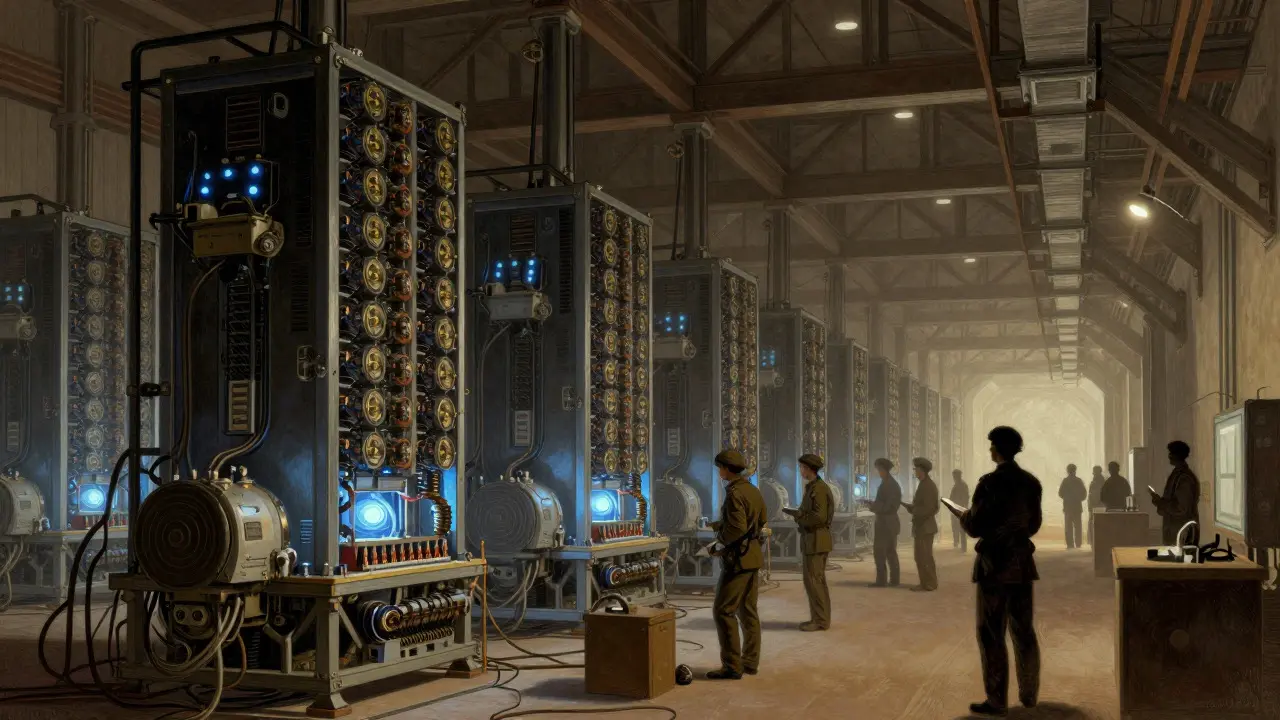
The infrastructure is massive. Consider the 175-megawatt Bitcoin farm in Rafsanjan, Kerman province. This facility is a joint venture between entities linked to the Islamic Revolutionary Guard Corps (IRGC) and Chinese investors. These operations are often located on military bases or within facilities controlled by powerful religious foundations like Astan Quds Razavi. They enjoy dedicated power feeds and political protection that lets them ignore electricity bills or access free energy.
The scale is staggering. The electricity consumed by Iranian miners requires the equivalent of roughly 10 million barrels of crude oil annually to generate. That represents about 4% of Iran's total oil exports in 2020. Essentially, instead of selling that oil, they burn the energy to mine Bitcoin. It is a direct swap of physical resource value for digital liquidity.
Most of the hardware comes from China. ASIC miners are smuggled in or imported through gray markets because direct sales are restricted by sanctions. Despite these hurdles, the competitive advantage of near-free energy keeps the hash rate high.
| Country | Global Hash Rate Share | Primary Motivation | Electricity Cost Advantage |
|---|---|---|---|
| United States | ~35% | Commercial Profit | Moderate ($0.03-0.08/kWh) |
| Kazakhstan | ~18% | Energy Export Surplus | High (Hydro/Nuclear) |
| Russia | ~11% | Sanctions Evasion / Profit | Very High (State Subsidized) |
| Iran | ~4.5% | Sanctions Circumvention | Extreme (Near Zero) |
| Venezuela | <1% | Currency Control (Petro) | High (But Grid Unstable) |
How the Money Moves: Obfuscation and Flows
Mining Bitcoin is only half the battle. The harder part is moving the value out of Iran without triggering alarms at international exchanges. This is where the strategy gets complex.
Iranian firms, including those affiliated with the IRGC, have processed billions in transactions through major platforms like Binance since 2018. To hide their tracks, they use a mix of techniques:
- Mixers and Tumblers: Services that scramble transaction histories to make tracing difficult.
- Proxy Exchanges: Using shell companies in Dubai, Hong Kong, or other free zones to act as middlemen.
- Stablecoins: Converting Bitcoin to TRON-based stablecoins to reduce volatility and ease transfer to partners.
- OtT (Over-the-Counter) Desks: Direct peer-to-peer deals with cash settlements abroad.
A landmark moment occurred in August 2025 when Iran placed its first official import order using cryptocurrency, totaling $10 million. This signaled that the state had mastered the logistics of converting mined coins into tangible goods like food, medicine, or technology parts.
Blockchain analytics firms like Elliptic, Chainalysis, and TRM Labs track these flows. Their data shows that while Iran holds 4.5% of the global mining share, the actual financial impact is amplified. Every time an Iranian miner collects a block reward, they are effectively extracting value from the global network. FinCEN issued advisories in mid-2025 warning banks about "teapot" refineries and UAE shell companies used to launder these proceeds.
Domestic Costs and Criticism
This strategy isn't without heavy costs for ordinary Iranians. The most visible issue is the power grid. During summer months, demand spikes, and mining farms consume so much electricity that blackouts become common. Citizens face rolling outages while IRGC-linked facilities run 24/7.
There is also the environmental angle. Much of this power comes from flaring natural gas. While better than letting the gas go to waste, it still contributes significantly to carbon emissions. Critics argue that the government prioritizes regime survival over public welfare and environmental sustainability.
Furthermore, the benefits are concentrated. Independent miners struggle with equipment shortages and regulatory uncertainty. Meanwhile, state-backed cartels reap the rewards. This creates a disconnect: the government uses crypto to evade sanctions, but the average citizen sees only higher prices and unstable internet.
Geopolitical Implications and Future Outlook
Iran’s success has drawn attention from other sanctioned nations. Russia has looked closely at Iran’s model, especially after facing similar sanctions following 2022. However, Iran has a head start. They have spent nearly seven years refining their infrastructure, building partnerships, and navigating enforcement actions.
Looking ahead, several trends will shape this strategy:
- Hardware Scarcity: As sanctions tighten, getting new ASIC miners becomes harder. Efficiency gains may slow down.
- Regulatory Crackdowns: International cooperation is increasing. More exchanges are implementing geographic blocks and KYC (Know Your Customer) checks that target Iranian IP addresses.
- Energy Reforms: If Iran fixes its grid or shifts more toward renewables, the marginal cost of mining might rise, reducing the profit margin.
- Diplomatic Shifts: Any return to the JCPOA or similar nuclear deals could reduce the incentive for crypto evasion. But current trends suggest expansion regardless of diplomacy.
Experts predict Iran will expand beyond Bitcoin. We may see more involvement in decentralized finance (DeFi) and central bank digital currencies (CBDCs). The goal remains the same: create a financial system that operates outside Western control.
What This Means for the Crypto World
For the broader cryptocurrency community, Iran’s presence raises questions about fungibility. Is all Bitcoin equal? If a coin was mined by an entity funding missile programs, should it be treated differently?
Some advocates argue that trying to segregate "clean" vs. "dirty" Bitcoin undermines the core principle of censorship resistance. Others say that ignoring the source exposes legitimate businesses to secondary sanctions. The debate continues, but one thing is clear: state-level adoption changes the game. It moves crypto from a niche tech experiment to a critical component of global geopolitics.
As we move through 2026, keep an eye on enforcement actions. The US Treasury and EU regulators are getting better at tracking these flows. But as long as sanctions exist, Iran will likely keep mining. It is a resilient, adaptive strategy that turns isolation into opportunity.
How much of the global Bitcoin hash rate does Iran control?
According to estimates by blockchain analytics firm Elliptic, Iran controls approximately 4.5% of the global Bitcoin mining hash rate. This makes it one of the top four mining jurisdictions worldwide, alongside the US, Kazakhstan, and Russia.
Why does Iran use Bitcoin mining to bypass sanctions?
Traditional banking channels are blocked by sanctions, preventing Iran from easily selling oil or moving money internationally. Bitcoin mining allows Iran to convert its abundant, subsidized energy into a globally recognized digital asset. This asset can then be traded for foreign currency or used directly to pay for imports, bypassing Western financial intermediaries.
Who runs the major Bitcoin mining farms in Iran?
Many of the largest and most influential mining operations are linked to the Islamic Revolutionary Guard Corps (IRGC) and powerful religious foundations like Astan Quds Razavi. These state-affiliated entities benefit from political protection, access to near-free electricity, and priority infrastructure support.
Does Bitcoin mining hurt Iran's civilian population?
Yes. The massive electricity consumption by mining farms strains the national power grid, leading to frequent blackouts for civilians and industries, especially during hot summer months. Critics argue that the government prioritizes regime revenue over public welfare.
How do Iranian miners move their profits out of the country?
They use a combination of methods including peer-to-peer (P2P) exchanges, shell companies in friendly jurisdictions like the UAE or Turkey, cryptocurrency mixers, and stablecoin conversions. Major exchanges like Binance have reported significant transaction volumes linked to Iranian entities, though many flows are obscured through intermediary wallets.
Is Iran's crypto strategy unique compared to other sanctioned countries?
Yes. Unlike Venezuela, which focused on a failed state-backed token (the Petro), or North Korea, which relies heavily on hacking, Iran focuses on legitimate large-scale Bitcoin mining. This approach generates internationally recognized assets and leverages existing industrial infrastructure, making it more sustainable and harder to shut down completely.