Imagine buying a house but signing the deed on a napkin. The deal works for you and the seller, but no bank will accept it, and you can't prove ownership to anyone else. That is what building Non-Fungible Tokens (NFTs) looked like before standards existed. Today, NFT standards are technical specifications that define how digital assets are created, transferred, and managed on blockchains. They act as the universal language that ensures your digital art, game item, or ticket works across wallets, marketplaces, and apps.
Without these rules, every developer would build their own isolated system. You might buy an NFT on one platform and find it’s completely invisible on another. Standards solve this by dictating exactly how data is stored and how transactions happen. In 2023, Ethereum held 78.3% of the NFT market share largely because its early standards became the industry default. But not all standards do the same thing. Some are built for rare, unique items, while others are designed for mass production in video games. Choosing the wrong one can cost you thousands in gas fees or break your entire project.
The Blueprint: How ERC-721 Established Digital Ownership
When people talk about NFTs, they are usually talking about ERC-721 is the first widely adopted standard for non-fungible tokens on Ethereum, introduced in 2018.
This standard was born out of necessity. In late 2017, the game CryptoKitties crashed the Ethereum network because each cat was treated as a unique asset with its own transfer logic. Developers realized they needed a common rulebook. By January 2018, EIP-721 was proposed, creating a template for "non-fungible"-meaning each token is distinct and cannot be exchanged one-for-one like Bitcoin or Ether.
Here is how ERC-721 defines functionality:
- Unique Token IDs: Every single NFT has a specific ID number. No two tokens in the same contract share the same ID.
- Strict Transfer Rules: To send an NFT, the smart contract checks three things: who is sending, who is receiving, and which specific token ID is moving. It also verifies if the recipient can actually accept the token.
- One-by-One Processing: This is the biggest limitation. ERC-721 handles only one token per transaction. If you want to send 10 NFTs, you must execute 10 separate transactions.
This structure makes ERC-721 perfect for high-value digital art, like pieces sold on SuperRare or OpenSea, where provenance and individual history matter most. However, it is incredibly inefficient for anything involving volume. Research shows that transferring 100 ERC-721 tokens requires 100 separate transactions, costing roughly $150 at average gas prices. For a user trying to move a collection, that friction is a dealbreaker.
The Multi-Token Solution: ERC-1155 for Gaming and Scale
If ERC-721 is a single envelope containing one letter, ERC-1155 is a multi-token standard developed by Enjin in 2018 that allows multiple token types in a single contract.
Developed specifically for gaming, ERC-1155 solves the inefficiency problem of ERC-721. It allows developers to create both fungible tokens (like in-game currency) and non-fungible tokens (like unique swords) within the exact same smart contract. More importantly, it enables batch transfers.
Consider a player in a blockchain game who wants to trade 10 gold coins, 3 health potions, and 1 legendary shield. With ERC-721, that is five separate transactions. With ERC-1155, it is one. According to technical benchmarks from Enjin, this reduces gas costs by approximately 90%. Specifically, ERC-1155 saves between 17,000 and 20,000 gas units per additional token compared to ERC-721’s consistent 45,000-60,000 units per transfer.
This functionality changes who uses the technology. While ERC-721 dominates the art world, ERC-1155 powers 32% of new NFT projects as of mid-2023, with 68% of those implementations being gaming applications. Companies like Axie Infinity use this standard to let players move complex inventories instantly and cheaply. If your project involves users holding many items, ERC-1155 is often the smarter functional choice.
Bridging the Gap: ERC-721A and Batch Minting
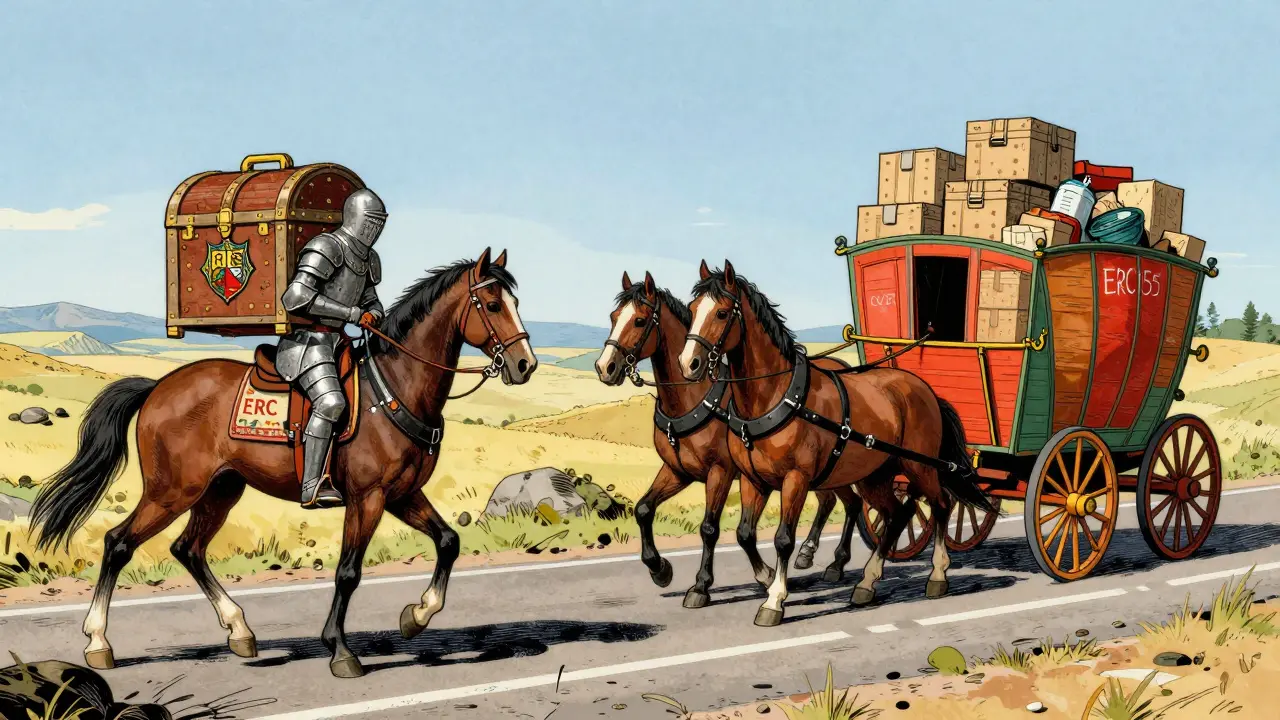
Sometimes you want the prestige of ERC-721 but need the efficiency of bulk operations. Enter ERC-721A is an extension of ERC-721 that adds batch minting capabilities while maintaining marketplace compatibility.
Created by Transak and popularized by projects like Art Blocks, ERC-721A keeps the familiar interface of ERC-721 so existing tools still work. However, it optimizes the code to allow multiple NFTs to be minted in a single transaction. This is crucial for generative art projects where artists release hundreds of pieces at once.
By Q3 2023, ERC-721A had captured 23% of the new project market, growing 320% in just six months. It addresses the primary complaint against ERC-721-high minting costs-without forcing developers to abandon the ecosystem's largest liquidity pools. For example, a creator minting a 100-piece collection could save nearly $400 in gas fees using ERC-721A compared to standard ERC-721, according to developer reports from late 2023.
Beyond Ethereum: SIP-009 and FA2
Ethereum isn't the only place NFTs live. Different blockchains have different priorities, leading to alternative standards that define functionality in unique ways.
| Standard | Blockchain | Key Functionality | Best Use Case |
|---|---|---|---|
| ERC-721 | Ethereum | Single unique tokens, strict validation | Digital Art, Collectibles |
| ERC-1155 | Ethereum | Batch transfers, mixed fungible/non-fungible | Gaming, Mass Market Items |
| ERC-721A | Ethereum | Batch minting, ERC-721 compatible | Generative Art, Large Drops |
| SIP-009 | Stacks | Bitcoin-backed security, BTC anchoring | Bitcoin-centric Assets |
| FA2 | Tezos | Low energy, batch operations, OCaml-based | Eco-friendly Art, Low-Cost Trading |
SIP-009 is the NFT standard for the Stacks blockchain, securing assets via Bitcoin's proof-of-work. It appeals to users who trust Bitcoin’s security model but want programmable tokens. Meanwhile, Tezos’ FA2 is a standard designed for low-cost, energy-efficient batch operations on the Tezos blockchain. FA2 gained traction in the art community due to Tezos' lower environmental impact and cheaper transaction fees.
Technical Pitfalls and Security Risks
Understanding functionality also means understanding failure points. Each standard introduces specific risks that developers and users must navigate.
With ERC-721, the biggest issue is the tokenReceiver check. When you send an NFT to a smart contract (like a wallet), the contract must explicitly say "I accept this." If it doesn’t, the transaction fails. In January 2023, 68% of questions on Ethereum Stack Exchange regarding ERC-721 were about transfer failures due to incorrect recipient validation. Users have lost funds by sending tokens to addresses that couldn't handle them.
Another risk lies in approvals. ERC-721 requires you to "approve" a marketplace to sell your NFT. If you approve a malicious site, it can drain your wallet. Between 2020 and 2022, improper approval handling led to $2.7 million in losses. Newer proposals like EIP-6454 aim to fix this with temporary delegations, but until then, users must be cautious.
For ERC-1155, the complexity comes from accounting. Because one contract holds both currency and unique items, errors in coding can lead to "mixed fungible/non-fungible token accounting" issues. A survey found that 41% of developers struggled with this balance, potentially locking up assets if the math gets wrong.
Choosing the Right Standard for Your Project
So, which one should you pick? It depends entirely on what you are building.
- Are you selling unique digital art? Stick with ERC-721. Buyers expect it, marketplaces support it natively, and the focus on individual provenance fits the medium.
- Are you building a video game? Use ERC-1155. Players need to move inventory quickly and cheaply. The ability to bundle items into one transaction is essential for user experience.
- Are you launching a large generative art drop? Consider ERC-721A. You get the compatibility of ERC-721 with the cost savings of batch minting.
- Do you prioritize Bitcoin security? Look at SIP-009 on Stacks.
- Is cost and sustainability your main concern? Explore FA2 on Tezos.
As of 2026, the trend is toward convergence. Gartner predicts that 70% of major platforms will support at least three standards by next year. However, fragmentation remains a risk. About 28% of cross-standard transfers fail due to incompatibility. Always ensure your chosen standard aligns with the wallets and marketplaces your audience already uses.
What is the difference between ERC-721 and ERC-1155?
ERC-721 treats each NFT as a unique, standalone token requiring separate transactions for each transfer. ERC-1155 allows multiple tokens (both unique and fungible) to be stored in a single contract and transferred in batches, significantly reducing gas fees and improving efficiency for gaming and mass-market applications.
Why do NFT standards matter for buyers?
Standards determine compatibility. If you buy an NFT on a standard that your wallet or favorite marketplace doesn't support, you may not be able to view, trade, or use it. Standards also affect transaction costs; some standards are much more expensive to transfer than others.
Is ERC-721 outdated?
Not necessarily. While it is less efficient for bulk operations, ERC-721 remains the gold standard for high-value digital art and collectibles due to its widespread adoption and clear provenance tracking. Many legacy collections still rely on it, and it is deeply integrated into major marketplaces like OpenSea.
What is ERC-721A used for?
ERC-721A is used primarily for batch minting. It allows creators to mint hundreds or thousands of NFTs in a single transaction, saving significant gas fees compared to standard ERC-721, while remaining compatible with existing ERC-721 infrastructure.
Can I convert an NFT from one standard to another?
Direct conversion is not possible because the underlying smart contract structures are different. However, specialized bridges or wrapping services exist that can lock an NFT in one standard and issue a representative token in another, though this introduces additional counterparty risks.
The whole NFT thing is just a digital pyramid scheme designed to separate fools from their money while the elites profit off the chaos. They tell you it's about 'ownership' but really it's about control and surveillance. I've seen how these platforms track every move you make. It's not technology, it's tyranny wrapped in code. Stay awake people.
good read but u misspelled enjin in the text. also why do we need so many standards its confusing af. just pick one and stick with it lol
Look at this mess of information 🤦♂️ People think they understand blockchain but they don't even know the difference between ERC-721 and ERC-1155 properly. The article tries to simplify it but honestly most readers are too lazy to grasp the technical nuances. Wake up sheeple 🐑
omg this is actually super helpful! i was so confused about gas fees before but now i get why erc-1155 is better for gaming. thanks for breaking it down so simply :)
Wow, what an incredible breakdown! It’s amazing to see how far we’ve come in standardizing digital assets. Let’s keep learning and supporting each other as we navigate this evolving landscape together. Peace and love to all creators out there ✌️
interesting points. i prefer simpler explanations though. maybe less jargon next time?
This article is a absolute masterpiece of clarity! The way it dissects the differences between these standards is nothing short of brilliant. Truly inspiring work that sheds light on the complexities of our digital future. Bravo!
great overview but i noticed some typos like 'enjin' should be capitalized. overall very informative though! thanks for sharing your knowledge with us all.
One must appreciate the meticulous attention to detail in this exposition regarding Ethereum-based token standards. The distinction between ERC-721’s singular focus and ERC-1155’s multifaceted utility is elegantly articulated. A truly scholarly approach to demystifying complex cryptographic protocols.
Another day another piece of fluff pretending to educate. You guys really think people care about which standard they use when the entire system is rigged against them? Stop selling snake oil and start talking truth.
I’m curious about the real-world impact of these standards beyond just tech specs. How does choosing one over another affect everyday users who aren’t developers? Also, loving the colorful examples used here!
It is imperative that we recognize the superiority of established frameworks such as ERC-721. While newer iterations attempt to innovate, they often compromise the integrity and provenance tracking that has made traditional standards indispensable for high-value collectibles.
What fascinating insights into the evolution of digital ownership! It makes me wonder how these technological shifts reflect broader societal changes in trust and value. Can we explore more about the philosophical implications behind adopting different standards?
Oh sure let’s pretend any of this matters when half the projects fail within months anyway. Typical hype cycle nonsense disguised as education. Who needs batch transfers when you can’t even sell your monkey JPEGs?
Listen up folks if you’re still using ERC-721 for anything other than art you’re doing it wrong. Basic stuff here no rocket science needed just common sense applied correctly.