When a single wallet moves 10,000 ETH-roughly $30 million-in a single transaction, the market feels it. Prices shift. Traders scramble. And if you’re not watching, you miss the signal. This isn’t speculation. It’s data. Every Bitcoin and Ethereum transaction is permanently recorded on a public ledger. That means anyone can see when whales-investors holding massive amounts of crypto-start moving their coins. The question isn’t whether you should track them. It’s how to do it right.
What Exactly Is a Crypto Whale?
A crypto whale isn’t just someone with a lot of crypto. It’s someone who holds enough to move markets. For Bitcoin, that’s typically 1,000 BTC or more. For Ethereum, it’s 10,000 ETH. These aren’t random numbers. They’re thresholds based on historical price movements and market impact. A single transfer of this size can trigger ripple effects: exchange deposits often signal selling pressure, while withdrawals to cold wallets suggest accumulation. According to Nansen.ai’s 2025 analysis, whale transactions over these thresholds often precede price swings of 3-5% within 24 hours.Not all large transfers are whales, though. Many come from exchanges like Binance or Coinbase, which move funds internally for operational reasons. That’s why tools now use wallet labeling to distinguish between institutional flows and true whale behavior. A wallet labeled "Binance Hot Wallet" isn’t a whale-it’s a bank. A wallet labeled "Unknown Whale - Accumulating"? That’s the signal you want.
How Whale Tracking Works
Whale tracking relies on blockchain explorers like Etherscan and BscScan. These tools read every transaction that happens on a blockchain. Specialized platforms take that raw data and filter it for unusual activity. They set thresholds-say, any ETH transfer over 5,000 ETH-and then alert users instantly.Most services work the same way: they scan the blockchain, detect large transfers, and push notifications. But the real difference comes in what happens after the alert. Premium tools like Nansen.ai and Arkham Intelligence don’t just show the transaction. They show who sent it, where it came from, and what it might mean.
For example, if a wallet labeled "Coinbase Institutional" sends 8,000 ETH to an unknown address, that’s different from a wallet labeled "Whale_0x7a9f" moving the same amount. The first might be a rebalancing. The second? Could be a major accumulation.
These systems use machine learning to spot patterns. Arkham Intelligence’s models, tested in Q1 2025, correctly identified strategic whale movements 92.7% of the time. That’s not luck. It’s data-driven analysis.
The Best Tools for Tracking Whale Movements
There are dozens of whale trackers, but only a few deliver real value. Here’s what actually works:| Platform | Price | Key Strength | Best For | Limitations |
|---|---|---|---|---|
| Whale Alert | Free | Real-time Twitter and Telegram alerts | Beginners, quick signals | No wallet labeling, high false positives |
| Nansen.ai | $99-$999/month | Labeled wallets, exchange flow analysis | Advanced traders, institutional users | Steep learning curve |
| Arkham Intelligence | $149+/month | 15-blockchain coverage, profit/loss tracking | Multi-chain traders, analytics pros | Expensive, complex interface |
| Debank | Free-$19.99/month | Portfolio tracking across chains | Portfolio managers, DeFi users | Weak whale-specific alerts |
| CryptocurrencyAlerting.com | $29/month | Custom thresholds, token-specific alerts | Mid-tier users, niche token traders | Limited historical data |
Whale Alert remains the most popular because it’s free and simple. But if you’re serious about using whale data, you need more than a Twitter bot. Nansen.ai leads in wallet intelligence. Arkham excels at cross-chain tracking. Debank is great if you’re already managing a DeFi portfolio. Choose based on your goals, not just price.
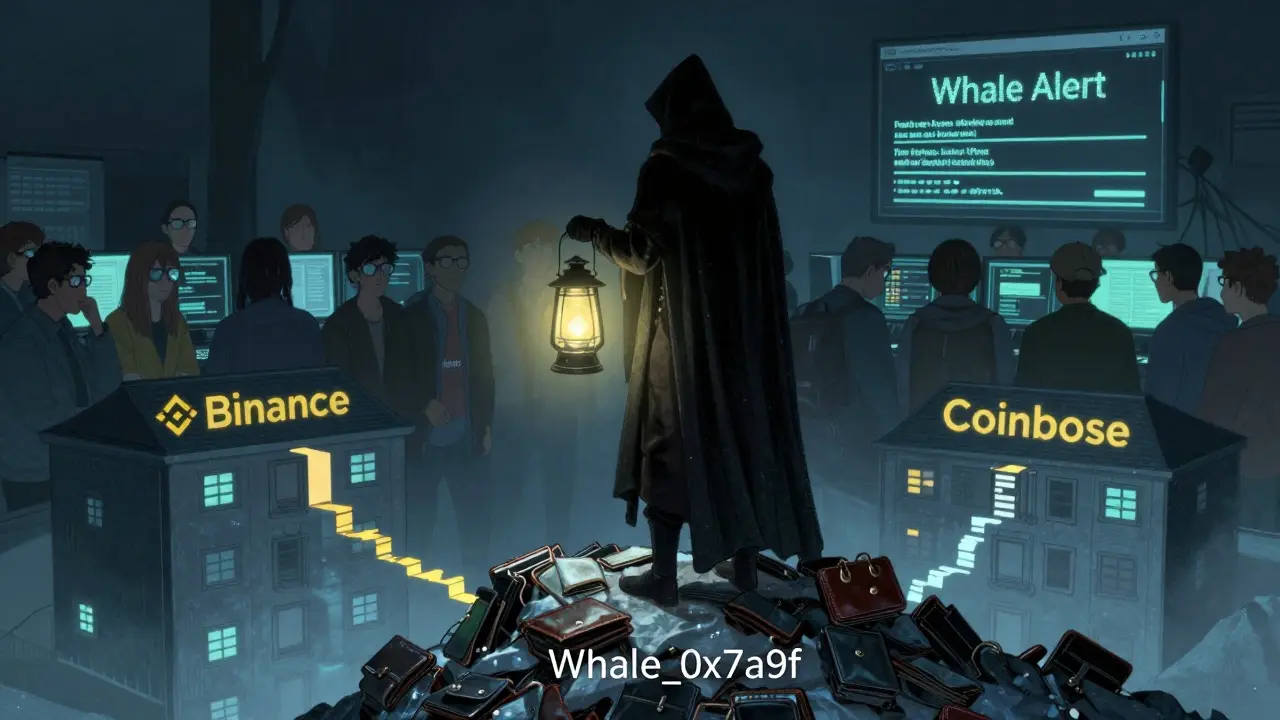
Five Proven Strategies to Interpret Whale Moves
Seeing a whale move isn’t enough. You need to know what it means. Here are five strategies backed by real data:- Monitor exchange net flows. When whales move crypto to exchanges, they’re likely preparing to sell. When they move it away from exchanges and into cold wallets, they’re accumulating. Nansen.ai found that ETH outflows from exchanges preceded 72% of major rallies in 2024-2025.
- Track stablecoin inflows. If a whale moves $10 million in USDT to an exchange, they’re probably ready to buy. Large stablecoin deposits on exchanges often signal buying pressure within 12-24 hours.
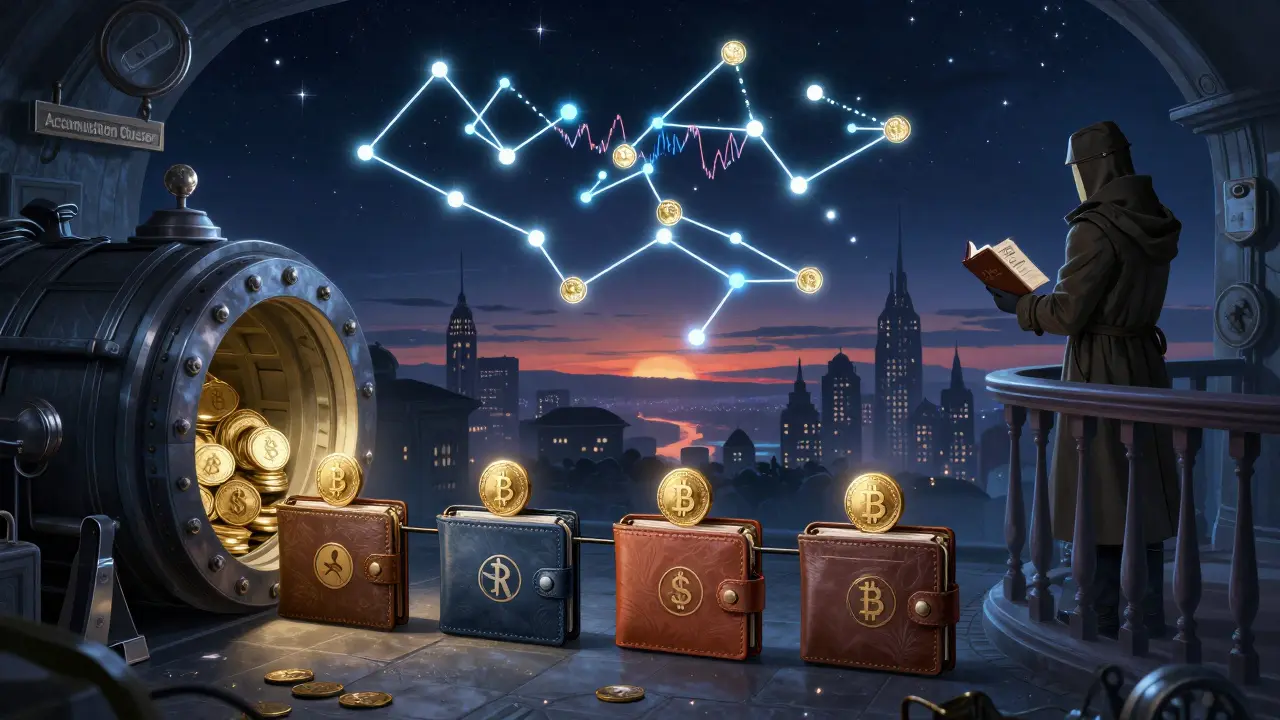
- Look for cluster behavior. Whales don’t operate alone. Tools like Arkham group related wallets into clusters. If 5 wallets in the same cluster all start withdrawing ETH, it’s not coincidence-it’s coordinated action.
- Cross-check with market sentiment. A whale deposit to Binance during a market panic? That’s likely a sell-off. But if it happens while Twitter is buzzing about a new Ethereum upgrade? It might be a trap. Combine whale data with social sentiment for better context.
- Use technical indicators. A Reddit user named u/CryptoWhaleWatcher made 37% in 72 hours in July 2025 by combining Nansen’s whale outflow alerts with RSI divergence on the ETH/USDT chart. Whale data alone gives you a signal. Technical analysis confirms it.
Common Mistakes and How to Avoid Them
Most people fail at whale tracking because they treat it like a magic bullet. Here’s what goes wrong:- False positives. Whale Alert has a 2.1/5 accuracy rating on Trustpilot. Many "whale" moves are just exchange transfers. Always check wallet labels. If it says "Binance" or "Coinbase," it’s not a whale.
- Overreacting. One big transfer doesn’t mean the market is crashing. Whale activity is noisy. Look for patterns over days, not single events.
- Ignoring privacy coins. Monero, Zcash, and privacy-focused DeFi protocols make 8-12% of total crypto value untrackable. Don’t assume whale data tells you the whole story.
- Chasing every alert. If you’re getting 20 alerts a day, you’re drowning. Set custom thresholds. Only alert on transfers over 5,000 ETH-not 1,000. Filter out noise.
- Forgetting manipulation. Some whales create fake signals. "Whale wall spoofing" means placing a huge buy order to scare others into buying, then canceling it. Wash trading inflates volume to lure in retail traders. Always verify with multiple sources.
What You Can’t Track (And Why It Matters)
The blockchain is transparent-but not perfect. Privacy tools like Tornado Cash and Mixer protocols are now used by 15-20% of ETH transactions, making them untraceable. That’s up from 5% in 2023. Some whales deliberately use these to hide their movements.Also, many large holders use multi-sig wallets, private nodes, or off-chain OTC deals. These don’t show up on public blockchains at all. That’s why whale tracking only covers part of the market. It’s a powerful tool, but it’s not a crystal ball.
How to Set Up Your First Whale Tracker
Start simple. Here’s how to get going in under an hour:- Choose your tool. Start with Whale Alert if you’re new. It’s free and gets the job done.
- Set up alerts. Subscribe to their Telegram or Twitter feed. Don’t overload yourself-only enable alerts for BTC and ETH at first.
- Define your threshold. Change the default from 1,000 BTC to 1,500 BTC. Fewer alerts = better signal-to-noise ratio.
- Track for 7 days. Write down every whale move you see. Note the time, amount, and direction (exchange deposit or withdrawal). Then check the price 24 hours later. Did it move?
- Upgrade. After a week, if you’re hooked, try Nansen.ai’s free trial. See how wallet labels change your perspective.
Don’t try to master Arkham on day one. Start with the basics. The goal isn’t to predict the market. It’s to spot patterns that others miss.
The Bigger Picture: Why This Matters
Whale tracking isn’t just about making trades. It’s about understanding market power. In 2025, 78% of crypto hedge funds use these tools. That means the smart money is already watching. If you’re not, you’re playing catch-up.Blockdata’s 2025 report shows the whale tracking industry hit $127 million in revenue last year-and it’s projected to hit $342 million by 2026. That’s not hype. It’s demand. Institutions aren’t using these tools because they’re trendy. They’re using them because they work.
But here’s the truth: whale tracking won’t make you rich overnight. It won’t replace technical analysis or fundamental research. What it does is give you an edge. It shows you where the real money is moving before the crowd reacts. That’s priceless.
Can you track crypto whales on all blockchains?
No. Most whale trackers focus on Ethereum, Bitcoin, and Binance Smart Chain because they’re transparent and widely used. Newer chains like Solana or Polygon are partially supported, but data quality varies. Privacy chains like Monero or Zcash are intentionally untrackable, and tools can’t monitor those. Always check which blockchains your tool supports before relying on it.
Are whale movements always a good signal to follow?
Not at all. Many whale moves are routine-exchange rebalancing, wallet consolidation, or corporate treasury shifts. A single large transfer doesn’t mean the market is about to spike. Look for patterns: multiple large withdrawals over days, combined with low exchange supply and rising stablecoin inflows. That’s the real signal. One alert? Just noise.
Is Whale Alert still reliable in 2026?
Yes-but only as a starting point. Whale Alert remains the most popular free tool, with over 500,000 users and 1.2 million Twitter followers. It’s great for real-time alerts. But it doesn’t label wallets or explain context. If you’re serious about trading, use it alongside Nansen.ai or Arkham Intelligence. Think of Whale Alert as your alarm bell. The other tools tell you what the alarm means.
Can whale tracking predict a crypto bull run?
It can give you early warning signs, but it doesn’t predict bull runs on its own. For example, if whales start moving ETH out of exchanges and into cold wallets while stablecoin balances on exchanges rise, that’s a classic accumulation pattern seen before past rallies. But you still need to confirm with on-chain metrics like network activity, developer growth, and macro conditions. Whale tracking is one piece of the puzzle-not the whole picture.
Do I need to pay for whale tracking tools?
No, but you’ll miss half the value. Free tools like Whale Alert and Debank give you basic alerts. Paid tools like Nansen.ai and Arkham Intelligence show you who is moving the money, why they might be doing it, and how it compares to past behavior. If you’re trading more than $10,000 at a time, the $99/month fee pays for itself in better decisions. For casual users, free tools are fine. For serious traders, paid tools are essential.
Next Steps: What to Do Now
Start today. Open Whale Alert’s Telegram channel. Set a reminder to check it once a day for a week. Write down every whale move you see. Then check the price 24 hours later. Did it go up? Down? Stay flat? You’ll start seeing patterns. That’s how you learn.After two weeks, try Nansen.ai’s free trial. Compare what you saw on Whale Alert with what Nansen labels. You’ll be shocked at how many "whales" are just exchanges.
Whale tracking isn’t about getting rich quick. It’s about seeing the market differently. The people who win aren’t the ones who predict the future. They’re the ones who notice what everyone else ignores.
This is overcomplicated. Just watch Whale Alert and move on.
The author misunderstands the fundamental architecture of market signaling. Whale movements are not predictive-they're reactive artifacts of liquidity repositioning. Nansen's labeled wallets are statistically noisy, and Arkham’s ML models are trained on survivorship bias. The 92.7% accuracy claim is a fabrication wrapped in institutional jargon. Real alpha comes from order flow depth, not blockchain breadcrumbs.
Wait wait wait… so you’re telling me the FED is behind ALL these whale moves?? And Nansen? That’s just a front for the CIA. I saw a guy on YouTube say they use satellite data to track cold wallets. Also, why is ETH always moving right before a Fed meeting? Coincidence? I think NOT. 🤔
I just started using Whale Alert and it’s so cool to see big moves in real time! I don’t know what all the fancy tools do but I’m learning. Anyone have tips on how to not panic when a whale moves? I froze last time and missed a 15% pump 😅
All this data is useless. The market is manipulated by a handful of firms. Whale alerts are just bait for retail. You think you're seeing patterns? You're being herded.
We have turned financial markets into a casino governed by invisible forces and algorithmic ghosts. The blockchain is not a ledger of truth-it is a theater of performance. To chase whales is to worship the shadows of capital. We have lost the moral compass of value. This is not progress. It is idolatry.
I think the article does a decent job laying out the tools. I use Debank daily and it helps me keep track of my portfolio across chains. The whale alerts are fun to watch but I never trade on them alone. Always combine with on-chain volume and sentiment. That’s how I stay sane.
OMG I just saw a 12k ETH transfer and I thought I was gonna die. Like literally. My heart stopped. I ran to my laptop, opened Nansen, and cried. It was Binance. I felt so stupid. Why do they even make these tools if they’re just lying to us?? I’m so done with crypto. 🥲💔
The entire premise of this article is a capitalist fallacy. In a truly decentralized system, the notion of ‘whales’ should be obsolete. The fact that institutions have monetized blockchain transparency into a subscription-based surveillance racket is a betrayal of the original ethos. The U.S. SEC has quietly endorsed this model to centralize control under the guise of transparency. This isn’t innovation-it’s enclosure.
It is imperative that traders recognize the elevated utility of institutional-grade analytics. The empirical data presented herein, particularly the 92.7% predictive accuracy of Arkham Intelligence’s models, represents a statistically significant advancement in market foresight. To dismiss these tools is to operate with obsolete paradigms. The future of trading is data-driven, not sentiment-driven.
I’m from the Philippines and we don’t have access to Nansen or Arkham. Whale Alert is my bible. But I gotta say, I’ve made more money ignoring whale alerts and just holding BTC during dips. Maybe the real whale is the one who doesn’t even look at the charts?
I just set up my first Whale Alert alert 🎉🎉🎉 and I’m so excited!! I got one last night and I was like ‘OMG I’M A PRO TRADER NOW’ 😭💸 I even told my cat and she looked at me like I was crazy. But I don’t care!! This is life changing!!! 🐳✨
I read this whole thing… and then I just cried. I’ve been chasing whales for two years. I lost 80% of my portfolio. I’m done. I’m selling everything. I’m moving to a farm. I miss grass.
The deeper issue here is not the tools, but the epistemological shift in market behavior. Whale tracking transforms market participants from actors into observers of deterministic signals, eroding the agency of individual decision-making. The blockchain, once a symbol of liberation, now functions as a panopticon for algorithmic capital. This is not democratization-it is the commodification of transparency. We must ask: who owns the data? Who profits from the surveillance? And at what cost to the autonomy of the retail participant?
You’re all missing the point. Whale tracking works ONLY if you integrate it with DeFi yield curves, MEV arbitrage patterns, and gas fee spikes. Nansen’s wallet labels are outdated-they don’t account for Tornado Cash washes. Arkham’s 15-chain coverage is useless if you’re not tracking ZK-sync rollups. And Whale Alert? That’s a toddler’s toy. Real traders use custom Python scripts scraping Etherscan logs with Web3.py. If you’re not coding, you’re not trading.
This article is a joke. You think whales are smart? They’re the same people who dumped Solana in 2022 and bought Dogecoin in 2021. They’re not geniuses-they’re gamblers with bankrolls. The only thing you’re tracking is the last mistake someone made. Don’t be a follower. Be the whale.
The data presented lacks methodological rigor. The sample size for Nansen’s 2025 analysis is not disclosed. The confidence intervals are omitted. The control group for Arkham’s 92.7% accuracy is undefined. Without peer-reviewed methodology, this is not research-it is marketing copy disguised as analysis. I am deeply disappointed in the lack of academic integrity here.
Whales don’t move markets. Markets move whales. The real signal is not in the transaction-it’s in the silence. The ones who don’t move are the ones who matter.