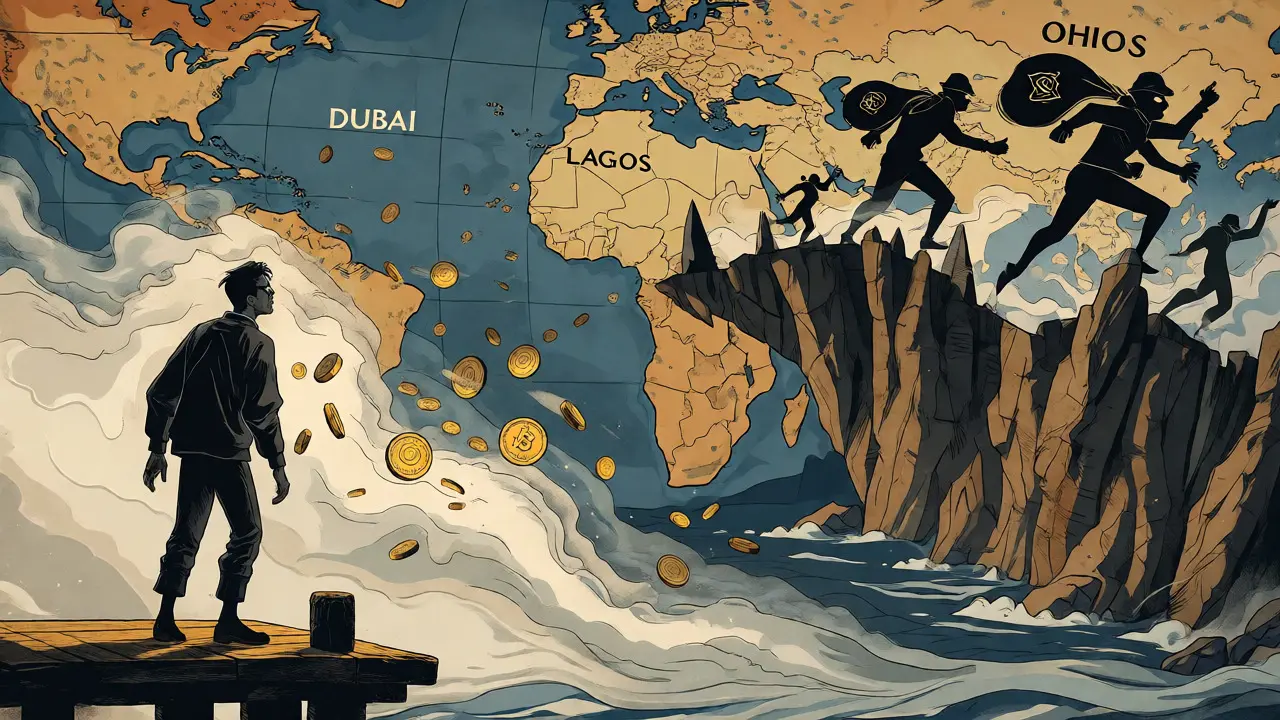
You send money to a stranger online. It vanishes. You report it to the police, but they shrug. The scammer is in another country, the money moved through five digital wallets in seconds, and your local law enforcement has no jurisdiction over what happened in Dubai or Lagos. This used to be the end of the story for victims of crypto crime. Today, it’s just the beginning.
The landscape has shifted dramatically by late 2026. We are no longer watching isolated national efforts struggle against borderless digital theft. Instead, we see coordinated global strikes that dismantle criminal networks across continents. If you’ve ever wondered how authorities actually catch someone who stole Bitcoin from a phone in Ohio while hiding in Southeast Asia, the answer lies in complex international cooperation frameworks that have matured rapidly over the last three years.
Why Solo Investigations Fail Against Borderless Theft
Cryptocurrency doesn’t respect borders. A transaction can hop from a wallet in Germany to an exchange in Singapore in under ten minutes. Traditional policing relies on physical presence and legal authority within specific geographic lines. When criminals exploit this gap, solo investigations hit a wall. You can’t arrest someone in a country where your officers don’t have power. You can’t seize assets held in a bank account you can’t legally touch.
This structural mismatch created a safe haven for cybercriminals. For years, scammers operated with near impunity because the friction of international bureaucracy was higher than the cost of their crimes. But the game changed when agencies stopped working in silos. The realization was simple: if the crime is global, the response must be too. This shift isn’t just about sharing emails; it’s about integrated operational structures that allow simultaneous actions in multiple jurisdictions.
The Engine Room: INTERPOL and the HAECHI Operations
At the center of this new era sits INTERPOL, which acts as the central nervous system for international police cooperation on financial crime. While many know INTERPOL for red notices, its role in crypto enforcement has evolved into something far more technical and proactive. The flagship example is the HAECHI Initiative, launched in 2020 to combat cyber-enabled financial crimes including voice phishing and romance scams.
By August 2025, Operation HAECHI VI demonstrated the raw power of this model. Involving 40 countries, the operation resulted in 3,000 arrests and, crucially, recovered $439 million in stolen funds. That number matters. It disproves the old myth that once crypto leaves your wallet, it’s gone forever. Theos Badege, Director pro tempore of INTERPOL’s Financial Crime and Anti-Corruption Centre, noted that these outcomes prove recovery is possible when nations act together.
How does it work? It’s not magic. It’s data synchronization. Participating countries share real-time intelligence on suspicious transactions. When a Korean steel company detected forged shipping documents linked to a fraudulent payment sent to Dubai, the Korean National Police Agency didn’t wait for a slow diplomatic request. They worked directly with Emirati authorities through established channels, recovering KRW 6.6 billion (USD 3.91 million). Speed is the weapon here, and cooperation is the delivery mechanism.
Technical Tools: Tracing the Invisible Money Trail
Cooperation fails without the right tools. You can’t arrest a ghost. Investigators need to see where the money went. This is where private sector technology partners like Chainalysis and Elliptic become critical allies to law enforcement. These firms provide the blockchain analytics software that traces illicit transactions across decentralized networks.
In 2025, the challenge wasn’t just tracing Bitcoin; it was tracking funds moving through complex DeFi protocols and cross-chain bridges. Elliptic’s research identified over $21.8 billion in illicit crypto laundered using cross-chain methods. Criminals use decentralized exchanges and no-KYC coin swaps to obscure their trail. To counter this, investigators now use automated cross-chain tracing tools. What used to take hours of manual ledger checking now takes clicks and minutes. This efficiency allows police to freeze assets before criminals can cash out.
Another key tool is I-GRIP (Global Rapid Intervention of Payments), launched by INTERPOL in 2022. Think of it as a global emergency brake. It enables real-time communication between financial intelligence units across borders. If a scam victim reports a transfer, I-GRIP alerts relevant financial institutions in other countries instantly, potentially stopping the movement of funds before they disappear into the dark web.

Regional Differences: Africa, Europe, and the US Approach
While the goal is unified, regional tactics differ based on local threats. In Africa, the focus has been on dismantling infrastructure. Operation Serengeti 2025 saw authorities in Angola dismantle 25 cryptocurrency mining centers in August 2025. These weren’t just hobbyist rigs; they were hubs for large-scale investment scams that defrauded 65,000 victims of an estimated $300 million in Zambia alone. The coordination involved African Union bodies like AFRIPOL working alongside INTERPOL, showing how regional blocs are strengthening their own capabilities while integrating with the global net.
In Europe, the approach leans heavily on regulatory alignment and prevention. Europol emphasizes issues like crypto-enabled money laundering and the online recruitment of minors. Their strategy involves harmonizing laws so that a license granted in one EU state carries weight in others, reducing the arbitrage opportunities for bad actors. Meanwhile, the United States focuses aggressively on prosecution. The Department of Justice has pursued high-profile cases, such as the October 2024 charges against 17 individuals for manipulating altcoin volumes using bots. The SEC complements this with civil suits, creating a dual-pressure environment for companies operating in the US market.
| Region | Primary Focus | Key Mechanism | Recent Impact |
|---|---|---|---|
| Africa | Infrastructure Dismantling | AFRIPOL + INTERPOL Coordination | Dismantled 25 mining centers in Angola; $300M recovered in Zambia |
| Europe | Regulatory Harmonization | Europol Conference of Police Chiefs | Focused on anti-money laundering and minor protection |
| United States | Criminal Prosecution | DOJ & SEC Joint Actions | $2.8M seized in Aug 2025; 17 charged for market manipulation |
| Asia-Pacific | Rapid Asset Recovery | HAECHI Initiative | $439M recovered in HAECHI VI; 3,000 arrests |
The Private Sector Role: Why Police Need Data Partners
Law enforcement agencies rarely build their own blockchain analysis software from scratch. It’s too fast-changing and resource-intensive. Instead, they rely on partnerships with firms like TRM Labs. TRM’s 2025 Crypto Crime Report highlights that sanctioned entities and terrorist groups have shifted tactics in response to global crackdowns. They adapt quickly. If one method of laundering gets blocked, they find another.
This dynamic requires constant information flow. INTERPOL Director Theos Badege explicitly stated that working with private sector experts enhances insights into cybercriminal activities. These companies monitor the blockchain 24/7, identifying patterns that human investigators might miss. For instance, Chainalysis reported that direct transfers from illicit entities to exchanges collapsed from 40% in 2021-2022 to around 15% in Q2 2025. Why? Because criminals started using more sophisticated intermediate steps. Detecting this shift requires the kind of big-data analytics only private tech firms can provide at scale.

Challenges That Still Remain
Despite the wins, cracks remain in the armor. Cross-chain tracing is still difficult. When funds move through decentralized finance (DeFi) bridges, the trail can go cold if the bridge doesn’t support standard metadata standards. Elliptic notes that automatic cross-chain tracing is improving, but it’s not perfect yet. Manual investigation still plays a role in complex cases.
There’s also the issue of training. Effective crypto investigations require specialized skills. Officers in Operation Serengeti underwent 120 hours of specialized training just to understand the basics of cryptocurrency tracing. Not every police station has access to this level of expertise. While 87% of INTERPOL member countries now have dedicated crypto units-up from 62% in 2022-the quality of those units varies wildly. A well-funded unit in Seoul operates differently than an under-resourced one in a smaller nation, creating uneven enforcement pressure globally.
Finally, speed remains a hurdle. Criminals move faster than bureaucracies. By the time a warrant is issued, approved, and executed internationally, the funds may have been converted to fiat currency and spent. The I-GRIP system helps, but it’s not universal. Adoption gaps mean some countries are plugged into the rapid-response network while others are not.
What This Means for You
If you’re an investor or regular user, this evolution changes your risk profile. The days of "send and forget" are ending. International cooperation means that if you fall victim to a scam, there is a genuine chance of recovery, provided you act fast. Reporting the incident immediately triggers the international alert systems. Your local police can tap into the global network via INTERPOL or regional equivalents.
For businesses, compliance is no longer optional box-ticking. With regulators coordinating across borders, hiding non-compliance in one jurisdiction while serving customers in another is getting harder. The $439 million recovered in HAECHI VI sends a clear message: the net is tightening. Staying compliant with evolving KYC (Know Your Customer) and AML (Anti-Money Laundering) standards protects you from being caught in the crossfire of enforcement actions.
Can I recover my stolen crypto if the scammer is overseas?
Yes, it is increasingly possible. Operations like HAECHI VI have recovered hundreds of millions of dollars by coordinating across borders. However, success depends on reporting the crime quickly to trigger mechanisms like I-GRIP, which alerts financial institutions in other countries to stop or flag the funds.
What is the HAECHI Initiative?
HAECHI is a multi-year initiative led by INTERPOL to combat cyber-enabled financial crimes, particularly those involving cryptocurrency. Launched in 2020, it facilitates cooperation among member countries to investigate and prosecute offenses like voice phishing and romance scams. As of 2025, it has facilitated thousands of arrests and significant asset recoveries.
How do police trace crypto transactions?
Police use blockchain analytics tools provided by private companies like Chainalysis, Elliptic, and TRM Labs. These tools analyze public ledger data to identify patterns, link wallets to known entities, and trace funds across different blockchains. Specialized training allows investigators to interpret this data and coordinate with exchanges to freeze assets.
Which countries are most active in crypto crime enforcement?
Countries participating in INTERPOL operations are highly active. South Korea, through its National Central Bureau, has been a leader in HAECHI operations. The United States focuses on DOJ prosecutions, while European nations coordinate through Europol. African nations, supported by AFRIPOL, have recently increased activity, notably in Angola and Zambia.
Does international cooperation slow down crypto transactions?
Not typically for legitimate users. Cooperation targets suspicious activity flagged by algorithms. However, if your transaction is flagged as high-risk, exchanges may delay processing while they verify compliance with international sanctions lists. This is part of the broader effort to prevent money laundering.