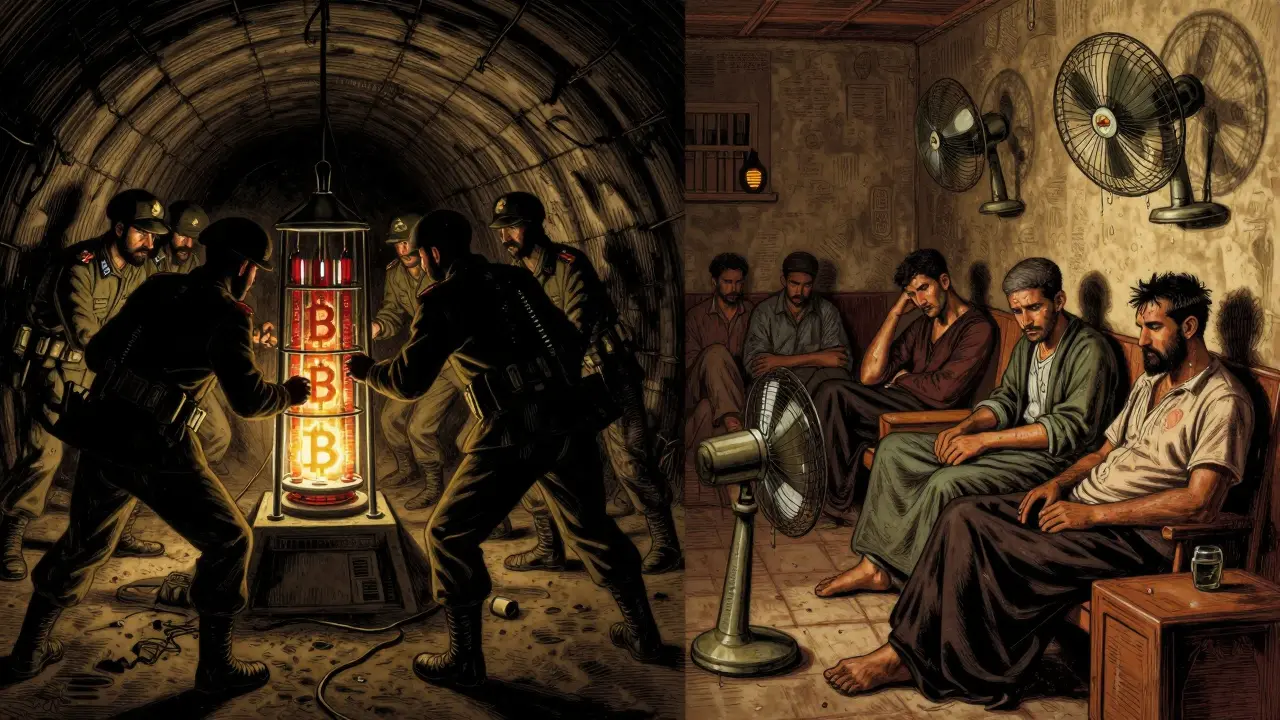
Imagine paying less than five cents for a kilowatt-hour of electricity. Now imagine that same power costs you $0.15 or more in most Western countries. This massive price gap is not a typo; it is the foundation of one of the world’s most controversial economic experiments. In Iran, the government provides heavily subsidized electricity to fuel a booming cryptocurrency mining industry that generates billions in revenue but leaves millions of citizens in the dark.
This isn't just about making money online. It is a complex web of sanctions evasion, state-controlled infrastructure, and public frustration. As of mid-2026, the intersection of Iranian energy policy and digital currency has created a system where the military controls vast amounts of computing power, ordinary households face daily blackouts, and the government walks a tightrope between economic survival and grid collapse. If you are trying to understand why Iran remains a top global player in Bitcoin production despite international isolation, you need to look at the lights-or rather, the lack thereof-in Tehran.
The Economics of Subsidized Power
To understand why miners flock to Iran, you have to look at the numbers. The cost advantage is staggering. According to reports from late 2024 and early 2025, the estimated cost to mine a single Bitcoin in Iran was around $1,300. Compare that to Italy, where the same process could cost upwards of $306,000 due to higher energy rates and regulatory fees. That is a difference of over 200 times.
Where does this cheap power come from? It comes from decades of state subsidies designed to keep household bills low. Residential users often pay between $0.01 and $0.02 per kilowatt-hour. Even "industrial" rates for licensed miners hover around $0.04 to $0.07 per kWh. While this sounds expensive compared to residential rates, it is still a fraction of what miners pay in the United States, Canada, or Europe.
| Region/Country | Avg. Electricity Cost (per kWh) | Est. Cost to Mine 1 BTC | Regulatory Status |
|---|---|---|---|
| Iran | $0.01 - $0.08 | $1,300 | Licensed only; strict quotas |
| United States | $0.05 - $0.15 | $15,000 - $25,000 | Legal; regulated by state laws |
| Italy | $0.20 - $0.30 | $306,000+ | Highly restricted; high taxes |
| Kazakhstan | $0.05 - $0.10 | $5,000 | Legal; regional hubs |
This economic disparity creates a powerful incentive. Miners can operate with profit margins that are impossible elsewhere. However, this profitability is artificial. It relies entirely on the state absorbing the true cost of energy generation through subsidies. When the global price of Bitcoin fluctuates, Iranian miners remain profitable because their overhead is so incredibly low. But this model has a hidden tax: the strain on the national power grid.
The Grid Under Siege
The physical reality of mining Bitcoin is intense heat and constant power draw. A single Bitcoin requires over 300 megawatt-hours of electricity to produce. To put that in perspective, that is enough energy to power approximately 35,000 average Iranian households for an entire day. Now multiply that by the hundreds of thousands of active miners in the country.
Official estimates suggest that cryptocurrency mining operations consume nearly 2,000 megawatts (MW) of electricity. That represents about 5% of Iran's total electricity consumption. But here is the kicker: during peak demand periods, such as the sweltering summer months, this 5% accounts for 15-20% of the country's electricity imbalance. In simple terms, when everyone turns on their air conditioning, the grid cannot handle the load because miners are already hogging a significant chunk of the supply.
The scale of illegal mining makes this problem worse. During a nationwide internet outage in mid-2025, power consumption dropped by 2,400 MW when over 900,000 illegal mining devices were temporarily shut down. The Iranian Energy Ministry estimates that illegal miners alone consume up to two gigawatts of power daily-equivalent to the electricity usage of Tehran, a city with 9 million residents. Former Energy Minister Reza Ardakanian warned in 2024 that these operations were using up to 10% of Iran's total electricity generation capacity.
The result is predictable. Summer blackouts become longer and more frequent. Residents in cities like Ahvaz and Tehran report outages lasting 8 to 12 hours a day. The infrastructure is simply not built to handle this dual burden of residential cooling and industrial-scale computing. Decades of underinvestment mean the grid operates at only 60-70% of its required capacity, according to analysis from the Carnegie Endowment.
The Role of the IRGC and State Control
You cannot talk about Iranian crypto mining without mentioning the Islamic Revolutionary Guard Corps (IRGC). This paramilitary organization has deep pockets and even deeper reach into the country's economy. Reports indicate that the IRGC controls approximately 55-65% of all mining operations in Iran, either directly or through affiliated front companies.
Why does the IRGC care? Sanctions. International financial restrictions make it difficult for Iran to move money across borders. Cryptocurrency offers a workaround. By mining Bitcoin and other coins, the IRGC can generate hard currency assets that can be used for cross-border trade, effectively bypassing traditional banking systems controlled by Western powers. In 2023, the government authorized cryptocurrency for cross-border trade specifically to circumvent these sanctions.
Dr. Saeed Laylaz, an economic advisor to former President Khatami, criticized this setup in February 2025, stating that the government had created a parallel economy where the IRGC controls both the energy supply and the cryptocurrency output, bypassing central bank oversight. This concentration of power means that while ordinary citizens suffer through blackouts, state-linked entities continue to run their mining farms 24/7. One notable example was the discovery of a large-scale mining operation hidden in the tunnels of Ahvaz Stadium in April 2025, which operated continuously despite widespread local outages.
Legal vs. Illegal: The Regulatory Tightrope
The Iranian government wants the money from crypto mining but hates the damage it does to the grid. This contradiction leads to a confusing and often contradictory regulatory environment. Here is how it works in practice:
- Licensing is Difficult: To mine legally, you must get approval from the Ministry of Industry for equipment imports, register with the Iran Power Generation Company for electricity quotas, and receive authorization from the Central Bank of Iran (CBI) for exporting the mined coins. This process takes 3-6 months, and fewer than 40% of applications are approved.
- Industrial Tariffs: Licensed miners do not get the rock-bottom residential rates. They pay industrial tariffs ranging from $0.04 to $0.08 per kWh. While still cheap globally, this rate is designed to discourage small-scale hobbyists and encourage large, efficient facilities.
- Seasonal Bans: The government frequently imposes temporary bans on mining during the summer months (June-August) when electricity demand peaks. These bans happened in 2021, 2022, and 2023. Legal miners must shut down or reduce operations, while illegal miners often ignore the orders until they are caught.
- Crackdowns on Illegals: The government offers rewards to citizens who report illegal mining operations. In the first six months of 2025, this program resulted in over 8,000 reports and more than 2,000 shutdowns. Authorities seize ASIC devices and arrest operators who tap into household lines.
Despite these measures, the black market thrives. The risk of getting caught is outweighed by the potential profit. With residential electricity costing pennies, a miner can set up a few machines in a basement, sell the Bitcoin on the black market (where premiums of 25-35% exist due to CBI restrictions on domestic payments), and make a substantial living.
Public Frustration and Social Impact
The human cost of this policy is visible on social media and in the streets. For many Iranians, the connection between crypto mining and their daily suffering is clear. On platforms like X (formerly Twitter) and Telegram, users share real-time maps of blackouts that correlate directly with known mining hubs.
One user with 52,000 followers tweeted in July 2025: "21 hours of blackouts this week while the IRGC's mining farms in Ahvaz Stadium tunnels run 24/7-this is economic terrorism against ordinary Iranians." This sentiment is echoed in Reddit threads and local news outlets. A survey of 1,450 comments on r/Iran in June 2025 found that 92% of users blamed cryptocurrency mining for the ongoing power crises.
The frustration goes beyond inconvenience. Without reliable electricity, businesses close, hospitals struggle, and families cannot cool their homes during temperatures that regularly exceed 40°C (104°F). The perception is that the state is prioritizing digital gold over human comfort. This erodes trust in the government and fuels broader political dissent. The narrative is simple: the elite mine Bitcoin while the people sweat in the dark.
Future Outlook: Can the Model Survive?
As we move through 2026, the situation shows no signs of resolving itself. The International Energy Agency predicts that without significant upgrades to the grid, power shortages could increase by 25-30% by 2027. The government faces a dilemma. If it shuts down mining completely, it loses a crucial source of foreign exchange needed to import essential goods under sanctions. If it allows mining to continue, the grid collapses further, leading to more social unrest.
Current trends suggest a continuation of the status quo: periodic crackdowns, seasonal bans, and continued growth in the underground sector. The government is investing in smart meters and real-time monitoring to catch illegal users, but the cat-and-mouse game continues. Meanwhile, the IRGC and other state-linked entities will likely maintain their dominance in the legal sector, ensuring that the profits from this energy-intensive industry flow back into the hands of those who control the power.
For the global crypto community, Iran remains an anomaly-a place where mining is cheaper than anywhere else, but the ethical and operational risks are sky-high. For the Iranian people, it is a daily reminder of a system that seems rigged against them. Until the energy subsidy structure changes or the grid is modernized, the lights will keep flickering, and the miners will keep digging.
Is cryptocurrency mining legal in Iran?
Yes, but strictly regulated. The government legalized mining in 2018, but operators must obtain licenses from multiple agencies, including the Ministry of Industry and the Central Bank of Iran. Unlicensed mining is illegal and subject to heavy fines, device seizure, and arrest. Additionally, domestic use of cryptocurrency for payments is prohibited; mined coins must be exported for trade settlement.
How much does electricity cost for miners in Iran?
Licensed miners pay industrial tariffs ranging from $0.04 to $0.08 per kilowatt-hour. Illegal miners often tap into residential grids, paying rates as low as $0.01 to $0.02 per kWh. This is significantly lower than global averages, giving Iranian miners a massive cost advantage.
Why does the Iranian government support crypto mining?
The primary reason is to generate foreign currency to bypass international sanctions. By mining Bitcoin and selling it abroad, the government and state-linked entities like the IRGC can acquire hard assets for cross-border trade. It also serves as a way to monetize excess energy capacity, particularly in winter months.
What impact does crypto mining have on Iran's power grid?
Mining consumes approximately 5% of Iran's total electricity but causes 15-20% of the grid's imbalance during peak summer demand. This contributes significantly to widespread blackouts, with some areas experiencing 8-12 hours of daily outages. Illegal mining alone is estimated to consume up to 2 gigawatts of power daily.
Who controls the majority of mining operations in Iran?
Reports indicate that the Islamic Revolutionary Guard Corps (IRGC) controls between 55% and 65% of all mining operations, either directly or through front companies. This allows the military branch to generate significant revenue and influence the energy sector independently of civilian oversight.