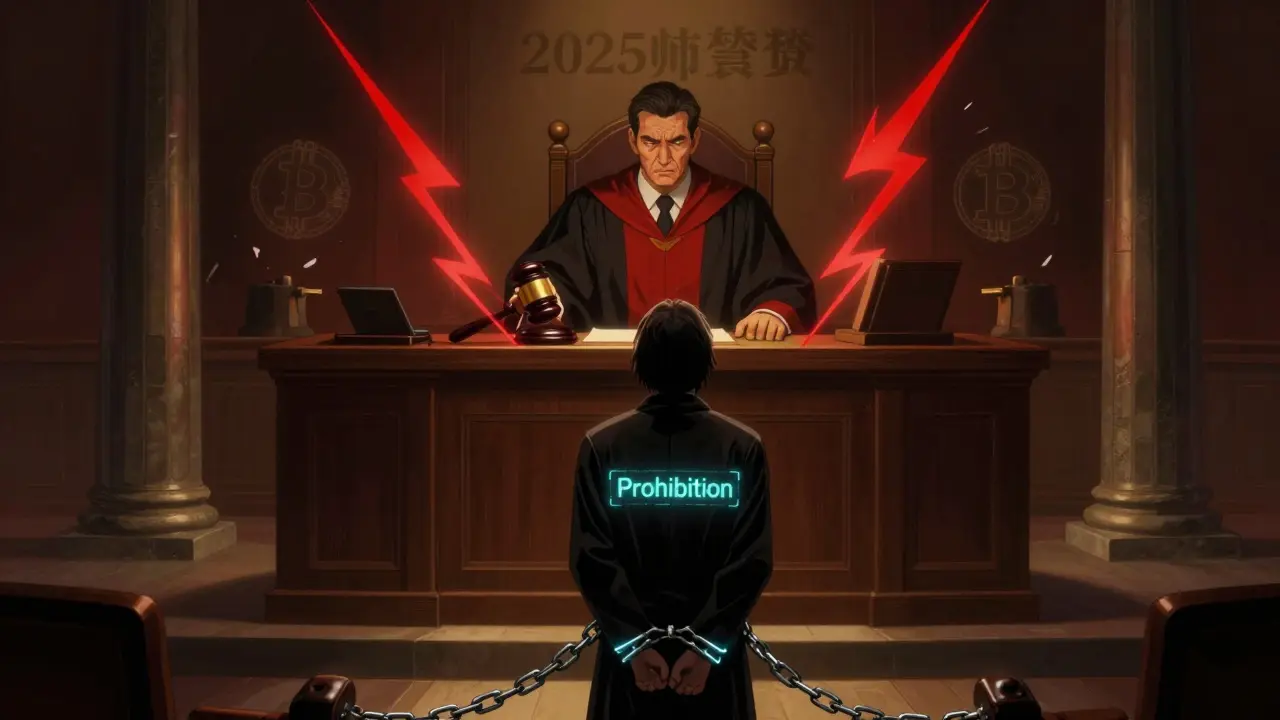
Forget everything you thought you knew about buying Bitcoin in China. As of mid-2026, the answer to whether crypto is regulated there isn't just "yes"-it's a hard, absolute "no." In fact, it’s worse than that. Holding, trading, or mining cryptocurrency in mainland China is now fully criminalized. If you are wondering if you can quietly buy some Ethereum while visiting Shanghai or run a mining rig in Sichuan, the short answer is: don't even think about it. The legal landscape has shifted from strict regulation to total prohibition, making China one of the most hostile environments for private digital assets on the planet.
This wasn't an overnight decision. It was the final nail in the coffin of a decade-long regulatory crackdown. On June 1, 2025, the People's Bank of China (PBOC), China's central bank and primary monetary authority issued a sweeping decree that prohibited not just trading and mining, but also individual ownership of cryptocurrencies. This marked the end of any ambiguity. Before this date, there were gray areas. Now, there is only black and white. Understanding this shift is crucial for anyone interacting with Chinese markets, investors, or technology sectors, because the penalties for violating these rules are severe, including prison time and asset seizure.
The Road to Total Prohibition: A Timeline of Crackdowns
To understand why the 2025 ban feels so sudden yet inevitable, we have to look at the path that led here. China didn't start as a crypto enemy. In fact, in the early days, it was one of the largest hubs for Bitcoin adoption and mining. But the government grew increasingly concerned about capital flight, financial instability, and money laundering. The regulatory tightening began slowly and accelerated rapidly over the years.
The journey started on December 5, 2013, when banks and payment institutions were first banned from processing Bitcoin transactions. This was a warning shot. By April 2014, the PBOC ordered the closure of Bitcoin trading accounts. Then, in September 2017, the government pulled the plug on Initial Coin Offerings (ICOs) and forced major exchanges like Huobi and OKEx to halt operations for Chinese users. Miners were pushed out of the country in waves throughout 2018 and 2021, moving their energy-intensive operations to places like Texas and Kazakhstan.
The pivotal moment came on September 24, 2021, when China effectively banned digital tokens through comprehensive restrictions on trading and mining. However, enforcement was patchy. Some people still held wallets; some underground exchanges operated. That changed with the 2025 decree. By explicitly criminalizing ownership, the government closed every remaining loophole. The message was clear: decentralized finance has no place in the state-controlled financial ecosystem.
Who Enforces the Ban? The Multi-Agency Net
You might wonder how a government enforces a ban on something that exists on a decentralized blockchain. The answer lies in a coordinated effort across multiple powerful agencies. It’s not just the police knocking on doors; it’s a systemic surveillance network designed to choke off access at every level.
The Ministry of Public Security, China's primary law enforcement agency responsible for maintaining public order leads the anti-money laundering efforts. They treat virtual currency transactions as illegal financial activity, similar to drug trafficking or fraud proceeds. Meanwhile, the Cyberspace Administration of China, The government body responsible for internet content regulation and cybersecurity works with internet companies to block and report any crypto-related content. If you try to search for a crypto exchange on Baidu or WeChat, you won’t find it. These platforms are mandated to scrub such content and flag users who attempt to access it.
Financial institutions play a critical role too. Banks and non-bank payment providers like Alipay and WeChat Pay must implement comprehensive monitoring systems. They use advanced algorithms to track online transactions and conduct offline inspections to identify any funds linked to virtual currency trading. If your bank account shows deposits from a known crypto platform, expect immediate freezing of assets and a visit from investigators. Overseas exchanges are explicitly banned from serving Chinese residents, and those that ignore this risk being blocked entirely within China’s digital firewall.
| Agency | Primary Role in Crypto Ban | Enforcement Power |
|---|---|---|
| People's Bank of China (PBOC) | Issued the 2025 total ban decree; sets monetary policy | Regulatory authority over all financial institutions |
| Ministry of Public Security | Leads anti-money laundering investigations; arrests suspects | Criminal prosecution and asset seizure |
| Cyberspace Administration | Blocks crypto websites; monitors social media for promotions | Internet censorship and platform compliance orders |
| Ministry of Industry and Information Technology | Oversees tech companies and internet infrastructure | Shuts down servers and apps facilitating crypto trade |

Real Consequences: Court Cases and Penalties
Laws on paper mean little without enforcement. Fortunately-or unfortunately, depending on your perspective-China has set clear precedents. The courts have moved quickly to demonstrate that breaking these rules carries serious risks. One landmark case occurred in August 2024 at the Beijing No. 2 Intermediate People's Court.
In this case, a defendant named Liu was sentenced to 3.5 years in prison and fined 40,000 yuan (approximately $5,570). Liu had facilitated cryptocurrency transactions involving stolen funds, selling USDT tokens worth 200,000 yuan. The key takeaway here isn't just that he dealt with stolen money; it's the legal standard applied. The court ruled that Liu "should have known" the funds were illicit. This "should have known" standard is terrifyingly broad. It means you don't need to prove intent to launder money; if you engage in crypto transactions that look suspicious, you can be held liable simply for negligence or ignorance.
Furthermore, in August 2024, China's Supreme Court revised anti-money laundering laws to explicitly recognize crypto transactions as money laundering methods. This created a clearer prosecution framework. Today, holding crypto isn't just a civil dispute where you might lose your investment; it's a criminal act that can lead to imprisonment. Civil courts have also denied investor claims in crypto-related disputes since 2022, meaning if you get scammed by an exchange, the Chinese legal system will not help you recover your losses.
The Exception: e-CNY and State-Controlled Innovation
If China hates crypto so much, why do they talk about blockchain and digital currency constantly? This is where the distinction between "private cryptocurrency" and "state-backed digital currency" becomes vital. China doesn't hate digital money; it hates decentralized money that it can't control.
Enter the e-CNY (Digital Yuan), China's official central bank digital currency (CBDC), launched for pilot testing in 2020 and widely rolled out by 2025. While Bitcoin and Ethereum are banned, the e-CNY is actively promoted. It is a centralized digital version of the Renminbi, issued directly by the PBOC. Unlike Bitcoin, which operates on a permissionless ledger, the e-CNY allows the government to track every transaction in real-time. This aligns perfectly with China's goals of financial stability and capital control.
This selective approach reveals the true nature of the ban. The government wants the efficiency of blockchain technology and the modernization of payments, but only under its strict supervision. Blockchain platforms are allowed to operate in 2023 and beyond, but only if they are centralized and compliant with state oversight. You can build a supply chain tracking system using blockchain, but you cannot use it to issue a token that trades freely. The line is drawn sharply between utility and speculation.

Is There Any Hope for Change?
With the ban so fresh and so severe, many observers wonder if this is permanent. Interestingly, there are whispers of internal debate. In July 2025, just weeks after the full ban took effect, the Shanghai State-owned Assets Supervision and Administration Commission held meetings to discuss strategic responses to stablecoins and digital currencies.
Experts participating in these discussions suggested that the rapid global evolution of digital assets might eventually force China to soften its stance. The argument is simple: you cannot ignore a global financial trend forever. However, as of mid-2026, no concrete policy changes have materialized. These discussions seem more like theoretical exercises than precursors to legalization. For now, the zero-tolerance approach remains intact. Businesses operating in China must assume the ban is permanent. Compliance requirements focus entirely on prevention and prohibition. Financial institutions must maintain rigorous Know Your Customer (KYC) protocols not to facilitate crypto trades, but to ensure none happen.
What This Means for You
If you are a foreign investor looking to enter the Chinese market, you must navigate this landscape with extreme caution. Do not attempt to use crypto for cross-border payments with Chinese entities. Do not hire remote workers in China and pay them in Bitcoin. Do not assume that because you are outside the country, you are safe from jurisdictional reach if your business relies on Chinese infrastructure. The coordinated working mechanism between banking regulators, internet oversight bodies, and law enforcement creates a net that is difficult to escape.
For Chinese citizens living abroad, the rules are slightly different but still restrictive. While they may hold crypto overseas, bringing those assets back into China or using Chinese bank accounts to interact with crypto platforms is strictly prohibited. Asset seizure measures target individuals involved in crypto activities, regardless of where the transaction technically occurred, if it impacts the domestic financial system.
The era of crypto in China is over. The future belongs to the e-CNY and state-approved blockchain applications. Until that changes-and there is no sign it will anytime soon-the safest strategy is complete avoidance. The risks of prison, fines, and frozen assets far outweigh any potential gains from trading in the shadows.
Can I own Bitcoin in China in 2026?
No. As of June 1, 2025, individual ownership of cryptocurrencies like Bitcoin is fully criminalized in mainland China. The People's Bank of China issued a decree prohibiting not just trading and mining, but also holding crypto assets. Violating this can lead to asset seizure and criminal penalties.
Is the e-CNY the same as Bitcoin?
No, they are fundamentally different. Bitcoin is a decentralized, private cryptocurrency that operates independently of any government. The e-CNY (Digital Yuan) is a Central Bank Digital Currency (CBDC) issued by the People's Bank of China. It is centralized, fully controlled by the state, and allows the government to monitor all transactions. While Bitcoin is banned, the e-CNY is actively promoted.
What happens if I get caught trading crypto in China?
Consequences are severe. You face asset seizure, substantial fines, and potentially multi-year prison sentences. Courts have established a "should have known" standard for money laundering charges, meaning even negligent involvement in crypto transactions can lead to criminal prosecution. Additionally, civil courts will not help you recover losses if you are scammed.
Can foreign companies use crypto to pay Chinese suppliers?
It is highly risky and generally advised against. Chinese financial institutions are required to monitor and block any transactions linked to virtual currencies. If a Chinese supplier accepts crypto, they risk having their bank accounts frozen and facing criminal investigation. Most legitimate businesses in China will refuse crypto payments to comply with the law.
Will China ever legalize cryptocurrency again?
There is no current indication that China will reverse its ban. While there were internal discussions in mid-2025 regarding stablecoins, the official stance remains a zero-tolerance prohibition. The government prefers state-controlled digital currencies like the e-CNY over decentralized alternatives. Any change would likely be decades away, if it happens at all.
its not just a ban its a total erasure of the concept. they dont want you to have money they cant see. its kinda brilliant in a dystopian way if you think about it. most people are too busy arguing about charts to realize their financial privacy is dead anyway. the e-cny is basically a digital leash with bells on it. and everyone is wagging their tails waiting for the treat.
Wow, this is absolutely terrifying 😱! I mean, seriously? Prison for holding Bitcoin? That seems like such an extreme reaction to a simple asset class 📉. It really makes you wonder what kind of society we are building when the state has to criminalize basic ownership 🏛️. I guess safety comes at a high price though, right? Just don't get caught is my advice lol 😅.
I have been thinking about this for a very long time and I believe that the issue is not really about the money itself but rather about the control that the government wants to have over every single aspect of our lives which includes how we trade and how we store value because if they cannot see it then they cannot tax it or manipulate it and that is something that no authoritarian regime can ever allow to happen in their territory so they must crush it completely even if it means breaking the law themselves.
The distinction between the e-CNY and Bitcoin is often misunderstood by those who do not take the time to read the primary sources from the PBOC regarding monetary policy frameworks. The e-CNY is designed to enhance the efficiency of the payment system while maintaining strict capital controls, whereas Bitcoin represents a direct challenge to the sovereign authority of the central bank to manage inflation and liquidity. It is important to understand that the ban is not arbitrary but rather a calculated move to preserve the integrity of the national currency against speculative assets that offer no intrinsic utility within the domestic economic structure. Furthermore, the enforcement mechanisms described in the article highlight the sophisticated nature of the surveillance state, which utilizes AI-driven transaction monitoring to identify anomalies in banking behavior that deviate from established norms. This level of scrutiny ensures that any attempt to circumvent the ban through offshore exchanges or peer-to-peer networks is met with immediate legal consequences, including asset forfeiture and potential imprisonment under anti-money laundering statutes. Therefore, individuals should recognize that participation in these markets is not merely a civil infraction but a serious criminal offense that undermines the foundational principles of the country's financial stability.
I think we should all try to understand why they feel so threatened by decentralized finance... It is interesting how different cultures approach security versus freedom... Perhaps there is a middle ground we haven't seen yet? Let us hope for more dialogue in the future... 😊
The idiocy of the average retail investor is perfectly illustrated here. They scream 'freedom' while begging for state protection when things go wrong. Now the state has simply removed the option entirely because the population proved too stupid to manage risk. The e-CNY is the logical endpoint of this collective incompetence. Enjoy your digital cage.
It is imperative to note that the legal framework surrounding cryptocurrency in China has evolved significantly since the initial warnings issued in 2013. The current prohibition is not merely a suggestion but a codified legal reality with severe penalties for non-compliance. Individuals residing in mainland China must adhere strictly to these regulations to avoid prosecution under the revised anti-money laundering laws. The integration of blockchain technology for legitimate business purposes remains permissible provided it does not involve the issuance or trading of virtual tokens. This nuanced approach allows for technological advancement while maintaining strict financial oversight.
This whole narrative is flawed. The real issue is corruption. They banned crypto because they couldn't track the bribes anymore. Simple as that. Don't let them fool you with talk of 'financial stability'. It is about power. Always has been. Always will be. Wake up sheeple.
i mean... isnt it kinda wild that they can just say no? like really no? i always thought bitcoin was unstopable. guess not. makes me wanna dig deeper into how they actually enforce it tho. is it just banks or like actual spies?
One must appreciate the sheer audacity required to attempt to operate outside the bounds of established financial law. The Chinese government has demonstrated a clear and unwavering commitment to protecting its citizens from the inherent risks associated with volatile digital assets. To suggest otherwise is to display a profound ignorance of both economic theory and geopolitical realities. The e-CNY offers a stable, secure, and transparent alternative that aligns with national interests. Those who cling to outdated notions of libertarian finance do so at their own peril. It is advisable to conform to the prevailing legal standards rather than engaging in reckless speculation.
Hey everyone! I found this part about the 'should have known' standard super interesting! It really changes how we think about negligence in tech spaces. Does anyone else think this could spread to other countries? I would love to hear your thoughts on global regulatory trends! Let us discuss! 👇
you guys are missing the point entirely. this isnt about regulation its about control. pure and simple. they hate anything they cant monitor. its sad really. most of you probably still use facebook so who are you to judge. just saying.