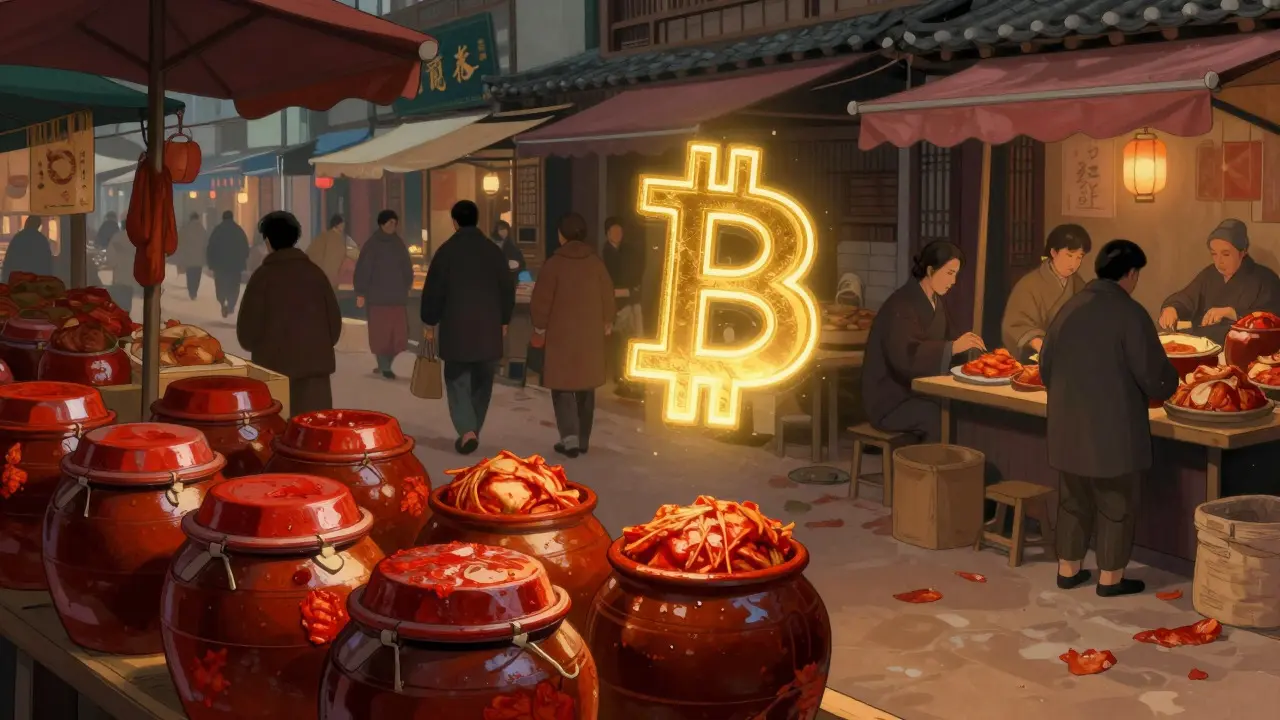
Imagine buying a Bitcoin for $45,000 on a global exchange like Coinbase and then seeing the exact same coin listed for $47,000 just across the ocean in Seoul. That price gap is not a glitch. It is a feature of the South Korean market known as the Kimchi premium. This phenomenon has puzzled traders, frustrated regulators, and fascinated economists since it first appeared in 2016.
The name comes from kimchi, the spicy fermented cabbage dish that is a staple of Korean cuisine. Just as kimchi is unique to Korea, this price disparity is unique to its cryptocurrency market. But why does this happen? And more importantly, if there is free money sitting in the form of price differences, why can’t everyone just grab it?
What Exactly Is the Kimchi Premium?
The Kimchi premium is the difference between the price of a cryptocurrency-usually Bitcoin (BTC)-on South Korean exchanges compared to international platforms. When Bitcoin trades higher in Korea than in the US, Europe, or other parts of Asia, the premium is positive. If it were lower, it would be a discount, but historically, it has almost always been a premium.
To calculate it, you simply compare the prices. Let’s say Bitcoin is trading at $100,000 globally. On a major Korean exchange like UpBit, it might trade at $104,500. The math is straightforward: ((104,500 - 100,000) / 100,000) * 100 = 4.5%. So, the Kimchi premium is 4.5%.
This isn't a new concept. Research from the University of Calgary documented the emergence of this trend starting in 2016. However, it wasn't always so modest. During the crypto boom of late 2017 and early 2018, the premium spiked dramatically. In January 2018, it reached a staggering peak of approximately 55%. In some extreme cases cited by financial analysts, when Bitcoin was around $10,000 globally, it hit $18,000 in Korea, creating an 80% premium. Those days are rare now, but the mechanism remains active.
Why Does the Premium Exist? The Demand Factor
The primary driver of the Kimchi premium is simple economics: supply and demand. South Koreans have an exceptionally high appetite for cryptocurrency trading. Cultural factors play a role here; the population is tech-savvy, financially literate, and willing to take significant risks for potentially higher rewards.
When local demand outstrips local supply, prices go up. In a perfectly efficient global market, this wouldn't matter much because traders could instantly move money in and out to balance things out. But the Korean market is not perfectly open. It is somewhat isolated. Because many Korean investors prefer trading on domestic platforms due to trust issues with foreign exchanges or language barriers, the buy pressure stays concentrated within Korea. This pushes prices up locally while global prices remain unaffected.
Another unique factor is the "listing pump." When a new cryptocurrency gets listed on major Korean exchanges like Bithumb or UpBit, the price often surges immediately. This isn't just about the asset's value; it's about the sheer volume of Korean retail investors rushing to buy into something new. This behavior amplifies the premium for specific coins, not just Bitcoin.
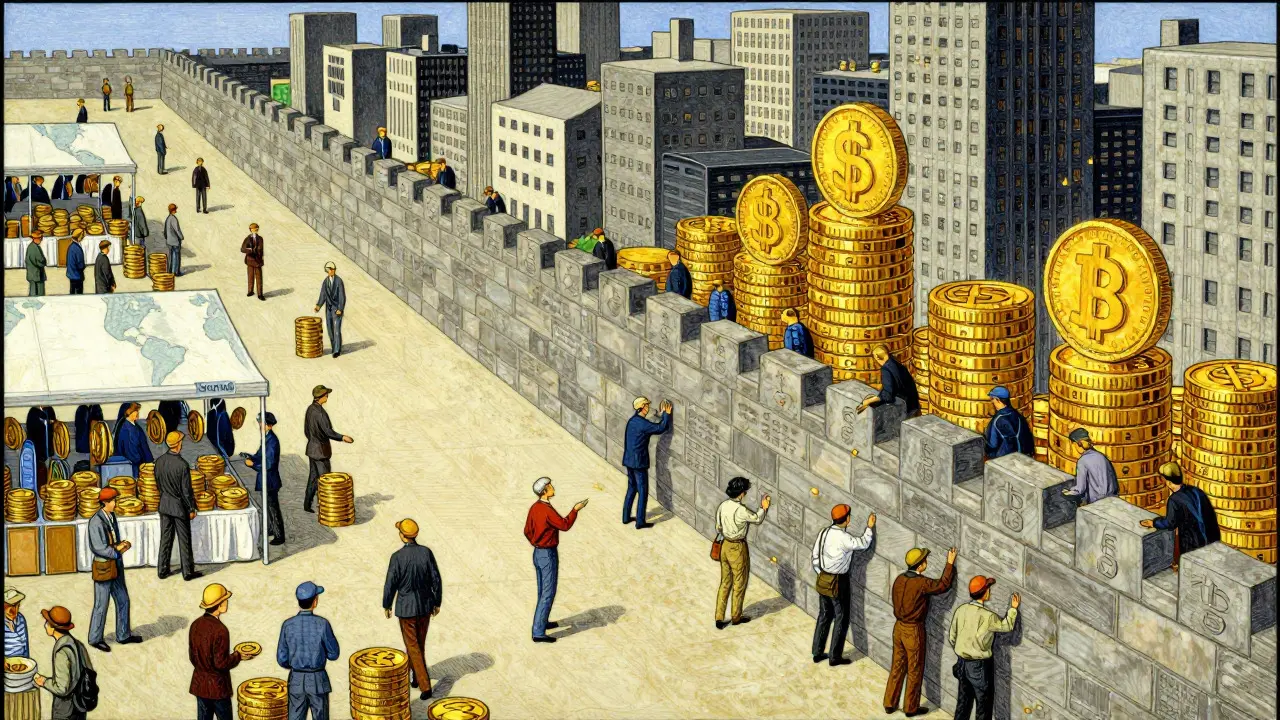
The Real Barrier: Capital Controls and Regulations
If the premium exists, why don't international traders just buy low abroad and sell high in Korea? This strategy is called arbitrage, and it should theoretically eliminate the price difference. The reason it doesn't work easily is because of strict government regulations.
The Bank of Korea (the central bank) implements rigorous capital control measures. These rules are designed to prevent rapid capital flight that could destabilize the Won (KRW). One of the most impactful rules is the "real-name account" system combined with limits on how quickly and how much money can be transferred in and out of the country for crypto purposes.
Here is the practical problem for an arbitrageur:
- Time Delays: Transferring fiat currency (like USD) into a Korean bank account to buy KRW, and then moving that KRW onto an exchange, takes time. It’s not instant. By the time your money arrives, the premium might have shrunk or disappeared.
- Verification Hurdles: You cannot just sign up for UpBit or Bithumb with a foreign passport easily. Most accounts require a Korean Resident Registration Number. This effectively locks out most international institutional traders who could otherwise smooth out the price differences with massive volume.
- Anti-Money Laundering (AML) Rules: Strict AML laws mean every transaction is scrutinized. Moving large sums of cash in and out triggers flags, adding friction and cost to the arbitrage process.
These regulatory walls create a "closed loop" economy for crypto in Korea. The money stays inside, the demand stays inside, and therefore, the higher prices stay inside.
| Feature | Global Markets (e.g., Binance, Coinbase) | Korean Markets (e.g., UpBit, Bithumb) |
|---|---|---|
| Price Benchmark | Standard global average | Often higher (Premium) |
| Capital Flow | Free and instant | Restricted and delayed |
| Access | Open to most nationalities | Requires Korean residency/ID |
| Regulatory Focus | Varies by country | Strict capital controls & AML |
| Arbitrage Feasibility | High | Low to Impossible for foreigners |
Can You Profit From the Kimchi Premium?
For the average international trader, the answer is largely no. The barriers we discussed make traditional arbitrage nearly impossible. However, the market has adapted. Some sophisticated players use complex strategies involving stablecoins or peer-to-peer (P2P) markets to bypass some restrictions, but these carry their own risks, including counterparty risk and regulatory crackdowns.
For Korean residents, the premium represents a different kind of opportunity. They can benefit from the higher valuations of assets they hold, assuming they plan to keep them in the ecosystem or sell them locally. However, selling crypto for fiat in Korea also involves taxes and reporting requirements, which eats into potential profits.
It is worth noting that the premium is not guaranteed. It fluctuates daily based on sentiment. If global crypto prices crash, the premium might narrow as panic selling hits both markets. If Korean regulators announce stricter rules, the premium might vanish overnight as confidence drops. Relying on it as a steady income source is risky.

The Kimchi Premium as a Market Indicator
Beyond just being a quirk, the Kimchi premium serves as a valuable barometer for the entire crypto industry. Analysts watch it closely for two main reasons:
- Sentiment Gauge: When the premium widens, it usually indicates strong bullish sentiment among Korean investors. Since Koreans are often early adopters and aggressive traders, a rising premium can signal that the local market expects prices to go further up.
- Regulatory Warning Sign: Conversely, if the premium spikes too high, it attracts the attention of regulators. The Korean government has intervened in the past when premiums became excessive, fearing market manipulation or instability. Therefore, a sudden drop in the premium might indicate impending regulatory action.
Academic studies, including those from the University of Calgary, have used data from 2016 to 2018 to show how the premium correlates with global volatility. Today, in 2026, it continues to serve as a case study for how decentralized technologies interact with centralized state power. It proves that even in a borderless digital world, physical borders and laws still matter.
Future Outlook: Will the Premium Disappear?
As cryptocurrency adoption grows globally, one might expect the Kimchi premium to fade. After all, if everyone uses the same global exchanges, prices should converge. However, the structural reasons for the premium-capital controls and cultural preference for local platforms-are deeply entrenched.
Unless the Bank of Korea significantly relaxes its capital controls, or unless a global standard for cross-border crypto settlement emerges that bypasses traditional banking rails, the Kimchi premium will likely persist. It may shrink from the 55% peaks of the past to a more manageable 2-5% range, but it will remain a distinctive feature of the Asian crypto landscape.
For investors and observers, understanding the Kimchi premium is essential. It highlights the inefficiencies that still exist in our supposedly efficient digital markets. It reminds us that geography still dictates price, and that regulation can create islands of value in a sea of global connectivity.
What is the current Kimchi premium percentage?
The Kimchi premium fluctuates daily based on market conditions. While it peaked at over 50% in 2018, it typically averages around 4.5% under normal market conditions in recent years. To get the exact real-time percentage, you need to compare the live price of Bitcoin on a Korean exchange like UpBit against the global average on platforms like CoinMarketCap or Binance.
Can foreigners easily exploit the Kimchi premium?
Generally, no. Strict capital controls, delays in fund transfers, and the requirement for a Korean Resident Registration Number to open accounts on major exchanges like UpBit and Bithumb make it very difficult for non-residents to perform arbitrage trades before the price gap closes.
Why is it called the Kimchi premium?
The term is a metaphorical reference to kimchi, a famous fermented vegetable dish native to South Korea. Just as kimchi is uniquely associated with Korean culture, this price disparity is uniquely associated with the South Korean cryptocurrency market. It emerged in media and academic circles around 2016 to describe this specific regional anomaly.
Does the Kimchi premium affect only Bitcoin?
While Bitcoin is the most commonly tracked asset for calculating the premium due to its liquidity and global benchmark status, the phenomenon can affect other cryptocurrencies as well. Altcoins often experience even wider spreads, especially during new listings on Korean exchanges, a trend known as the "listing pump."
How do capital controls contribute to the premium?
Capital controls implemented by the Bank of Korea limit the speed and volume of money moving in and out of the country. This prevents traders from quickly buying cheap crypto abroad and selling it dear in Korea. The delay allows the price gap to persist because the arbitrage mechanism-the force that normally equalizes prices-is blocked by bureaucratic and financial hurdles.
Hey everyone! 👋 This is such a fascinating read about the Kimchi Premium. It’s wild to think that geography still dictates price in our 'borderless' digital world. 🌏💸 As someone who loves connecting cultures, I find it really interesting how Korean tech-savviness creates this unique market bubble. Thanks for sharing this insight! 🙌✨ #CryptoCulture
Indeed; the article provides a remarkably clear explanation of the economic forces at play! The capital controls implemented by the Bank of Korea are quite stringent; and they effectively prevent arbitrage! It is encouraging to see how financial literacy is evolving globally! We must remain optimistic about future regulatory clarity! Thank you for the detailed analysis! !!
the premium is just a symptom of deeper societal flaws. people chase quick riches instead of building real value. it shows a lack of moral grounding in the crypto space. we should question why we allow such inefficiencies to persist. is it greed or ignorance? probably both. the system rewards speculation over substance.
it’s basically a liquidity trap disguised as a cultural phenomenon. the jargon around 'arbitrage feasibility' is misleading because the real barrier is institutional friction. when you look at the delta between global BTC prices and KRW conversions, you see pure inefficiency driven by state-level capital controls. it’s not magic, it’s just bad policy meeting high demand.
Let’s be honest: the mainstream media wants you to believe this is just 'cultural preference.' It’s not. The central banks are manipulating the Won to keep retail investors trapped in domestic exchanges while elites siphon value through offshore channels. The 'Kimchi Premium' is a smokescreen for systemic wealth extraction. Wake up!
long article. boring. just buy btc on binance. why do koreans pay more? stupid. typo here too lol.
most people dont get it. its simple supply and demand but blocked by rules. if you cant move money fast you lose. thats life. dont overthink it. just accept the gap exists because bureaucrats say so. easy fix would be deregulation but nobody wants that.
I’ve been following the crypto markets for years, and I always wondered why there was such a persistent price difference between Seoul and New York, and reading this really clears up so many questions I had about the mechanics behind it, especially regarding the strict verification hurdles and the time delays involved in transferring fiat currency into Korean bank accounts, which seems like such a frustrating barrier for anyone trying to engage in arbitrage trading on an international scale.
everyone says its a premium but its actually a tax on stupidity. koreans are just being ripped off by their own regulators. why trust local exchanges when global ones exist? its irrational behavior. stop calling it a feature call it what it is a failure of market efficiency due to isolationist policies.
Oh, the exquisite irony of a 'borderless' technology being held hostage by the petty bureaucratic whims of a single nation! It’s almost poetic, isn’t it? The Koreans hoard their digital gold like dragons guarding treasure, all while the rest of us watch from outside the gates. Deliciously inefficient! 🐉💰
Great point Paul! :) If you're interested in learning more about how P2P markets are bypassing some of these restrictions, I can share some resources. It's a complex topic but very rewarding to understand. Keep asking questions! :)
EXCELLENT RESEARCH!! This highlights the importance of understanding local market dynamics!! Don't ignore the cultural factors!! They are CRUCIAL for success in international finance!! KEEP LEARNING!!!