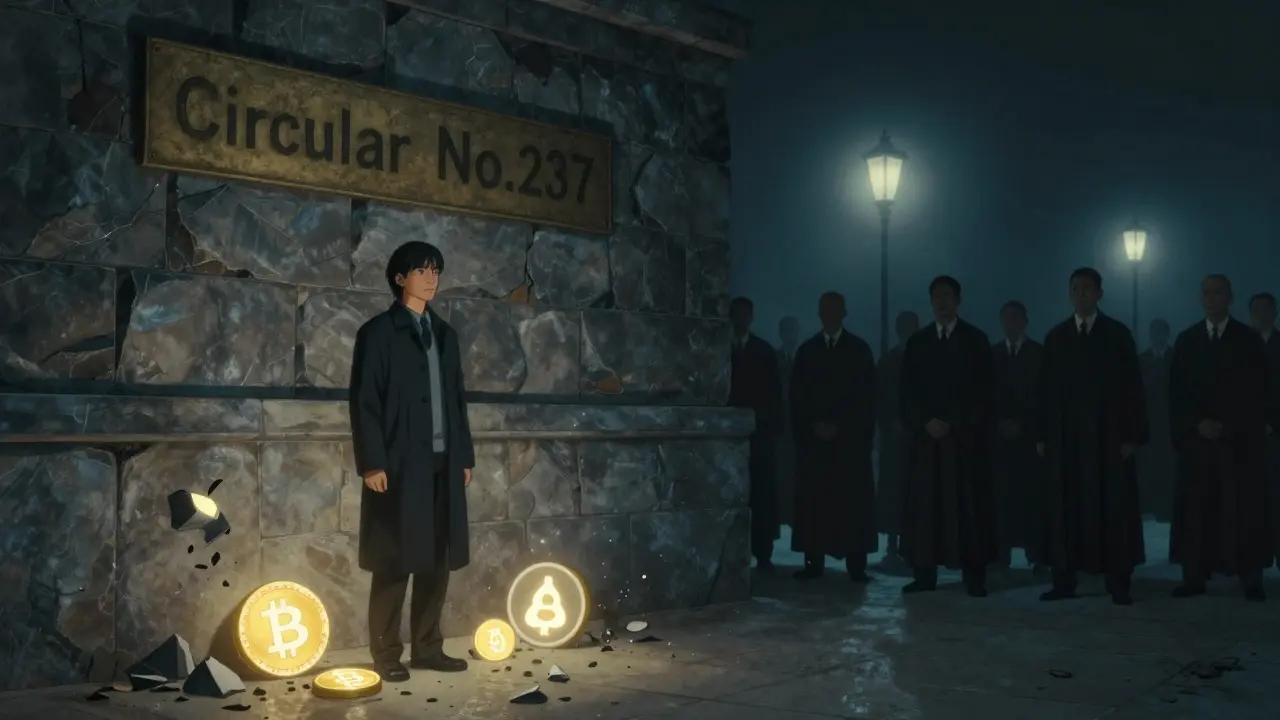
As of 2026, owning or trading cryptocurrency in China is illegal. Not just discouraged - not just restricted - but outright banned. This isn't a gray area. It's a hard stop. If you're in China, holding Bitcoin, Ethereum, or any other digital token is legally risky. And if you're running a business that touches crypto in any way, you're breaking the law.
How China Went From Crypto Enthusiast to Crypto Ban
Just a few years ago, China was one of the biggest players in the global crypto scene. It hosted the majority of Bitcoin mining operations. Chinese investors dominated trading volumes. Exchanges like Huobi and OKX were household names. But that changed fast. In 2017, the People's Bank of China shut down initial coin offerings (ICOs). Then in 2021, it banned all cryptocurrency transactions and forced exchanges to leave the mainland. But even that wasn't enough. On June 1, 2025, China took the final step: a total ban on all crypto-related activity under Circular No.237. This law didn't just stop exchanges - it made it illegal to even hold crypto as a private individual. The government didn't flip a switch. It built a wall, brick by brick. First, it cut off banks from handling crypto. Then it shut down mining farms. Then it blocked websites and apps. Finally, it declared any crypto transaction void under Chinese law. No contracts. No protections. No recourse.What Exactly Is Banned?
The 2025 ban covers everything:- Buying, selling, or trading any cryptocurrency - even peer-to-peer
- Mining Bitcoin or other coins - all hardware must be shut down
- Holding crypto in personal wallets - no legal recognition
- Providing exchange services, pricing tools, or wallet apps
- Marketing crypto to Chinese residents - even from overseas
- Using crypto to pay for goods or services
- Participating in decentralized finance (DeFi) platforms
What Happens If You Get Caught?
There are no warnings. No first-time leniency. The penalties are severe and consistent.- Any crypto you own can be confiscated by authorities - no appeal
- Bank accounts linked to crypto activity may be frozen
- Using crypto to transfer money can be treated as money laundering
- Operating a crypto-related business can lead to criminal prosecution
- Chinese courts refuse to hear cases about lost crypto - you're on your own
Crypto Mining? Completely Shut Down
China used to be home to 70% of the world's Bitcoin mining. That ended in 2021. By 2025, every mining facility - from massive data centers in Inner Mongolia to hidden warehouses in Sichuan - was shut down. The government cited two reasons: energy waste and financial instability. Power grids in provinces like Xinjiang and Inner Mongolia were being strained by mining rigs running 24/7. At the same time, regulators saw crypto as a threat to financial control. So they turned off the lights. Thousands of miners fled to Kazakhstan, the U.S., and other countries. Today, there are zero legal mining operations left in mainland China.
Blockchain Is Fine - Just Not Crypto
Here's the twist: China loves blockchain - as long as it's controlled by the state. While private cryptocurrencies are banned, the government is investing billions into blockchain technology. The State Council promotes blockchain for supply chain tracking, land registries, and tax collection. The key difference? China's blockchain is centralized. It's not decentralized. It's not anonymous. It's not open. The government calls this "blockchain for governance." It's a tool to increase transparency - but only on their terms. Private crypto? That's "financial chaos." State-controlled blockchain? That's "innovation."The Digital Yuan Is the Real Alternative
China isn't just banning crypto - it's replacing it. The digital yuan, or e-CNY, is the centerpiece of China's financial future. Launched in 2020, it's now used in over 200 cities. People use it to pay for groceries, subway rides, and utility bills. The government pushes it hard - through mobile apps, subsidies, and even mandatory payroll integration in some state-owned companies. Unlike Bitcoin, the digital yuan is fully traceable. The central bank knows who you paid, how much, and when. There's no anonymity. No decentralization. No risk to state control. The message is clear: If you want digital money in China, it has to be ours.What About Hong Kong?
Hong Kong is the exception that proves the rule. While mainland China bans crypto, Hong Kong - as a separate customs and financial zone - passed the Stablecoin Bill in May 2025. It now licenses stablecoin issuers, allows regulated trading, and permits institutional crypto investment. This isn't a loophole. It's a deliberate policy split. Hong Kong serves as China's financial bridge to global markets - but only under strict oversight. The mainland doesn't recognize Hong Kong's crypto rules. If you're a mainland resident trading on a Hong Kong exchange, you're still breaking Chinese law.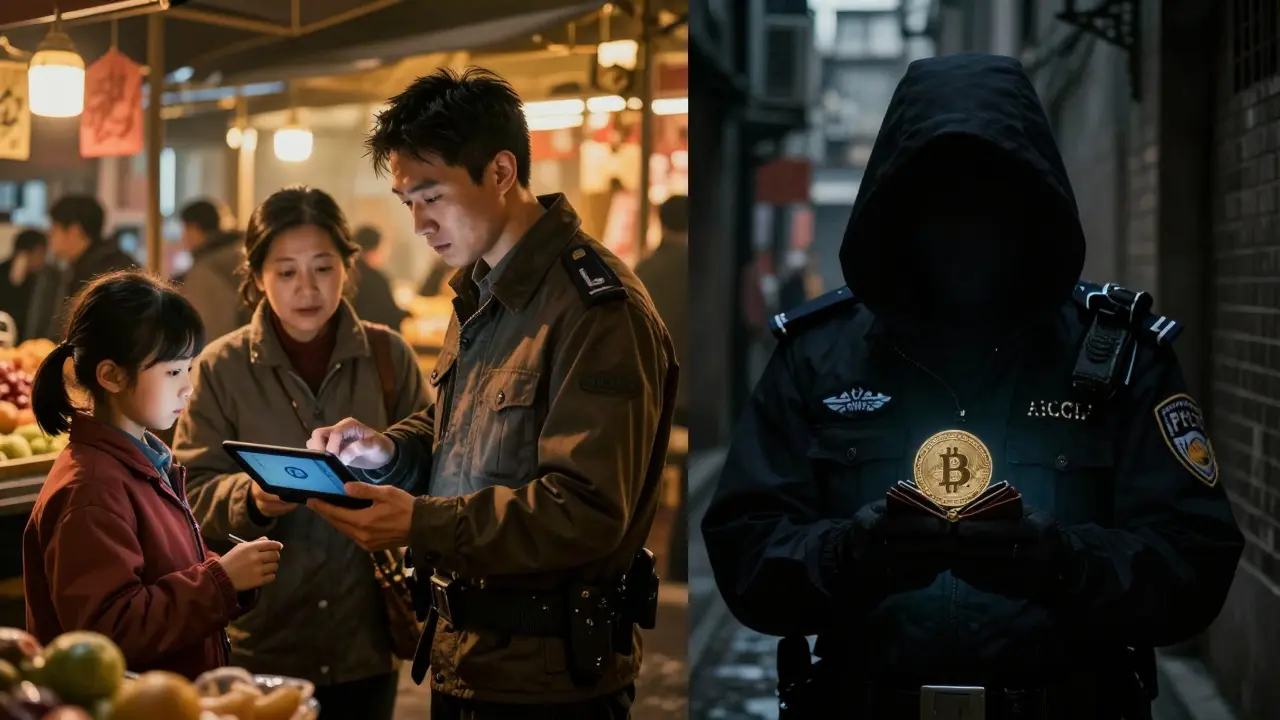
Can You Work Around the Ban?
Some try. Some use VPNs to access foreign exchanges. Some store crypto in offshore wallets. Some use peer-to-peer cash trades. But here's the reality: it doesn't work. Chinese regulators have tools to detect crypto activity. They monitor bank transfers. They track domain names. They scan social media for crypto ads. They pressure internet service providers to block access. Even if you're not in China, if you're marketing crypto to Chinese users - even through a website - you're at risk of being blacklisted or fined. There's no legal way to operate a crypto business targeting China. No licenses exist. No exceptions. No gray zone.Why Does China Care So Much?
It's not about technology. It's about control. The Chinese government fears losing financial power. Cryptocurrencies bypass the banking system. They let people move money without oversight. They enable capital flight. They undermine the yuan's dominance. By banning crypto, China:- Keeps money flowing through state-controlled banks
- Prevents citizens from moving wealth offshore
- Eliminates competition to the digital yuan
- Reduces risks of fraud and money laundering
- Reinforces the state's monopoly on financial infrastructure
What’s Next?
Don’t expect a reversal. The ban is now baked into law. The penalties are enforced. The infrastructure is built. The digital yuan is expanding. In 2026, China is the most restrictive country in the world when it comes to cryptocurrency. There are no signs of change. No political movement to legalize crypto. No court decisions to overturn the ban. The only path forward is the digital yuan - and China is pushing it hard.Is it illegal to own cryptocurrency in China?
Yes. While the law doesn't explicitly say "owning crypto is a crime," it makes no legal distinction between holding and transacting. Since all transactions are banned, and financial institutions can't support crypto, owning it carries no legal protection. Authorities can seize it, and courts won't help you recover losses. It's effectively illegal in practice.
Can I mine cryptocurrency in China?
No. All cryptocurrency mining operations were shut down by 2025. The government banned mining due to excessive energy use and financial risk. Any remaining mining equipment is subject to confiscation. There are no legal mining farms left in mainland China.
Can I use Bitcoin to pay for things in China?
No. No business in mainland China can legally accept cryptocurrency as payment. Even if a shop accepts it, the transaction is void under Chinese law. The only legal digital currency is the digital yuan (e-CNY).
Is the digital yuan the same as Bitcoin?
No. The digital yuan (e-CNY) is a central bank digital currency issued and controlled by the People's Bank of China. It's fully traceable, centralized, and tied to the Chinese yuan. Bitcoin is decentralized, anonymous, and not backed by any government. China promotes the digital yuan precisely because it rejects Bitcoin's core features.
Can I invest in crypto through a Hong Kong exchange?
Technically, you can access Hong Kong exchanges from mainland China - but it's still illegal. The Chinese government treats any crypto activity by its residents as a violation of Circular No.237, regardless of where the transaction occurs. If you're caught, you risk asset seizure and penalties.
What happens if I send crypto to someone in China?
The recipient could face legal consequences. Even receiving crypto - even as a gift - is treated as participating in an illegal financial activity. Authorities have frozen bank accounts and investigated individuals who received crypto transfers from abroad. There is no legal safe harbor.
Are there any exceptions for businesses?
No. All businesses - domestic or foreign - are prohibited from offering crypto services to Chinese residents. This includes exchanges, wallet providers, DeFi platforms, and even marketing campaigns targeting Chinese users. There is no licensing system for crypto businesses in mainland China.
Let's be clear: China's move isn't just regulatory-it's a paradigm shift in sovereign monetary control. Cryptocurrencies represent a systemic threat to the state's monopoly on capital flows, and Circular No.237 is the logical culmination of a decade-long consolidation of financial sovereignty. The digital yuan isn't an alternative-it's the inevitable successor to decentralized finance in a centralized state. Blockchain? Fine. Decentralization? Non-negotiable extinction. This isn't anti-innovation. It's hyper-innovation under authoritarian precision.
I get why they did it but honestly i just feel bad for regular people who bought bitcoin before the ban and now cant even access their wallets
China doesn't ban crypto because it's dangerous-it bans it because it's the only way to maintain absolute control over its population's financial behavior. The digital yuan isn't progress, it's surveillance with a user interface. This is the future of authoritarian capitalism: no anonymity, no freedom, no choice. The West is already falling behind. Wake up.
It's wild how many people don't realize the digital yuan is basically a government tracking app for your spending. I get the control thing but i'm just glad i'm not living under that system. Also can we talk about how cool it is that hong kong still has some breathing room? Like, it's not perfect but at least it's not total surveillance.
so like... china banned crypto but like... theyre building a blockchain thing? so its not really banned its just like... banned if its not theirs? idk man i think this is just like... weird. also i think the digital yuan is kinda creepy. like who wants the govt to know every coffee you buy? just sayin.
OMG YES I LOVE THIS POST!! 💥 China is literally the future and everyone else is still stuck in the 2010s with their "decentralized" nonsense. The digital yuan is clean, efficient, and secure. No more shady p2p scams. No more mining farms sucking up power. No more financial chaos. This is what real innovation looks like. 🚀👏
The real irony here is the state’s obsession with blockchain as a governance tool while demonizing decentralization. This is a classic case of epistemic closure: they co-opt the technology but reject its philosophical underpinnings. The digital yuan isn't innovation-it's institutional capture. You can't have blockchain without trustlessness, and you can't have trustlessness under a totalitarian regime. The contradiction is ontological.
As someone who works in fintech, I’ve seen how China’s approach is actually quite strategic. They’re not rejecting technology-they’re redefining it. The digital yuan gives them control, yes, but it also eliminates fraud, reduces transaction costs, and increases financial inclusion for unbanked populations. The trade-off is real, but it’s not as simple as "freedom vs oppression." It’s about what kind of society you want to build. And for China, that society prioritizes stability over speculative freedom.
Oh please. China bans crypto because they’re scared. They’re terrified of people having financial autonomy. Meanwhile, the US is letting innovation happen. We’ve got Coinbase, Kraken, Bitcoin ETFs. China’s just a big, slow, paranoid dinosaur trying to hold back the tide with a broom. Their "digital yuan"? It’s a digital leash. I’d rather lose my crypto than live under that.
Wait… so you’re telling me the government can just take your crypto… and they’ve been monitoring your bank accounts… and they’re tracking EVERYTHING through the digital yuan… and this is supposed to be "safe"? … I’ve been reading about this for years… and I think this is all part of a global plan… to control money… through surveillance… and they’re using China as a testbed… for the rest of the world…
I just want to say… I really feel for people who lost their crypto in China. Like… imagine believing in something… putting your money into it… and then one day… poof… it’s gone… and no one can help you. That’s not justice. That’s cruelty disguised as policy. And I just… I don’t know how anyone sleeps at night knowing they’re part of a system that does this to people.
China banned crypto? Big deal. So did 47 other countries. The real story is how fast the rest of the world is catching up. The U.S. is regulating. The EU is taxing. India is banning. China didn’t invent control-they just did it fastest. The real question is why everyone else is still pretending they’re not following the same playbook. We’re all just rearranging deck chairs on the Titanic of financial centralization.
It’s not about money. It’s about morality. Cryptocurrency is built on speculation, greed, and the exploitation of human desperation. The digital yuan represents order, discipline, and responsibility. When people choose to gamble with their life savings on a volatile token, they’re not exercising freedom-they’re surrendering to chaos. China is not the villain here. The people who sold them the dream are.
I think there’s room for both. China’s approach works for them. It’s not perfect, but it’s coherent. And maybe the West doesn’t need to copy it-but we shouldn’t demonize it either. Financial systems evolve based on culture, history, and values. China values stability. The West values autonomy. Neither is inherently right. But both deserve to be understood, not just hated.
Okay but like… imagine being a normal person in Shanghai and suddenly your phone says "your crypto wallet is now illegal" and the government freezes your savings because you bought 0.02 BTC in 2020? That’s not policy. That’s psychological warfare. And now they’re forcing everyone to use the digital yuan? I’m not even mad-I’m terrified. This isn’t the future. This is a dystopian Netflix series.
The digital yuan is not a currency-it is a mechanism of social control. The Chinese state has engineered a financial system where every transaction is recorded, analyzed, and potentially penalized. This is not innovation. This is totalitarianism with a mobile app. And the fact that so many in the West are praising it as "efficient" reveals a terrifying moral decay. We are normalizing surveillance under the guise of convenience.
Let’s be real-this isn’t about crypto. It’s about the CCP’s fear of losing power. The moment people can move money outside the system, the system cracks. The digital yuan is a weapon. Every transaction is a data point. Every wallet is a surveillance target. And the ban? It’s not to protect citizens-it’s to prevent them from ever knowing they could be free. This is the quietest revolution: the disappearance of financial autonomy.
As someone who’s lived in both the U.S. and China, I can say this: China’s move makes sense in context. They’re not anti-tech-they’re anti-chaos. The digital yuan isn’t perfect, but it’s the only way to bring financial access to hundreds of millions without relying on Western banking systems. It’s not about control-it’s about inclusion. And honestly? I’d rather have a traceable currency than a wild west of crypto scams.