
State channels were supposed to fix blockchain’s biggest problem: speed. If you’ve ever waited minutes for a Bitcoin or Ethereum transaction to confirm, you know why. State channels let two or more people trade coins back and forth off-chain, only settling the final balance on the blockchain. Sounds perfect, right? But here’s the truth: state channels are not the universal scaling fix they were sold as. They work well in narrow cases - like a game with frequent micro-payments or a business paying a freelancer daily - but fall apart in almost every other scenario.
They Need You to Be Always Online
One of the biggest assumptions behind state channels is that everyone involved is always awake. If you’re using a state channel to send payments to a friend, and your phone dies, or your laptop goes to sleep for a few hours, you’re in trouble. Someone else could broadcast an old, unfair transaction - like claiming you owe them $100 when you actually paid them $80 - and the blockchain would accept it because it doesn’t know the real latest state. This isn’t theoretical. Developers on the Lightning Network’s GitHub report that mobile users frequently lose channels because their apps get killed by battery-saving modes. Reddit users in r/Bitcoin complain about having to manually rebalance channels three or four times a week just to keep payments flowing. That’s not convenience - that’s a maintenance burden. To fix this, people built “watchtowers”: third-party services that monitor your channel and punish cheaters if you’re offline. But now you’re trusting someone else. What if the watchtower gets hacked? What if it goes offline? What if it starts colluding with your counterparty? You traded one problem for three new ones.You Have to Lock Up Your Money
To open a state channel, you need to lock up funds. If you want to send $500 worth of ETH over a channel, you have to put $500 (or more) into a smart contract. That money sits idle. You can’t use it for staking, lending, or even buying something else on-chain. It’s locked up - and you’re paying opportunity cost. Dr. Christian Decker from Blockstream called this “the most significant adoption barrier.” It’s not just a small inconvenience. If you’re a small business or someone with limited crypto, you can’t afford to tie up capital just to make payments. Deloitte’s 2023 survey found that 78% of small enterprises skipped state channels because they simply didn’t have enough funds to lock up. That’s not a technical flaw - it’s an economic one. It excludes the very people who need cheaper, faster payments the most.Disputes Are Slow and Expensive
State channels promise off-chain speed. But when things go wrong - and they will - you’re forced back onto the blockchain. If your counterparty tries to cheat, you have to file a dispute. That means paying gas fees, waiting for block confirmations, and hoping the smart contract logic doesn’t have a bug. The Blockchain Research Institute found that 67% of blockchain developers consider dispute resolution the biggest technical headache. Ethereum Stack Exchange threads show developers spending 20-30% more time coding dispute logic than they expected. And it’s not just about time. On Ethereum, a single dispute transaction can cost $10-$50 in gas. That’s more than some of the payments you were trying to save money on. Worse, if more than two people are in a channel - say, a group paying for a shared service - getting everyone to agree on the state becomes a nightmare. Every change needs unanimous approval. One person goes quiet? The whole channel freezes. That’s why multi-party channels are almost never used in practice.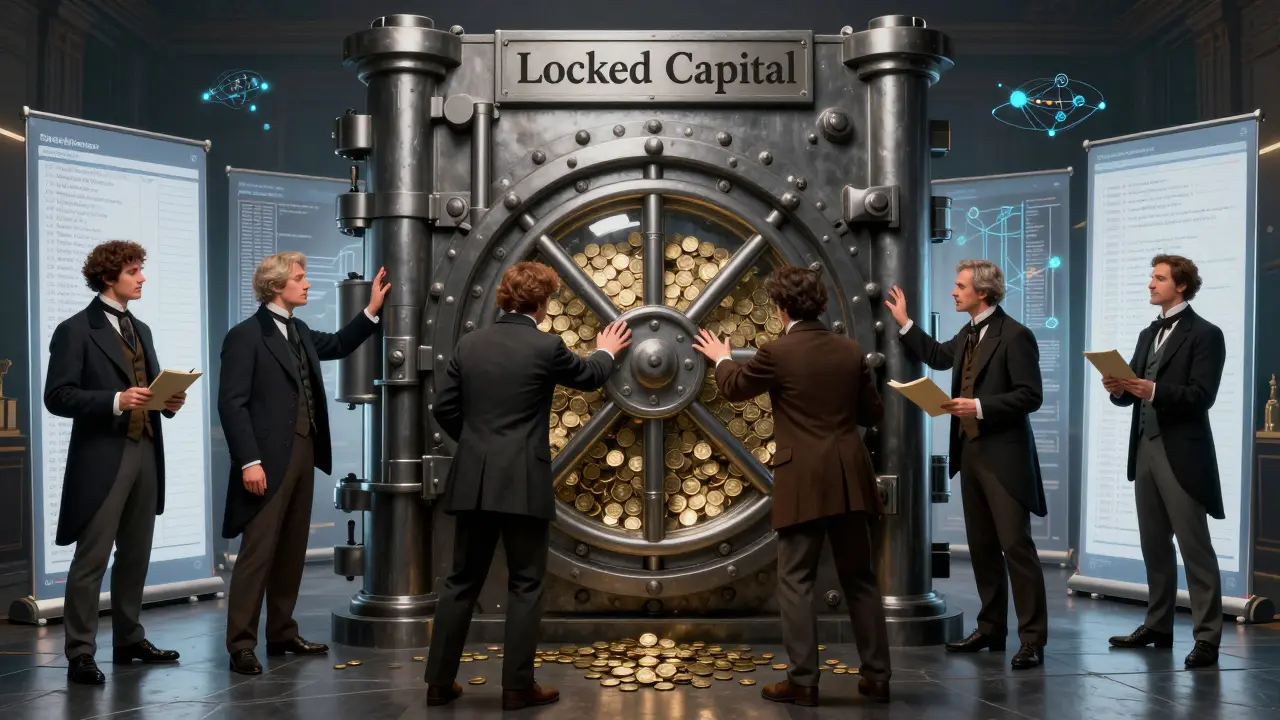
They’re Not Public
State channels are private by design. Only the opening and closing transactions appear on-chain. Everything in between? Hidden. That’s great for privacy - but terrible if you need proof of what happened. Imagine a supply chain where a vendor needs to prove they received 10 payments over a week. Or a court case where someone needs to verify a transaction history. State channels can’t do that. There’s no public ledger of the intermediate steps. You’re relying on the honesty of the participants. If one party disappears or denies the history, you have no way to prove it. Compare that to rollups - especially ZK-rollups - which compress thousands of transactions into one on-chain proof, but still let anyone verify every single one. State channels can’t offer that. They trade transparency for speed, and sometimes, you can’t afford to lose transparency.Too Hard to Build and Maintain
If you’re a developer, building on state channels is like assembling a Swiss watch while blindfolded. The documentation for Lightning Network rates 3.8/5 - decent, but not great. Raiden Network? 3.2/5. ConsenSys Academy says it takes 8 to 12 weeks of full-time study just to get comfortable. And that’s after you’ve already mastered Solidity, Ethereum, and smart contract security. Community support is scattered. The State Channel Community Slack has over 1,200 members, but responses to technical questions often take over 72 hours. That’s not a thriving ecosystem - it’s a graveyard of unanswered questions. Meanwhile, rollup tooling has exploded. Frameworks like Foundry, Hardhat, and Alchemy now have native support for ZK and Optimistic rollups. State channels? You’re on your own.
They’re Losing the Scaling Race
In 2023, Gartner reported that state channels make up less than 3% of enterprise blockchain scaling solutions. Rollups? 55%. Sidechains? 42%. Why? Because rollups don’t lock up your money. They don’t require you to be online 24/7. They offer public verifiability. And they scale better. Ethereum’s Account Abstraction (EIP-4337) helps reduce capital lockup by 30-40%, but it’s still a band-aid. Watchtowers help with liveness, but they add centralization risk. The core problems remain. Vitalik Buterin put it bluntly: state channels “work well for specific use cases but cannot serve as a general-purpose scaling solution.” That’s not a bug - it’s the design. They’re optimized for bilateral, high-frequency, trusted interactions. Everything else? They break.Where They Still Work - And Where They Don’t
Let’s be fair: state channels aren’t dead. They have a real place.- Good for: Gaming microtransactions, recurring payments between known parties (like a freelancer and client), IoT device micropayments, and any scenario where two parties transact dozens of times per day and can afford to lock up capital.
- Bad for: Public marketplaces, one-time payments, users with limited funds, mobile-only users, multi-party systems, and anything requiring audit trails or public verification.
What’s Next?
The future of state channels isn’t about fixing their core flaws - it’s about accepting their limits. They’re not the future of blockchain scaling. They’re a niche tool for very specific jobs. Watchtowers, smart contract improvements, and account abstraction will help. But they won’t turn state channels into a universal solution. The market has already voted. Rollups are winning. Sidechains are growing. State channels? They’re holding on in their corner - useful, but not essential. If you’re considering them for your project, ask yourself: Are you sure you need off-chain speed? Can you afford to lock up capital? Will your users stay online? If the answer to any of those is no - look elsewhere.Can state channels be used for multi-party payments like group bills?
Technically yes, but in practice, no. Every participant must agree on every transaction update. If one person goes offline or refuses to sign, the whole channel freezes. Disputes become exponentially harder to resolve with more people. Most real-world implementations avoid multi-party channels entirely because they’re too fragile and complex.
Do I need to use a watchtower with state channels?
You don’t *need* one, but you’re taking a huge risk without it. If your device goes offline and your counterparty broadcasts an old state, you could lose funds. Watchtowers monitor your channel and punish cheaters on your behalf. But they add a new layer of trust - you’re relying on someone else to act honestly and stay online. Some services are decentralized, but most are centralized, which defeats part of blockchain’s purpose.
Why are rollups better than state channels for most users?
Rollups don’t require you to lock up funds or stay online. They batch thousands of transactions off-chain but post cryptographic proofs on-chain, so anyone can verify everything. You can send a payment from your phone, even if it dies five seconds later. You don’t need to trust third parties. And you can participate without having large amounts of crypto upfront. That’s why rollups dominate the market.
Are state channels secure if both parties are honest?
Yes - if both parties are honest and online, state channels are extremely secure. The blockchain only settles the final state, so there’s no risk of double-spending or censorship. The problem isn’t security between good actors - it’s what happens when one party goes offline, gets hacked, or acts maliciously. That’s where the system breaks down.
Can I use state channels with Bitcoin and Ethereum the same way?
The concept is similar, but the implementations differ. Bitcoin’s Lightning Network is more mature and widely used, with over 14,000 nodes. Ethereum’s Raiden Network and Connext are less adopted and have more technical friction. Ethereum’s smart contract flexibility allows more complex logic, but also more bugs. Bitcoin’s simpler design makes Lightning more stable, but less flexible for non-payment use cases.
Is there a way to reduce the capital I need to lock up?
Yes, but not enough. Ethereum’s Account Abstraction (EIP-4337) allows smarter wallets that can use delegated payments or credit lines, reducing the locked capital by 30-40%. Some newer protocols also use “channel factories” to share collateral across multiple channels. But these are still in early stages. You’ll still need to lock up more than you’d like, and it’s not enough to make state channels viable for average users.
If you're building something that needs speed, privacy, and low cost - and you control both ends - state channels still have value. But for everything else? The industry has moved on.
State channels? More like state *nightmares*. You lock up cash, hope your phone doesn't die, and pray some third-party watchtower doesn't ghost you or sell your data. Meanwhile, rollups just work. No babysitting. No capital paralysis. Just clean, verifiable, off-chain scaling. This isn't even close to a fair fight.
It's not just about technology. It's about human frailty. We're not machines. We sleep. We lose phones. We get distracted. The system assumes perfect rational actors in perfect conditions. That's not reality. That's a philosophy lecture dressed as engineering. And we're paying the price in convenience, capital, and sanity.
I don't even bother anymore. Tried it once. Lost a channel because my laptop updated at 3 a.m. Had to wait 48 hours for a friend to respond. Paid $23 in gas to reopen it. Now I just use a ZK-rollup wallet. Zero stress. Zero drama. Why are we still talking about this?
The economic exclusion is the most damning aspect. We claim to be building a decentralized future, yet we've created a system that requires you to already be wealthy enough to lock up capital just to participate. This isn't innovation. It's a gated community with blockchain branding. The irony is thick enough to spread on toast.
Look. I get it. State channels feel elegant. Like a perfect duet. Two people, one channel, no middlemen. But life isn't a duet. It's a chaotic orchestra. Someone misses a note. Someone's phone dies. Someone's got a baby. And suddenly, you're stuck. The whole thing collapses. And then? You pay $40 in gas to fix it. No thanks. I'd rather use a rollup that doesn't require me to be a blockchain janitor.
They sold this as freedom. But it's just another form of control. Lock up your money. Stay online. Trust strangers. Accept fragility as normal. It's not liberation. It's a trap wrapped in whitepaper. And the people who keep defending it? They're either paid by the devs or they've never had to pay rent. This isn't tech. It's a cult.
Honestly? I think state channels are like flip phones. Cool in 2005. Totally obsolete now. You can still use one if you really want to, but why? Rollups are the smartphone. Faster. Smarter. Less effort. And they don't require you to carry a charger everywhere. Just saying.
In India, many people use mobile data intermittently. State channels? Impossible. You need constant connectivity. Rollups? You send a tx, close the app, and come back later. The transaction still goes through. This isn't about tech specs-it's about real people, real lives. We need systems that adapt to us, not the other way around.
From a protocol design standpoint, state channels are a classic case of optimizing for a narrow utility function-latency between two trusted peers-while ignoring systemic resilience, accessibility, and composability. The opportunity cost of capital lockup, combined with liveness dependencies and non-scalable dispute resolution, renders them non-viable as a general-purpose scaling layer. Rollups, by contrast, inherit the security model of L1 while achieving L2 throughput. The math is incontrovertible.
I tried to set up a lightning channel for my freelance work. Took 3 days. Had to rebalance twice. Lost a payment because my router rebooted. Ended up using a ZK wallet instead. Took 5 minutes. No drama. I'm not mad. Just disappointed. We had a chance to do better.
If you're still using state channels in 2025, you're either a masochist, a dev who doesn't understand market trends, or you're being paid to promote them. The market moved on. Rollups won. Get over it. Your ‘elegant solution’ is now a relic. Like dial-up. Or fax machines. Or believing that ‘this time it’s different.’
I think people miss the point. State channels aren't dead-they're just not for everyone. They're perfect for high-frequency, low-value, trusted interactions. Like a coffee shop that takes crypto tips. Or a game where players buy skins every 30 seconds. But for general use? No way. It's like trying to use a scalpel to chop wood. The right tool for the right job. Not all jobs.
They're not broken. They're being *suppressed*. Why do you think rollups got all the funding? Because centralized exchanges and VC-backed teams want control. State channels are truly peer-to-peer. No middlemen. No KYC. No data harvesting. They're a threat to the system. That's why they're being buried under noise. Wake up.
In my village, people send small amounts to each other daily-milk money, school fees, bus fare. State channels? Impossible. No one has 24/7 uptime. But with rollups? They just open the app, send, close. Done. The tech that works for people, not theory. State channels feel like a rich man's toy. Rollups? For everyone.
I get why devs love them. They’re elegant. But users? We just want to pay for stuff without reading a 10-page manual. If I have to babysit a channel like it’s a pet goldfish, I’m switching. Simple as that. Rollups don’t ask me to be a blockchain sysadmin. They just… work.
State channels = ✨ elegant ✨ but 🤡 impractical 🤡. Rollups = 🚀 scalable 🚀 and 🤖 low effort 🤖. Why are we still having this debate? It’s like arguing whether a horse-drawn carriage is better than a Tesla. The answer isn’t ‘it depends’-it’s ‘you’re clearly not in the 21st century.’ 😅
The systemic failure is not technical-it's epistemological. The blockchain community has conflated theoretical elegance with practical viability. State channels exemplify this pathology: a solution designed for idealized agents in a frictionless environment, deployed in a world of bounded rationality, intermittent connectivity, and capital-constrained actors. This is not innovation. It is epistemic arrogance dressed in smart contract code.