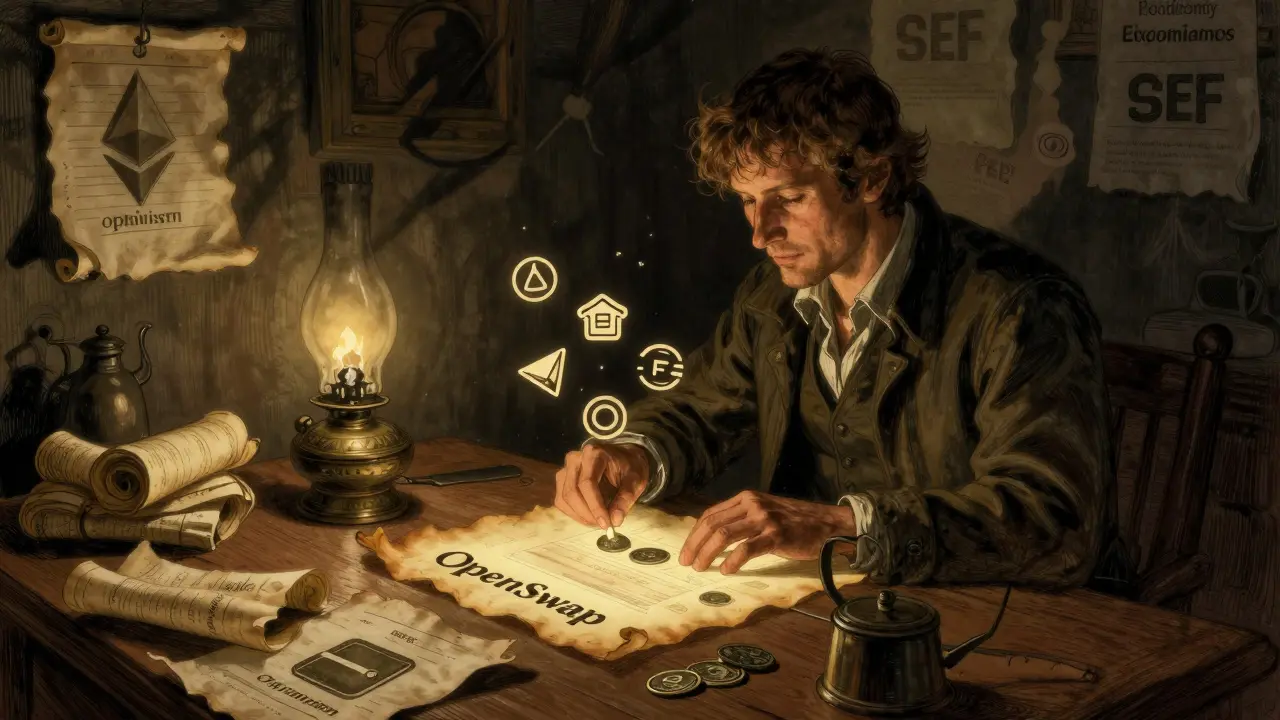
OpenSwap on Optimism isn't another big-name crypto exchange. You won't find it on CoinMarketCap’s top 100, and you won’t see ads for it on YouTube. But if you’re tired of paying trading fees on every small trade, it’s worth a look. This isn’t a platform for beginners or people looking for customer support. It’s a quiet, no-frills decentralized exchange built on Optimism’s Layer 2 network - and it charges zero fees for every trade. That’s not a typo. No maker fees. No taker fees. Just 0.00%.
How OpenSwap (Optimism) Works
OpenSwap runs entirely on Optimism, which is a Layer 2 scaling solution for Ethereum. Instead of sending transactions through the congested and expensive Ethereum mainnet, OpenSwap bundles trades into batches and processes them off-chain. Then it posts a single proof back to Ethereum. This cuts gas fees by over 90% and makes trades settle in seconds, not minutes.
Because it’s built on Optimism, OpenSwap works with any EVM-compatible wallet - MetaMask, WalletConnect, Rabby, you name it. You connect your wallet, pick a token pair, and trade. There’s no KYC. No account creation. No email verification. It’s pure decentralization. If you’ve used Uniswap before, the interface will feel familiar: simple, clean, and focused on swapping tokens.
The Zero-Fee Model - Too Good to Be True?
Most DEXs charge between 0.1% and 0.3% per trade. Even Uniswap V3 takes a small cut through slippage and gas. OpenSwap doesn’t. At all. That’s rare. And it raises a question: how do they make money?
The answer isn’t public. There’s no clear revenue stream. No token burn. No staking rewards. No liquidity mining program. Some speculate they’re funded by grants from the Optimism Foundation. Others think they’re testing a model where volume alone eventually justifies the cost. Either way, right now, traders get free trades. That’s a big deal if you’re swapping small amounts - say, $50 worth of ETH for OP or WBTC.
But here’s the catch: free doesn’t mean risk-free. With no fee revenue, there’s less incentive to invest in security audits, bug bounties, or customer support. You’re on your own.
Who Uses OpenSwap?
Not many. According to SimilarWeb, OpenSwap gets about 1,500 visits per month. That’s less than 0.5% of Uniswap’s traffic. It ranks 441st out of 612 crypto exchanges in organic traffic. Most visitors come from direct links or crypto forums - not search engines.
But here’s something interesting: those 1,500 people aren’t just clicking and leaving. The bounce rate is only 25%. People stay an average of 9 minutes and check 4.4 pages per visit. That suggests users who find OpenSwap are actually using it - not just checking it out. They’re likely traders who care about low fees and know how to navigate a DEX without hand-holding.
OpenSwap Token: What Do We Know?
There is an OpenSwap token. Coinbase lists it. Price predictions say it might hit ARS 55.24 in three months. But that’s about all. There’s no whitepaper. No tokenomics page. No info on total supply, circulating supply, or how the token is used.
Is it a governance token? A fee-sharing token? A reward token? No one says. That’s a red flag. If you’re holding OpenSwap tokens, you’re betting on something no one can explain. It’s not like UNI or OP, where the utility is documented and debated in public forums. Here, it’s a mystery.
That doesn’t mean the token is fake. But it does mean you’re investing in opacity. If you’re considering buying or staking it, treat it like a high-risk gamble - not a core holding.
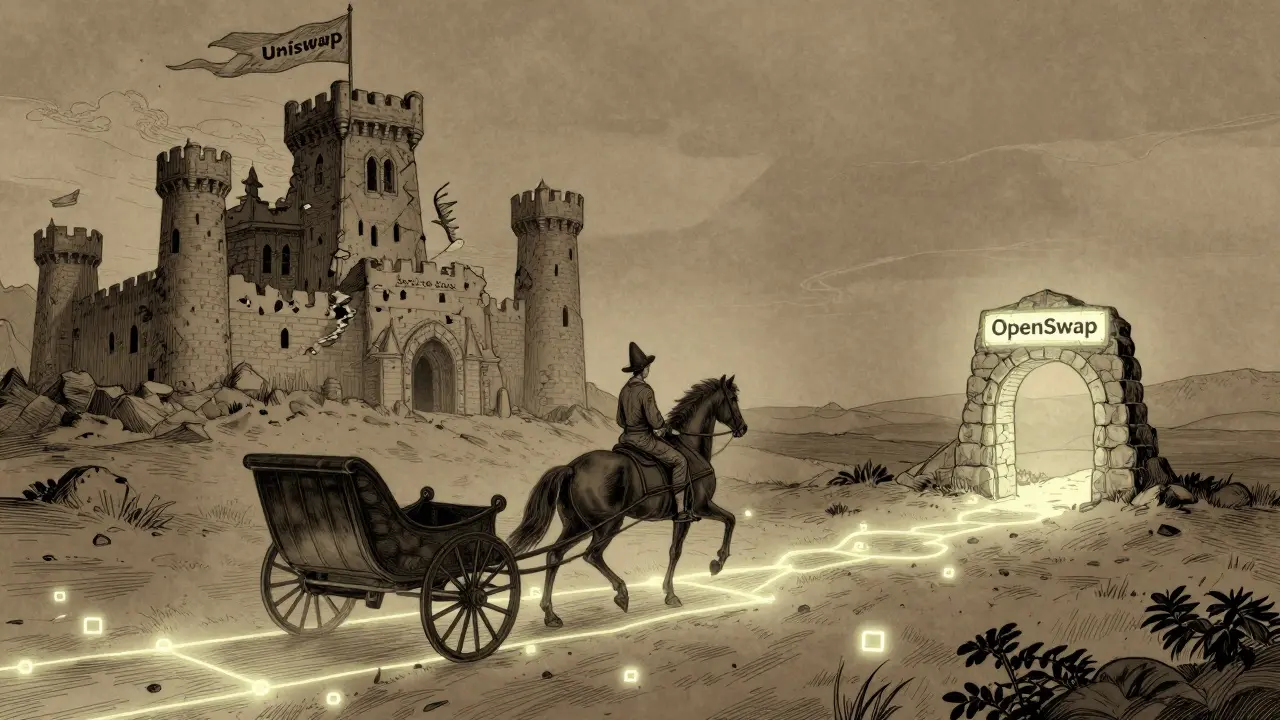
Why Optimism Matters
OpenSwap’s real strength isn’t the exchange itself - it’s the network it’s built on. Optimism is one of the most mature Layer 2 solutions. It uses optimistic rollups, which are battle-tested and compatible with Ethereum’s smart contracts. That means developers can deploy apps here without rewriting code.
As of May 2025, the OP token was trading around $0.72. That’s up from $0.08 in early 2024. Optimism has a strong community, a unique governance system (Token House + Citizens’ House), and growing adoption from DeFi projects like Synthetix and Frax.
OpenSwap benefits from this. Faster trades. Lower gas. More stable infrastructure. But it also means OpenSwap’s fate is tied to Optimism. If Optimism loses market share to Arbitrum or zkSync, OpenSwap will fade with it.
What’s Missing
OpenSwap has no mobile app. No analytics dashboard. No liquidity charts. No historical trade data. No API for developers. No blog. No Twitter with updates. No Discord community.
You get a website. A wallet connection. A swap interface. That’s it. For some, that’s perfect. For others, it’s frustrating. If you want to track your trading history, analyze liquidity pools, or see volume trends - you’re out of luck. The platform doesn’t provide those tools.
Is OpenSwap Safe?
No independent audit reports are publicly available. No security firm has published a review. That’s unusual for a DeFi platform. Most DEXs hire firms like Certik or PeckShield to audit their code. OpenSwap doesn’t appear to have done that.
That doesn’t mean it’s hacked or broken. Optimism’s core contracts are audited. OpenSwap likely uses standard, well-tested code from Uniswap V2 or similar. But without proof, you’re trusting an anonymous team with your funds. That’s the nature of DeFi - but it’s still a risk.
If you’re swapping small amounts - under $500 - the risk is manageable. If you’re moving thousands, you’re playing with fire.

Who Should Use OpenSwap?
- You trade small amounts regularly and hate paying fees.
- You already use Optimism for other DeFi apps.
- You’re comfortable with no customer support.
- You don’t need charts, analytics, or a mobile app.
- You’re okay with a token that has no clear purpose.
Who Should Avoid OpenSwap?
- You’re new to crypto and need hand-holding.
- You’re trading large sums and want security audits.
- You rely on customer service or dispute resolution.
- You want to track your trading history or export data.
- You’re looking for a long-term investment in the OpenSwap token.
The Bottom Line
OpenSwap (Optimism) isn’t trying to be the next Binance. It’s not trying to attract millions. It’s a tiny, focused tool for a specific group: low-volume traders who want free swaps on a fast, reliable Layer 2 network. It works. It’s simple. It’s quiet. And it’s risky.
If you’re already on Optimism and swap small amounts often - give it a try. Connect your wallet. Swap 10 USDC for OP. See how fast it is. See how cheap it is. Then decide if you want to keep using it.
But if you’re looking for a trusted, well-documented exchange with strong security and clear tokenomics - keep looking. OpenSwap isn’t that.
Is OpenSwap (Optimism) regulated?
No, OpenSwap is not regulated by any government or financial authority. It operates as a decentralized exchange with no KYC, no licensing, and no oversight. This gives users freedom but removes legal protections. Treat it like any other DeFi platform - assume full responsibility for your funds.
Does OpenSwap charge any trading fees?
No. OpenSwap charges 0.00% for both maker and taker fees. This is extremely rare in the crypto space. Most DEXs charge 0.1%-0.3%. OpenSwap’s zero-fee model likely exists to attract users to the Optimism network, but how it sustains itself long-term remains unclear.
How many people use OpenSwap?
OpenSwap receives about 1,500 monthly visits, according to SimilarWeb. That’s very low compared to major exchanges like Uniswap or SushiSwap. But its bounce rate is only 25%, and users spend nearly 10 minutes on the site. This suggests that while few people find it, those who do are actively using it.
Is the OpenSwap token safe to buy?
There’s no clear information on the OpenSwap token’s supply, utility, or distribution. Coinbase lists it, but there’s no whitepaper or official documentation. Buying it is speculative. Don’t treat it as a core investment. Only risk what you can afford to lose.
Can I use OpenSwap on mobile?
No, OpenSwap has no dedicated mobile app. You can access it through your mobile browser using a wallet like MetaMask, but there’s no optimized experience. It’s designed for desktop use, and the interface doesn’t adapt well to small screens.
Is OpenSwap better than Uniswap on Optimism?
Not necessarily. Uniswap V3 on Optimism has far more liquidity, better price slippage, and a proven track record. OpenSwap’s only advantage is zero fees. If you’re trading small amounts and want to save on fees, OpenSwap might help. But for most users, Uniswap’s deeper liquidity and reliability make it the better choice.
If you're looking for a low-fee, no-nonsense way to swap tokens on Optimism, OpenSwap delivers. Just remember: you're trading with a team you can't contact, a token you can't understand, and a platform that doesn't show its work. It’s DeFi in its purest - and most risky - form.
Okay but like… zero fees? On a DEX? That’s either genius or a trap wrapped in a riddle dipped in moon juice. I’ve been swapping small amounts on OpenSwap for months-$20 here, $50 there-and it’s been smoother than butter on a hot pancake. No drama, no surprise gas, just *poof* trade done. I don’t need a dashboard or a Discord server when my wallet does the talking.
Also, the token? Yeah, it’s a mystery. But so was UNI in 2020. Sometimes the quiet ones win.
As someone who’s audited DeFi protocols for a living, I can say this: OpenSwap’s codebase appears to be a clean fork of Uniswap V2 with Optimism’s L2 integration. No red flags in the bytecode. But you’re absolutely right-it’s not audited publicly, and that’s the real risk. Not the zero fees. The silence.
For small traders? Totally viable. For anything over $1k? I’d still use Uniswap V3 on Optimism. Liquidity depth matters more than fee savings when slippage hits 3%.
And yes, the token’s utility is nonexistent. But it’s not a rug. It’s a ghost. And ghosts don’t always mean danger-sometimes they’re just unfinished business.
The zero-fee model is not a business model-it’s a phenomenological disruption. Capitalism operates on scarcity, but OpenSwap weaponizes abundance. The absence of fee revenue isn’t a flaw-it’s a dialectical negation of centralized extraction. We are witnessing the emergence of a post-economic exchange paradigm.
Optimism’s rollup architecture enables this not because of tech, but because it embodies the ontological purity of permissionless value transfer. The token? A symbolic residue of a system still in gestation. Its opacity is not ignorance-it’s epistemic humility.
Those who demand whitepapers are still trapped in the anthropocentric illusion of documentation as legitimacy. The code speaks. Are you listening?
Zero fees? LOL. This is either a honeypot or a rugpull in disguise. No audits, no team, no Twitter, no blog? You’re telling me this isn’t a dev who made this in a weekend and is now waiting for someone to deposit 100 ETH so he can drain the liquidity pool?
And don’t even get me started on that token. Coinbase lists it? So what. They listed FTX. They listed TeraCoin. They listed a coin called ‘Burger King Coin’ once. That’s not validation, that’s chaos.
Don’t be a sucker. This is DeFi’s version of a pyramid scheme with a nice UI.
How quaint. A DEX for people who think ‘low volume’ is a lifestyle choice. OpenSwap is the crypto equivalent of a bookstore that only sells one copy of a book no one’s heard of-and then charges nothing because ‘art shouldn’t be commodified.’
The fact that users spend 9 minutes on the site? That’s not engagement-it’s confusion. They’re staring at the swap screen wondering if they should click ‘approve’ or call a lawyer.
And the token? Oh, it’s ‘mysterious.’ That’s code for ‘we didn’t think that far ahead.’
If you’re not trading in liquidity pools with over $10M in TVL, you’re not trading-you’re doing performance art.
✨ I LOVE this. ✨
It’s like finding a hidden gem in a thrift store-no label, no tag, no instructions… but the fabric feels like heaven. OpenSwap is that. No fanfare, no ads, no screaming influencers. Just pure, quiet, trustless swapping. 🌿
And yeah, the token’s a mystery-but isn’t that kinda beautiful? Like a poem without a title. You don’t need to understand it to feel it.
Also, the fact that people stay 9 minutes? That’s not a bug. That’s a love letter to autonomy. 💫
OpenSwap is a government backdoor. I’ve seen this before. Zero fees? They’re not making money-they’re collecting data. Every swap is logged. Every wallet address is tied to IP. They’re building a profile of every ‘small trader’ to sell to the Feds later. No audits? Because they don’t want anyone to see the surveillance layer.
And that token? It’s a tracking beacon. Coinbase listed it because they’re in on it. You think they’d list a coin with zero utility unless they were monetizing it? Wake up.
Just tried OpenSwap today-swapped 15 USDC for OP. Took 3 seconds. Gas was 0.0001 ETH. Zero fees. No pop-ups. No drama. 🤯
I’m not a crypto wizard, but I know what feels right. This feels right.
It’s like the internet in 1999-no ads, no noise, just the thing you needed. I’m hooked. <3
They say it's built on Optimism... but what if Optimism itself is a front? What if the 'Layer 2' is just a proxy for a centralized server farm in Virginia? What if the 'zero fees' are just a lure to get you to deposit tokens... then they freeze your wallet under 'regulatory compliance'?
I checked the domain registration. It was bought with Monero. The SSL cert was issued by a CA that shut down in 2021. The code repo has no commits since 2023. Someone is playing a very long game.
And the token? It's not a token. It's a Trojan horse. Buy it, and you're signing a contract with shadows.
OMG I JUST SWAPPED MY FIRST $20 AND IT WAS SO FAST I THOUGHT MY PHONE BROKE 😭💖
NO FEES? NO KYC? NO CHAT SUPPORT? YES PLEASE. I’M A MESSY TRADER WHO JUST WANTS TO SWAP AND GO. NOBODY’S HOLDING MY HAND, AND I LOVE IT. 🤖✨
THE TOKEN? IDK. I’M NOT BUYING IT. BUT THE EXCHANGE? I’M STICKING AROUND. IT’S LIKE A COZY CAFE FOR CRYPTO-NO MUSIC, NO WAITERS, JUST GREAT COFFEE. ☕️
Oh look, someone actually used it. Congrats. You’re the 1,499th person who thought ‘zero fees’ meant ‘safe.’
Let me guess-you didn’t check the contract address against the GitHub repo. Didn’t verify the owner. Didn’t even look at the transaction history. You just clicked ‘swap’ and called it a day.
That’s how rugpulls happen. Not with a ‘SELL’ button. With a ‘0.00%’ label and a pretty UI.
Next time, Google ‘OpenSwap contract address’ before you send anything. Or better yet-stick with Uniswap. It’s boring. And safe. And real.