
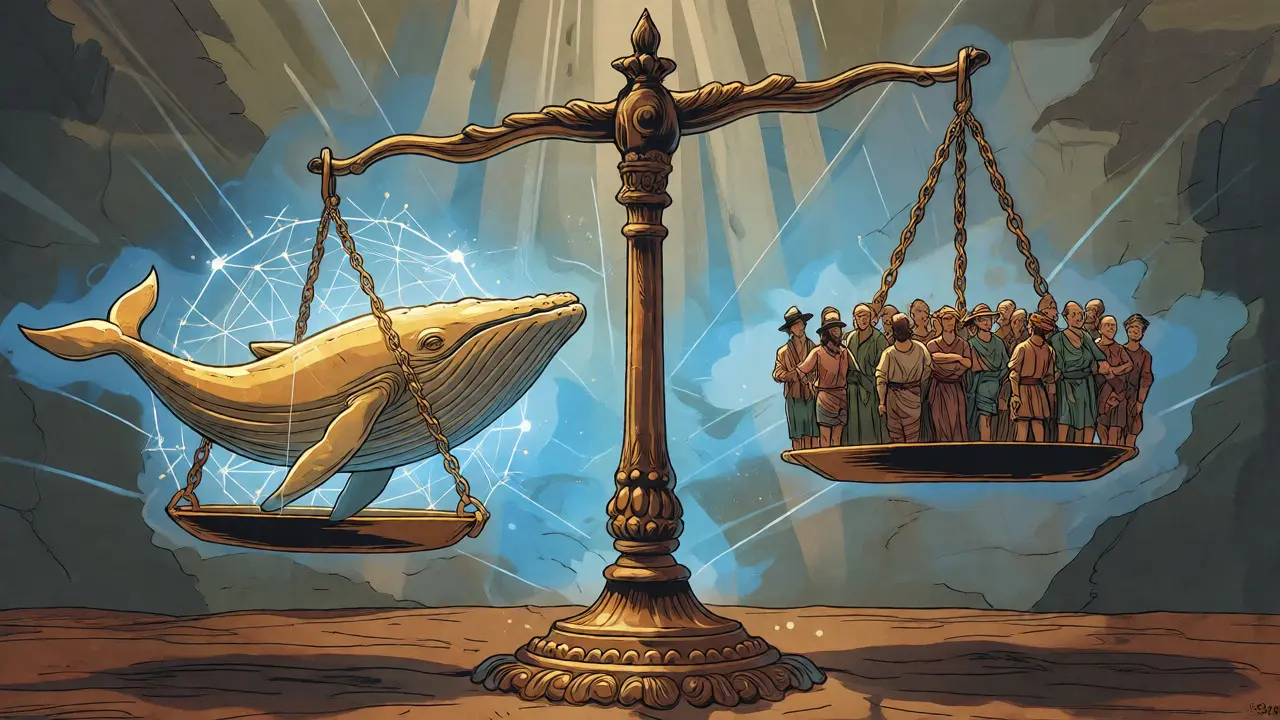
You’ve probably seen the headlines: a small group of whales just voted through a proposal that drained half the treasury. Or maybe you’re a long-time contributor who feels like your voice is drowned out by someone holding 10% of the supply. It’s frustrating, right? That feeling isn’t just in your head-it’s a structural flaw in how most Decentralized Autonomous Organizations (DAOs) work today. The standard model, token-weighted voting, assumes that if you hold more tokens, you care more about the outcome. But does owning 1,000 tokens mean you care 1,000 times more than someone with one token? Probably not.
This is where Quadratic Voting comes in as a sophisticated voting mechanism designed for DAOs that captures both the direction and intensity of voter preferences by implementing a quadratic cost function for additional votes. It’s not magic, but it’s close enough to feel like it when you see whales suddenly losing their grip on governance. If you’re trying to figure out if this system is worth the hassle for your community, or just want to understand why everyone is talking about it, stick around. We’re going to break down exactly how it works, why it fixes the "plutocracy problem," and what it actually takes to implement it without breaking your DAO.
The Problem with One Token, One Vote
Let’s be real about the current state of affairs. In a traditional DAO setup, voting power is linear. If Alice holds 100 tokens, she gets 100 votes. If Bob holds 1 token, he gets 1 vote. Simple, right? But here’s the catch: this system doesn’t measure conviction; it measures wealth. A whale can buy up enough tokens to push through any proposal they want, regardless of whether the rest of the community agrees. This leads to two major issues: plutocracy (rule by the wealthy) and apathy. Why would Bob bother voting if his single vote is statistically irrelevant against Alice’s hundred?
Research published in Frontiers in Blockchain highlights that linear systems tend to reflect the will of the largest holders rather than the majority of participants. When governance becomes a game of capital accumulation rather than community consensus, people stop participating. And when participation drops, collusion becomes easier because only the most engaged (and often most cynical) members show up. Quadratic voting attempts to solve this by changing the math behind how votes are counted.
How Quadratic Voting Actually Works
The core concept is simple but powerful: the cost of each additional vote increases quadratically. Instead of paying 1 credit for every vote, you pay $n^2$ credits for $n$ votes. Let’s look at the numbers:
- 1 vote costs 1 credit ($1^2 = 1$)
- 2 votes cost 4 credits ($2^2 = 4$)
- 3 votes cost 9 credits ($3^2 = 9$)
- 10 votes cost 100 credits ($10^2 = 100$)
See what happened there? To get 10 votes, you need 100 times the resources of getting 1 vote. This creates a diminishing return on voting power. A whale with a massive budget still has more influence than a regular user, but not nearly as much as they would under a linear system. They have to make hard choices. Do they dump all their credits into Proposal A, or spread them across Proposals B and C? This forces voters to think deeply about what they actually care about, rather than just flexing their balance sheet.
| Voter Type | Tokens Held | Linear Votes | Quadratic Votes (Budget-based) |
|---|---|---|---|
| Whale | 100 Tokens | 100 Votes | 10 Votes |
| Regular User | 1 Token | 1 Vote | 1 Vote |
| Community Group (99 Users) | 99 Tokens Total | 99 Votes | 99 Votes |
In this scenario, the whale loses dominance. Under linear voting, the whale (100 votes) beats the community group (99 votes). Under quadratic voting, the whale is capped at 10 votes, allowing the 99-person group to easily prevail. This shift empowers the minority and encourages broader participation.
Real-World Implementation: Realms and Civic Pass
You might be thinking, "Cool theory, but how do I actually set this up?" You don’t need to write complex smart contracts from scratch anymore. Platforms like Realms a prominent DAO platform that offers a Quadratic Voting Plugin making voting power proportional to the square root of the number of tokens held have integrated these mechanisms directly into their interfaces. Realms allows DAOs to configure quadratic voting plugins where voting power is derived from the square root of the tokens held. This effectively compresses the power curve, giving smaller holders relatively more influence compared to large token holders.
However, there’s a critical technical requirement: Sybil resistance. If users can create multiple fake wallets to get more credits, the whole system breaks. A whale could just split their tokens across 100 wallets and regain their linear advantage. To prevent this, implementations often rely on identity verification tools like Civic Pass an integration used to ensure each voter represents a unique individual and prevent Sybil attacks. This ensures that one person equals one voting budget, regardless of how many wallets they control. Without robust Sybil resistance, quadratic voting is just expensive chaos.
Benefits Beyond Just Stopping Whales
While stopping whales is the headline feature, the secondary benefits are arguably more important for long-term health. First, it reveals preference intensity. In a standard vote, you either vote yes or no. You can’t say, "I really hate this proposal." With quadratic voting, you can spend more credits to signal strong opposition. This data is invaluable for project teams. If a proposal passes but receives low total credits, it means the community agreed but didn’t care much. If it passes with high credits, it means there’s genuine enthusiasm. This nuance helps leaders prioritize better.
Second, it reduces polarization. Because spreading votes across multiple issues is cheaper than dumping them all into one, voters are encouraged to support a basket of proposals that align with their values. This tends to produce more moderate, broadly acceptable outcomes rather than extreme swings driven by a single passionate faction. As noted by experts at Colony.io, this mechanism "helps mitigate the risk of extreme outcomes dominated by a small group and leads to more informed decisions."
The Challenges: Complexity and Education
It’s not all sunshine and rainbows. Implementing quadratic voting introduces significant friction. The biggest hurdle is user education. Your average DAO member understands "more tokens = more votes." They do not intuitively understand why their second vote costs three times as much as their first. If the interface isn’t incredibly clear, users will feel cheated or confused. They might think the system is broken when their vote weight doesn’t match their expectation.
Furthermore, setting up the initial credit allocation is tricky. Do you give everyone 100 credits? 1,000? If the budget is too small, whales still dominate. If it’s too large, the quadratic effect is diluted. There’s no one-size-fits-all number; it requires experimentation. Also, voter fatigue is real. Calculating how to best spend a limited voting budget across five different proposals is mentally taxing. Many users simply won’t bother, leading to lower participation rates among casual members, which ironically opens the door back up for organized groups to sway results.

Is Quadratic Voting Right for Your DAO?
So, should you switch? Here’s a quick decision framework based on our experience analyzing various DAO structures:
- Adopt QV if: Your DAO suffers from severe whale dominance, you have a diverse community with varied interests, and you have the technical capacity to integrate identity verification (like Civic or Worldcoin).
- Stick to Linear if: Your DAO is very new, your community is small (<50 active voters), or your proposals are binary and urgent (e.g., emergency security patches). The overhead of QV might slow you down when speed matters most.
Startups like CityDAO have experimented with QV for pluralistic decision-making, showing that it works best in communities that value inclusivity over efficiency. If your goal is to build a resilient, democratic organization that can survive the next bull run without being hijacked by a few insiders, QV is a serious contender. But remember, technology alone doesn’t fix culture. You need to educate your members, explain the "why," and provide great UI/UX to make the math invisible.
Frequently Asked Questions
Does quadratic voting eliminate whales completely?
No, it doesn’t eliminate them entirely, but it significantly curbs their power. A whale still has more voting power than a single user, but the relationship is sub-linear. For example, a whale with 100x the tokens of a user might only have 10x the voting power, rather than 100x. This makes it much harder for a single entity to unilaterally pass contentious proposals.
What is Sybil resistance and why is it crucial for quadratic voting?
Sybil resistance prevents users from creating multiple fake identities to gain extra voting credits. In quadratic voting, if a whale splits their tokens across 50 wallets, they could potentially bypass the quadratic penalty. Tools like Civic Pass verify that each wallet belongs to a unique human, ensuring that the voting budget reflects actual individuals, not just accumulated assets.
Is quadratic voting harder to use than standard voting?
Yes, initially. It requires users to manage a "voting budget" and decide how to allocate credits across proposals. However, modern platforms like Realms abstract much of this complexity. The key is good UX design-showing users exactly how many credits they have left and what their vote will cost in real-time.
Can quadratic voting be combined with other governance models?
Absolutely. Many DAOs use hybrid models. For instance, you might use quadratic voting for community sentiment polls or non-binding proposals, while keeping linear voting for binding executive actions or emergency decisions. This allows you to benefit from the nuance of QV without sacrificing the speed needed for critical operations.
What happens if voters don’t use their full budget?
Unused credits typically expire at the end of the voting period. This encourages active participation during the window. Some advanced implementations allow rolling over unused credits, but this can complicate the economy of the voting system. Most DAOs find that expiring credits keeps engagement high and prevents hoarding strategies.