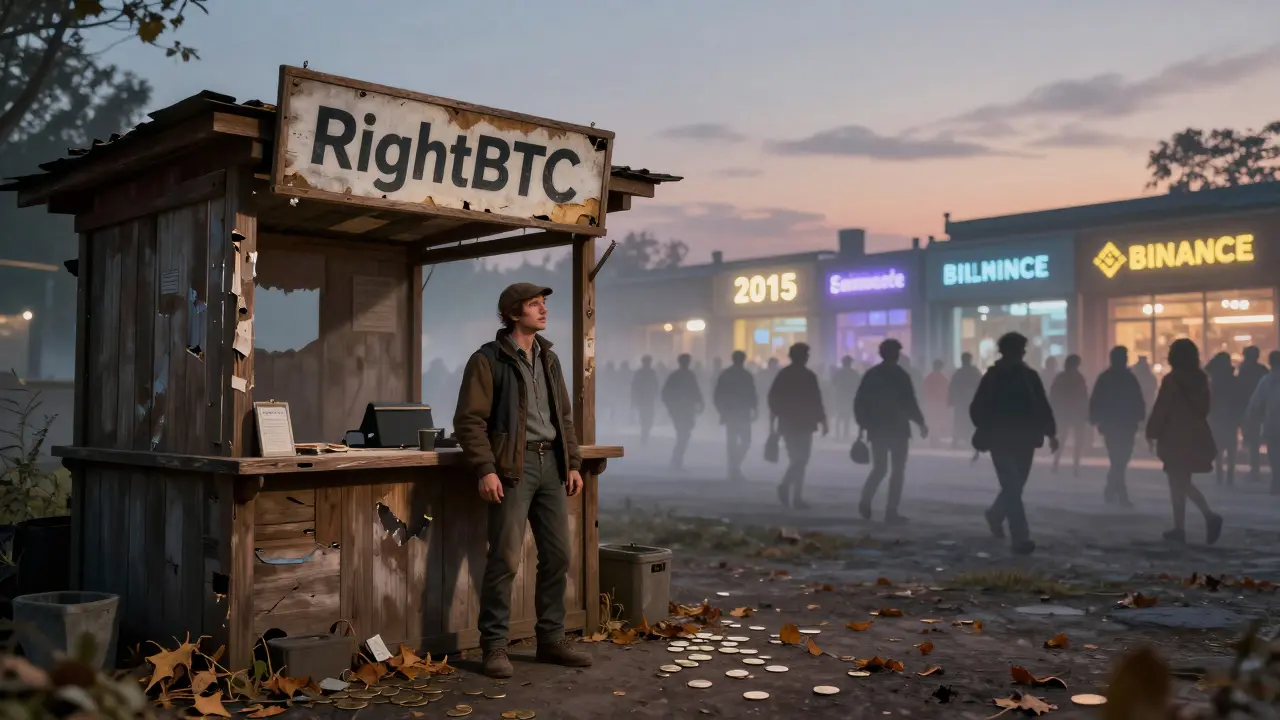
RightBTC was once a name you might have seen on lists of top crypto exchanges. It showed up in early 2015, right when Bitcoin was starting to break into the mainstream. Back then, if you wanted to trade crypto, you didn’t have dozens of polished platforms to choose from. RightBTC promised simplicity: a clean interface, 24/7 support, and a flat 0.2% trading fee - no matter if you were buying Bitcoin or selling Ethereum. For a while, it worked. People used it. But today, if you try to visit RightBTC.com, you’ll find a dead website. No login page. No trading. No customer service. Just silence.
What RightBTC Actually Offered
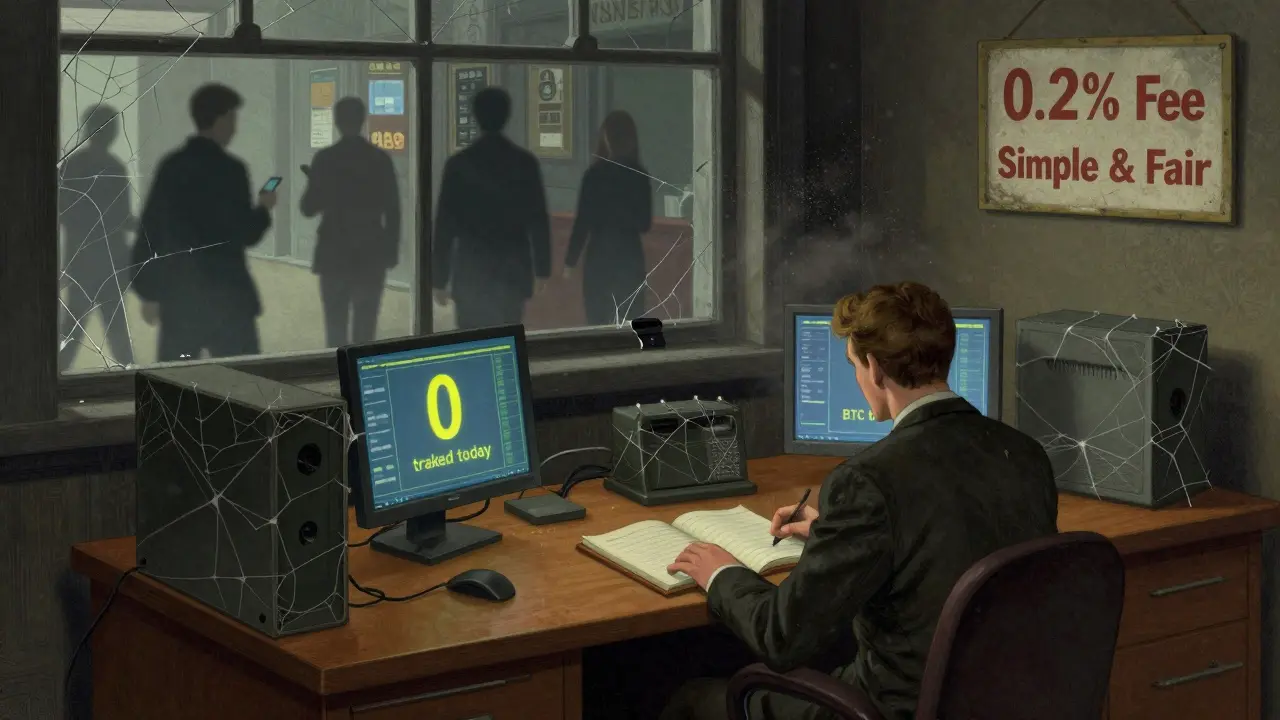
When RightBTC was active, it didn’t try to be the biggest or the flashiest. It didn’t offer futures, staking, or margin trading like Binance or Kraken did later on. Instead, it stuck to basics: spot trading. You could buy and sell Bitcoin, Litecoin, and a few other early coins. The platform had a clean design - users back then often said it felt "great" and "intuitive," especially compared to clunky early exchanges. The fee structure was simple too: 0.2% on every trade, maker or taker. No tiered pricing. No volume discounts. Just one number.
That simplicity had its upside. For someone new to crypto, it was easy to understand. No confusing fee tables. But it also had a downside. By 2018, most exchanges had dropped their fees. Binance offered 0.1% for makers and 0.1% for takers. Kraken had fees as low as 0.16% for high-volume traders. RightBTC’s 0.2% started looking expensive. And as trading volumes grew, users began to notice: the order books were thin. Spreads were wide. It wasn’t just a matter of fees - it was liquidity. If you wanted to sell 10 BTC in one go, you’d have to wait. Or accept a bad price.
Why RightBTC Failed
RightBTC didn’t get hacked. There’s no record of a major breach. No leaked user data. No sudden collapse like FTX. Its downfall was quieter - and more common. It ran out of money.
Most exchanges that fail don’t get taken down by hackers. They fail because they can’t keep up with costs. Security. Compliance. Customer support. Server maintenance. Liquidity provision. RightBTC never invested in any of those at scale. While Coinbase spent $150 million a year on compliance by 2023, RightBTC had no public audit trail, no proof of reserves, and no regulatory licenses. After the FTX crash in late 2022, users across the crypto world started demanding transparency. If you couldn’t prove you had the coins you claimed to hold, you lost trust. RightBTC never made that move.
It also didn’t adapt. As the market shifted from simple spot trading to DeFi, staking, and cross-chain swaps, RightBTC stayed stuck in 2015. No mobile app. No API for traders. No integration with wallets like MetaMask. Meanwhile, smaller exchanges that pivoted fast - like BitMart or KuCoin - grew. RightBTC just faded.
The Numbers Don’t Lie
By 2023, every major crypto data tracker had removed RightBTC from their lists.
- CryptoWisser labeled it "dead" in their Exchange Graveyard, citing a completely inactive website and zero trading volume.
- ICORankings called it "empty" - no active markets, no reserve transparency, no user activity.
- CoinMarketCap stopped listing it after November 2023, after confirming daily volume had dropped below $100,000 - the minimum threshold for inclusion.
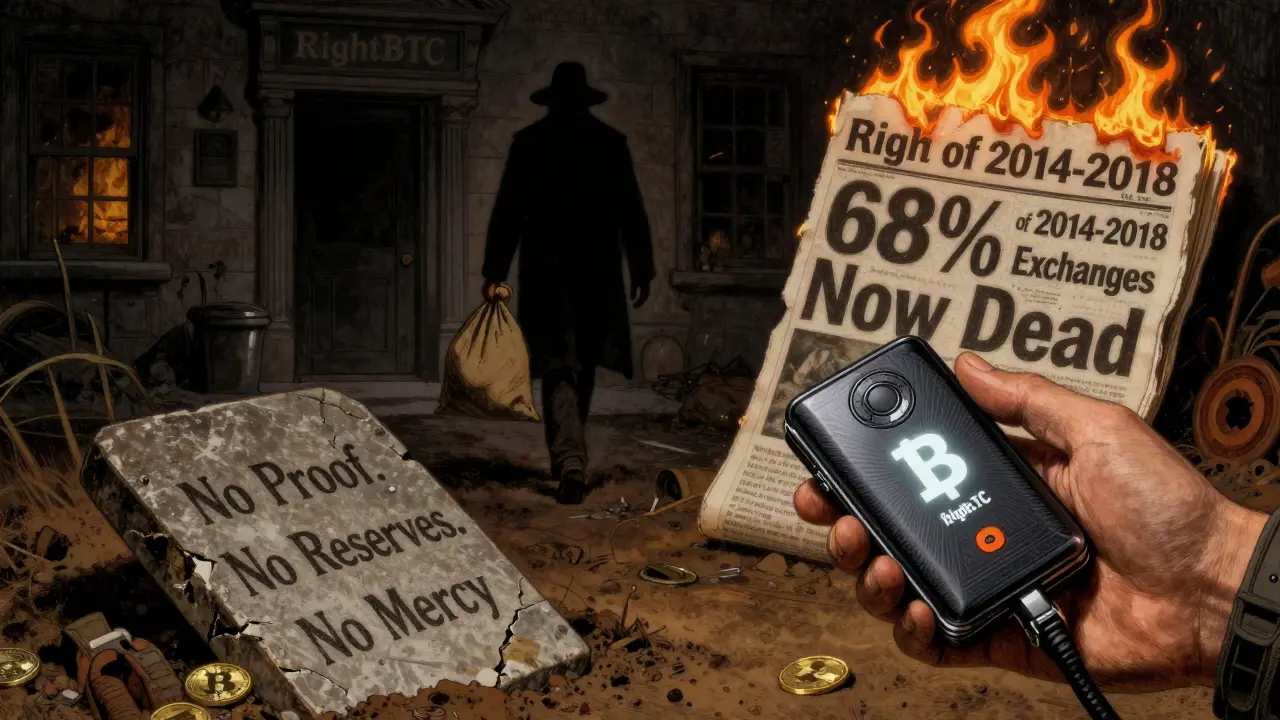
Chainalysis reported in 2023 that 68% of exchanges launched between 2014 and 2018 shut down by 2023. RightBTC was one of them. It didn’t stand out for being bad - it stood out for being average. And in crypto, average means dead.
What Happened to Your Money?
If you had funds on RightBTC when it shut down - and many users did - you lost them. Period.
A 2022 study from the Cambridge Centre for Alternative Finance found that 83% of failed crypto exchanges offered no way for users to withdraw their assets. RightBTC was one of them. No announcement. No migration plan. No refund. Just a website that went dark. There’s no legal recourse. No insurance. No FDIC protection. Crypto exchanges are not banks. And RightBTC never claimed to be one.
Some users reported trying to contact support in the months before the shutdown. No replies. Others tried to withdraw small amounts - only to see transactions hang for days. Then disappear. That’s the quiet end of a crypto exchange: users slowly realize they’re trapped.
How RightBTC Compares to Today’s Top Exchanges
| Feature | RightBTC (Historical) | Binance | Kraken | Coinbase |
|---|---|---|---|---|
| Trading Fees | Flat 0.2% | 0.1% maker / 0.1% taker | 0.16%-0.26% (volume-based) | 0.5%-1.5% (credit card), lower for Pro |
| Assets Supported | ~15 coins (est.) | 500+ coins and tokens | 200+ coins | 100+ coins |
| Proof of Reserves | No | Yes, monthly audits | Yes, quarterly audits | Yes, regular audits |
| Regulatory Status | None | Global licenses | US, EU, Canada, Japan | Licensed in 49 US states |
| Current Status | Defunct | Active | Active | Active |
The table shows how far the industry has come. RightBTC offered one thing: access. Today’s top exchanges offer security, transparency, compliance, and depth. They don’t just let you trade - they protect your money. RightBTC didn’t.
What You Can Learn From RightBTC
RightBTC’s story isn’t unique. It’s a pattern. A lot of exchanges rose during the 2017 and 2021 bull runs. They looked good. They had flashy websites. They promised easy money. But when the market turned, they vanished.
Here’s what to look for today:
- Check for proof of reserves. If an exchange doesn’t publish regular audits from a third party, walk away.
- Look at trading volume. If daily volume is under $50 million, it’s risky. Low volume means slippage. Slippage means lost money.
- See if it’s regulated. Exchanges licensed in the US, EU, or Japan have legal obligations. That’s not perfect, but it’s better than nothing.
- Don’t trust design. RightBTC had a "great theme." That didn’t save it. A pretty website doesn’t mean secure funds.
- Never keep large amounts on any exchange. Use a hardware wallet. Always.
RightBTC was never a scam. It just wasn’t built to last. And in crypto, if you’re not building for the long term, you’re already losing.
Frequently Asked Questions
Is RightBTC still operational?
No. RightBTC has been defunct since at least late 2023. Its website is inaccessible, trading has stopped, and it no longer appears on any major crypto data platforms like CoinMarketCap or CoinGecko. All signs point to a complete shutdown.
Can I recover my funds from RightBTC?
No. RightBTC never provided a withdrawal mechanism before shutting down. There is no official process to recover assets, and no legal entity exists to handle claims. If you had funds on RightBTC, they are permanently lost. This is why experts recommend using only exchanges with strong security and regulatory oversight.
Why did RightBTC fail when bigger exchanges survived?
RightBTC failed because it didn’t adapt. It didn’t invest in security, compliance, or liquidity. While exchanges like Binance and Coinbase spent hundreds of millions on audits, legal teams, and infrastructure, RightBTC stayed small and simple. When market conditions tightened after 2022, it had no buffer. It couldn’t afford to keep running - so it just stopped.
Was RightBTC a scam or a hack?
There’s no evidence RightBTC was a scam or got hacked. It appears to have failed due to financial unsustainability. It simply ran out of money to cover operating costs. This is more common than people realize - most failed exchanges don’t get hacked. They just can’t keep up.
What should I use instead of RightBTC today?
Use exchanges with clear proof of reserves, high trading volume, and regulatory licenses. Binance, Kraken, and Coinbase are the safest options for most users. For smaller traders, Bitstamp and Gemini also have strong reputations. Always keep your funds in a hardware wallet when not actively trading.
I used RightBTC back in 2016. Honestly? It was the first exchange I trusted. Clean UI, no drama. I remember my first BTC buy-felt like I was part of something real. Now I look back and laugh. We were all just kids playing with fire, thinking the platform would last forever. Turns out, no one was keeping the lights on.
RightBTC didn't fail because it was bad-it failed because it was *human*. It was built by one guy, maybe two, in a basement, with a dream and a credit card. No VC money. No legal team. No PR firm. And in crypto? That's suicide. We romanticize the underdog, but the market doesn't care about your passion-it cares about solvency. And RightBTC? It ran out of both.
Let’s be real-RightBTC was the OG chill exchange. No hype. No NFTs. No ‘community tokens.’ Just Bitcoin and Litecoin, trading like adults. And now? We got 500 coins on every platform, 17 different staking options, and 37 layers of KYC. We traded simplicity for spectacle. And guess what? We got scammed more often. RightBTC didn’t die because it was weak-it died because we stopped valuing honesty.
You people are delusional. RightBTC was a graveyard waiting to happen. No audits? No licenses? No liquidity? You think that’s "simple"? No-it’s negligent. You’re glorifying a failure. If you lost money there, you deserved it. Don’t cry about it. You didn’t do your homework. That’s not crypto’s fault. That’s YOUR fault.
I must say, the linguistic precision of this article is... *ahem*... rather underwhelming. One might argue that the syntactic structure lacks the requisite elegance one expects from a scholarly dissection of digital asset infrastructure. The use of "dead website" is particularly... *unrefined*.
In India, we had a similar story with a local exchange called Coinsecure. They vanished in 2019 too. No warning. No refund. Just silence. People lost life savings. I still remember the Telegram group-hundreds of people posting "Where is my BTC?" at 3 AM. RightBTC? It’s not just a story. It’s a pattern. And we keep falling for it. Why? Because we want to believe.
Bro, this hits hard 😔 I lost 0.5 BTC on RightBTC. Didn’t even notice until 2021. Now I keep everything in Ledger. No exchange is safe. Not even Binance. Just saying. 🙏
Oh wow, another crybaby who lost money because they didn’t read the fine print? Newsflash: crypto is WILD WEST. You didn’t get hacked. You got OUTMANEUVERED. And now you want a hug? Grow up. The ones who survived? They moved fast. They hedged. They didn’t trust some 2015 website with a "clean interface." And you? You got played. Welcome to the jungle.
I think this is one of the clearest breakdowns I’ve seen. RightBTC wasn’t evil. It was just… out of time. Like a horse-drawn carriage in 1920. The world moved on. The people who stayed loyal? They got left behind. But honestly? I’m glad it happened. It taught us that trust can’t be built on aesthetics. It has to be built on transparency.
Hey everyone, I just wanted to say-this post helped me realize I was still holding coins on an old exchange I forgot about. I moved them all to my wallet today. Thank you for the reminder. It’s easy to get complacent. Don’t be. Your peace of mind is worth more than the 0.2% fee.
Ah yes, the classic Western narrative: "Oh, poor RightBTC, so misunderstood." Meanwhile, in India, we had 12 exchanges vanish in 2018 alone. No one wrote a 2000-word obituary for them. We just moved on. Maybe the real lesson? Don’t romanticize failure. Just learn. And move on.
I knew this was coming. The whole thing was a Fed-backed decoy. They let RightBTC run to collect user data, then shut it down to scare people into trusting "regulated" exchanges. Now you’re all begging for Coinbase to "protect you." Wake up. The system doesn’t want you to own crypto. It wants you to rent it. RightBTC? Wasn’t a failure. It was a test.
The assertion that RightBTC's demise was due to financial unsustainability is, strictly speaking, an oversimplification. One must consider the confluence of macroeconomic factors, regulatory arbitrage, and the structural inefficiencies inherent in non-compliant market participants. To attribute failure to a singular cause is to misunderstand the complexity of decentralized finance.
Wait-so you’re saying exchanges that don’t do audits are doomed? But what about the ones that do audits and still steal? Like the one in 2021 that published a "proof of reserves" with a fake Merkle tree? RightBTC didn’t lie. It just didn’t bother. Maybe it was more honest than the ones pretending to be safe?
It’s critical to recognize that RightBTC’s operational model was not inherently flawed-it was merely under-resourced. The failure was systemic, not individual. The crypto ecosystem, at its nascent stage, lacked the infrastructure to sustain small, non-VC-backed entities. Regulatory frameworks were non-existent, liquidity pools were shallow, and user education was virtually absent. RightBTC was a casualty of a broader failure to build institutional guardrails-not a reflection of poor management. We must learn from this by investing in governance, not just technology.
The truth is nobody cared enough to save RightBTC. It was just another website. No one had skin in the game except the users. And users? We’re the ones who always get burned. The founders? They vanished. The investors? They moved on. The regulators? They were asleep. And we? We just keep signing up for the next shiny thing.
I’m not mad about losing money-I’m mad that I didn’t move faster. RightBTC taught me one thing: if you’re not actively watching your funds, you’re already losing. I started using cold storage the next day. And now? I’m up 4x. Don’t wait for a shutdown to wake up. Wake up before it happens.