
Setting up a crypto exchange in Malta isn’t just about finding a good office location or hiring a team. It’s about passing one of the strictest, most thorough regulatory tests in the world - and coming out with a license that lets you operate across the entire European Union. If you’re serious about running a crypto exchange that lasts, Malta’s MiCA framework is the gold standard. But it’s not easy. And it’s not cheap. But for businesses that need legitimacy, scale, and EU-wide access, there’s no better path.
Why Malta? It’s Not Just About Taxes
People often think Malta is attractive because of low taxes. That’s partly true - but it’s not the main reason top exchanges like Gate Technology, Coinbase, and Kraken chose it. The real value is EU passporting. Once you get a license from the Malta Financial Services Authority (MFSA) under the Markets in Crypto-Assets Regulation (MiCA), you can offer services in all 27 EU countries without needing separate approvals in each one. That’s a massive advantage over places like the U.S., where you’d need state-by-state licenses, or Switzerland, where you still face fragmented rules across borders. Malta’s regulatory system didn’t start with MiCA. It began in 2018 with the Virtual Financial Assets Act (VFAA), one of the first real attempts to regulate crypto. That early move gave Malta time to test, refine, and adapt. By the time MiCA came into force on December 30, 2024, Malta already had a working model. The MFSA wasn’t starting from scratch. They had experience reviewing business plans, auditing cybersecurity systems, and evaluating risk controls. That’s why, in September 2025, Gate Technology Ltd became the first major exchange to receive a full MiCA license - and why others are following fast.What MiCA Actually Requires
MiCA doesn’t just say “be honest.” It demands proof. If you want to operate a crypto exchange in Malta, you must show the MFSA that you can handle:- Capital requirements: You need enough funds to cover operational risks - typically €125,000 minimum, but most successful applicants hold much more, especially if they plan to hold client assets.
- Corporate governance: Clear roles for directors, compliance officers, and AML officers. No vague titles. No family-run setups. You need documented policies on decision-making, conflict of interest, and reporting.
- Cybersecurity: Independent audits of your systems. Evidence of penetration testing, encryption standards, multi-signature wallets, and cold storage protocols. The MFSA will ask for your incident response plan - not just that you have one, but that it’s been tested.
- Risk management: You must map out every possible failure point: exchange hacks, liquidity crunches, regulatory changes, third-party vendor failures. Then show how you’ll respond.
- Transparency: Your business plan must detail exactly what services you’ll offer - spot trading? Derivatives? Custody? Staking? Each one has different rules under MiCA.
You can’t wing it. A friend who tried to apply without legal help told me his application got rejected because he listed “crypto arbitrage” as a service without explaining how he’d manage the associated market risk. The MFSA doesn’t care if you’re “just a startup.” They care if your systems can survive a 20% market crash, a DDoS attack, or a sudden regulatory shift.
The Licensing Process - Step by Step
There’s no secret shortcut. The process takes 6 to 12 months. Here’s what it looks like:- Pre-application consultation: Talk to the MFSA. They’ll tell you if your business model fits MiCA. Skip this, and you waste months.
- Document preparation: Build a 50+ page application package. This includes articles of incorporation, ownership structure, financial projections, KYC/AML procedures, and a detailed IT infrastructure map.
- Submission: File everything through the MFSA’s online portal. They’ll assign a case officer.
- Review and questions: The MFSA will send back 20+ detailed questions. Expect to revise your business plan 3-4 times.
- On-site inspection: An MFSA team will visit your offices. They’ll check your server rooms, interview your compliance officer, and test your incident response drill.
- Decision: Approval, conditional approval, or rejection. If approved, you pay the licensing fee (€25,000-€75,000 depending on scope) and get your license.
Gate Technology spent 11 months on this process. They hired three legal teams - one for MiCA, one for EU data law (GDPR), and one for Maltese corporate law. They didn’t cut corners. And now they’re operating across 27 countries.

Who Can Do This? The Real Barriers
If you’re a solo founder with $50,000 and a laptop, forget it. MiCA isn’t designed for small players. The average cost to set up and license a crypto exchange in Malta is between €500,000 and €1.5 million. That includes:- Legal and consulting fees (€200,000-€400,000)
- Compliance software and cybersecurity audits (€100,000-€250,000)
- Capital reserves (minimum €125,000, but realistically €500,000+)
- Office space and staff (at least 5 full-time roles: CRO, CCO, CTO, AML officer, compliance analyst)
There’s no way around this. The MFSA doesn’t give licenses to “ideas.” They give them to institutions. That’s why startups with venture funding are the ones succeeding - not bootstrapped operators.
Taxes: What You Actually Pay
Malta’s corporate tax rate is 35%, but there’s a twist. If you’re a crypto exchange, you’re not taxed on every trade. You’re taxed on profits - and Malta allows you to claim deductions for everything from server costs to compliance software. More importantly, Malta has over 70 double-tax treaties. That means if you’re a U.S.-based company with Maltese operations, you won’t get hit twice on the same income.Also, cryptocurrencies are treated as capital assets. So if you hold Bitcoin long-term, you might qualify for tax exemptions. But if you’re trading daily? You’re paying the 35% on net gains. That’s higher than some places - but again, you’re buying EU access, not tax avoidance.
What Happens After You Get Licensed?
Getting the license isn’t the finish line. It’s the starting line. The MFSA doesn’t just hand you a certificate and say “good luck.” They monitor you. Quarterly reports. Annual audits. Random inspections. If your system goes down for 4 hours? You report it. If a customer complains about delayed withdrawals? You log it. If you change your custody provider? You notify them 30 days in advance.And MiCA isn’t frozen. The European Securities and Markets Authority (ESMA) keeps updating rules. In early 2025, they added new requirements for stablecoin issuers. In 2026, they’re expected to tighten rules on leverage trading. If you’re not constantly updating your compliance team, you’ll fall out of alignment - and lose your license.
Is Malta Right for You?
If you’re building a global exchange and need to operate in the EU - yes. If you’re trying to avoid regulation, no. If you’re a small local platform with 1,000 users, the cost and complexity will crush you. But if you have the resources, the patience, and the long-term vision, Malta’s MiCA license is the most powerful tool in crypto regulation today.It’s not about being “crypto-friendly.” It’s about being trustworthy. The MFSA doesn’t care if you’re a blockchain believer. They care if your systems can protect users. That’s why the biggest exchanges are all moving there. Not because it’s easy. Because it’s the only way to play for keeps.
Can I set up a crypto exchange in Malta without a physical office?
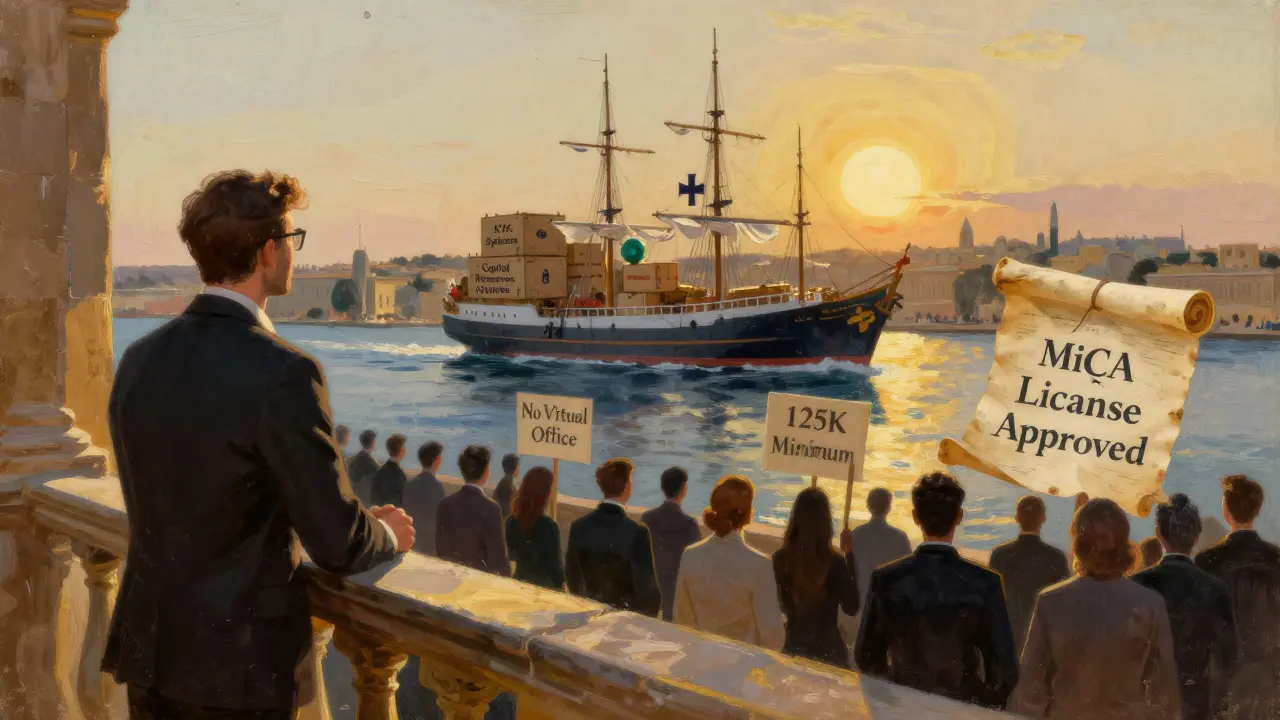
No. The MFSA requires a registered physical office in Malta. You can’t use a virtual address or a co-working space. You need a dedicated office with proper infrastructure, including secure server access, meeting rooms for audits, and a local point of contact. The MFSA will conduct on-site inspections, and they won’t approve your application without proof of a real, operational presence.
How long does the MiCA license application take?
Typically 6 to 12 months. The timeline depends on how complete your application is and how quickly you respond to MFSA questions. Some applicants with poor documentation have taken over a year. The fastest approvals happen when applicants work with experienced legal teams who’ve gone through the process before. There’s no fast-track option.
Do I need to be based in the EU to get a MiCA license in Malta?
No, you don’t need to be an EU citizen or resident. But you must establish a legal entity in Malta - usually a private limited company. Foreign founders can own 100% of the company, but the company itself must be incorporated under Maltese law, with a local registered address and at least one Maltese-resident director.
What happens if my MiCA license is revoked?
If your license is revoked, you must immediately stop all crypto-asset services in the EU. You’ll be given a short window - usually 30 days - to wind down operations, return client assets, and notify users. You’ll also be barred from reapplying for at least two years. Revocation typically happens due to repeated compliance failures, fraud, or failure to maintain capital requirements.
Can I offer staking or lending services under a standard exchange license?
Not automatically. A standard crypto exchange license covers spot trading and custody. If you want to offer staking, lending, or yield products, you must apply for additional service categories under MiCA. Each one requires separate documentation and approval. Many applicants start with just exchange and custody, then expand later after proving compliance.
Is MiCA the same as the old VFAA?
No. The VFAA (Virtual Financial Assets Act) was Malta’s original crypto law from 2018. MiCA is the new EU-wide standard that replaced it. While VFAA-licensed firms had a transition period, all new applications must now follow MiCA. MiCA is stricter, more detailed, and harmonized across the EU. If you were licensed under VFAA, you still need to reapply under MiCA to keep operating after December 2024.
MiCA? More like MiCA-NOPE. All that paperwork for what? Just move to Singapore and chill.
Oh wow so we're all just supposed to be impressed that a company spent a million bucks to do what any decent dev team could do in a garage? 🙃
500k to start? Lol. I run a bot on Binance for less than 5k. This is why crypto is broken.
You're missing the systemic risk architecture. MiCA mandates CRR 2.0 compliance under Article 67, which necessitates a dynamic liquidity buffer calibrated to volatility index gamma. Without a CDS overlay, your entire capital stack is exposed to counterparty contagion.
YESSS this is sooo important!! 🙌 I just got my MiCA license last month and it was a nightmare but WORTH IT!! 🥳 Now I'm live in 27 countries and my users are loving it!! 🚀 (ps: if you need help DM me!!)
The regulatory rigor outlined here is precisely what the industry needs. While the upfront cost is substantial, the long-term credibility and operational stability it confers are irreplaceable. Many jurisdictions lack the institutional maturity to enforce such standards, making Malta’s framework a de facto benchmark.
You say 'no shortcut' but everyone knows the MFSA takes bribes. I've seen the emails. This whole thing is a pay-to-play scam.
I love how this post flips the script - instead of 'crypto is wild and unregulated,' it shows how serious players are building real institutions. That’s the future. Not memes. Not pump-and-dumps. Real infrastructure. Keep going.
i think the real issue is not the cost but the fact that you need to have a local director. why cant we just use a virtual office like in dubai? its so unfair to startups
MiCA? More like MIA-CRASH. The second a real hack happens, the whole EU will panic and shut it down. They don’t even know what a private key is.
i got my license last year. its a grind but honestly worth it. the mfsa reps were super helpful. just dont skip the pre-app consult. i did and wasted 3 months
The capital requirements are laughably insufficient. A true institutional-grade exchange requires a Tier 1 capital buffer of at least €2.5M, not this €125k token gesture. MiCA is a regulatory theater designed to appease retail sentiment while enabling institutional capture.
Too expensive. Just use Binance.
They say 'EU passporting' like it's magic. Except every country has its own tax authority, consumer protection laws, and local AML rules. You still need lawyers in 27 countries. This isn't a passport - it's a checklist.
You think this is hard? Try doing it in the US. You need 50 state licenses, FBI background checks, and a personal meeting with the Fed chair. Malta is a vacation compared to that. Stop complaining and get to work.
This is how the global elite are consolidating control. MiCA isn’t about consumer protection - it’s about creating a gated system where only corporations with deep pockets can participate. Meanwhile, ordinary people are left with decentralized alternatives. This isn’t regulation. It’s exclusion disguised as compliance.