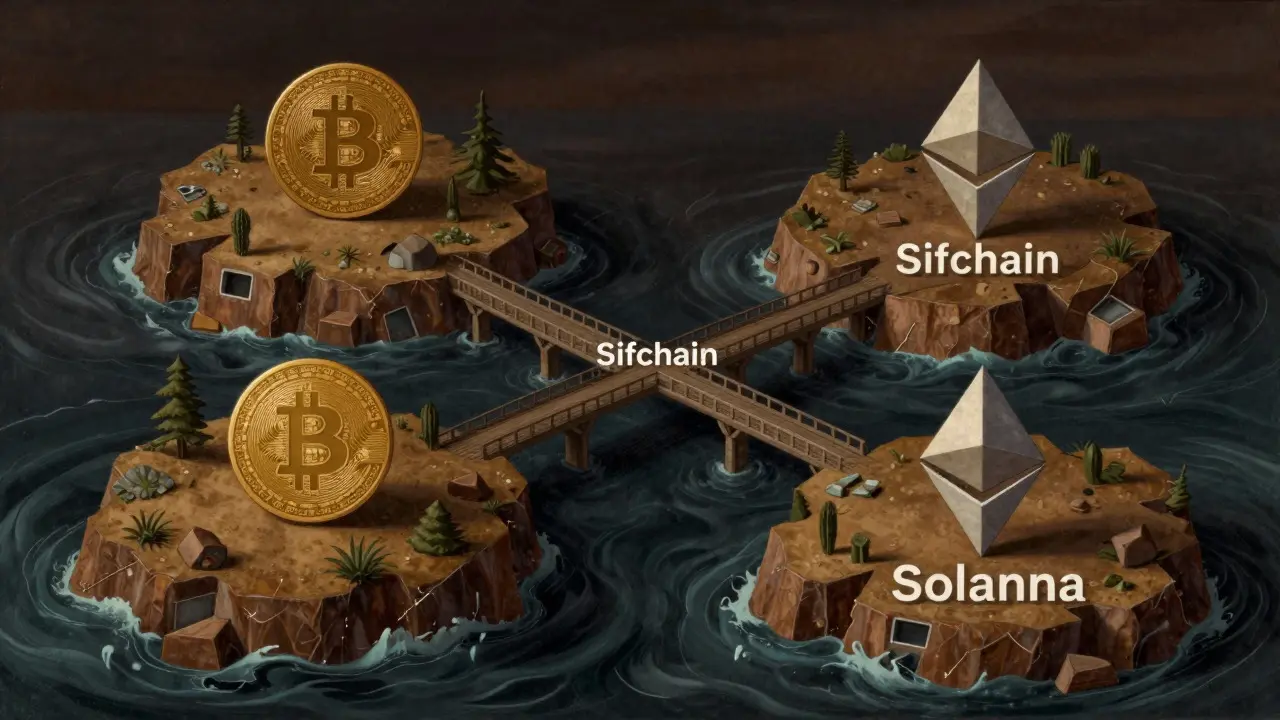
Remember when moving Bitcoin to Ethereum felt like defusing a bomb? You had to trust bridges, hope for the best, and pray your funds didn’t vanish into the ether. That was the reality of early DeFi. Today, platforms promise seamless "omni-chain" connectivity, but do they actually deliver? Sifchain is an omni-chain decentralized exchange (DEX) designed to connect multiple blockchains through a single interface. Founded in 2020, it aims to be the first comprehensive solution for swapping assets across 20-25 major networks without centralized intermediaries. But here’s the hard truth: while the vision is ambitious, the execution has been rocky. Before you bridge your savings, let’s look at what Sifchain actually offers in 2026, where it falls short, and whether it belongs in your portfolio.
The Core Problem Sifchain Tries to Solve
Cryptocurrency isn’t just one network anymore. It’s a fragmented landscape. You have Bitcoin on its own chain, Ethereum smart contracts, Solana’s speed, and BNB Chain’s ecosystem. Historically, if you wanted to swap BTC for ETH, you needed a centralized exchange or a risky bridge. Cross-chain swaps are transactions that move value between different blockchain networks without using a central authority. Sifchain positions itself as the fix. By acting as an intermediary layer, it allows you to trade assets natively across chains. The native fuel for this engine is the ROWAN token, which serves as the governance and settlement asset for the Sifchain ecosystem. You use ROWAN to pay fees, vote on protocol changes, and provide liquidity. The idea is simple: one interface, all chains. In theory, it saves time and reduces exposure to bridge hacks. In practice, however, the user experience has historically been steep and liquidity thin.
How Sifchain Works Under the Hood
You might assume Sifchain works like Uniswap, with simple automated market makers (AMMs). It’s more complex. The platform combines liquidity pools with traditional order book mechanics. This hybrid approach allows for limit orders, which is rare in most DEXs. When you place a limit order, it sits in the pool until the market price hits your target. To prevent front-running-a common issue where bots see your pending transaction and jump ahead-Sifchain uses a commitment-reveal scheme. You submit a hash of your transaction first, then reveal the details later. This adds security but also complexity.
Liquidity providers can add assets symmetrically (equal value of two tokens) or asymmetrically (just one token). Validators secure the network and participate in SifDAO, the decentralized autonomous organization that governs Sifchain protocol upgrades and parameters. Your voting power depends on how much ROWAN you hold. While this structure sounds robust, it requires users to understand gas fees on multiple chains and bridge mechanics. If you’re new to crypto, this isn’t a plug-and-play solution. You need intermediate knowledge to avoid failed transactions or excessive costs.
User Experience: Steep Learning Curve
Let’s talk about usability. A 2023 study by the DeFi Education Project rated Sifchain’s difficulty at 4.2 out of 5. New users typically need 8-10 hours to become proficient, compared to 2-3 hours for single-chain DEXs like Uniswap. Why so long? Because you’re managing keys, approvals, and gas limits across different ecosystems simultaneously. Documentation quality is average (3.7/5), with gaps in troubleshooting cross-chain failures. Support response times average 18 hours, which is slow when your funds are stuck in limbo. Reddit discussions show mixed feelings. Users appreciate the concept but complain about slippage and thin liquidity on smaller pairs. If you stick to major assets like ETH and BTC, execution is smoother. For altcoins, expect wider spreads and higher risks.
| Feature | Sifchain | THORSwap | Uniswap V3 |
|---|---|---|---|
| Supported Chains | 20+ (Target) | 10+ | Ethereum + L2s |
| Order Types | Limit & Market | Market Only | Market Only |
| Learning Curve | Steep (Intermediate) | Moderate | Easy (Beginner) |
| Liquidity Depth | Low ($1.8M TVL) | High ($847M TVL) | Very High |
| Native Token | ROWAN | RUNE | UNI |
Liquidity and Market Reality
Here’s the elephant in the room: liquidity. As of late 2023, Sifchain’s Total Value Locked (TVL) was around $1.8 million. Compare that to THORSwap, its main competitor, with $847 million. That’s a massive gap. Low liquidity means higher slippage. If you try to swap a large amount of a less popular token, the price you get will be worse than the market rate. Most transactions on Sifchain involve ROWAN pairs, not actual cross-chain utility. Only 22% of swaps involve major assets like ETH/BTC. This suggests speculative trading rather than real-world usage. If you’re looking for deep markets, Sifchain isn’t there yet. Stick to top-tier DEXs for high-volume trades.
ROWAN Token Analysis
The ROWAN token is the economic backbone of Sifchain, used for fees, staking, and governance. Its price history has been volatile. Predictions vary wildly. Some analysts saw a bearish drop, others predicted massive gains. In reality, ROWAN has struggled to maintain momentum against larger competitors. With a low market cap, it’s susceptible to manipulation and high volatility. If you buy ROWAN, you’re betting on Sifchain’s future adoption, not current utility. Keep this in mind before allocating significant capital. Regulatory scrutiny on governance tokens is also increasing, adding another layer of risk.
Security and Risks
Security is paramount in DeFi. Sifchain’s multi-chain architecture introduces complexity. Each connection point is a potential vulnerability. While the commitment-reveal scheme helps with front-running, bridge security remains a concern. The SEC’s framework for multi-chain applications hints at future regulatory pressure. If regulators classify ROWAN as a security, it could impact liquidity and accessibility. Additionally, technical bugs in cross-chain messages can lead to frozen funds. Always start with small amounts. Never put more than you can afford to lose. Check audit reports regularly, though independent audits for Sifchain have been limited compared to industry leaders.
Future Roadmap and Viability
Sifchain plans to migrate to a new consensus mechanism to reduce transaction times from 15-20 minutes to under 2 minutes. They aim to integrate Polkadot and Cardano by end of 2024. A $5 million grants program supports ecosystem development. These steps are promising but unproven. The omni-chain DEX segment is growing, projected to capture 5-7% of total DEX volume by 2025. If Sifchain executes well, it could gain traction. However, competition is fierce. THORSwap, Cosmos-based alternatives, and Layer 2 solutions are advancing rapidly. Delphi Digital rates Sifchain as medium-risk, medium-reward. CryptoCompare places it in the high-volatility quadrant. Success depends on solving liquidity issues and simplifying the user experience.
Who Should Use Sifchain?
Sifchain isn’t for everyone. It suits advanced users who:
- Want to experiment with cross-chain limit orders.
- Believe in the long-term vision of omni-chain interoperability.
- Are comfortable managing gas fees across multiple networks.
- Can tolerate low liquidity and higher slippage.
If you’re a beginner, stick to Uniswap or PancakeSwap. If you need deep liquidity, use THORSwap or centralized exchanges. Sifchain is a niche tool for specific use cases, not a general-purpose trading platform.
Is Sifchain safe to use?
Sifchain employs security measures like commitment-reveal schemes to prevent front-running. However, its low liquidity and complex cross-chain architecture introduce risks. Start with small amounts and verify contract addresses independently. It is generally safer than unknown bridges but less battle-tested than major DEXs.
What is the minimum fee for Sifchain transactions?
Fees vary based on network congestion and the specific chains involved. You pay gas fees on both the source and destination chains, plus a protocol fee in ROWAN. Cross-chain swaps typically cost more than single-chain trades due to bridging overhead.
How does Sifchain compare to THORSwap?
THORSwap has significantly higher liquidity ($847M vs $1.8M TVL) and broader adoption. Sifchain offers unique features like limit orders and aims for wider chain integration (20+ chains). THORSwap is better for immediate, high-volume trades; Sifchain is for experimental, advanced strategies.
Can I earn yield by providing liquidity on Sifchain?
Yes, you can provide liquidity symmetrically or asymmetrically. Earners receive trading fees and potentially ROWAN incentives. However, impermanent loss and smart contract risk apply. Due to lower volume, yields may be inconsistent compared to larger DEXs.
When will Sifchain support Polkadot and Cardano?
The roadmap targets integrations with Polkadot and Cardano by the end of 2024. Progress depends on technical development and community grants. Monitor official channels for updates, as delays are common in DeFi projects.