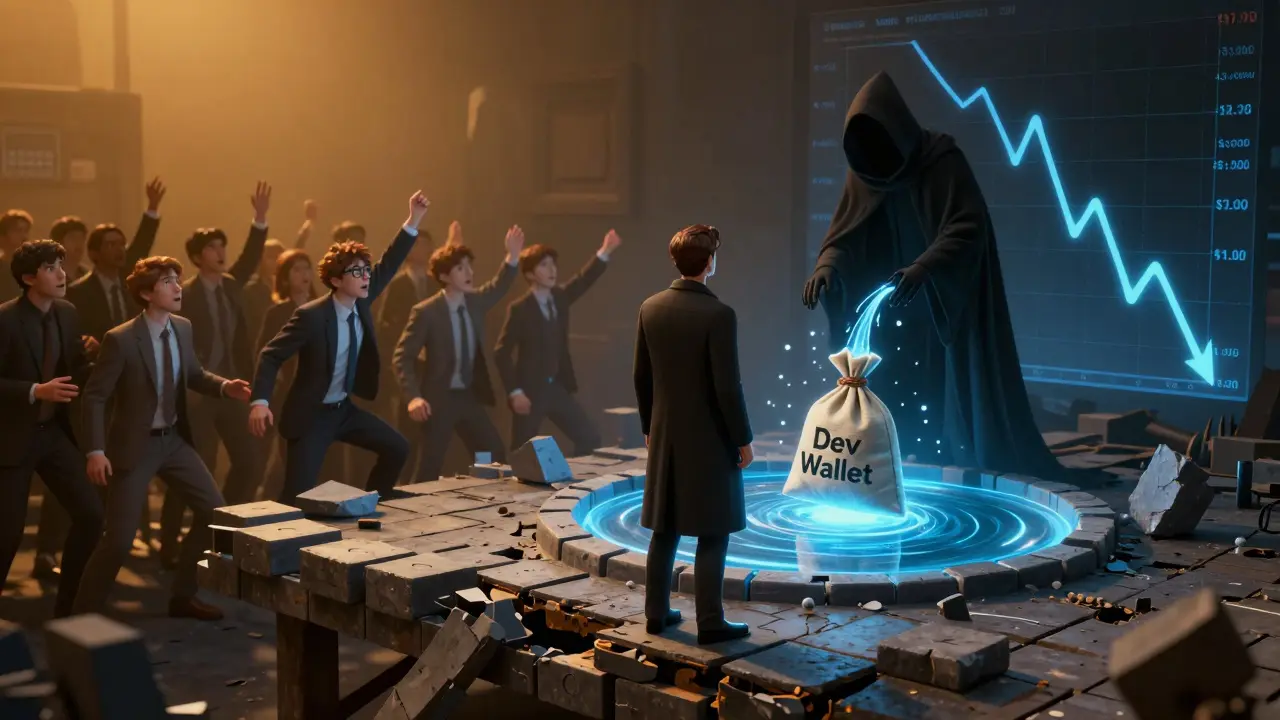
When you buy a new crypto token promising 100x returns, you’re not just risking money-you’re trusting code. And that code? It might be rigged. Smart contract rug pulls are not random glitches. They’re carefully engineered exit scams built into the very foundation of decentralized finance. These aren’t hacks. They’re smart contract rug pull mechanisms-pre-programmed traps that look like legitimate projects until the moment they vanish with your funds.
How Rug Pulls Actually Work
A rug pull isn’t a surprise raid. It’s a slow burn. Developers launch a token, create a trading pair on Uniswap or PancakeSwap, and add a small amount of liquidity-say, $50,000 in ETH or BNB. Then they flood social media with hype: “Next 100x gem!” “Backed by blockchain innovation!” “Celebrity-endorsed!” Investors rush in. The price climbs. Liquidity grows to $5 million. Then, in one transaction, the devs callremoveLiquidity() and drain every last dollar. Poof. The token drops to zero. Investors are left holding digital trash.
This is the classic liquidity pull. It’s the most common because it’s simple. No fancy code needed. Just a contract with an ownerOnly function that lets the creator withdraw funds at will. No locks. No audits. No accountability. TRM Labs tracked over 1,200 such cases in 2024 alone. The SQUID token in 2021 was one of the first to go viral. It raised $3.38 million before the devs pulled the plug. The token’s contract had no restrictions. Anyone could buy. Only the devs could sell. Or rather, only they could take everything.
The Honeypot Trap: You Can Buy. You Can’t Sell.
Then there’s the honeypot-a smarter, nastier version. In this scheme, the contract doesn’t just let devs drain liquidity. It makes it impossible for you to sell your tokens at all. How? By hardcoding a rule: only whitelisted addresses can execute sell transactions. Everyone else? Locked out. Imagine buying a stock that you can only purchase, never sell. That’s a honeypot. The contract checks the sender’s wallet address. If it’s not on the dev’s secret list, the sell function returns an error: “Transaction failed: Unauthorized.” Meanwhile, the devs are quietly selling their own holdings on the open market, driving the price up with fake demand. Investors think they’re winning. They’re not. They’re bait. The SQUID Game token didn’t just drain liquidity. It was a honeypot. Hundreds of investors posted screenshots of failed sell attempts on Reddit. One user lost $47,000. Another, $120,000. The contract looked clean. The token had a website, a whitepaper, a Discord server. But the code? It was a one-way door. Only devs could exit.Pump and Dump: The Social Engineering Scam
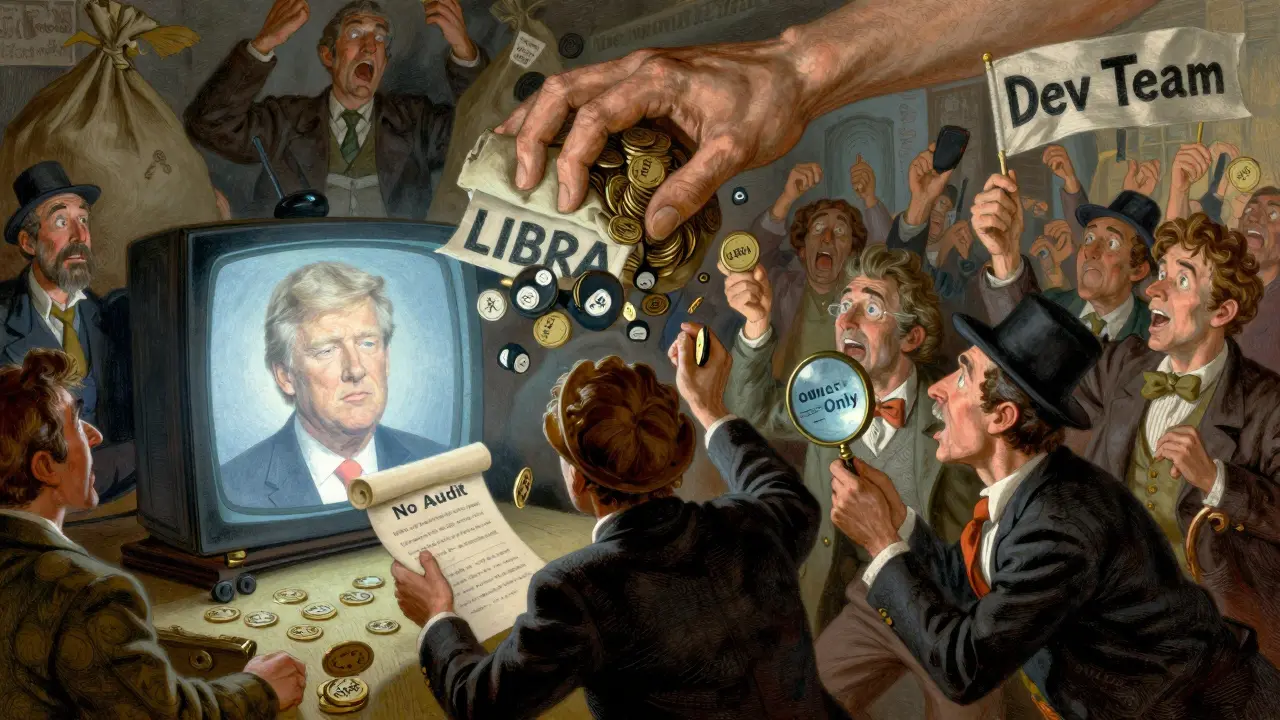
Not all rug pulls need broken code. Some rely on pure psychology. This is the pump and dump-a classic market manipulation scheme, but with crypto’s speed and anonymity. Here’s how it works: developers mint 1 billion tokens. They keep 80% for themselves. They tell you it’s a “fair launch.” They post charts showing 10% daily gains. They hire influencers to shout “BUY NOW!” They even get a politician-like Argentina’s President Javier Milei in February 2025-to casually mention a token called LIBRA on live TV. Within hours, the price spikes 400%. Thousands invest. Then, in a single 12-hour window, the devs dump their 820 million tokens. The market drowns in supply. Price crashes 95%. $107 million vanishes. No smart contract exploit. No locked funds. Just coordinated selling. This is the quietest rug pull. No code flaws. No obvious backdoors. Just greed, timing, and a massive audience of people who didn’t check who owned what.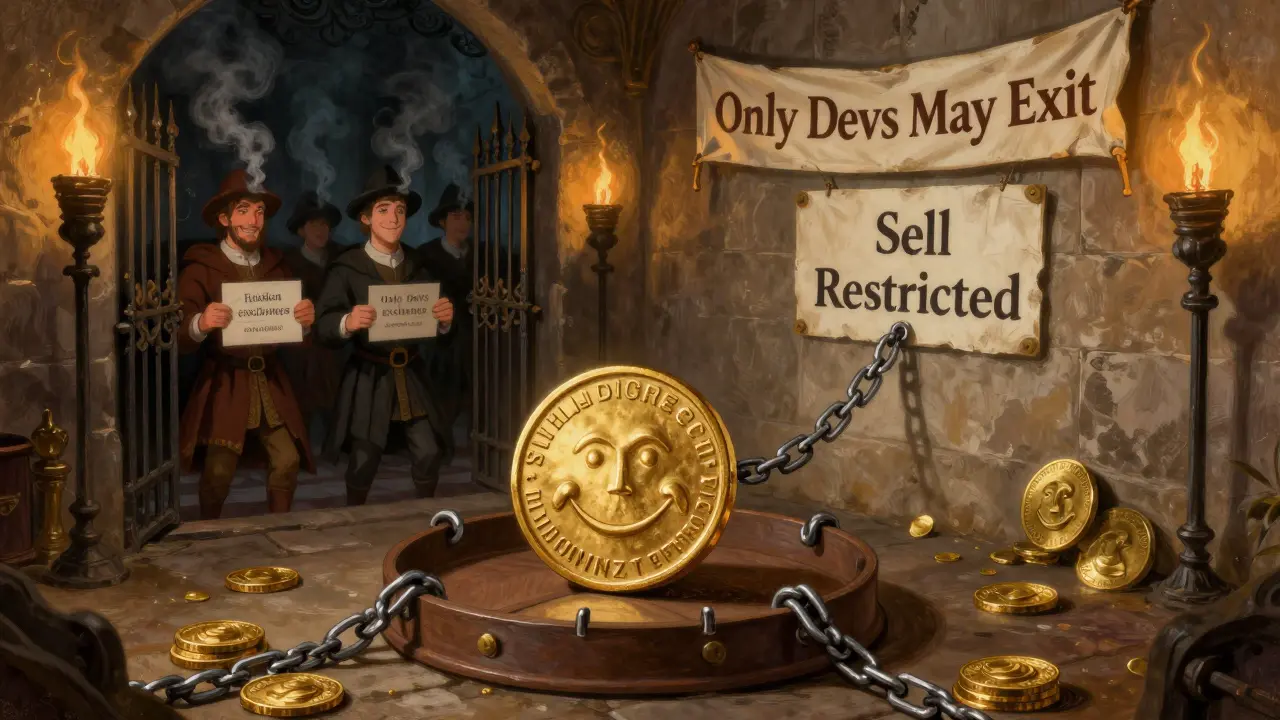
Red Flags You Can’t Ignore
You don’t need to be a coder to spot these scams. Here’s what to look for:- Anonymous team: No LinkedIn profiles. No real names. Just pseudonyms and avatars. Legit projects don’t hide. They show their faces.
- No liquidity lock: If the liquidity isn’t locked for at least 6 months, walk away. Locks are the only real guarantee that devs can’t pull funds early. Tools like Unicrypt and Team Finance make locking simple. If they didn’t do it, they’re not trustworthy.
- Dev wallet owns over 50%: If the team holds more than half the total supply, they can crash the price anytime. That’s not a fair launch. That’s a suicide mission for investors.
- Unrealistic promises: “1000x in 7 days!” “Guaranteed returns!” If it sounds too good to be true, it is. Real projects don’t promise returns. They explain how they create value.
- No audit: A professional audit from firms like CertiK, Hacken, or PeckShield costs $10,000-$50,000. If a project skips it, they’re hiding something. Even a basic audit finds 70% of honeypots.
Why These Scams Keep Working
People think blockchain is transparent. It is. But transparency doesn’t mean safety. Anyone can read a contract. But most people don’t. They see a chart going up. They see a tweet from a celebrity. They see a Discord full of people saying “TO THE MOON!” And they act on emotion. The average investor doesn’t know whatremoveLiquidity() does. They don’t check if the contract has a transferRestriction() function. They don’t run a simulation to test if they can sell. They trust the hype.
Scammers know this. That’s why they spend more on TikTok ads than on code. They don’t need to be geniuses. They just need to be loud.
What Can You Do?
There’s no foolproof way to avoid every rug pull. But you can stack the odds in your favor:- Always check the liquidity lock. Use Etherscan or BscScan. Look for a lock duration. If it’s 0 or “unlocked,” leave.
- Verify token distribution. On Etherscan, go to the “Token Holders” tab. If the top 5 wallets own more than 60%, it’s a red flag.
- Test a small sell. Buy $10 worth. Try to sell it. If the transaction fails, the contract is a honeypot. Walk away.
- Use audit tools. Tools like RugDoc and TokenSniffer scan contracts in seconds. They flag honeypots, owner controls, and hidden functions.
- Wait 72 hours. If a token launches and immediately surges 300%, it’s likely a pump. Let it settle. If it’s still trading after 3 days, maybe it’s real.
The Hard Truth
Once a rug pull happens, there’s no recovery. Blockchain is immutable. The money is gone. The devs are anonymous. The police won’t help. Crypto exchanges won’t reverse transactions. You’re on your own. The SQUID token’s creators? Never found. The LIBRA team? Disappeared into the void. No arrests. No lawsuits. Just empty wallets and broken trust. The only defense is awareness. Don’t trust the hype. Don’t trust the charts. Don’t trust the influencers. Trust the code. And if you can’t read it? Don’t invest.Can you recover funds after a rug pull?
No. Once a smart contract executes a rug pull-whether through liquidity withdrawal, honeypot locks, or mass dumping-the funds are permanently moved. Blockchain transactions are irreversible. There are no chargebacks, no refunds, and no central authority to appeal to. Recovery efforts are nearly impossible, and most victims never see their money again.
Are all new crypto tokens rug pulls?
No. But the vast majority of low-cap tokens launched without audits, liquidity locks, or transparent teams are high-risk. Legitimate projects use public audits, lock liquidity for months, and disclose team identities. If a token lacks these basics, treat it as speculative at best-and a scam at worst.
Can smart contract audits prevent rug pulls?
Audits reduce risk but don’t eliminate it. A good audit catches honeypots, owner controls, and hidden functions. But audits can’t detect social engineering, insider dumps, or fake marketing. Some audits are even faked. Always check who performed the audit and verify the report on the auditor’s official site.
Why do developers create rug pulls instead of building real projects?
Because it’s faster and more profitable. Building a legitimate DeFi protocol takes months of development, marketing, and community building. A rug pull can be set up in a weekend. With low barriers to entry and zero consequences, many choose the easy money. The lack of regulation and anonymity on blockchain make this possible.
Is it safe to invest in tokens endorsed by celebrities or politicians?
No. Celebrity endorsements are often paid promotions, not approvals. In the case of LIBRA in 2025, President Milei was not involved in the project-he merely mentioned it during a public speech. The devs used that mention to create FOMO and dump millions. Never invest based on a tweet, a video, or a quote from a public figure.
Let me break this down real simple: rug pulls aren't accidents. They're business models. Developers don't stumble into this-they design it. The contract is written with exit clauses baked in from day one. You think you're buying into innovation? Nah. You're buying into a rigged casino where the house holds all the cards and the rules change the second you put money in.
And here's the kicker-most people don't even check the contract. They see a shiny website, a Discord full of bots screaming '1000x', and a TikTok influencer in a hoodie saying 'this is the future'. That's not due diligence. That's surrender.
I've seen wallets with $200k in tokens that can't be sold because the sell function has a hidden modifier: only owner can trigger it. The devs already dumped 80% before the token even hit DEX. You're not late to the party-you're the last one in, holding the bag while they vanish into a VPN in a country with no extradition treaty.
There's no moral here. Just math. If a project doesn't lock liquidity for 6+ months, doesn't have a verified audit from a reputable firm, and the dev wallet holds more than 30% of supply? It's not a gamble. It's a suicide mission. And you're the one holding the gun.
Don't blame the market. Don't blame the 'hype'. Blame yourself for not reading the code. Because in crypto, ignorance isn't bliss-it's bankruptcy.
I've been in crypto since 2017 and I still get caught sometimes. Not because I'm dumb-but because the scams are getting smarter. The new ones don't even need code exploits. They just buy ad space on Twitter Spaces, pay a few influencers, and ride the FOMO wave until the pump turns to dump.
I remember one token called 'CryptoCrisis'-looked like a real DeFi protocol. Whitepaper, team photos, even a podcast. Turned out the 'CTO' was a guy who worked at a pizza place in Ohio. He used MidJourney to generate his LinkedIn profile. The audit? A fake PDF from a website that doesn't exist.
Don't trust the polish. Trust the process. If they're rushing to launch in 72 hours? Run. Real projects take months. Real teams have history. Real value isn't sold with memes.
It is not merely a failure of financial literacy-it is a metaphysical collapse of human agency. We have surrendered our autonomy to algorithmic specters, entrusting our capital to code written by anonymous entities who have no stake in the future they purport to build. The blockchain, once heralded as a panacea of decentralization, has become the cathedral of predation, where the sacrament of trust is offered upon the altar of greed.
One does not invest in such projects. One performs a ritual of self-annihilation. The token is not currency-it is a sigil of surrender. The liquidity pool is not a market-it is a grave. And those who enter? They are not investors. They are the willing dead.
Is it any wonder that the most dangerous rug pulls are those that appear legitimate? The veil of legitimacy is the final deception. The true predator does not roar-he whispers. And we, in our hubris, lean in to listen.
Look, I get it. You're scared. You don't want to miss out. But here's the truth: if you're not testing a $10 sell before you go all in, you're not serious. I've done this 37 times. Bought $10. Tried to sell. Failed? Walked away. Got through? Then I waited 48 hours. If it's still trading? Maybe it's real.
Most people think they're being smart by buying early. Nah. They're just feeding the machine. The devs know exactly how many people will fall for 'next 100x'. They count on it. They bank on it. They build their whole operation around your FOMO.
Stop chasing moonshots. Start checking contracts. Use RugDoc. Use TokenSniffer. If it takes more than 90 seconds to scan, walk away. Your wallet will thank you. And yeah-I've lost money too. But I don't lose $50k anymore. I lose $10. And I learn. That's the difference.
i just wanted to say i read your whole thing and it was super helpful. i didnt know about the honeypot thing where you cant sell even if you want to. i thought it was just about liquidity pulls. but now i get it-some contracts are designed to trap you. like, you can buy but you cant get out. thats wild.
i checked my last token and the dev wallet had like 75% of supply. i sold it all for $5 and walked away. i lost a little but i saved myself from losing way more.
also i used rugdoc and it flagged it in 3 seconds. i wish i knew about that tool sooner. thanks for sharing this. really needed it.
There is a critical misconception in the community: audits prevent rug pulls. They do not. Audits detect known vulnerabilities-owner-controlled functions, hardcoded restrictions, unverified liquidity. But they cannot detect social engineering, influencer manipulation, or coordinated dumps. A project can pass a CertiK audit and still be a rug pull-because the code is technically clean, but the intent is malicious.
Furthermore, many audits are fraudulent. The same firm that 'audited' SQUID was later found to have issued fake reports for 14 other projects. Always verify the auditor's official website. Cross-reference the report hash. If the link redirects or the PDF is hosted on GitHub, treat it as compromised.
The only reliable defense is behavioral: never invest more than you can afford to lose. Never trust hype. Always test a micro-sell. And if you cannot read Solidity? Do not touch the token.
the whole point of crypto is to remove middlemen so why are we still trusting strangers with code we cant read why are we letting influencers tell us what to buy this isnt investing this is gambling with a fancy name
Let’s be brutally honest: the entire DeFi ecosystem is a Ponzi theater. The rug pulls aren't bugs-they're features. The system is designed to extract value from the naive. The devs aren't criminals. They're entrepreneurs. They’ve identified a market inefficiency: human gullibility.
And you know what? They're winning. Why? Because the average investor doesn't understand the difference between a liquidity pool and a honeypot. They see a 300% gain and assume it's growth. It's not. It's a countdown.
And the audits? A joke. A $20,000 audit from a firm with a WordPress site and a Discord bot? That's not security. That's theater. The only thing that matters is who controls the wallet. If it's not multisig, locked, and publicly verifiable? You're not investing. You're donating.
i bought a token last week that had a 500x chart. i tried to sell and it failed. i thought it was a glitch. then i checked the contract on Etherscan and saw the sell function had a modifier that only allowed the owner address. i lost $22k. i didnt even know this was a thing. now i know. dont trust anything that looks too good to be true. it always is.
bro this is why i dont touch new tokens anymore 😔
if you’re not a dev or you don’t have a dev friend to check the code for you
just stick to BTC and ETH
everything else is a trap with a website
and no i don’t care if someone says ‘but this one’s different’
it’s not
it’s never different
😭
The entire narrative of decentralization is a myth perpetuated by those who benefit from centralized control. The smart contracts you trust are governed by a single private key. The liquidity pools you fund are controlled by one wallet. The audits you rely upon are often paid for by the same developers who built the contract. This is not decentralization. This is camouflage.
The true innovation is not in code. It is in the psychological manipulation of the masses. The illusion of opportunity. The theater of transparency. You are not an investor. You are a participant in a performance designed to extract your capital, your hope, and your dignity.
they all do it. every single one. even the ones with ‘audits’ and ‘team photos’. it’s a system. you’re not being scammed. you’re being processed.
if you’re not from the US you’re basically a target. the devs know you don’t have legal recourse. they launch from offshore and vanish. no cops. no lawyers. just your wallet with $0 and a bunch of screenshots of ‘TO THE MOON’.
i used to think i was smart until i lost $87k on a token that had a ‘verified’ audit. turns out the audit was from a fake firm. the website looked like a bank. the discord had 10k members. the influencer had 2M followers. i believed it all. now i know: if it looks too clean, it’s a trap. real projects are messy. scammers are polished.
just buy small test it sell it wait 3 days if it still trades then maybe its real. thats my rule. no fancy tools no code reading. just simple. and i sleep better now
i used to be all in. now i just watch. i read the posts, i check the contracts, i laugh at the hype. i don’t invest unless i’ve slept on it for a week. if it still looks good? maybe. if it’s still trending? probably a rug. the market rewards patience. not speed.
It is astonishing how the myth of decentralization persists in the face of overwhelming empirical evidence to the contrary. The smart contract is not a neutral instrument-it is a weaponized abstraction, designed by individuals with no accountability, deployed without oversight, and governed by a single, often pseudonymous, entity. The very architecture of DeFi is predicated on the assumption that anonymity equates to freedom. It does not. It equates to impunity.
Every rug pull is a logical consequence of a system that prioritizes velocity over verification, hype over hygiene, and spectacle over substance. The developers are not rogue actors-they are the logical endpoint of a market that rewards speed, not integrity. The investors are not victims-they are enablers. And the regulators? They are spectators, waiting for the body count to rise before they bother to act.
There is no redemption here. Only attrition.