
Imagine filing an insurance claim and getting paid before you’ve even finished writing the email. No phone calls to customer service, no stacks of paperwork, and no waiting weeks for an adjuster to visit your property. This isn’t a futuristic dream; it’s happening right now through smart contracts for automated insurance claims processing. These self-executing digital agreements are changing how insurers handle payouts, turning a slow, manual process into an instant transaction.
Traditional insurance claims are frustratingly slow. You submit a form, wait for verification, deal with back-and-forth emails, and hope the check arrives on time. Smart contracts cut out the middlemen by encoding policy terms directly into computer code on a blockchain. When a specific event happens-like a flight delay or a hurricane hitting a certain zone-the contract checks the data, verifies the claim, and releases the money automatically. It’s fast, transparent, and leaves little room for human error or fraud.
How Smart Contracts Work in Insurance
To understand why this matters, you need to look at the mechanics. A smart contract is a program stored on a blockchain that automatically executes actions when predefined conditions are met. In the context of insurance, these contracts act as digital escrow agents. Instead of a human reading a policy document to decide if a claim is valid, the code does it.
The process relies on three main components:
- The Policy Code: The terms of your insurance (e.g., "pay $500 if flight is delayed >2 hours") are written into the contract.
- The Trigger Event: Something happens in the real world that matches those terms.
- The Oracle: This is the bridge between the physical world and the blockchain. An oracle feeds verified data (like weather stats or flight schedules) into the smart contract so it can make a decision.
Once the oracle confirms the event, the smart contract doesn’t ask for permission. It simply executes. If the condition is true, the payout is sent to your digital wallet instantly. If false, nothing happens. There’s no negotiation, no appeals process for simple cases, and no administrative backlog.
The Rise of Parametric Insurance
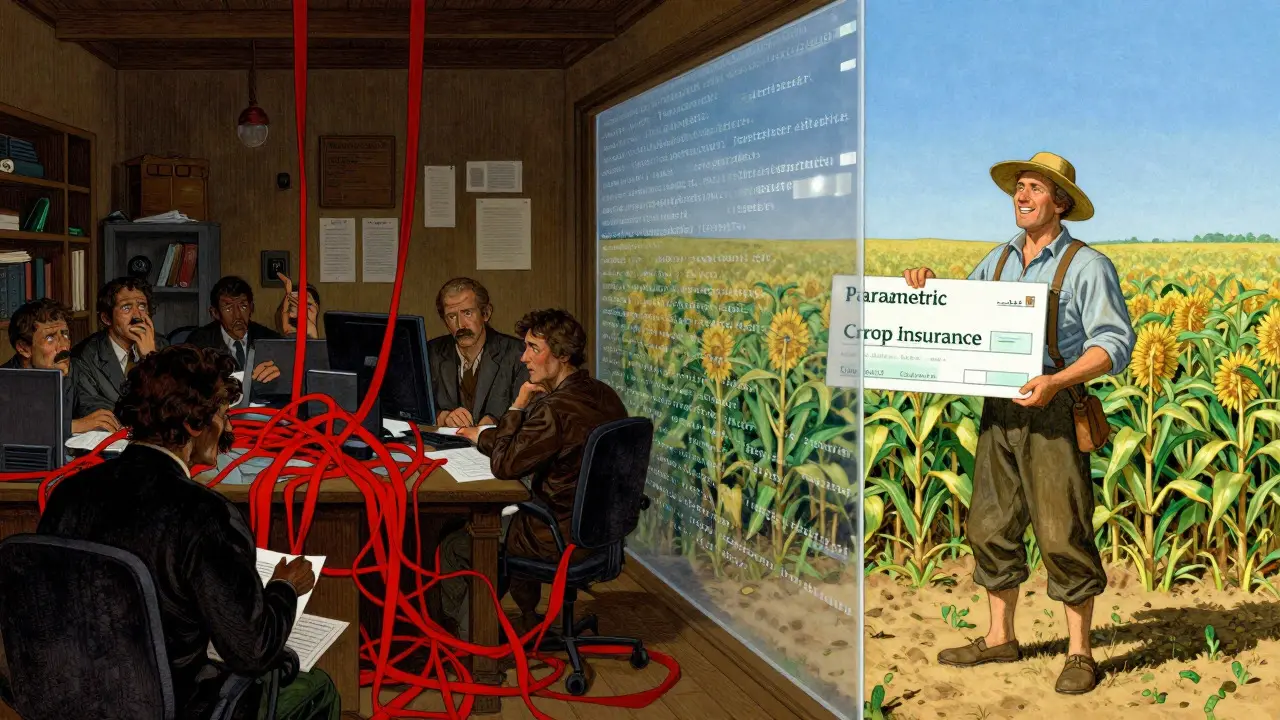
You might be wondering, "Can this work for everything?" Not yet. The biggest success story for automated claims is parametric insurance, which is coverage that pays out based on objective metrics rather than assessed damage. Traditional insurance requires an adjuster to estimate how much your roof was damaged by hail. That takes time. Parametric insurance just asks: "Did hail larger than 1 inch fall in ZIP code 12345?"
If the answer is yes, you get paid. It doesn’t matter if your roof actually leaked or not; the metric was met. This model is perfect for smart contracts because the data is objective and easy to verify via oracles. We’re already seeing pilots for:
- Travel Insurance: Automatic refunds for delayed flights using airline API data.
- Crop Insurance: Payouts to farmers when rainfall drops below a certain threshold.
- Event Cancellation: Instant refunds if a concert is rained out or canceled due to weather.
In 2024, several major insurers began piloting these solutions outside of health and life sectors, focusing on property and casualty lines where data is readily available. One Reddit user shared in March 2024 about filing a parametric weather claim that paid out within two hours of a hurricane hitting their area-no paperwork involved. That speed is unheard of in traditional insurance.

Benefits for Insurers and Policyholders
Why are companies investing in this technology? The benefits are clear for both sides of the table.
For policyholders, the experience is vastly improved. You get compensation quickly, which reduces stress during emergencies. Whether it’s replacing a stolen laptop or covering hotel costs after a storm, immediate liquidity matters. Plus, the transparency of the blockchain means you can see exactly why a claim was approved or denied. There’s no hidden agenda.
For insurers, the savings are massive. Administrative costs make up a huge chunk of insurance expenses. By automating routine claims, companies reduce the need for large claims departments. Fraud also drops significantly. Since the payout is tied to immutable data from trusted oracles, it’s hard to fake a claim. You can’t lie to a smart contract about a flight delay if the airline’s official data says otherwise.
| Feature | Traditional Claims | Smart Contract Claims |
|---|---|---|
| Processing Time | Weeks to months | Seconds to minutes |
| Human Intervention | High (adjusters, admins) | Low (only for disputes) |
| Fraud Risk | Moderate to High | Low (data-verified) |
| Cost Efficiency | High overhead | Reduced administrative costs |
| Transparency | Opaque internal processes | Immutable audit trail |
Challenges and Limitations
It’s not all smooth sailing. Implementing smart contracts for claims comes with hurdles. The biggest issue is the oracle problem. The smart contract is only as good as the data feeding it. If the weather station malfunctioning reports incorrect wind speeds, the wrong people might get paid-or worse, the right people might be denied. Ensuring data integrity is critical.
Another challenge is complexity. Not every claim is black and white. What if a car accident involves partial fault? Current smart contracts struggle with subjective judgments. They excel at binary outcomes (yes/no, happened/didn’t happen) but fail when nuance is required. For now, they work best for straightforward, parameter-based policies.
Integration with legacy systems is also tough. Many insurers still run on decades-old software. Connecting these old databases to modern blockchain networks requires significant technical overhaul. Additionally, legal frameworks are playing catch-up. Lawyers and regulators are still figuring out how to enforce code-based contracts in court. As noted by Harvard Law School in 2018, key terms often still need to be set forth in text-based contracts to ensure legal validity alongside the code.
The Future of Automated Claims
Despite these challenges, the trajectory is clear. The banking sector has already adopted smart contracts for trade finance and swaps, proving the technology works at scale. Insurance is following suit, starting with low-risk, high-volume areas like travel and parametric products.
We can expect to see broader adoption as oracle technology improves and regulatory clarity increases. Insurers who adopt early will gain a competitive edge by offering faster, cheaper, and more transparent services. For consumers, this means a future where insurance actually feels like protection, not a bureaucratic nightmare. The shift from manual processing to automated, trustless execution is inevitable-and it’s already here.
What is a smart contract in insurance?
A smart contract in insurance is a self-executing agreement stored on a blockchain. It automatically verifies claims and disburses payouts when predefined conditions are met, eliminating the need for manual intervention and intermediaries.
How do smart contracts prevent fraud?
Smart contracts reduce fraud by relying on immutable data from trusted external sources called oracles. Since the payout is triggered by objective, verifiable data (like flight times or weather metrics), it is difficult for individuals to submit false claims.
What is parametric insurance?
Parametric insurance is a type of coverage that pays out based on objective metrics rather than assessed damage. For example, if wind speeds exceed 100 mph in a specific location, the policyholder receives a payout regardless of actual property damage.
Are smart contracts legally binding?
Yes, but with caveats. While the code executes automatically, legal enforceability often requires accompanying text-based contracts to define terms clearly. Regulatory frameworks are still evolving to fully recognize code-only agreements in all jurisdictions.
What is the oracle problem?
The oracle problem refers to the risk that the external data fed into a smart contract may be inaccurate or manipulated. Since the contract relies on this data to execute, bad data leads to incorrect payouts or denials. Trustworthy oracles are essential for system integrity.