
Social Recovery Setup Calculator
Calculate your recovery security and convenience trade-offs based on your guardian setup. Learn how many guardians and thresholds affect your wallet safety.
Recovery Security Analysis
Key Benefits
Potential Risks
Imagine losing your phone, and with it, access to all your crypto. No seed phrase written down. No backup. No way to recover. This isn’t a hypothetical-it’s what happens to 20% of all Bitcoin sitting untouched because someone forgot or lost their key. For most people, crypto feels like a high-stakes game where one mistake means permanent loss. But there’s a better way now: social recovery with account abstraction.
What Is Account Abstraction?
Traditional crypto wallets rely on externally owned accounts (EOAs). These are simple: one private key, one public address. If you lose that key, your funds are gone forever. No help desk. No customer service. Just silence. Account abstraction changes that. It replaces the old EOA model with a smart contract wallet-basically, a programmable account that can run code. Think of it like upgrading from a basic lock to a smart door that can let people in only if they meet certain rules. Maybe two out of three friends need to approve access. Maybe you need to wait 24 hours before a change takes effect. That’s the power of account abstraction. This isn’t science fiction. It’s live on Ethereum since March 2023, thanks to ERC-4337, the standard that made smart contract wallets practical for everyday use. Wallets like Argent, Safe (formerly Gnosis Safe), and Stackup now use it. And the biggest feature built on top? Social recovery.How Social Recovery Works
Social recovery lets you pick trusted people-friends, family, even your lawyer-as your "guardians." If you lose access to your wallet, you don’t need a 12-word seed phrase. You just ask your guardians to help you get back in. Here’s how it usually works:- You choose 3 to 5 guardians when setting up your wallet.
- You set a threshold: for example, 2 out of 5 must approve a recovery request.
- If you get locked out, you start a recovery request through your wallet app.
- Your guardians get a notification and sign off using their own wallets or apps.
- After a waiting period (usually 24 to 72 hours), your wallet is restored.
Why This Beats Seed Phrases
Let’s be honest: seed phrases are terrible for real people. A 2023 study by Blockchain@USC found that 97% of non-technical crypto users store their seed phrases in unsafe places: on their phones, in Notes apps, on sticky notes, or even in emails. One guy wrote his down on a napkin and lost it at a bar. Another saved it in a Google Doc labeled "My Secret Stuff." Social recovery fixes this. You don’t need to memorize or write down anything complicated. You just need to trust people you already know. And if one guardian is offline, sick, or just doesn’t respond? You’ve got backups. Most wallets let you assign tiered contacts: primary, secondary, emergency. And the results speak for themselves. Argent, one of the leading wallets with social recovery, has 1.2 million monthly users. Over 67% of its Trustpilot reviews mention social recovery as the reason they finally felt safe storing real money. People aren’t just using it-they’re sticking with it.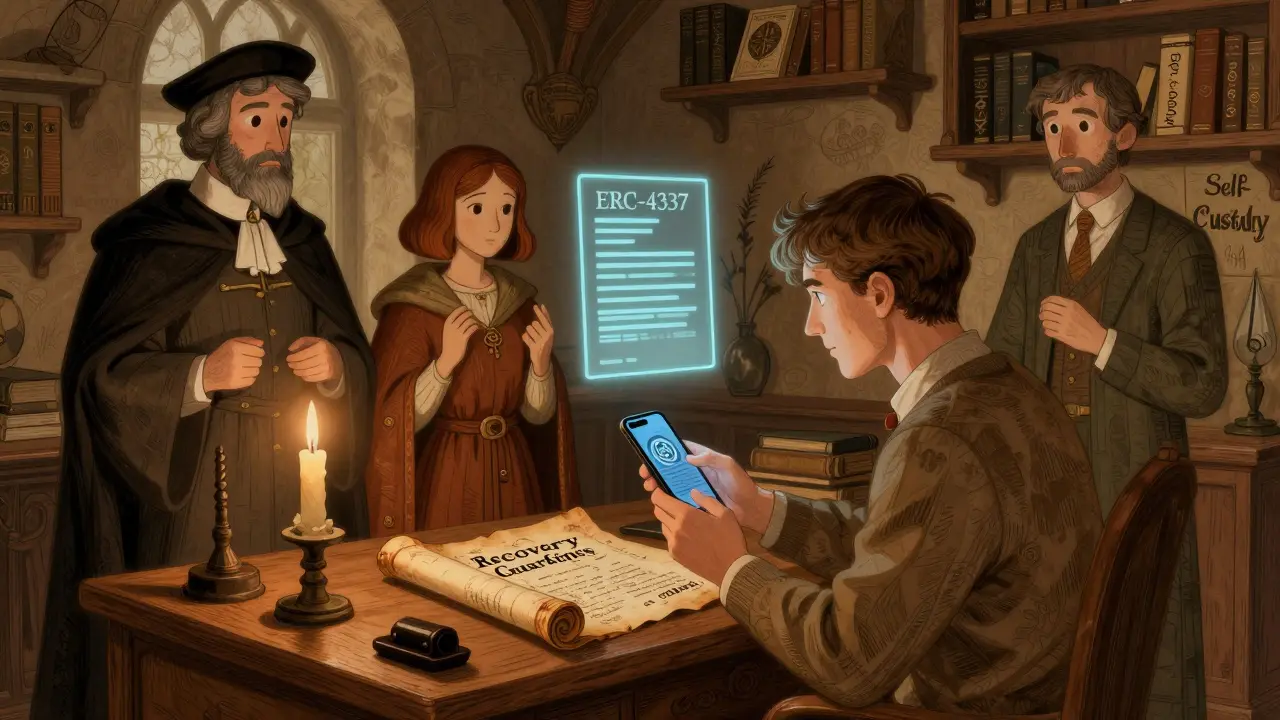
The Trade-Offs: It’s Not Perfect
Social recovery isn’t magic. It has real downsides. First, it creates new risks. Hackers can target your guardians. There have been at least three documented cases on Ethereum where scammers convinced a recovery contact to sign a fraudulent request-often by pretending to be the wallet owner in a fake video call. That’s why verification matters. Argent now lets you verify guardians through Telegram or WhatsApp calls. Safe integrates with enterprise tools like Okta for business users. Second, the delay. If your phone dies and you need to access funds fast-for an emergency, a bill, a flight-you’re stuck waiting. 24 hours feels like forever when you’re in a pinch. Some wallets let you lower the delay, but that weakens security. It’s a trade-off: convenience vs. safety. Third, your guardians might disappear. A Reddit user in June 2023 tried to recover his wallet after a hospital stay. Two of his three guardians were traveling overseas with no internet. He lost access for three weeks. He eventually got in-but it was a nightmare. That’s why best practices recommend choosing guardians who are tech-savvy, reliable, and easy to reach. Don’t pick your 80-year-old aunt who doesn’t know what a wallet is. Pick your sibling who uses crypto regularly. Or your accountant. Or your lawyer.Who’s Using It-and Who Should?
Right now, social recovery is mostly used by people who already understand crypto. Only about 18% of all crypto wallet holders use smart contract wallets with account abstraction. But adoption is growing fast. Institutional users are leading the charge. Companies managing crypto treasuries need multi-person approval for security. Squads.so, a Solana-based tool for teams, lets businesses assign recovery contacts like CFOs and auditors. Their G2 rating? 4.7 out of 5. Enterprises don’t care about memes-they care about control and audit trails. Emerging markets are another big opportunity. In countries where smartphones get stolen or lost 30% of the time (according to GSMA Intelligence), seed phrases are useless. Social recovery works on any device. You don’t need to remember a phrase-you just need someone you trust to help you log in. And for regular users? If you’ve ever panicked thinking, "What if I lose my phone?"-this is your solution.
Setting It Up: What You Need to Know
Getting started takes about 10 minutes. Here’s the step-by-step:- Choose a wallet that supports ERC-4337: Argent, Safe, or Starknet Wallet.
- During setup, select "Social Recovery" as your security method.
- Add 3 to 5 guardians. Use real names and verified contact info.
- Set your threshold: 2-of-3 is the sweet spot for most people.
- Confirm each guardian’s identity-some wallets require a video call or SMS code.
- Test the recovery process. Most wallets let you simulate a recovery to make sure it works.
The Future: Biometrics, AI, and Cross-Chain Recovery
This isn’t the end. It’s the beginning. Authereum is working on biometric login-fingerprint or face ID-to replace the need for guardian signatures in low-risk situations. Consensys has prototyped AI that can detect suspicious recovery attempts by analyzing communication patterns. And Squads.so is building a bridge so you can recover your Ethereum wallet using a Solana-based guardian. Gartner predicts that by 2025, 65% of new crypto users will use social recovery wallets. That’s not just growth-it’s a shift in how we think about ownership. Regulators are paying attention too. The EU’s MiCA framework may soon require guardians to be verified with KYC if they control over $1,000 in assets. That could make recovery more secure-but also more bureaucratic.Final Thought: It’s Not About Technology. It’s About Trust.
Crypto was supposed to be about freedom. But without a way to recover your assets, it’s just a trap for the careless. Account abstraction with social recovery doesn’t remove responsibility-it makes it manageable. You’re still in control. You’re still self-custodial. But now, you’re not alone. This isn’t just a technical upgrade. It’s a cultural one. It says: you don’t have to be a cryptographer to own crypto. You just need to know who to trust. If you’ve ever felt like crypto was too risky to hold seriously, this is your sign to try again. Pick a smart wallet. Set up your guardians. Test it. Sleep better.Is social recovery safer than a seed phrase?
Yes, for most people. Seed phrases are easy to lose, steal, or accidentally delete. Social recovery replaces a single point of failure with multiple trusted contacts. While it introduces new risks like social engineering, it’s far more practical and resilient for non-technical users. Studies show 97% of users store seed phrases unsafely-social recovery fixes that.
Can I recover my wallet if all my guardians are unavailable?
It depends on your setup. Most wallets let you assign backup guardians or include a time-based fallback (like a 30-day delay after a recovery request). Some wallets also allow you to set up a backup key or hardware wallet as a secondary recovery method. Always configure at least one fallback option during setup.
Do I need to pay extra gas fees for social recovery?
Yes, recovery transactions cost more than regular transfers because they involve smart contract execution. On Ethereum mainnet, expect 15-25% higher gas fees. On layer-2 networks like Starknet or Polygon, the extra cost drops to 5-10%. Many wallets also offer paymasters that let you pay fees in tokens instead of ETH, making it even easier.
Which wallets support social recovery right now?
Leading wallets with social recovery include Argent, Safe (Gnosis Safe), and Starknet Wallet. Stackup and Braavos also offer it. These are all ERC-4337-compatible and work on iOS, Android, and browsers. Avoid older wallets that only use EOAs-like MetaMask by default-unless you’ve enabled account abstraction manually.
Can I use social recovery for business accounts?
Absolutely. Many companies use Safe or Squads.so to manage crypto treasury funds. They assign guardians like CFOs, auditors, or legal officers instead of personal contacts. This adds accountability and audit trails, making it ideal for institutional use. Some platforms even integrate with enterprise identity systems like Okta or Microsoft Entra ID.
What happens if a guardian’s wallet gets hacked?
If a guardian’s wallet is compromised, they can’t recover your wallet alone-you need the required number of approvals (e.g., 2-of-3). But if a hacker tricks your guardian into signing a recovery request, they could gain access. That’s why verification matters: use video calls, SMS confirmations, or multi-channel checks. Always review recovery requests carefully and avoid approving anything you didn’t initiate.
Is social recovery regulated?
Not yet in most places, but regulations are coming. The EU’s MiCA framework may require guardians to be verified with KYC if they control over $1,000 in assets. The U.S. and other jurisdictions are watching closely. For now, it’s self-regulated-but expect more rules as adoption grows.
Finally, something that actually makes sense for normal people. I used to keep my seed phrase in a Google Doc called 'secret stuff' like some kind of idiot. Now I just tell my brother and my crypto-savvy roommate to help me if my phone dies. No more panic attacks at 2 a.m. when I think I deleted the backup.
Also, the 48-hour delay? Genius. I had a friend get phished last year - his whole wallet got drained in 12 minutes because he clicked a link. This stops that cold.
This is the only reason I’m finally holding crypto.
I’ve been thinking about this a lot. It’s not just about security - it’s about redefining ownership. We used to think owning crypto meant being completely alone with your keys. But maybe true ownership means having the wisdom to let others help you when you’re vulnerable.
It’s not weakness to need people. It’s human.
Let me break this down for you people who think this is magic. First, you're still trusting humans - and humans are the weakest link. I’ve seen three cases where someone’s ‘trusted friend’ was actually a scammer who got access via a fake Zoom call. The wallet doesn’t care if it’s your mom or your ex - it just counts signatures.
Second, gas fees on Ethereum are still insane for recovery. You’re paying $15-$25 just to get your own money back? That’s not user-friendly - that’s extortion.
Third, what if your guardians die? What if they move to another country and lose their phone? What if they get arrested? There’s no ‘I’m sorry, my guardian is in jail’ option. This isn’t a solution. It’s a gamble with more variables.
And don’t even get me started on the fact that 80% of people will pick their aunt who still thinks Bitcoin is a type of coffee. This system only works if you’re already tech-savvy enough to pick the right people - which defeats the whole point.
Seed phrases are bad, yes. But at least they don’t require you to have a social circle that’s crypto-literate. I’ll stick with my metal backup plate and a fireproof safe. At least I know where my trust lies.
Y’all are overcomplicating this. I set up my Safe wallet with my sister, my roommate, and my crypto tutor. Two of ‘em got back to me in like 10 minutes when I lost my phone. No drama. No panic. I just used my backup email to start the process and boom - done. The 24-hour wait? Honestly, I didn’t even notice. I was at a concert.
And yeah, gas fees are higher - but I pay in USDC via a paymaster. No ETH needed. Easy peasy.
Also, if you’re picking your 70-year-old uncle as a guardian… yeah, you’re doing it wrong. Pick people who know what a wallet is. That’s not hard.
Of course this is the future. Because we all know the real enemy isn’t hackers - it’s the fact that people are too lazy to memorize 12 words. You want to be safe? Then be responsible. Stop asking for hand-holding. This is just another way for the industry to infantilize users and make them dependent on systems that can be manipulated. You think your ‘guardians’ won’t get pressured? You think they won’t be blackmailed? You think the government won’t force them to hand over access? This isn’t freedom. It’s a trap wrapped in a hug.
And don’t tell me about ‘self-custody’ - if you need five people to access your money, you don’t own it. You’re just renting it from your friends.
Real crypto is solitary. Real crypto is silent. Real crypto is you and your key. Nothing else. This is Web2 thinking dressed in Web3 clothes. And it’s disgusting.
This is one of those rare moments where tech actually serves humanity instead of demanding we adapt to it.
Think about it - we’ve spent decades telling people to ‘be their own bank.’ But we never gave them the tools to be a *good* bank. A bank doesn’t leave you stranded if you lose your key. A bank has protocols. A bank has backup systems. A bank has people who care.
Account abstraction isn’t removing responsibility - it’s giving us the structure to carry it without drowning.
And for those saying ‘trust is weak’ - yes, but so is memory. So is paper. So is fear. This isn’t about replacing one vulnerability with another. It’s about replacing *impossible* vulnerability with *manageable* vulnerability.
We don’t need more gods. We need better systems.
As someone from a country where phones get stolen every other week, this is life-changing.
I used to tell people to write their seed phrases on paper and hide them under the mattress. But in my neighborhood? That’s just asking for trouble. Now I tell them to use Argent and pick two relatives who are on WhatsApp every day. No paper. No fear.
And the best part? My cousin in Lagos just set one up. She’s never held crypto before. But she feels safe. That’s not tech. That’s dignity.
While I appreciate the innovation, I must emphasize the importance of rigorous due diligence in selecting guardians. The psychological burden of being a recovery contact is nontrivial - and often unacknowledged. One must consider not only the technical competence of the individual, but their emotional stability, availability, and ethical alignment. In my professional experience as a compliance officer, I have witnessed cases where guardians, under duress or coercion, inadvertently facilitated unauthorized access. Therefore, I strongly recommend formalizing guardian agreements - even if only via a signed digital note - to establish mutual expectations and reduce interpersonal friction. This is not merely a technical issue. It is a fiduciary one.
ERC-4337 is not a protocol - it’s a paradigm shift in identity abstraction. The EOA model is a relic of Web1. Social recovery is the first implementation of decentralized identity governance at scale. The real innovation isn’t the threshold - it’s the programmable logic layer that enables dynamic access policies. This is the foundation for AI-driven recovery orchestration and cross-chain guardian interoperability. You’re not just recovering a wallet. You’re redefining digital personhood.
Of course it’s better. But only for the uneducated. Real crypto users don’t need babysitters. They need discipline. This system rewards laziness. It’s like giving a toddler a car with training wheels and calling it a Ferrari.
So now we’re trusting our friends to save our crypto? What’s next? Asking our landlord to hold our keys? This is what happens when you let people who think ‘crypto’ is a brand of energy drink run the internet. You think your cousin in Ohio knows what a private key is? He thinks it’s a type of crypto coin. This isn’t innovation. It’s cultural surrender. America’s gonna turn Bitcoin into a TikTok trend and then cry when it’s gone. Just wait.
If you’re using social recovery, you’re already a lost cause. Real crypto holders don’t need help. They don’t need backups. They don’t need friends. They have one thing: discipline. You? You’re just another person who got scammed because you didn’t write down your seed phrase. This isn’t progress. It’s a bandage on a severed artery.
Just wanted to say - I set this up last week with my wife and my brother-in-law. We did the video verification thing on Argent. Took 15 minutes. Tested it. Worked perfectly.
And honestly? I feel way less stressed. I used to wake up sweating thinking about my seed phrase. Now I just know - if something happens, I’ve got people who’ve got my back. That’s not weakness. That’s smart.
Also, if you’re scared of gas fees? Use Polygon. Or Starknet. It’s like 50 cents. Stop being cheap and protect your shit.
Let me tell you what they don’t want you to know. This isn’t about recovery. It’s about surveillance. Every guardian signature is logged. Every delay is tracked. Every video call? Recorded. The government already has backdoors into these wallets - they just call them ‘compliance features.’ They’re building a database of who trusts who. Next thing you know, they’ll block recovery requests if you’re on a watchlist. This isn’t freedom. It’s a honeypot for regulators. And you’re handing them the keys.
Account abstraction enables composability. Social recovery is merely the most accessible instantiation of programmable identity. The true potential lies in recursive guardianship - where guardians themselves employ delegated recovery protocols. This is not a feature. It is an ontological evolution of digital sovereignty.