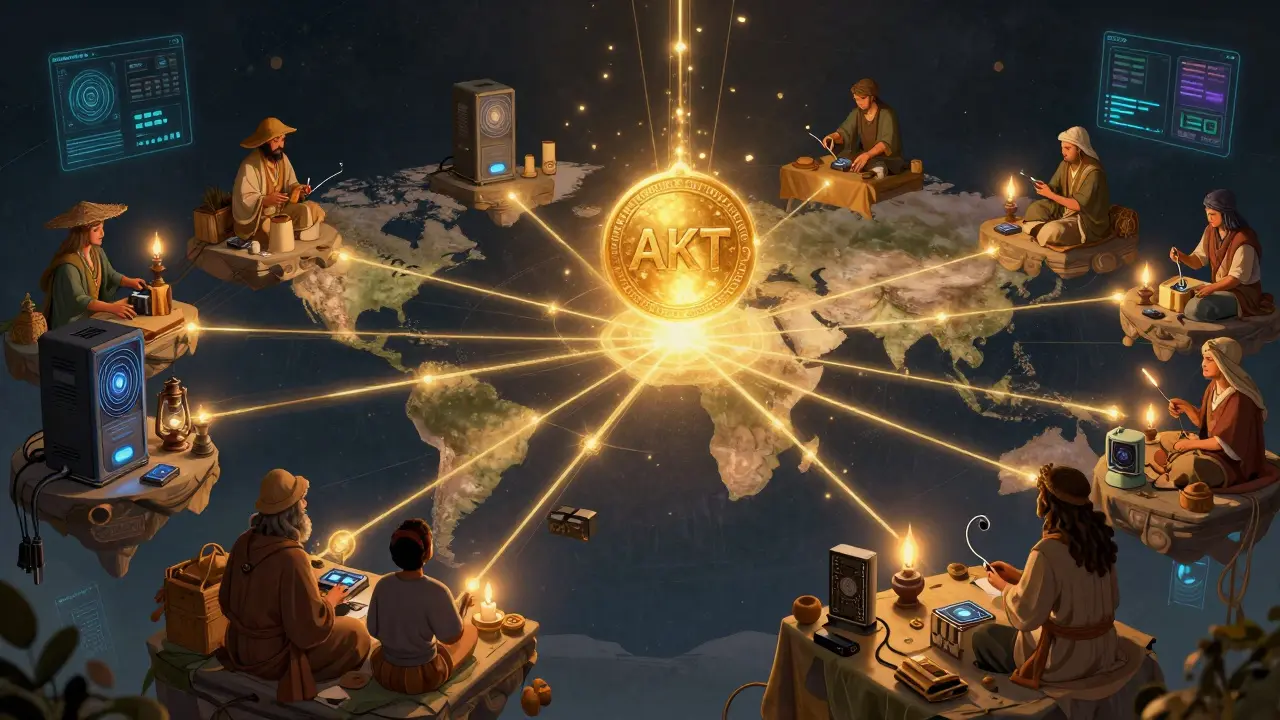
Most people think of cloud computing as something you rent from big companies like Amazon or Google. But what if you could rent computing power directly from strangers around the world-cheaper, faster, and without middlemen? That’s what Akash Network is trying to do. And its native token, AKT, is the engine that makes it all work.
What Exactly Is Akash Network?
Akash Network isn’t another cryptocurrency that just moves money. It’s a decentralized marketplace for cloud computing. Think of it like Airbnb for servers. Instead of paying big tech companies for GPU power, you can rent unused computing resources from individuals or small data centers who are willing to sell them. The network uses blockchain to match buyers with sellers, automate payments, and ensure no one can cheat the system.
It launched in September 2020 and runs on the Cosmos blockchain, which means it’s built for speed, scalability, and can talk to other blockchains. This isn’t some experimental side project-it’s designed to handle real-world workloads like AI training, video rendering, and running complex simulations. In fact, Akash claims you can deploy applications up to 10 times faster than on AWS or Google Cloud.
How Does AKT Actually Work?
AKT is the only token you need to use Akash Network. It’s not just a coin you buy and hope goes up in value-it’s the fuel for the whole system. Here’s how:
- Payment: You use AKT to pay for computing leases. Want to rent a GPU to train an AI model? You pay in AKT.
- Staking: If you’re a provider (someone with spare computing power), you must stake AKT to join the network. This locks your tokens as collateral to prove you’re serious and won’t disappear after taking payment.
- Governance: AKT holders vote on upgrades, fee changes, and how funds are allocated. The more AKT you hold, the more weight your vote carries.
There’s also a clever twist: you can pay for leases using Bitcoin or other tokens, but the price is locked in AKT at the moment you start the lease. This lets users avoid constant crypto swings while still keeping the network’s economy tied to AKT.
Where Did AKT Come From?
The total supply of AKT is capped at 388,539,008 tokens. When it launched, 100 million AKT were distributed. Today, about 280 million are in circulation. Here’s how the original supply was split:
- 34.5% (34.5 million) went to investors
- 27% (27 million) to the team and advisors
- 19.7% to the Decentralized Cloud Foundation
- The rest to ecosystem growth, testnets, and marketing
Most of these tokens were locked up for a year before being released slowly over time. That’s meant to prevent a massive dump right after launch. Right now, the network is still in growth mode, with inflation slowly decreasing each day to encourage long-term holding instead of short-term trading.

Why Is AKT Different From Other Crypto Projects?
Akash isn’t trying to be a meme coin or a payment network. It’s solving a real problem: cloud computing is too expensive and too centralized. Big companies control 80% of the market, and if they raise prices or cut service, you’re stuck.
Akash flips that model. Providers anywhere in the world can list their idle servers-whether it’s a gaming rig in Toronto or a data center in Poland. Buyers get access to cheaper, more flexible resources. And because it’s built on Cosmos, Akash can integrate with other chains, making it easier to move assets and data across networks.
Compare it to Render Network (RNDR), which focuses on rendering, or Filecoin, which is for storage. Akash is unique because it targets GPU-heavy workloads-exactly what AI developers need. And unlike centralized providers, there’s no vendor lock-in. You can switch providers mid-computation without losing your data.
How Do People Use Akash Today?
You don’t need to be a tech expert to use it. Akash offers something called Akash Apps-pre-built tools you can launch with one click. Need a free AI chatbot? Run a Minecraft server? Host a website? All available without buying hardware or setting up cloud accounts.
For developers, it’s even better. You can deploy applications directly from your terminal using Akash’s CLI. It’s like using Docker, but instead of paying AWS, you’re renting from a global network of providers. One user reported saving 68% on their AI training costs by switching from AWS to Akash.
There are over 1,000 active providers on the network, and thousands of users have rented compute time. The platform is still growing, but the infrastructure is live and handling real workloads right now.
What’s the Price of AKT Like?
As of February 2026, AKT is trading around $0.7658. Its 24-hour trading volume is over $10 million, and its market cap sits at roughly $230 million. That puts it around #183 on the list of cryptocurrencies-not in the top 100, but not obscure either.
It’s been volatile. In the past week, AKT dropped 21.5%, which was worse than the broader crypto market. That’s partly because of market-wide sell-offs and partly because Akash is still a relatively small project with fewer buyers and sellers than Bitcoin or Ethereum.
But analysts point to strong fundamentals. The network is growing. More providers are joining. More developers are building on it. Some predict AKT could reach $1 by the end of 2025 and possibly $7-$9 by 2030. Long-term, some even speculate it could hit $800 by 2050-if the decentralized cloud market hits $800 billion as projected.

Who Backs Akash Network?
It’s not just a group of devs working in a garage. Akash has backing from serious players:
- TRG Capital
- Alpha Block Investments
- Forbole
- Outpost Capital
- ChainLayer
These aren’t random investors-they’re firms that specialize in blockchain infrastructure. Their involvement signals confidence that Akash isn’t just another token, but a piece of future infrastructure.
What Are the Risks?
Akash is promising, but it’s not without risks:
- Adoption is still low-most people still use AWS. Convincing them to switch takes time.
- Competition-Render Network, Filecoin, and even centralized providers are improving their offerings.
- Volatility-AKT’s price swings hard. If you’re holding it for long-term use, that’s fine. If you’re speculating, be ready for rough rides.
- Technical complexity-while Akash Apps makes things easy, full deployment still requires some technical know-how.
But here’s the thing: every major tech shift starts this way. No one believed you could rent computing from strangers in 2006. Now, AWS is worth over $1 trillion.
What’s Next for Akash?
The roadmap is clear:
- Support more payment options-stablecoins like USDC and discounted AKT for long-term users
- Launch a Public Goods Fund to reward developers building useful tools on the network
- Improve user experience for non-technical users
- Expand support for more types of workloads beyond AI-like blockchain nodes, scientific simulations, and gaming servers
The goal isn’t to beat AWS tomorrow. It’s to build a better, open alternative over time. And AKT is the key to making that happen.
Is AKT a good investment?
Whether AKT is a good investment depends on what you’re looking for. If you believe decentralized cloud computing will grow into a multi-billion-dollar industry, then AKT has real utility behind it. It’s not a meme coin-it’s a token that powers a working network. But it’s still early, and price volatility is high. Don’t invest more than you can afford to lose.
Can I use AKT to pay for cloud services right now?
Yes. You can use AKT directly to lease GPUs, CPUs, and other computing resources on the Akash Network. You can also pay with Bitcoin or other tokens, but the price is always locked in AKT at the time of lease. This gives you flexibility without destabilizing the network’s economy.
How do I stake AKT?
You can stake AKT through any Cosmos-compatible wallet like Keplr or Cosmostation. Choose a validator node to delegate your tokens to. Staking rewards range from 15% to 25% annually, depending on how long you lock your tokens-longer locks earn higher returns. Your AKT stays yours-you can unstake anytime, but there’s a 14-day waiting period.
What makes Akash different from AWS or Google Cloud?
AWS and Google Cloud are centralized. If they go down, you’re offline. If they raise prices, you have no choice. Akash is decentralized-thousands of providers spread across the globe. If one goes offline, another picks up. Prices are set by supply and demand, not corporate boards. Users report up to 70% cost savings and 10x faster deployment times.
Can I earn AKT by providing computing power?
Yes. If you have spare GPU or CPU power, you can list it on the Akash Network as a provider. When someone rents your resources, you get paid in AKT. You need to stake AKT to join, but once you’re active, you can earn more than you spend on electricity and hardware wear. Many users report covering their costs and turning a profit within months.
lol ok so we're renting servers from strangers now? 🤡
This is nothing short of revolutionary. Imagine a world where computing power is as accessible as electricity-democratized, decentralized, and driven by human ingenuity rather than corporate greed. Akash isn't just a project; it's the dawn of a new digital era.
Let's be real. America built the cloud. We don't need some blockchain weirdo from Poland renting out his gaming rig to 'disrupt' AWS. This is crypto nonsense dressed up as innovation.
AKT supply 388 million locked tokens released slowly inflation decreasing staking rewards 15 to 25 percent providers earn more than electricity cost
Wait... so I can just... rent a GPU? For less than AWS? Like... for real? 😳 I'm scared to try. What if it crashes? What if they just disappear? I need a manual. A VERY detailed manual.
YASSS GIRL! This is the future we’ve been waiting for! No more corporate gatekeepers! No more price hikes! Just pure, unfiltered, decentralized power in your hands! You go Akash! 💪🔥
It’s fascinating how we’ve moved from centralized control to peer-to-peer resource sharing. The philosophical implications are profound: if computing power can be owned by anyone, then so can innovation. We’re not just building infrastructure-we’re redefining agency in the digital age.
The market cap is $230 million. That’s less than the annual ad revenue of a single mid-tier tech company. This is a speculative bubble wrapped in a whitepaper. The 'decentralized cloud' is a fantasy until it handles 1% of AWS’s traffic. Until then, it’s a hobby.
This is exactly the kind of naive techno-utopianism that gives crypto a bad name. You don't 'rent from strangers.' You risk your data on unregulated, anonymous nodes. This isn't innovation. It's negligence.
I understand the appeal, but we're trading one form of exploitation for another. Who are these providers? Are they being paid fairly? Is their hardware being overused? Who monitors environmental impact? We can't just glorify decentralization without asking the hard questions.
OMG I tried this last week and it was SO EASY! I spun up a Minecraft server for my kid in 2 minutes for $0.42. My AWS bill used to be $80/month. 🥹💖 You guys should totally try it!
hmm interesting i wonder if my old rtx 3060 would work as a provider
i think akash is cool but i keep spellin it akash not akash
I’ve been using Akash for my AI projects for 6 months. Saved 70%. No drama. No vendor lock-in. Just good, clean, decentralized power. If you’re a dev, give it a shot. You’ll thank me later.