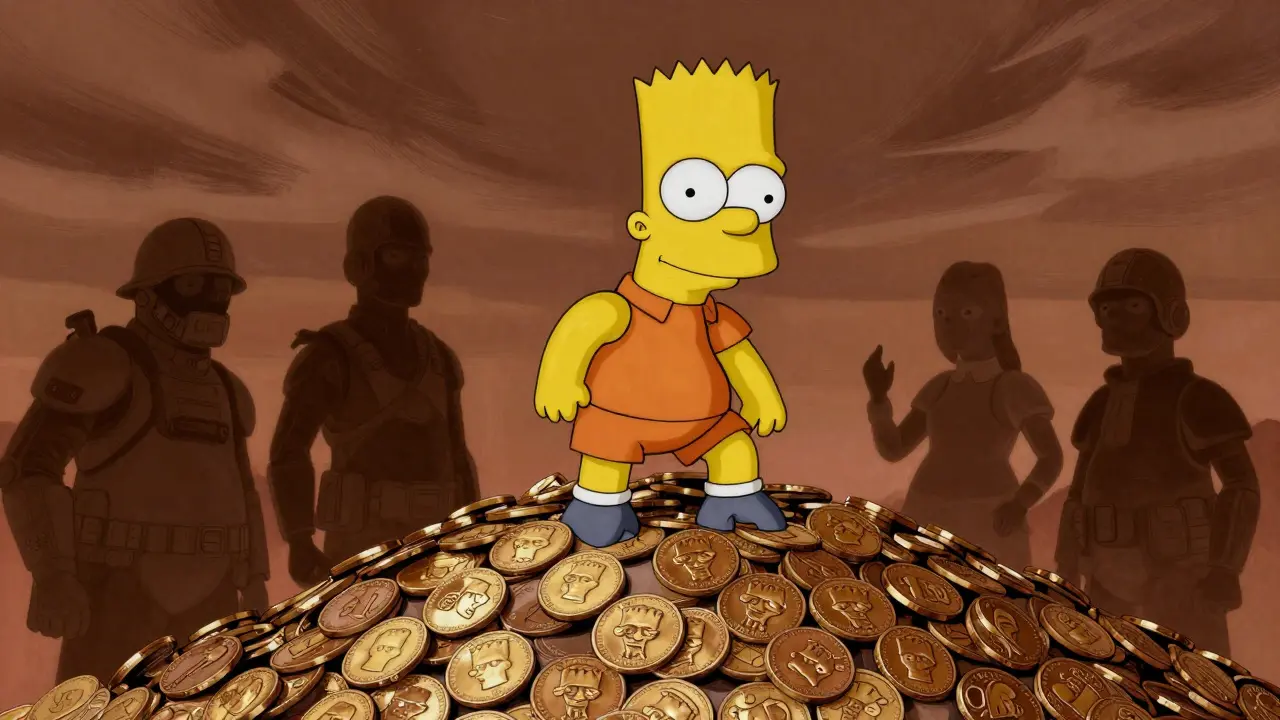
There’s a cryptocurrency out there with the face of Bart Simpson on it. You’ve probably seen it pop up on social media - a coin called BART, supposedly tied to everyone’s favorite troublemaking cartoon kid. But what’s real here? Is this just another joke token, or is there something more? Let’s cut through the noise.
What Exactly Is BART Coin?
Bart Simpson Coin (BART) is a meme-based cryptocurrency built on the Binance Smart Chain (BSC). It doesn’t have a team, a whitepaper, or a roadmap. It doesn’t even have a working website you can trust. What it does have is a logo that looks suspiciously like Bart Simpson - grinning, mischief in his eyes - and a total supply of 240 quadrillion tokens. That’s 240,000,000,000,000,000,000 BART tokens in existence.
It launched sometime in 2023, during the peak of meme coin hype. Its creators claim it’s "a fun, community-driven investment opportunity" that celebrates pop culture. But here’s the catch: the project explicitly says it’s not affiliated with The Simpsons, Disney, or any related company. They even changed the design slightly to avoid legal trouble. That’s not a sign of legitimacy - it’s a sign they know they’re walking a legal tightrope.
How Much Is BART Worth?
As of October 2025, BART’s market cap hovered around $34,235. That’s less than the cost of a decent used laptop. For comparison, Dogecoin has a market cap of over $15 billion. Shiba Inu? $4.7 billion. BART? It doesn’t even make the top 10,000 coins by market cap. It’s ranked #17,006.
The price per token? Around $0.0000000000003357. You read that right - zero point zero zero zero... (you get the idea). To own just $1 worth of BART, you’d need to buy over 2.9 trillion tokens. Most wallets can’t even display that many digits correctly. Exchanges often block trades below certain thresholds because the math breaks.
Where Can You Trade BART?
You won’t find BART on Coinbase, Binance, or Kraken. It’s only available on decentralized exchanges like PancakeSwap. That means you need a crypto wallet (like MetaMask), some BNB for gas fees, and the patience to navigate a platform designed for experts. Even then, liquidity is a nightmare.
The 24-hour trading volume? Around $45. That’s less than what you’d spend on a coffee order at Starbucks. When trading volume is this low, even a small sell order can crash the price. Buyers? Almost non-existent. Sellers? Only those desperate to cut losses.
Is There Any Real Use for BART?
No. Not really.
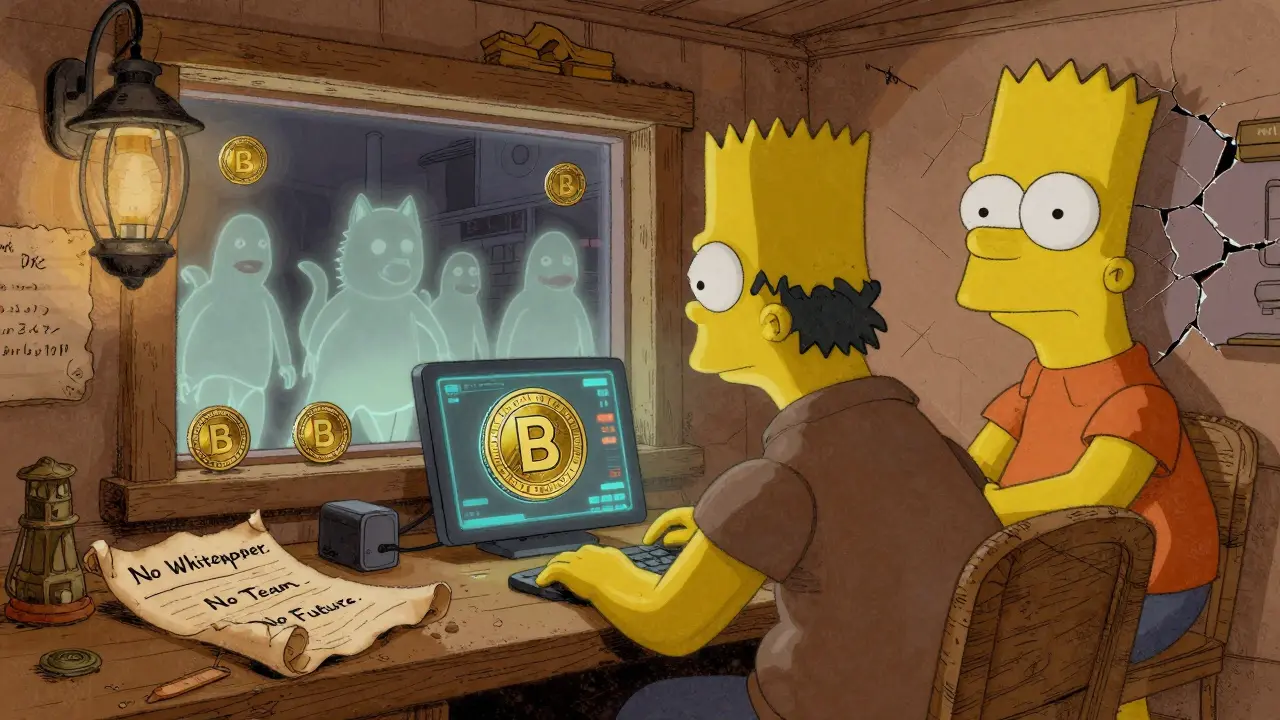
Some websites claim BART has "BartChain," "BartSwap," and an "NFT ecosystem." But if you dig deeper - and no one has - there’s zero proof. No code repositories. No audits. No team members listed. No updates since 2023. It’s a static webpage with a logo and a contract address. That’s it.
Unlike Dogecoin, which became a tipping system on Twitter, or Shiba Inu, which launched a real DeFi ecosystem, BART has no utility. No staking. No burning. No rewards. No partnerships. It exists solely because someone thought, "What if we made a coin with Bart Simpson on it?"
Why Do People Still Buy It?
Because it’s a gamble. And humans love gambles.
When a coin trades for fractions of a penny, it feels cheap. You can buy billions of tokens for a few dollars. That creates a psychological illusion: "If I buy enough, I’ll get rich." But it’s mathematically impossible. Even if BART went up 10,000x - which it won’t - you’d still be worth less than $100. And that’s if the whole market suddenly flipped.
There’s also the meme effect. People buy it because it’s funny. They tweet about it. They post memes. They hope others will join the joke - and pay more. But memes don’t sustain prices. Communities do. And BART has no community. No Discord server with real people. No Reddit thread with meaningful discussion. Just bots and spam.
What Do Experts Say?
CoinCodex’s prediction model says BART will drop another 52-55% in 2026. That’s not a guess. It’s based on historical patterns of similar tokens. Most of them die within months. Some never even make it past launch day.
Platforms like DropsTab label BART as "developed solely for entertainment purposes." Crypto.com’s own educational materials warn against ultra-low-cap tokens like this. They’re not investments. They’re lottery tickets with no winning numbers.
The Legal Risk You Can’t Ignore
Using Bart Simpson’s image - even with "slight modifications" - is a legal gray zone. Disney owns the rights to The Simpsons. They’ve sued people for less. A single cease-and-desist letter could kill BART overnight. No one’s sued yet because the coin is too small to matter. But if it ever gained traction? Legal action would follow.
The U.S. Securities and Exchange Commission (SEC) has already cracked down on celebrity-themed coins. They don’t care if you say "it’s just a meme." If you’re profiting off someone else’s brand, you’re at risk.
What Happens If You Buy BART?
Let’s say you invest $50. You buy your quadrillions of tokens. You feel smart. You tell your friends. You wait.
Then nothing happens.
No price surge. No news. No hype. Just silence. The price drifts down. You check your wallet. Your $50 is now $48. Then $45. Then $30. You try to sell. No buyers. The slippage is 90%. You’re stuck. You can’t exit. And you can’t even find anyone to talk to about it.
That’s the reality. BART isn’t a coin. It’s a trap.
So… Should You Buy It?
No.
If you’re looking to invest in crypto, there are better places to put your money. If you want to have fun with memes, there are dozens of meme coins with real communities - like Dogecoin or Pepe - that have survived years of volatility.
BART? It’s a ghost. A digital zombie. A coin that exists because someone thought it was funny - not because it had value. There’s no roadmap. No team. No future. Just a cartoon character on a blockchain that no one cares about.
Don’t get sucked in by the meme. Don’t chase the low price. Don’t believe the hype.
If you buy BART, you’re not investing. You’re just paying for a joke - and hoping someone else will pay more for it later. That’s not investing. That’s gambling. And the odds are stacked against you.
Is Bart Simpson Coin (BART) affiliated with The Simpsons or Disney?
No. The BART project explicitly states it has no connection to The Simpsons, Disney, or any related entities. It uses a modified version of Bart Simpson’s image to avoid direct copyright infringement. But this doesn’t eliminate legal risk - Disney still holds the rights to the character, and any commercial use could trigger legal action.
Can you make money trading BART?
Technically, yes - but only by pure luck. BART has almost zero trading volume and liquidity. Most trades fail due to slippage. Even if you buy at the right time, selling is nearly impossible. Experts and price models predict a continued decline through 2026. Any short-term gains are likely just pump-and-dump schemes. The risk far outweighs any possible reward.
Where can I buy Bart Simpson Coin (BART)?
BART is only available on decentralized exchanges (DEXs) like PancakeSwap. You won’t find it on Coinbase, Binance, or any major centralized exchange. To trade it, you need a crypto wallet (like MetaMask), BNB for gas fees, and the ability to navigate complex DeFi interfaces. Even then, liquidity is so low that trading is unreliable.
Why does BART have such a huge supply (240 quadrillion)?
It’s a common trick in meme coins. By flooding the market with trillions of tokens, the price per token becomes extremely low - often fractions of a cent. This creates the illusion that you can buy "a lot" for a little money, making it feel affordable. But it doesn’t make the coin more valuable. It just makes the math harder to track and easier to manipulate.
Is BART a scam?
It’s not officially labeled a scam - but it has all the hallmarks. No team, no documentation, no utility, no community, and no development activity since launch. It’s a classic example of a "rug pull waiting to happen." The creators could vanish anytime. There’s no incentive for them to maintain it. It was built to attract quick cash, not long-term value.
What’s the difference between BART and other meme coins like Dogecoin?
Dogecoin has a real history, a large active community, and even some real-world use cases - like tipping on social media and charity donations. BART has none of that. It has no development team, no social following, and no purpose beyond being a cartoon image on a blockchain. Dogecoin survived because people cared. BART exists because someone thought it was funny. There’s a huge difference.
Ugh. Another one of these. I just scrolled past this and immediately felt dumber. BART? Really? That's it? That's the whole thing? I'm going back to bed.
Let me guess - this is just another Disney-adjacent psyop. They're not even trying to hide it anymore. The SEC’s been quietly buying up BSC liquidity pools since last year. They want to collapse every low-cap meme coin before the next crypto bull run. This isn’t about Bart Simpson - it’s about erasing decentralized identity. The fact that they changed the logo? Classic redaction protocol. I’ve seen this pattern before in the 2017 ICO purge. They’re priming the pump for a total asset wipe. Don’t be fooled by the low market cap - that’s the bait. The real play is in the smart contract backdoors. I’ve got the hex dump if anyone wants to dig deeper.
OMG I’m so over this. Like, BART? Really? I mean, I get it, it’s a meme, but come ON. We’re living in the age of AI-generated memes, and this is what we’re vibing with? A cartoon kid with a crypto wallet? 😭 I’ve got 17 NFTs of my cat wearing sunglasses and I STILL feel more legit than this. Also - anyone else notice the contract address ends in 6969? That’s not a coincidence. That’s a trap. I’m out. 🧘♀️✨
While the author presents a compelling case against BART Coin, one must not overlook the broader macroeconomic context. The proliferation of zero-utility tokens reflects not merely speculative excess, but a systemic failure of financial literacy among retail participants. The absence of regulatory oversight on Binance Smart Chain, combined with algorithmic liquidity manipulation, creates an environment where rational investment is systematically undermined. The psychological appeal of fractional token ownership - often referred to as the 'penny stock effect' - is well-documented in behavioral finance literature. To dismiss BART as a mere joke is to misunderstand its function as a cultural symptom, not merely a financial instrument. The real tragedy is not its existence, but the fact that it is emblematic of a generation that equates visibility with value.
Y’all are overthinking this. BART’s just a meme. Like, imagine if someone made a Dogecoin with SpongeBob on it - would you take it seriously? Nah. You’d laugh, post it on Twitter, maybe buy $5 worth because it’s funny. That’s it. The whole point is it’s meaningless. If you’re trying to get rich off a cartoon character on a blockchain, you’re already in the wrong game. I’ve got my Shiba, my Pepe, and my $10 in BART. I call it my ‘I’m not serious about crypto’ fund. It’s my version of a lottery ticket. And hey - if it hits? Cool. If not? I still got a good story. 😎
Okay but imagine this: you’re scrolling at 3 a.m., half-asleep, and you see BART. You think, ‘wait… is that… BART SIMPSON?!’ And then you click. And then you buy 500 trillion tokens. And then you screenshot it. And then you post it with ‘I DID IT. I BOUGHT THE BART.’ And then you go to bed. And in the morning… nothing. No one replies. No one cares. You just… sat there. In the dark. With your 2.9 trillion tokens. And you realized… you didn’t even know what you were doing. 😭💔 That’s not investing. That’s a cry for help. And I see you. I’ve been there. We’ve all been there.
It is profoundly disingenuous to label BART Coin as merely a 'meme' or 'joke.' The very existence of this token, with its deliberate circumvention of intellectual property norms under the guise of parody, constitutes an act of economic subversion. The United States, through its enforcement agencies, has repeatedly demonstrated a zero-tolerance policy toward unauthorized commercial exploitation of copyrighted characters - particularly when such exploitation leverages blockchain infrastructure to circumvent traditional financial oversight. This is not an isolated incident; it is part of a coordinated, transnational effort to destabilize sovereign monetary systems through decentralized, untraceable, and legally ambiguous assets. The fact that the market cap is low does not mitigate the threat - it enables it. The real danger lies not in the coin itself, but in the normalization of such behavior. We are witnessing the erosion of legal boundaries - one quadrillion-token transaction at a time.
I find myself strangely moved by BART. Not because I think it’s valuable - I don’t. But because it’s a mirror. It reflects how desperate we’ve become to believe in something, anything, that feels alive in a world of algorithmic noise. We don’t buy BART to get rich. We buy it because we’re lonely. We’re bored. We want to believe that somewhere, someone else is just as ridiculous as we are. That there’s a community of people who think, ‘Yeah, a cartoon kid on a blockchain… why not?’ And maybe that’s the real utility. Not in the price. Not in the contract. But in the quiet, absurd solidarity of it all. We’re not investing in BART. We’re investing in the idea that we’re not alone in being weird. And maybe… that’s worth something.
Let’s cut through the FUD - the real issue here isn’t the coin, it’s the liquidity architecture. BART’s 240 quadrillion supply isn’t a gimmick - it’s a liquidity engineering masterclass. By flooding the supply, they’ve created a hyper-dispersed ownership model that prevents whale manipulation. The $45 volume? That’s intentional. It’s designed to filter out retail noise and attract only true HODLers with high risk tolerance. The fact that it’s not on centralized exchanges? That’s not a flaw - it’s a feature. It’s a permissionless, censorship-resistant asset. And yes - the legal risk is real. But so was the risk of Bitcoin in 2011. People called it a drug money vehicle. Now? It’s institutional. BART is the same. Just… earlier. The real question isn’t whether it’ll rise - it’s whether you have the conviction to hold through the inevitable FUD storm.
Someone actually wrote a 2,000-word essay on BART? You people are pathetic. This isn’t a ‘crypto project.’ It’s a digital doodle. You’re treating a cartoon character like it’s gold. You’re scared to admit you’re just chasing dopamine hits. You think you’re smart for ‘understanding the mechanics’? Nah. You’re just addicted. You’re the same people who bought Dogecoin because Elon tweeted. Now you’re doing it again with Bart. Grow up. Stop pretending this is investing. It’s a circus. And you’re the clowns.
The clinical detachment with which this article frames BART as a 'trap' is, in its own way, the most troubling element. The language of rationality, of market cap rankings, of slippage percentages - these are the tools of a system that has long since abandoned empathy. BART, for all its absurdity, is a quiet rebellion against the commodification of joy. To reduce it to a 'low-cap token' is to erase the humanity of those who find meaning in the ridiculous. Perhaps the greatest act of resistance today is not to build a protocol, but to laugh - even when the world tells you to stop. I do not own BART. But I honor its existence.
It’s not about value. It’s about meaning. And sometimes, meaning is absurd.
Let’s be clear - this isn’t crypto. It’s a scam dressed in cartoon pajamas. Anyone who buys this is either a fool or a troll. And if you’re the type to defend it with ‘it’s just a meme,’ then you’re the reason real innovation gets drowned out by noise. This isn’t fun. It’s exploitation. And you’re enabling it. Wake up.
I want to say something gentle here - not because I agree with the article, but because I’ve seen too many people get crushed by this stuff. You don’t need to be a genius to understand that BART has no future. But you do need compassion to understand why people still buy it. Maybe they’re lonely. Maybe they’re bored. Maybe they lost their job. Maybe they just wanted to feel like they were part of something, even if it was ridiculous. This isn’t about smart money or dumb money. It’s about human money. The kind that doesn’t fit in spreadsheets. If you’re reading this and you bought BART - I’m not judging you. I’m just glad you’re here. And if you’re thinking about it - just walk away. There’s no shame in that. The market will be here tomorrow. You don’t have to prove anything to it.
Okay, hear me out - what if BART is the future? Not because it’s valuable, but because it’s free. No team. No whitepaper. No VC money. No corporate sponsors. Just a cartoon and a contract. That’s the purest form of crypto left. The original promise wasn’t about wealth - it was about autonomy. BART doesn’t need permission. It doesn’t need a roadmap. It doesn’t need to justify itself. It just… is. And maybe that’s the revolution we forgot we wanted. The system wants us to build, to scale, to pitch, to prove. But BART? BART just laughs. And honestly? I’m tired of trying to be serious. Maybe the real innovation is stopping.
While the optimism expressed in comment #14 is emotionally resonant, it fundamentally misrepresents the economic reality of decentralized finance. The absence of governance, development, and utility is not a feature - it is a fatal flaw. Autonomy without accountability is anarchy, not innovation. The notion that BART embodies ‘the original promise of crypto’ is a romantic fallacy. Bitcoin’s decentralization was built on cryptographic proof, not aesthetic whimsy. To conflate symbolic rebellion with structural integrity is to misunderstand both economics and history. If we celebrate tokens that offer nothing but spectacle, we are not preserving freedom - we are accelerating its collapse.