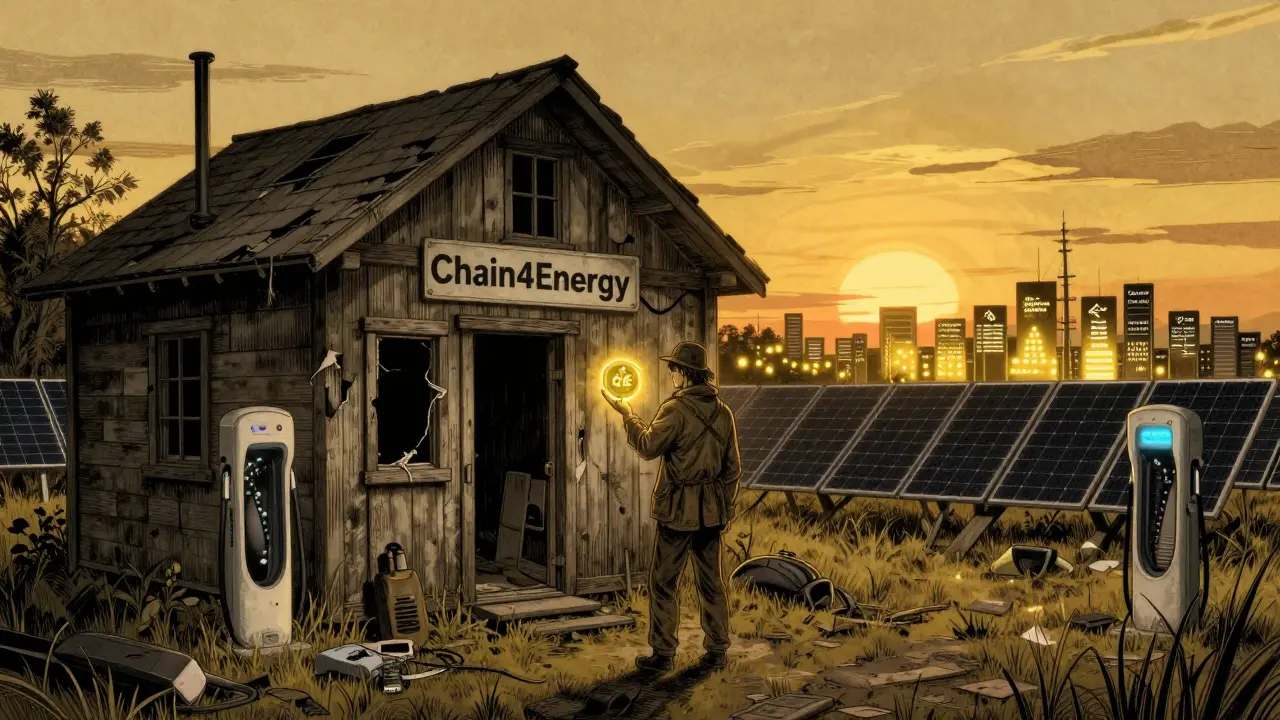
C4E (Chain4Energy) is a cryptocurrency built to connect blockchain technology with real-world energy systems. Unlike most coins that exist only as digital assets, C4E was designed to power peer-to-peer energy trading, electric vehicle charging networks, and AI-driven home energy optimization. But here’s the catch: despite its ambitious goals, there’s little evidence it’s actually working in the real world today.
What C4E Actually Does (On Paper)
C4E operates as a Layer 1 blockchain meant for decentralized physical infrastructure networks, or DePIN. That’s a fancy way of saying it tries to reward people for contributing to energy systems - like letting your solar panels sell excess power directly to neighbors, or letting your EV charger become part of a shared grid. The token, C4E, is supposed to be the fuel for these transactions.
The project claims its system integrates with smart meters, renewable energy sources, and EV chargers. In theory, if you install a compatible device in your home, you could earn C4E tokens just by using energy efficiently. The idea sounds smart: turn passive energy use into income. But there’s no public proof this works. No case studies. No live networks. No data from real users.
Price and Market Data - A Mess
C4E’s price varies wildly depending on where you look. CoinMarketCap says it’s around $0.0026, CoinGecko says $0.0031, and Binance lists it at $0.0019. That kind of inconsistency isn’t normal. It usually means low trading volume and fragmented markets.
The daily trading volume hovers under $5,000 across all exchanges. For context, even obscure tokens with no real use case often trade over $100,000 daily. C4E’s market cap is under $1 million, placing it outside the top 4,000 cryptocurrencies. Compare that to Power Ledger or Energy Web Token - both have market caps over $50 million and actual partnerships with utilities.
The token’s total supply is over 309 million, but only 12.3 million are circulating. That means over 96% of the tokens are still locked up. If they ever hit the market, the price could crash. The fully diluted valuation (FDV) ranges from $776,000 to over $2.7 million - a huge gap that shows how uncertain the future supply really is.
Why the Price Is So Low
C4E launched with a seed round valuation of $10.5 million. Today, its market cap is less than 0.3% of that. That’s not just a drop - it’s a collapse. Early investors who bought at $0.035 are now watching their holdings lose over 90% of their value.
Why? Three big reasons:
- No real product. The website says it has AI-driven energy optimization and P2P trading, but there are zero technical specs, no API docs, and no working examples.
- No developer activity. GitHub shows only three repositories, all inactive for over six months. No updates. No new code. No community contributions.
- No user adoption. Less than 0.02% of token holders are actively using their C4E. That’s not a community - it’s a graveyard of abandoned wallets.
One user on Telegram summed it up: "I bought during the seed round at $0.035, now it’s trading at $0.0026 - I don’t see any real-world implementation despite their claims."
Community and Support - Barely There
The project’s online presence is tiny. Twitter has about 1,200 followers. Telegram has 850 members. Their last blog post was in October 2023. Their support team takes up to three days to reply to simple questions.
Reddit has only 12 posts about C4E in six months. Most are questions like: "Is this even real?" or "Why does the website look like a 2018 crypto scam?"
There are no Trustpilot reviews. No independent audits. No verified partnerships with energy companies. Not even a single utility or city has publicly said they’re using C4E.
Is C4E a Scam?
It’s not labeled a scam by regulators - yet. But it ticks nearly every box for a high-risk project:
- Massive token supply with almost none in circulation
- Extremely low trading volume
- No working product after years of development
- Failed to attract developers or enterprise partners
- Price down over 90% from initial sale
CryptoQuant and IntoTheBlock both rate C4E as "high risk." Analysts at BlockRoots called the disconnect between its seed valuation and current price a sign of "market rejection."

How It Compares to Other Energy Blockchains
There are better alternatives already doing what C4E promises:
| Project | Market Cap | Trading Volume (24h) | Real-World Use | Developer Activity |
|---|---|---|---|---|
| C4E | $30K-$900K | <$5K | None verified | None |
| Power Ledger | $50M | $1.2M | Used in Australia, Japan, US microgrids | Active GitHub, regular updates |
| Energy Web Token (EWT) | $100M | $3.5M | Partnered with Shell, Equinor, DNV | High activity, open-source tools |
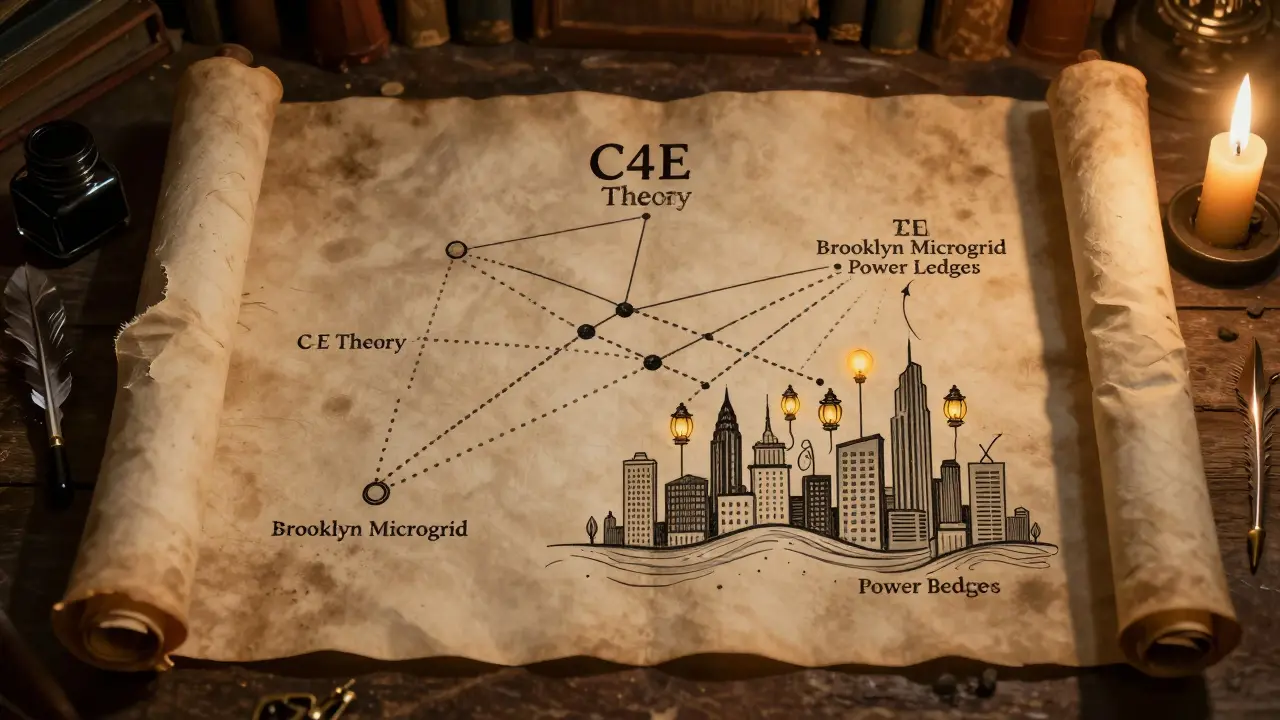
| LO3 Energy (Brooklyn Microgrid) | $25M | $800K | Live P2P trading since 2016 | Active development, academic research |
C4E doesn’t just lag behind - it’s not even in the same league. These projects have live networks, documented partnerships, and active communities. C4E has a website, a token, and a handful of people still holding it.
Should You Buy C4E?
If you’re looking for a long-term investment, C4E is not it. The project has shown zero progress since its 2023 launch. No upgrades. No integrations. No users. Just price swings on low-volume exchanges.
If you’re speculating - maybe you’re hoping for a pump - be aware: coins like this are easy targets for manipulation. With under $5,000 in daily volume, a single large buy or sell can swing the price 20% in minutes.
There’s also regulatory risk. The SEC has been cracking down on tokens that raise money privately and then list on DEXs without clear utility. C4E’s seed round structure - with a 4-month cliff and 10-month vesting - fits the profile of a security under 2023 SEC guidance.
Bottom line: C4E is a concept that never became a product. It’s a coin with no home, no users, and no future.
What Happens Next?
Unless Chain4Energy releases actual working software, partners with real energy providers, or opens its code to public review, the token will keep sliding. The community is too small to sustain it. The market has moved on.
There’s still a chance - if the team suddenly delivers on its promises. But after two years of silence, that’s not a bet anyone should make.
Is C4E a real cryptocurrency or just a scam?
C4E is a real token with a blockchain and exchange listings, but it lacks real-world utility. It’s not a scam in the legal sense, but it has all the red flags of a failed project: no working product, no developer activity, and a price down 90% from its initial sale. It exists on paper, not in practice.
Where can I buy C4E crypto?
C4E is listed on decentralized exchanges like Osmosis and PancakeSwap (v2). The most traded pair is C4E/UOSMO. However, due to extremely low liquidity, trading it is risky. You may not be able to sell your tokens when you want to, and prices can jump or drop sharply with small trades.
Can I use C4E to trade energy or charge my EV?
No. Despite claims on the Chain4Energy website, there are no known systems, apps, or devices that accept C4E for energy trading or EV charging. No utility companies, no smart meter integrations, and no public examples of real usage. All claims remain theoretical.
Why is C4E’s price so different on different sites?
This happens because of low trading volume and fragmented liquidity. Most trades occur on one exchange (Osmosis), but data gets copied unevenly to others. CoinMarketCap and CoinGecko use different methods to calculate price, and without enough trades, their numbers don’t match. This inconsistency signals a weak, unreliable market.
Is C4E a good long-term investment?
No. C4E has no clear path to growth. It lacks developers, users, partnerships, and product updates. Even if the energy blockchain market grows to $3 billion by 2025, C4E is currently worth less than 0.1% of that. Without major changes, it’s unlikely to recover.
C4E is dead. No product, no devs, no users. Just a token floating in a graveyard of abandoned wallets. I've seen this movie before - it ends with a rug pull.
Done.
This whole thing is a CIA operation to drain retail crypto wallets. They’re using ‘energy blockchain’ as a front to funnel money into offshore shell companies. I’ve got documents. The SEC knows. They’re just waiting for the right moment to shut it down - and let the Feds take the fall.
I CRIED WHEN I SAW THE PRICE DROP.
My entire life savings went into C4E because I BELIEVED in the vision. They said it would revolutionize how we use power. I imagined my solar panels talking to my EV, trading energy like friends sharing coffee. Now? It’s a ghost. No updates. No code. No heart.
I’m not mad. I’m just… heartbroken.
Low volume + fragmented pricing = classic signs of a washed-out project. Nothing here that wasn’t obvious from day one. The real tragedy? People who thought this was going to be the next Power Ledger. It’s not even close.
I get why people still hold it. Hope is a powerful drug. But let’s be real - if you’re still holding C4E, you’re not investing. You’re grieving. And that’s okay. Just don’t throw good money after bad. There are real projects out there doing the work. Go find one.
This is why America is losing crypto to China and India. We let these scams grow because we’re too lazy to do real research. C4E? More like C4B for 'Crypto for Bots'.
The DePIN model is sound - but execution is everything. C4E’s failure is textbook: no developer traction, no on-chain metrics, zero measurable utility. The tokenomics are a house of cards. 96% locked? That’s not a vesting schedule - that’s a time bomb.
I’ve been tracking energy blockchain projects since 2020. Power Ledger and EWT have real partnerships. Real deployments. Real data. C4E? Their ‘whitepaper’ looks like a first-year CS student’s midterm. No API docs. No testnet. No audit. Just a website with buzzwords and a Discord full of bots.
I used to think C4E had potential. Then I dug into their GitHub. Three commits. Last one six months ago. One of them was just changing the logo size. That’s not a team. That’s a ghost town with a token.
This isn’t a crypto project. It’s a psyop. The team raised $10M, then vanished. The token’s price is manipulated by a single whale. The ‘community’? Paid shills. The website? Bought from Fiverr. They’re not trying to fix energy - they’re trying to empty your wallet before the SEC raids them.
You people are so dramatic. It’s just a coin. If you bought it, you knew the risk. Stop crying. The market doesn’t care about your feelings. C4E’s price will go to zero. So what? Move on.
I wonder if anyone on the team even still believes in this. Or if they’re just waiting for the next idea. The silence speaks louder than any whitepaper. Sometimes, the most honest thing a project can do is just… disappear.
You’re not alone. I held too. I believed. But here’s the thing - your hope isn’t wasted. You cared about clean energy. That’s beautiful. Now go find a real project. One with code. One with people. One with heart. You deserve better.
The FDV gap is insane - $2.7M vs $776K. That’s not volatility. That’s a red flag waving in a hurricane. If you’re not auditing the token unlock schedule, you’re not investing. You’re gambling.
People still defend this? Wow. The website looks like it was built in 2017 with a free WordPress theme. The ‘team’ has no LinkedIn profiles. The whitepaper has typos. This isn’t a blockchain project - it’s a satire.
So C4E is a concept that never became a product. That’s not a failure. That’s a philosophical statement. We build things to solve problems. But sometimes, we build things just to prove we can. And then we wonder why no one shows up.
C4E is the crypto equivalent of a startup that never shipped. They raised money, made a slick pitch deck, and then went silent. The only thing moving is the price on Osmosis - and that’s because bots are playing ping pong with it.
The most telling detail: zero public case studies. No utility partnerships. No developer logs. No GitHub commits. If a project can’t even document its failures, it doesn’t deserve a second look.
I’m not giving up on energy blockchain. But I’m done trusting teams that don’t talk. If you’re building something real, you show your work. You invite feedback. You admit mistakes. C4E? Silent. And silence, in crypto, is the loudest red flag of all.