
You’ve probably heard the buzz around SocialFi-the idea that social media shouldn’t just harvest your data but actually pay you for it. But when you dig into the actual tokens powering this shift, many turn out to be vaporware or ghost chains with zero activity. Enter OpenSocial Protocol, a multichain infrastructure project aiming to fix broken social incentives. Its native token, OSP, lives on the Base blockchain and represents the evolved identity of the earlier Qrolli project. If you’re wondering whether OSP is a hidden gem or just another micro-cap gamble, you need to look past the hype and at the mechanics: who’s building it, how the token actually works, and why liquidity remains its biggest headache.
The Evolution from Qrolli to OpenSocial
To understand what OSP is today, you have to look at where it came from. The project didn’t start as OpenSocial; it launched in 2023 as Qrolli (QR), a user-owned social network designed to let creators control their own online presence. Over time, the team realized that a single app wasn’t enough-they needed an entire infrastructure layer that other developers could build on top of. Between March 2023 and July 2026, they progressively rebranded from Qrolli to OpenSocial, shifting focus from a standalone platform to a protocol that empowers others to build decentralized social apps (dApps).
This isn’t just a marketing refresh. The technical foundation changed too. While Qrolli was about one specific community hub, OpenSocial Protocol is now positioned as a "horizontal enablement layer." Think of it like LEGO bricks for social media. Instead of forcing users onto one rigid platform, OpenSocial provides modular tools-feeds, chatrooms, posting mechanisms, and voting systems-that developers can snap together to create custom social experiences. The token ticker changed from QR to OSP to reflect this broader ambition, signaling that the asset is no longer just fueling one app but potentially an entire ecosystem of social applications.
How OSP Works on the Base Network
OSP is not running on its own isolated chain. It is deployed on Base, the Ethereum Layer-2 network backed by Coinbase. This choice matters because Base offers low transaction fees and high compatibility with existing Ethereum tools, making it easier for regular users to interact with the protocol without needing specialized hardware or deep technical knowledge.
The architecture relies heavily on account abstraction, specifically using the ERC-4337 standard. In plain English, this means wallets behave more like smart contracts than simple key-holders. For you, the user, this translates to a smoother experience. You don’t always need ETH to pay gas fees. The system supports a "Gas Account" feature that allows you to pay transaction costs in stablecoins like USDT or USDC. If your balance runs low, the interface tells you exactly what you need. This removes one of the biggest friction points in crypto: the annoyance of holding random native tokens just to move funds.
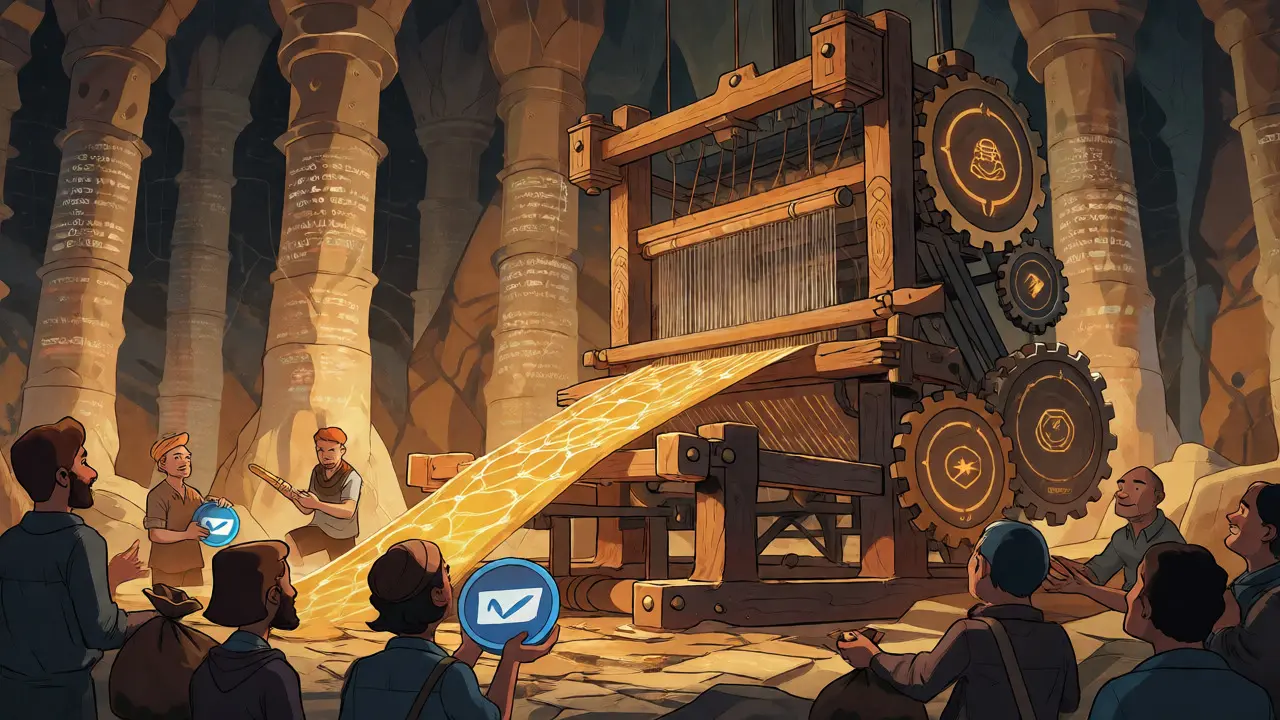
Tokenomics: Supply, Utility, and Governance
Let’s talk numbers, because this is where things get tricky for investors. The total supply of OSP is fixed at 3.5 billion tokens. However, public data sources disagree wildly on how many are actually circulating. Some aggregators report nearly 3.47 billion in circulation, while others list zero, likely due to delays in updating self-reported metrics after the rebrand. This discrepancy highlights a common issue with newer, smaller projects: transparency gaps.
So, what do you actually use OSP for?
- Incentivizing Participation: Users earn OSP for engaging with content, similar to how you might earn points in a gamified forum.
- Governance: Holders can vote on protocol upgrades and treasury decisions, giving the community a say in the project's direction.
- Transactions: It serves as the medium of exchange within dApps built on the protocol, such as tipping creators or paying for premium features.
The economic model aims to align incentives between creators, users, and developers. By rewarding engagement with tangible assets, OpenSocial tries to solve the retention problem that plagues traditional Web2 social platforms, where users provide value but receive little back.
| Metric | Value / Status | Notes |
|---|---|---|
| Total Supply | 3,500,000,000 OSP | Fixed cap, no inflation. |
| Blockchain | Base (Ethereum L2) | Low fees, high EVM compatibility. |
| Main Use Case | SocialFi Infrastructure | Supports dApps like SoMon. |
| Liquidity | Low / Micro-cap | Primarily traded on DEXs like Uniswap V2. |
| Funding | $26M Total Raised | Led by Framework Ventures and North Island Ventures. |
Real-World Adoption: The SoMon Experiment
A protocol is only as good as the apps built on it. The flagship application currently showcasing OpenSocial’s capabilities is SoMon (Social Monsters). Launched in June 2024, SoMon functions similarly to Reddit but gives communities ownership over their content and data. It’s a testbed for the protocol’s modularity, featuring forums, polls, and multimedia posts.
The early metrics were promising. Within two weeks of launch, SoMon attracted over 30,000 active on-chain users and processed more than 300,000 transactions. Average engagement times hovered around 20 minutes per session, which is surprisingly high for a new Web3 app. These numbers suggest that people aren’t just clicking through; they’re staying and interacting. However, keep in mind that these are early-stage figures. Scaling from tens of thousands to millions of users is the hard part, and so far, OSP has not seen a massive viral explosion comparable to major DeFi protocols.
Market Reality: Liquidity and Volatility Risks
If you’re thinking about buying OSP, prepare for volatility. This is a micro-cap asset, ranking roughly between #5,900 and #6,500 on major aggregators. That means it lacks the depth of larger coins. On some days, trading volume might be under $100; on others, it spikes to $10,000. Such thin liquidity leads to wild price swings. A small buy order can push the price up 20%, and a small sell order can crash it just as fast.
Furthermore, OSP is not listed on tier-1 centralized exchanges like Binance or Coinbase for direct trading. You’ll mostly find it on decentralized exchanges (DEXs) on the Base network, such as Uniswap V2. This requires you to manage your own wallet, bridge funds to Base, and handle slippage manually. It’s not as simple as hitting a "Buy" button on a familiar app, which limits accessibility for casual investors.
Should You Invest in OSP?
OpenSocial (OSP) is a bet on the future of SocialFi. The technology is solid-account abstraction, multichain readiness, and strong venture backing ($26 million raised) are green flags. The partnership with heavyweights like Framework Ventures adds credibility. However, the risks are equally real. The token suffers from low liquidity, inconsistent supply reporting, and competition from other Web3 social initiatives.
If you believe that decentralized social networks will eventually replace or complement Web2 giants, OSP offers exposure to that thesis via a developer-friendly infrastructure play. But if you prefer stability and easy exit strategies, the current market conditions make OSP a speculative hold rather than a safe haven. Monitor the growth of dApps beyond SoMon and watch for any moves toward listing on larger exchanges, as those would be the true catalysts for broader adoption.
Is OpenSocial the same as Qrolli?
Yes, OpenSocial is the rebranded evolution of Qrolli. The project started as Qrolli (token: QR) in 2023 and transitioned to OpenSocial (token: OSP) to reflect its expansion from a single social platform to a multichain infrastructure protocol. The underlying technology and team continuity remain, but the scope and branding have shifted significantly.
Where can I buy OSP tokens?
You cannot buy OSP directly on major centralized exchanges like Coinbase or Binance. Most trading occurs on decentralized exchanges (DEXs) on the Base network, primarily through Uniswap V2. You will need a Web3 wallet like MetaMask, some ETH or WETH on Base, and then swap for OSP.
What is the total supply of OSP?
The total supply of OpenSocial (OSP) is capped at 3.5 billion tokens. However, circulating supply figures vary across data providers due to reporting lags and the recent rebrand, with some sources showing near-full circulation and others showing minimal amounts.
Who backs OpenSocial Protocol?
OpenSocial Protocol has raised approximately $26 million in funding. Key investors include Framework Ventures and North Island Ventures, which led a $6 million strategic round. The development is supported by Everest Ventures Group, a Web3 venture studio.
What is SoMon?
SoMon (Social Monsters) is the first major decentralized social application built on the OpenSocial Protocol. It functions like a Reddit-style forum where users own their content and data. It serves as a practical example of how developers can use OpenSocial’s modular tools to build social dApps.