
Imagine buying a ticket to a concert where only 231 people showed up, and the band never played. That’s roughly the current state of Poupe, a Solana-based meme coin that promises community fun but delivers near-zero market activity. If you’ve stumbled upon this token while scrolling through decentralized exchanges or seeing it pop up in your wallet’s "recently added" list, you’re probably wondering: Is this the next big thing, or just digital dust?
The short answer? It’s likely the latter. But understanding why requires looking past the cute monkey mascot and into the cold, hard data. As of late 2025, Poupe sits at rank #8449 with a market cap of just $3,560. To put that in perspective, if Bitcoin were a skyscraper, Poupe would be a single brick in the foundation. Let’s break down what this actually means for your portfolio.
The Core Identity: More Monkey Business Than Tech
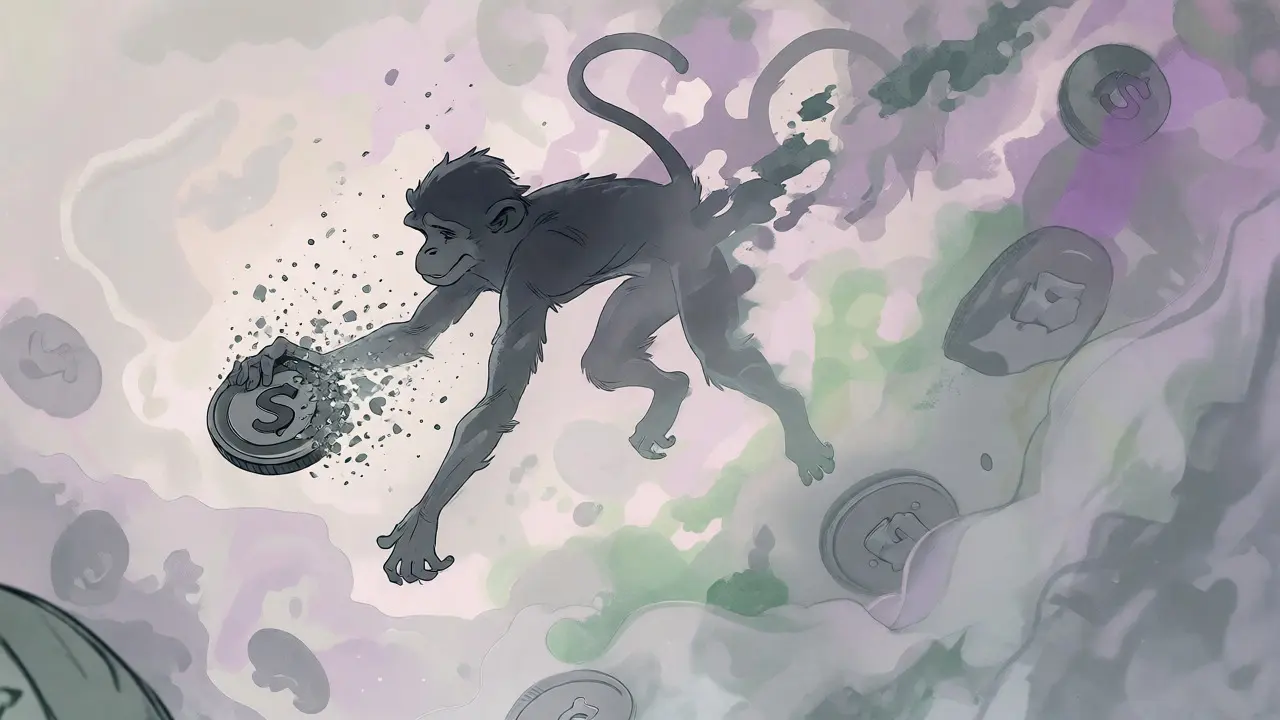
Poupe isn’t trying to solve blockchain scalability or revolutionize finance. It’s a meme coin built on the Solana blockchain. Its pitch relies entirely on humor and community vibes, featuring a playful ape holding a magical coin. The project describes itself as a group of "mischievous monkeys united by a love for crypto."
This places it in the same broad category as Dogecoin or Shiba Inu, but without the massive brand recognition or utility layers those larger coins have developed. While Dogecoin powers actual transactions for brands like Tesla (occasionally) and Shiba Inu has its own ecosystem (Shibarium), Poupe currently lacks any discernible technological innovation. It exists primarily as a speculative asset driven by social sentiment rather than functional use cases.
Market Data: The Red Flags Are Waving
When you look at the numbers, the story gets clearer-and less exciting. According to CoinMarketCap, the total supply is fixed at 1 billion tokens, all of which are reportedly in circulation. Sounds good, right? Not when you check the liquidity.
| Metric | Poupe (POUPE) | Dogecoin (DOGE) | Context |
|---|---|---|---|
| Market Cap | $3,560 | >$10 Billion | Poupe is a nano-cap; DOGE is blue-chip. |
| Holders | 231 | Millions | Extremely small community size. |
| 24h Volume | $0 USD | Billions | Zero trading activity indicates illiquidity. |
| Price | ~$0.00000189 | ~$0.10 - $0.20 | Fractional pricing due to low demand. |
The most alarming stat here is the zero trading volume. In crypto, volume equals life. Without trades happening, there’s no price discovery, no exit strategy, and effectively no market. You might see a price listed on aggregators, but if no one is buying or selling, that number is theoretical. Some platforms like CoinCarp show wild discrepancies-claiming millions in volume-but these are often glitches or errors in data aggregation for dormant tokens. Trust the consensus from major trackers like CoinMarketCap: if the volume says $0, it’s practically untradeable.
Why Does Poupe Exist? The Meme Coin Lifecycle
To understand Poupe, you have to understand the "ghost token" phenomenon. Thousands of tokens launch every month on chains like Solana because creating a token is easy. Most fail immediately. They get picked up by bots, maybe gain a few dozen holders, and then fade into obscurity.
Poupe fits this profile perfectly:
- No Active Community: There are no verified active Telegram groups, Discord servers, or Twitter accounts driving engagement. Legitimate projects usually have loud communities; Poupe is silent.
- No Utility: It doesn’t power a game, a DeFi protocol, or an NFT marketplace. It’s purely speculative.
- Development Stagnation: There are no recent roadmap updates or developer announcements. The project appears dormant.
This isn’t necessarily a scam in the traditional sense (like a rug pull where devs steal funds), but it is a "zombie" project. It lives on the blockchain, but it doesn’t breathe.
How to Buy (and Sell) Poupe: The Liquidity Trap
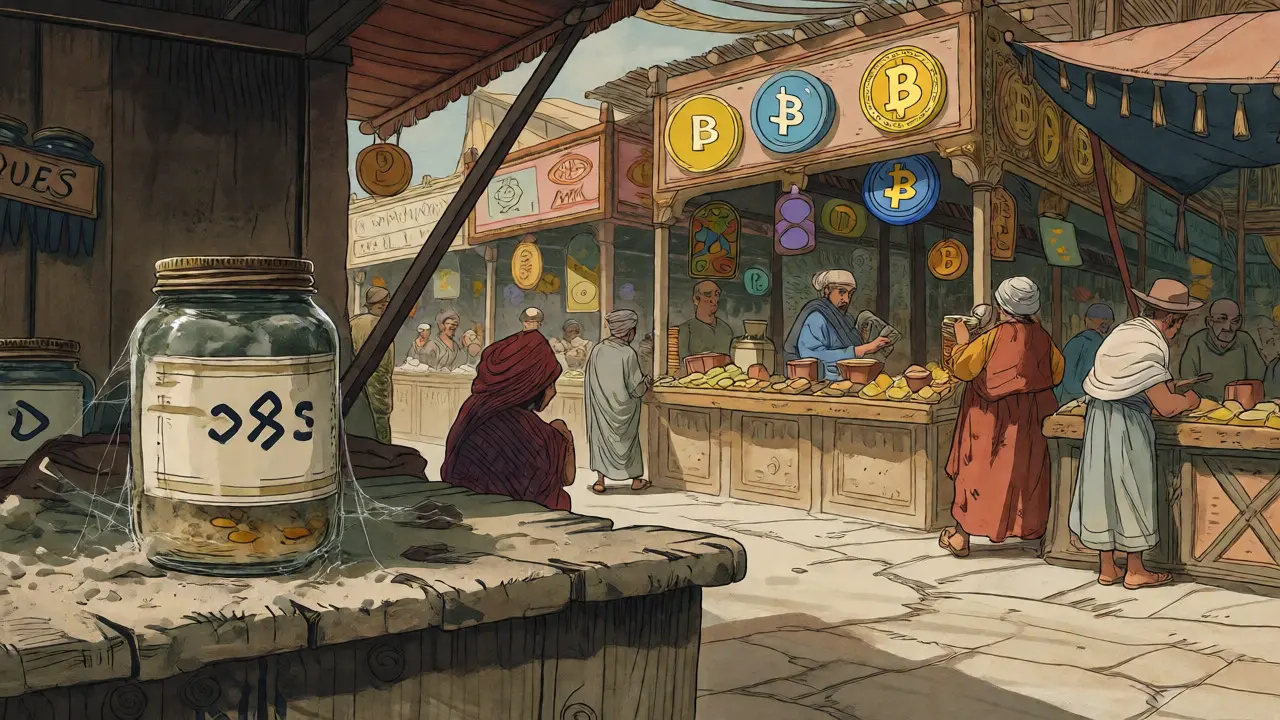
If you’re determined to buy Poupe, you can’t do it on Coinbase or Binance directly. You’ll need to use a Web3 wallet like Phantom or MetaMask and swap SOL for POUPE on a decentralized exchange (DEX) like Raydium or Jupiter. However, here’s the catch: because the liquidity pools are so thin, even a small trade can cause massive slippage.
Slippage means you might pay significantly more than the listed price to buy, or receive much less when selling. With $0 reported volume, you might find yourself unable to sell at all. You could end up holding a bag of worthless tokens that you can’t offload without crashing the price further. Always check the liquidity pool depth before swapping. If the pool has less than $1,000 in it, tread carefully.
Is Poupe a Good Investment?
Let’s be real. For 99% of investors, Poupe is not a viable investment. Here’s why:
- Survival Rate: Historical data suggests that tokens with under 500 holders and zero volume have a less than 1% chance of surviving two years.
- Opportunity Cost: Capital tied up in Poupe could be deployed in assets with actual liquidity and growth potential.
- Risk of Delisting: Aggregators like CoinMarketCap regularly delist inactive tokens. If Poupe disappears from tracking sites, finding it again becomes difficult.
It’s fine to hold a tiny amount for curiosity or as a lottery ticket-if you lose it, it won’t hurt. But don’t expect it to moon. The infrastructure for a breakout simply isn’t there.
Comparing Poupe to Other Micro-Caps
Not all small caps are created equal. Compare Poupe to other emerging Solana memes. Successful ones usually have three things Poupe lacks: viral marketing, influencer backing, and a clear narrative beyond "it’s funny." For example, BONK launched with airdrops to the Solana community, instantly creating thousands of holders. POPCAT gained traction through strong branding and consistent content creation. Poupe has neither the distribution nor the narrative engine.
This lack of differentiation makes it vulnerable. In a crowded market, attention is the scarcest resource. Poupe has lost the battle for attention.
Final Verdict: Proceed with Extreme Caution
Poupe represents the extreme fringe of the cryptocurrency ecosystem. It’s a fascinating case study in how many tokens fail, but it offers little practical value to investors today. The combination of negligible market cap, zero trading volume, and a tiny holder base paints a picture of a project that has already peaked and faded.
If you’re looking for exposure to the Solana meme coin sector, you’re better off researching tokens with active communities and measurable trading volume. Poupe is best viewed as a cautionary tale: just because a token exists on the blockchain doesn’t mean it has a market.
Is Poupe (POUPE) a scam?
Poupe is not necessarily a "scam" in the sense of theft, but it exhibits characteristics of a "ghost token." With zero trading volume and minimal development activity, it may simply be abandoned. Investors should be wary of projects with no active community or liquidity, as they carry high risks of being worthless despite existing on-chain.
Where can I buy Poupe coin?
You cannot buy Poupe on centralized exchanges like Binance or Coinbase. It must be purchased via decentralized exchanges (DEXs) on the Solana network, such as Raydium or Jupiter, using a compatible wallet like Phantom. Be aware that low liquidity may make execution difficult.
Why is the Poupe price different on various websites?
Discrepancies occur because some data aggregators may display stale data, glitched feeds, or prices from very thin liquidity pools where a single trade can skew the average. CoinMarketCap generally reflects the lack of activity ($0 volume) accurately, while other sites might show outliers.
Does Poupe have a future?
Currently, Poupe shows no signs of revival. Without new marketing campaigns, utility updates, or community growth, its long-term viability is extremely low. Most tokens with similar metrics disappear from major trackers within months.
What is the total supply of POUPE?
The total supply of Poupe is capped at 1 billion tokens, with all tokens reportedly in circulation. This fixed supply means there is no inflation from new emissions, but it also means the entire value depends on demand, which is currently non-existent.
It is fascinating how we anthropomorphize digital dust, assigning value to the void simply because it bears a monkey’s face. The market cap of $3,560 is not a price; it is an epitaph for attention spans that refuse to engage with substance over spectacle. We are witnessing the entropy of culture in real-time, where meaning dissolves into noise and noise becomes currency. To hold this token is to hold a mirror up to our own collective indifference. It reflects nothing back but the empty echo of our own desires for quick riches without effort. The silence of the trading volume speaks louder than any whitepaper ever could.
This isn't just about bad investing; it's about a fundamental misunderstanding of what value actually means in a decentralized world. When liquidity evaporates, so does reality. You cannot trade on hope alone when the order books are as empty as a philosopher's promise of happiness. Poupe is the physical manifestation of the Dunning-Kruger effect applied to finance: confident ignorance masquerading as opportunity. Do not mistake existence for relevance. Just because it is on the blockchain does not mean it belongs in your portfolio. It is a ghost haunting the graveyard of failed experiments, waiting for a séance that will never come.
Oh wow, reading this really hit me right in the feels! 😭 I remember when I first saw these cute little monkey coins popping up everywhere and I got so excited thinking they were gonna be the next big thing. But seeing the zero volume stat makes me feel kinda sad for all the people who bought in early hoping for a miracle. It’s like watching a puppy get left behind at the shelter, you know? You want to help but there’s just no energy left in the room. I hope whoever holds these tokens doesn’t lose too much sleep over it because honestly, their hearts are in the right place even if the charts aren’t. 💔
Greetings from across the pond! 🇺🇸 As someone deeply embedded in the Solana ecosystem, I must emphasize the critical importance of on-chain metrics here. The discrepancy between theoretical price and realized liquidity is a classic example of the 'thin market' phenomenon prevalent in micro-cap assets. When we discuss slippage in pools with less than $1k depth, we are effectively discussing the impossibility of exit strategies for retail participants. This is not merely a lack of interest; it is a structural failure of the tokenomics model itself. Without active community engagement or developer momentum, the network effects required to sustain a meme coin simply do not materialize. We must respect the boundary between speculation and investment. Poupe sits firmly in the former, yet often gets marketed as the latter. Let us learn from this case study and prioritize projects with verifiable utility and vibrant social graphs. Keep building, keep learning, and stay safe out there! 🚀
Listen up everyone! Stop crying about the losses and start looking at the data! 👏 Yes, it is small, yes it is quiet, BUT that means it is uncorrelated! If you believe in the power of community resilience, then you know that every giant was once a seedling. Do not let the naysayers dictate your mindset. We need aggressive action, not passive observation. Buy the dip, hold strong, and push through the fear! This is exactly what happens before the breakout. The market is sleeping, but WE are awake. Stay positive, stay loud, and never give up on your dreams! 💪🔥
I appreciate the detailed breakdown provided in the original post, as it allows for a more nuanced understanding of the current state of the POUPE asset class within the broader Solana meme coin sector. It is crucial to consider the psychological aspects of holding illiquid assets, where the perceived value often diverges significantly from the realized value due to the absence of consistent market-making activity. Furthermore, the comparison to established entities like Dogecoin highlights the importance of brand equity and utility layers in sustaining long-term investor confidence, which appears to be entirely absent in this specific instance. The narrative surrounding 'mischievous monkeys' serves primarily as a marketing veneer rather than a substantive technological or economic foundation, leading to what many analysts might term a 'zombie project' status. For those considering entry or exit, the implications of zero trading volume suggest that any attempt to liquidate positions may result in significant price impact, thereby eroding potential returns before they can be fully realized. It is a sobering reminder that in crypto, liquidity is king, and without it, even the most charming mascots cannot save a token from obscurity. We should remain open-minded but cautious, recognizing that while novelty attracts initial attention, only sustained engagement ensures survival. The path forward for such micro-caps remains uncertain, heavily dependent on external catalysts that currently seem lacking in both frequency and magnitude. Therefore, maintaining a balanced perspective, acknowledging both the speculative nature and the inherent risks, is essential for any rational participant in this volatile market segment. Let us continue to observe and analyze, keeping our expectations grounded in empirical evidence rather than hopeful speculation.
One must inquire regarding the governance structure of such entities. Is there a centralized authority managing the treasury, or is it purely decentralized by design? The lack of recent roadmap updates suggests a vacuum of leadership which is detrimental to project longevity. I am curious if the developers have communicated with the holder base recently, or if the silence is indicative of abandonment. These are important considerations for anyone evaluating the risk profile of this asset. Thank you for sharing this analysis.
Solana garbage again. Another pump-and-dump scheme for tourists. Americans love buying worthless ape pictures while ignoring real tech. Zero volume means nobody cares. Move on.
Don't you think it's suspicious that CoinCarp shows different numbers? They're probably manipulating the feed to make it look alive. Who benefits from fake volume? The insiders dumping their bags. Trust nothing you see on aggregators. It's all rigged.
Yeah, whatever. Another dead cat bounce waiting to happen. Or maybe it's already dead. Who cares. The devs probably rug-pulled the liquidity months ago and just forgot to delete the contract. Typical lazy crypto stuff. Don't touch it with a ten-foot pole unless you like burning money.
The sheer audacity of labeling this a 'community' when there are barely enough holders to fill a bus seat is staggering. It is a moral failing of the modern investor to chase such low-liquidity mirages. We should be ashamed of ourselves for allowing such frivolous assets to clutter our wallets. This is not innovation; it is noise pollution. The technical debt incurred by interacting with such dormant contracts is not worth the negligible potential upside. One must maintain high standards in asset selection, lest one become complicit in the proliferation of junk tokens. Poupe is a testament to the decline of analytical rigor in retail crypto circles. Disgraceful.
Hey guys! Dont stress too much about the red candles! 🌟 Crypto is a rollercoaster ride and sometimes we gotta buckle up! Even if Poupe is chillin right now, who knows what tomorrow brings? Maybe a big influencer tweets about it and boom! 🚀 Keep smiling and keep hodlin! We are all in this together fam! ❤️
zero vol = zero interest 📉 simple math don't overthink it 🧠 just sell or forget it exists 💨💨💨
There is a certain poetic melancholy to the existence of Poupe, akin to a forgotten melody lingering in the halls of an abandoned theater. It whispers of ambitions that were never fully realized, of communities that formed briefly like mist and then dissipated under the harsh sun of market realities. The data tells a cold story, yes, but human stories are rarely written in spreadsheets alone. Perhaps there is beauty in its stillness, a pause in the frantic rhythm of the blockchain economy. Yet, for the pragmatic observer, the silence is deafening. It reminds us that attention is the true currency of our age, and Poupe has spent its last coin on a joke that few understood and fewer cared to remember. We walk past it like ghosts, aware of its presence but unmoved by its plight. In the grand tapestry of crypto history, it will likely serve as a footnote, a cautionary verse in a song about hubris and humility. Let us tread lightly around such relics, for they teach us more about our own expectations than about the assets themselves. The monkey holds the coin, but the coin holds nothing but air. And perhaps, that is enough for some.
Great read! ✅ Really helpful context for newbies. Just remember folks, always check the liquidity pool depth before swapping. Don't let slippage eat your lunch! 🥗 If the pool is thin, use limit orders if possible. Stay safe out there! 🛡️
You say it is dead but I see movement on the explorer. Someone is accumulating. Quietly. While you panic sell, whales are loading up. The zero volume is a trap. They want you to think it is dead so they can buy cheap. Then they dump. Classic strategy. Do not be fooled by the surface level stats. Look deeper. Always look deeper.
Hey everyone! Just wanted to add a friendly note here. If you are new to DEXs, take your time. It is okay to sit on the sidelines. Not every token needs to be bought today. Enjoy the process of learning. Have a great day! ☀️
I hear the frustration in the comments, and it is valid. It hurts to see capital stuck in assets that go nowhere. Please be gentle with yourselves if you are holding. It is not a reflection of your intelligence, but of the unpredictable nature of these markets. Sending good vibes to everyone navigating this uncertainty. 🌿
The analysis provided is adequate but lacks the granular detail required for serious due diligence. Merely stating 'zero volume' ignores the nuances of cross-exchange arbitrage opportunities that may exist despite low aggregate numbers. Furthermore, the dismissal of Poupe fails to account for the potential of sudden liquidity injection via coordinated whale activity, which can occur instantaneously in low-cap environments. The author relies too heavily on static snapshots rather than dynamic flow analysis, leading to a conclusion that is premature at best. A truly robust evaluation would incorporate on-chain wallet clustering data to identify accumulation patterns that precede volatility spikes. Without this layer of scrutiny, the verdict remains superficial and potentially misleading for sophisticated investors who understand that illiquidity is often a precursor to explosive movement, not necessarily death. The bias towards established names like DOGE creates a false dichotomy, ignoring the asymmetric risk-reward profiles inherent in nano-caps. One must question whether the lack of activity is a sign of abandonment or a period of consolidation before a major narrative shift. The data presented is incomplete, and therefore, the conclusions drawn are insufficient for making informed financial decisions. More rigorous methodology is needed to support the claim of 'digital dust.' Until proven otherwise, the possibility of revival remains statistically non-zero, albeit small. Investors should remain vigilant rather than dismissive.
Exactly what I was feeling! It is so hard to let go when you put your heart into something. Thanks for validating those feelings, Ritchie. 🥰
Your emotional attachment to a string of code is precisely why you struggle to see the truth. Sentiment is the enemy of clarity. You cling to the 'feels' because the facts are too cold to bear. That is not empathy; that is denial. Wake up.