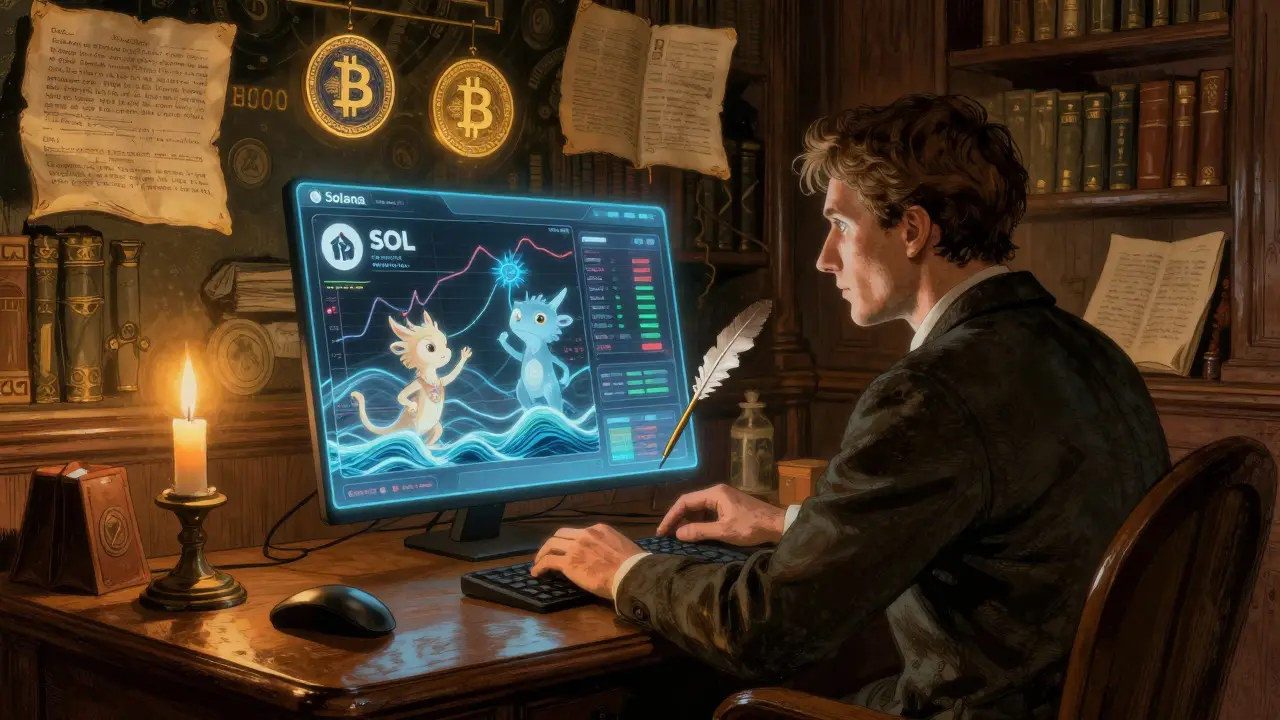
Project Plutus, also known by its token symbol PPCOIN, isn't just another cryptocurrency. It’s an attempt to merge artificial intelligence with decentralized finance into one usable system - and it’s built on Solana. Launched in December 2024, it’s still young, but its design cuts through the noise of typical crypto projects. Instead of asking users to manually track charts or set stop-losses, Project Plutus uses AI agents that trade for you. You tell it what you want - like "buy more Bitcoin when it drops 5%" - and the AI does the rest. No coding. No guesswork. Just results.
How Project Plutus Works
At its core, Project Plutus is a DeFi platform that lets you manage your crypto portfolio using natural language. Think of it like Siri or Alexa, but for your crypto holdings. You type in commands like "rebalance my portfolio to 60% SOL, 30% ETH, 10% BTC" or "take profit when my NFT collection hits $5,000," and the platform’s AI agents execute those tasks on-chain. These agents don’t just follow rigid rules - they learn from market behavior, adjust strategies over time, and even factor in macro trends like Bitcoin halving cycles or Solana network congestion.
Unlike traditional DeFi apps that require you to jump between wallets, DEXs, and analytics dashboards, Project Plutus brings everything into one clean interface. You can see your SOL, tokens, and NFTs in real time. You can approve trades with a single click. And because it runs on Solana, transactions cost pennies and confirm in under a second. That’s critical when you’re trying to capitalize on fast-moving opportunities.
What Is PPCOIN Used For?
The PPCOIN is the native utility token of Project Plutus. It’s not just a currency - it’s your key to the platform’s ecosystem. Holding PPCOIN gives you access to AI trading agents, which are otherwise locked behind paywalls. The more PPCOIN you hold, the more advanced agents you unlock. For example, a basic agent might only do dollar-cost averaging. A premium agent could handle multi-chain rebalancing, tax-loss harvesting, and NFT liquidation triggers.
There’s also a unique NFT layer tied to PPCOIN. Holders can convert their tokens into non-fungible access passes. These NFTs aren’t just collectibles - they’re functional. Each one grants you a specific tier of AI service. You can trade, upgrade, or even rent these NFTs on secondary markets. This creates a self-sustaining economy where token holders are directly incentivized to grow the platform’s user base.
And here’s the catch: 20% of all platform fees - from trades, rebalancing, or NFT upgrades - are automatically used to buy back and burn PPCOIN. That means the total supply slowly shrinks over time. With a fixed supply of 1 billion tokens and no more being minted, this deflationary model is designed to increase scarcity. It’s not just hype - it’s coded into the contract.
PPCOIN Price and Market Reality
As of February 2026, PPCOIN is trading around $0.000019. That’s down over 99% from its all-time high of $0.025194. The market cap hovers between $8,000 and $19,000 depending on the exchange, and daily trading volume is often under $5. Binance doesn’t list it. Coinbase doesn’t touch it. You’ll only find it on tiny decentralized exchanges like TradeSanta or Raydium.
That doesn’t mean it’s dead. It means it’s early. The 2,300 holders it has are mostly early adopters and Solana enthusiasts. The price drop reflects low liquidity, not failure. Many of these holders are still holding because they believe in the long-term vision - not because they’re flipping for quick gains.
The last 7 days showed a small rebound of +3.73%, which could signal renewed interest. But the 30-day trend is still negative, and the 90-day chart looks like a rollercoaster that crashed. If you’re considering buying PPCOIN, you’re not investing in a stable asset. You’re betting on a prototype becoming a product.
Why Solana? Why Not Ethereum?
Project Plutus didn’t pick Solana by accident. Solana handles 65,000 transactions per second with fees under $0.00025. Ethereum? Around 15 TPS and $1-$5 per trade. For an AI agent that needs to execute dozens of trades per hour - rebalancing portfolios, claiming rewards, selling NFTs - Solana’s speed and low cost aren’t optional. They’re mandatory.
Plus, Solana’s DeFi ecosystem is already packed with tools like Jupiter Aggregator, Raydium, and Serum. Project Plutus plugs right into that infrastructure. It doesn’t have to rebuild everything from scratch. It just needs to layer on the AI. That’s why it’s not on Arbitrum, Polygon, or Base. Solana is the only chain that can handle what Project Plutus wants to do - at scale.
The Roadmap: What’s Next?
The team’s roadmap is simple: test, learn, expand.
- Phase 1 (Now): AI agents are being rolled out to early NFT holders. Feedback is being collected on accuracy, speed, and usability.
- Phase 2 (Q2 2026): Public beta launch. Anyone with PPCOIN can join. No whitelist. No invite.
- Phase 3 (Late 2026): Integration with cross-chain bridges, expanded AI models trained on real-time macroeconomic data, and partnerships with Solana-based NFT marketplaces.
Their biggest move so far? Participating in the Solana AI Hackathon. They didn’t just show up - they won. Their AI agent design was rated the most practical and user-friendly by judges. That’s not marketing. That’s validation from real developers.
Who Is This For?
Project Plutus isn’t for day traders chasing pumps. It’s not for people who want to get rich overnight. It’s for:
- People who own crypto but don’t have time to watch charts.
- Investors who want automation but hate complex DeFi interfaces.
- Those who believe AI should serve finance, not replace humans.
- Solana users who already hold tokens and want smarter ways to manage them.
If you’re the kind of person who sets up automatic bank transfers or uses robo-advisors for stocks, Project Plutus is the crypto version of that. It’s not flashy. It’s not viral. But it might just work.
The Risks
Let’s be clear: this is high-risk. The price could drop another 90%. The AI agents could fail. The team could vanish. There’s no guarantee this becomes the next big thing. The market cap is smaller than a single meme coin. Trading volume is near zero. You can’t even buy it on major exchanges.
But here’s the flip side: if it works, it could redefine how ordinary people interact with DeFi. No more gas wars. No more confusing menus. Just tell your AI what you want, and let it handle the rest.
Is Project Plutus (PPCOIN) a scam?
There’s no evidence Project Plutus is a scam. The code is open-source, the team has a public GitHub, and they’ve participated in real events like the Solana AI Hackathon. But being legitimate doesn’t mean it’s safe. Many honest projects still fail. PPCOIN’s value is based entirely on future potential, not current utility. Treat it like a startup investment - not a guaranteed return.
Can I buy PPCOIN on Binance or Coinbase?
No. PPCOIN is not listed on Binance, Coinbase, Kraken, or any major centralized exchange. You can only buy it on small decentralized exchanges like TradeSanta or Raydium. That means higher risk, lower liquidity, and potential slippage. Always use a trusted wallet like Phantom and never send funds to an unknown contract.
How many PPCOIN tokens are in circulation?
The total supply is fixed at 1 billion PPCOIN, and as of early 2026, all 1 billion are in circulation. No new tokens will be created. The deflationary mechanism burns 20% of all platform fees, so the circulating supply will slowly decrease over time. This makes PPCOIN a scarce asset by design.
Why is the price so low?
The price is low because demand is minimal. With no major exchange listings, limited media coverage, and a small holder base of around 2,300 people, there’s not enough buying pressure to drive the price up. The all-time high of $0.025 was likely driven by hype. The current price reflects reality: this is a niche project still in its testing phase.
Is PPCOIN a good investment?
Only if you believe AI-driven DeFi will become mainstream. If you think platforms like Project Plutus will replace manual trading in 5 years, then yes - it’s a high-risk, high-reward bet. But if you’re looking for stable growth, diversification, or short-term gains, there are far safer options. Don’t invest more than you can afford to lose. This isn’t a coin. It’s a bet on a future that hasn’t happened yet.
Project Plutus isn’t the future of crypto. Not yet. But it’s one of the few projects that actually tries to solve real problems - not just create another token. Whether it succeeds or fades away depends on one thing: can AI agents become as reliable as humans? Time will tell. Until then, PPCOIN remains one of the most interesting experiments in DeFi.
I love how this actually feels like a tool, not another token dump. I’ve been using the beta AI agent to rebalance my SOL/ETH portfolio and it’s saved me hours. No more staring at charts at 3 a.m. 🤖
this is so cool 😍 i just bought 500k ppcoin and now i feel like a crypto wizard 🧙♀️✨
lol 19k market cap? you call this a project? this is a graveyard with a whitepaper. the team probably lives in their parents’ basement and thinks ‘AI’ means typing ‘help me’ into chatgpt.
The deflationary mechanism is genuinely smart - burning 20% of fees creates real scarcity. And the NFT-tiered access model? That’s not gimmicky. It’s a functional loyalty system. Most projects just pump and dump. This one actually builds.
Oh wow, another ‘AI-powered’ crypto project… because nothing says innovation like slapping ‘AI’ on a contract that runs on autopilot with 5 rules and a prayer. Next up: ‘Quantum-Blockchain-DeFi-2.0’ powered by your grandma’s wisdom.
I’ve been holding since January. I didn’t buy it to get rich. I bought it because I believe in the idea - that finance shouldn’t require a PhD in gas fees. If this works, it’ll be quiet, unglamorous, and life-changing. And honestly? That’s more valuable than any meme coin.
Solana’s throughput is a red herring. The real bottleneck is oracle reliability. AI agents need real-time macro data - not just price feeds. If the chain goes down or the oracle is manipulated, the agents become liabilities, not assets. This isn’t innovation. It’s fragility with a UI.
I don’t understand why people get so excited about this. It’s just a better interface. The tech isn’t new. The idea isn’t new. The token is just another way to gatekeep access. If it’s so good, why isn’t it on Binance?
I appreciate the thoughtful structure of this project. The phased rollout, the open-source code, and the hackathon validation suggest serious intent. While the current market cap is small, the underlying architecture is one of the few I’d consider for long-term exposure in the AI-DeFi space.
I’ve been using this for 3 months now. My portfolio is up 14% without me doing a single trade. I’m not a trader. I’m a dad who works 60 hours a week. This thing? It’s a gift. 🙏
Project Plutus is a quiet revolution. Most crypto projects are about extracting value. This one is about augmenting human decision-making. The AI doesn’t replace you - it handles the noise so you can focus on what matters. The fact that it’s built on Solana? Genius. Ethereum would’ve choked on the transaction volume. This isn’t hype. It’s infrastructure.
they’re lying. the ‘burn’ is fake. the team controls 40% of the supply. the ‘NFT access passes’? they’re just minted on demand. this is a rug. the hackathon win? paid actors. i’ve seen the contracts. it’s all smoke.
I love how this doesn’t scream ‘BUY NOW’ like every other coin. It’s just… there. Quiet. Working. Like a Swiss watch. 🤖💎
You’re all delusional. The AI agents are just glorified bots that trigger on 10% price swings. They’re not learning. They’re not adaptive. They’re just scripts with a fancy name. And the burn? The team has a backdoor to mint more tokens. I’ve been tracking the wallet. It’s all a lie.
I’ve been following this since the alpha. The team’s GitHub commits are consistent. The code audits are public. The fact that it’s still alive after 14 months - with no marketing budget - says more than any hype video ever could.
why are we even talking about this? it’s worth 0.000019. that’s less than a penny. you could buy a candy bar with 500 of these. this isn’t investing. it’s throwing money into a black hole.