
You saw the buzz. Maybe it was on Twitter, maybe in a Telegram group, or perhaps a friend sent you a link screaming about the COVIDTOKEN airdrop. The promise is always the same: free tokens just for showing up, connecting your wallet, and waiting for the big payout. But here is the hard truth that most hype-chasing investors learn too late: if a project isn't listed on major tracking platforms like CoinGecko or Airdrops.io by October 2026, it’s probably not real.
The search for "COVIDTOKEN" details yields silence from reputable sources. No significant mention in the 2024 annual reports of major aggregators. No inclusion in the $20 billion worth of airdrops tracked last year. This absence is a red flag. Before you connect your hardware wallet to some sketchy website promising moonshots, let’s break down why this specific token feels suspicious and how you can actually verify any airdrop claim yourself.
Why COVIDTOKEN Is Hard to Find
Legitimate cryptocurrency projects leave a digital footprint. They get indexed by data providers. They appear in news cycles. They have verified smart contracts. When researchers looked into the COVIDTOKEN project associated with pandemic-themed branding, they found nothing concrete in established databases.
Consider the landscape of 2025 and 2026. Major airdrops came from heavy hitters like Hyperliquid, Starknet, and Monad. These are infrastructure plays with billions in total value locked (TVL). Did you hear about COVIDTOKEN alongside them? Probably not. That’s because it likely lacks the fundamental backing required for serious market attention. It might be a micro-cap experiment, a dead meme coin, or worse-a phishing attempt disguised as an opportunity.
The name itself triggers skepticism. "Covid" tokens surged in popularity during 2020-2021 when the world was in lockdown chaos. Many were pump-and-dump schemes that vanished within months. By 2026, launching a new token with "Covid" in the title feels outdated unless there is a massive utility update or a rebranding strategy. Without clear documentation on their official website, you are flying blind.
How Legitimate Airdrops Actually Work
To understand what you might be missing-or falling for-you need to know how real distributions happen. It’s not magic. It’s code. Most legitimate projects use two main methods: snapshots and task-based claims.
A Snapshot is a record of all wallet addresses holding a specific asset at a precise block height on the blockchain. Imagine taking a photo of every person standing in line at a store at exactly noon. If you held the native token before that moment, you qualify. Developers then distribute the new tokens to those addresses automatically or via a claim portal. There is no guessing involved; the blockchain ledger is immutable.
Task-based airdrops require work. You join Discord, follow on X (formerly Twitter), retweet announcements, or refer friends. Projects do this to build community engagement. However, even these tasks usually lead to a verifiable contract address where you claim your tokens. If a site asks for your private key instead of letting you sign a transaction, run away.
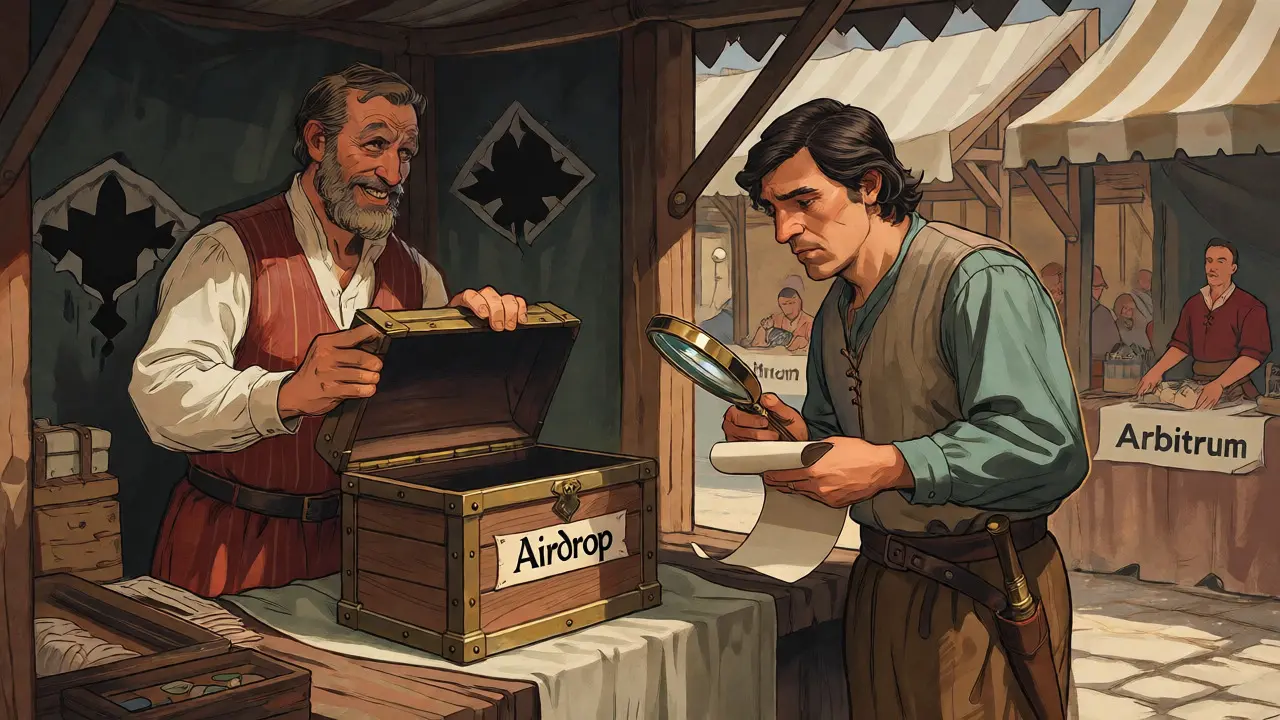
The Red Flags of Fake Airdrops
Since we cannot find solid data on COVIDTOKEN, we must assume risk. Scammers love obscure names. Here is what typically goes wrong with unknown tokens:
- No Smart Contract Verification: On Ethereum or Solana, anyone can check the source code. If the contract isn’t verified on Etherscan or Solscan, the team could mint unlimited tokens whenever they want.
- Liquidity Traps: Some fake tokens have high volume but zero liquidity. You can buy, but you can’t sell without crashing the price to zero.
- Phishing Sites: Look closely at the URL. Is it `covidtoken.com` or `c0vidtoken-airdrop.net`? Typosquatting is common.
- Gas Fee Scams: Some sites ask you to pay a small ETH or SOL fee to "claim" your free tokens. Often, this fee is higher than the token value, or the transaction simply drains your wallet.
In 2024, over 36 notable airdrops added value to the market. None were named COVIDTOKEN. If it were a top-tier event, it would be front-page news on CoinDesk or Cointelegraph. Its obscurity suggests it either failed to launch, lost its community, or never existed beyond a whitepaper PDF.
How to Verify Any Token Yourself
Don’t trust; verify. This mantra saves wallets. Here is a step-by-step checklist you can apply to COVIDTOKEN or any other mystery project.
| Check Item | Action Required | Red Flag Indicator |
|---|---|---|
| Official Website | Search for the exact domain. Check WHOIS registration date. | Domain registered less than 3 months ago. |
| Social Media Presence | Look for verified badges and consistent posting history. | Bots commenting generically; no real user engagement. |
| Contract Address | Paste the token contract into Dextools or DexScreener. | Liquidity pool is under $10k or unlocked. |
| Team Transparency | Find LinkedIn profiles of founders. | Anonymous team with no track record in Web3. |
| Aggregator Listing | Search CoinGecko, CoinMarketCap, and DefiLlama. | Not listed on any major aggregator. |
If COVIDTOKEN fails more than two of these checks, treat it as highly speculative. Remember, anonymity in crypto is fine, but anonymity combined with lack of data is dangerous.

What to Do If You Already Claimed
Suppose you already connected your wallet and claimed some COVIDTOKENs. Now what? First, check the balance in your wallet explorer. Second, look at the current market price. Third, assess the liquidity.
If the liquidity is low, selling a large amount will slip the price significantly. For example, if the total liquidity is only $5,000 and you try to sell $2,000 worth of tokens, you might receive only $1,500 due to slippage. Use tools like Uniswap or Jupiter (for Solana) to simulate the trade before executing it.
Also, revoke permissions. If you signed a transaction that allowed the COVIDTOKEN contract to spend your USDC or ETH, go to Revoke.cash. Disconnect any unused approvals. This prevents malicious contracts from draining your funds later.
The Bigger Picture: Airdrop Fatigue
By 2026, the crypto industry has matured. Users are smarter. We’ve seen projects rug-pull after raising millions. We’ve seen farming rewards diluted by inflation. The era of easy money from clicking a button is over. Successful airdrops now reward long-term holders and active ecosystem participants.
Projects like Arbitrum and Optimism set the standard. They rewarded users who bridged assets and used dApps for months. A random token popping up out of nowhere with a pandemic theme doesn’t fit this narrative. It feels like nostalgia bait. And in crypto, nostalgia rarely pays dividends unless the underlying tech delivers.
Keep your expectations realistic. If COVIDTOKEN turns out to be legit, it’s likely a small cap play. Don’t mortgage your house for it. Treat it as lottery ticket money-only invest what you can afford to lose completely.
Is COVIDTOKEN a legitimate project?
As of October 2026, there is limited evidence supporting COVIDTOKEN as a major legitimate project. It does not appear in major aggregators like CoinGecko or recent industry reports. This suggests it may be a minor project, a defunct entity, or a potential scam. Always verify the smart contract and team background before investing.
Where can I find the official COVIDTOKEN website?
There is no widely recognized official website for a major project named COVIDTOKEN. Be cautious of multiple domains claiming to be official. Search for the token contract address on blockchain explorers to find the true project page linked to the verified contract.
How do I avoid airdrop scams?
Never share your private key or seed phrase. Only connect your wallet to sites with verified social media links. Check the contract address on Dextools or DexScreener for liquidity and holder distribution. If a site asks for upfront payment to claim free tokens, it is likely a scam.
Can I sell my COVIDTOKEN immediately?
You can attempt to sell immediately if there is liquidity. However, check the depth of the order book. Low liquidity means high slippage, so selling a large position might result in a lower return than expected. Simulate the trade first using a decentralized exchange interface.
Why aren't pandemic tokens popular anymore?
The initial hype around pandemic-related crypto themes peaked in 2020-2021. By 2026, investor interest has shifted toward AI, Layer 2 scaling solutions, and DeFi infrastructure. Thematic tokens often lack sustainable utility, leading to decreased relevance and trading volume over time.