
Iran’s crypto surge isn’t about speculation-it’s survival
When the FATF added Iran to its blacklist in 2019, it didn’t just cut off banks. It cut off access to the global economy. Iranian families couldn’t pay for medicine. Small businesses couldn’t import parts. Parents couldn’t send money to relatives abroad. The response? Millions turned to cryptocurrency-not because they loved Bitcoin, but because it was the only thing left that worked.
By 2024, Iran accounted for over $9 billion of the $15.8 billion in crypto transactions flowing into all sanctioned countries combined. That’s more than Russia, North Korea, and Syria put together. And it’s not growing because people are chasing gains. It’s growing because there’s no other way out.
What the FATF blacklist actually does to Iran
The Financial Action Task Force isn’t a court. It’s a global watchdog that tells banks: ‘Don’t do business with these countries.’ When Iran was blacklisted, global banks froze Iranian accounts. SWIFT payments stopped. Even non-sanctioned companies refused to touch anything linked to Iran. The result? A financial wall.
By 2025, Iran had just three correspondent banking relationships left-down from 28 in 2018. That means no international wire transfers. No PayPal. No Stripe. No Visa. No Mastercard. For ordinary Iranians, this wasn’t a policy debate-it meant no way to buy a laptop, pay for an online course, or receive money from a cousin in Canada.
FATF’s rules force banks to monitor every transaction going in or out of Iran. So they just say no. And that’s exactly what pushed people toward crypto.
How Iranians are using crypto to survive
Most people think crypto users in Iran are miners or traders. They’re not. They’re teachers, mechanics, shopkeepers, and nurses. They’re using Bitcoin and Ethereum to move money across borders when banks won’t.
Chainalysis found that 78% of crypto transactions from Iran are Bitcoin. Why? Because it’s decentralized. No bank can shut it down. No government can freeze a wallet if you control the keys. Ethereum makes up 14%-used mostly for smart contracts and tokenized payments. Monero, the privacy coin, is only 5%, because it’s harder to use and less understood.
People aren’t buying $10,000 worth of Bitcoin at once. They’re sending $1,200 here, $800 there. Why? To avoid detection. The average transaction dropped 40% since 2023. Fragmented, small, frequent transfers are harder to flag.
Most of these transactions happen through mobile wallets like Trust Wallet and Exodus. Over 90% of users access crypto via their phones. That’s because Iran’s internet is tightly controlled. You need a registered SIM card to get online. Many use apps like Soroush+ to bypass filters-but 41% of those apps get blocked anyway.
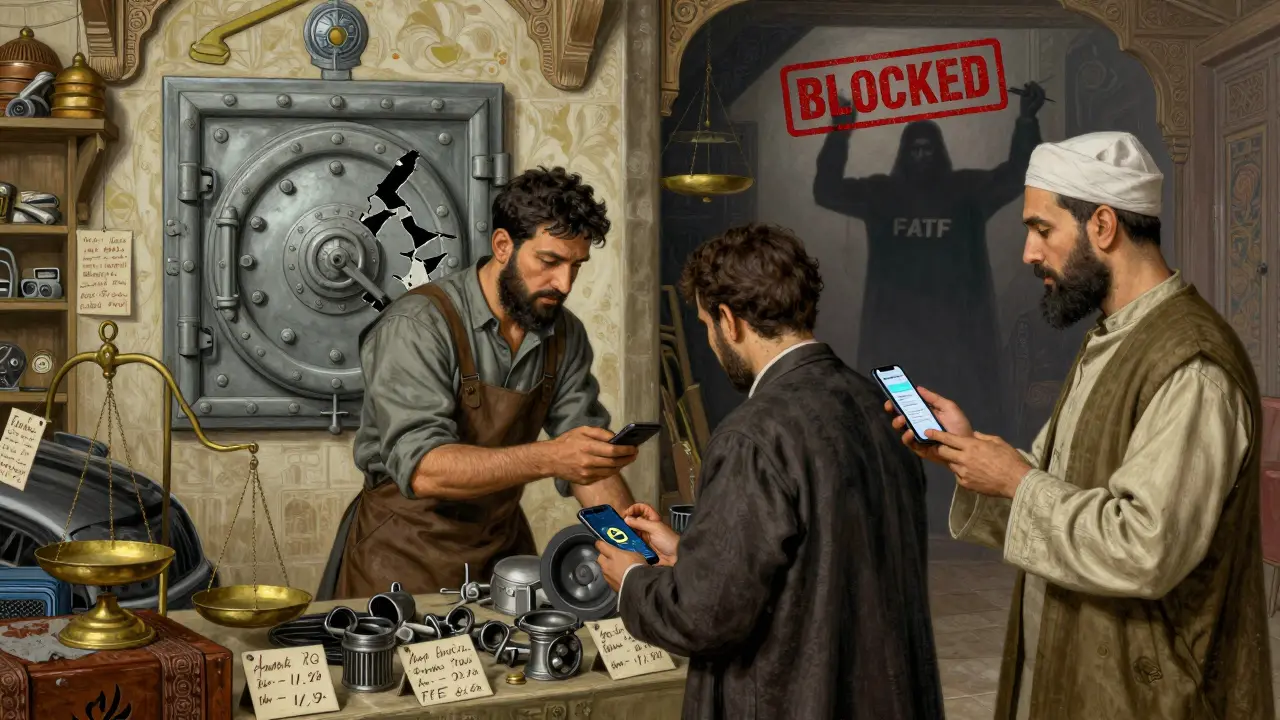
The exchange trap: You’re caught between two governments
Here’s the cruel irony: To use crypto, Iranians need global exchanges like Binance or Bybit. But those exchanges are forced by FATF to follow the ‘travel rule’-collecting names, IDs, and addresses of senders and receivers.
So Iranian users sign up with their real names. They upload IDs. They do everything right. Then-boom. Their account gets frozen. Why? Because the exchange’s compliance system flags Iran as high-risk. In a September 2025 survey of 14,200 Iranian users on Nobitex, 33% reported their global exchange accounts were frozen after just a few small transactions.
One user, ‘TehranTrader’ on Reddit, lost $8,200 after three transfers under $1,500. The exchange didn’t accuse him of anything. They just blocked him because his location triggered a FATF flag.
Even exchanges based in friendly countries like the UAE and Singapore aren’t safe. In July 2025, a UAE-based platform called Rain shut down 317 Iranian accounts overnight, wiping out $4.1 million in combined funds. No warning. No appeal. Just silence.
The underground workarounds
People aren’t giving up. They’re adapting.
Peer-to-peer (P2P) trading is booming. Platforms like LocalBitcoins and decentralized apps let users trade directly. Success rates are around 78%, but there’s a catch: you pay a 22% premium. That means if you want $1,000 worth of Bitcoin, you pay $1,220 in Iranian rials. It’s expensive-but better than nothing.
Some are using atomic swaps-direct, trustless trades between wallets. One user in Shiraz moved 2.3 BTC to Turkey in 17 minutes without KYC. No exchange involved. No middleman. Just code.
Then there’s the ‘HalalChain’ project-a local peer-to-peer network built on Iranian-made blockchain tech. It’s not connected to the global crypto market, but it lets people trade crypto within Iran and to nearby countries like Iraq and Turkey. It’s slow. It’s limited. But it works.
And now, Iran’s central bank has launched a gold-backed stablecoin called HSC. In its first month, 4.2 million people used it to send $280 million. But here’s the problem: it’s completely isolated from the global system. No foreign bank accepts it. No exchange lists it. It’s a national experiment-useful inside Iran, useless abroad.
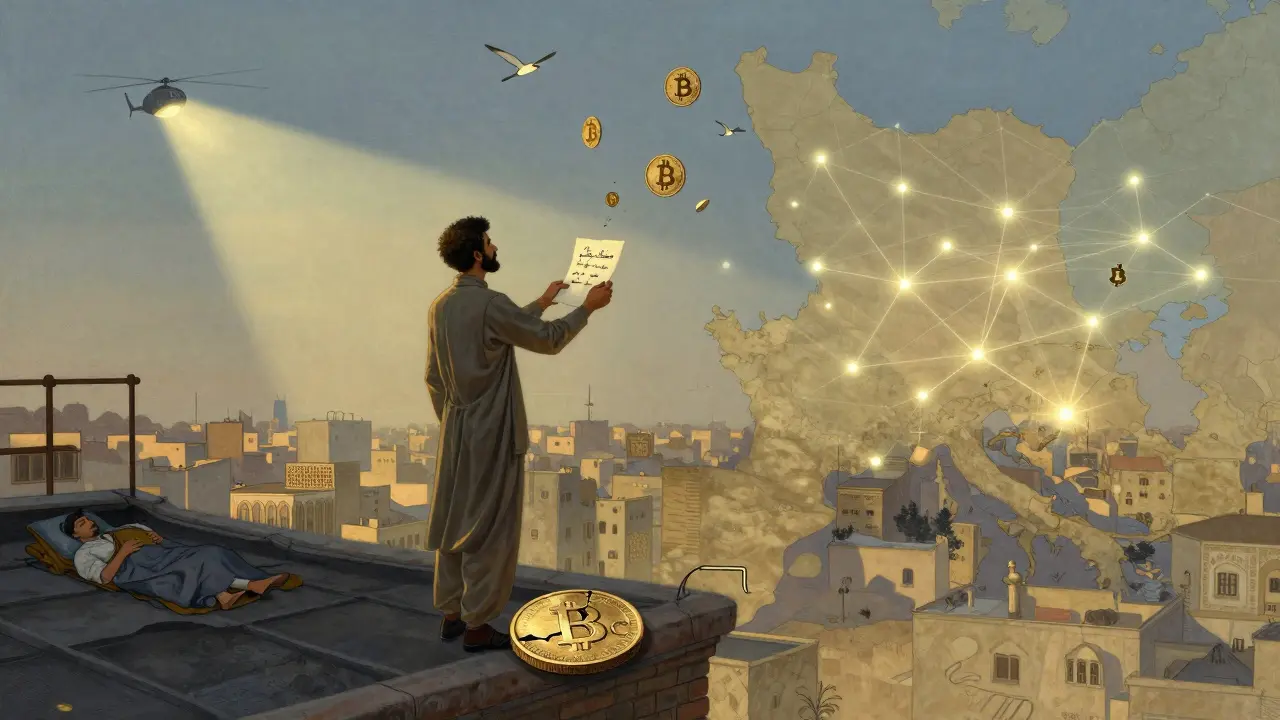
The human cost of compliance
It’s not just about money. It’s about dignity.
Iranian crypto users spend hours learning how to manage seed phrases. 61% need help setting up wallets. One wrong tap and your life savings vanish-no customer service, no recovery.
Internet access is tied to your phone number. That means the government knows who’s using crypto. If you’re flagged, you could face questioning-or worse. Some users report being summoned by authorities after large transfers.
And support? Forget 24/7 help desks. Iranian exchanges have Farsi chat support that takes 14 hours to respond. Global exchanges block Iranian IPs 99.8% of the time. So users turn to GitHub for open-source tools like ‘IranCryptoKit’-a collection of code to bypass firewalls. But 37% of those tools have been hacked or contain malware.
On Reddit’s r/CryptoIran, 68% of users say exchanges are unreliable. But 82% say crypto is the only way they can survive.
Why the FATF blacklist is backfiring
Experts agree: the blacklist isn’t stopping Iran. It’s accelerating crypto adoption.
Dr. Emad Kiyaei, a sanctions expert in Switzerland, wrote in September 2025: ‘The blacklist has become counterproductive. It’s not reducing proliferation risks-it’s forcing Iran to build a parallel financial system.’
Iran has ratified three of the 12 FATF action items. But FATF won’t budge. No dialogue. No negotiation. Just more pressure.
Meanwhile, crypto usage keeps climbing. In 2024, 18.7 million Iranians-42% of the adult population-used crypto. That’s more than the entire population of Sweden. By 2027, FATF itself predicts over 25 million users.
But here’s the scary part: if this continues, Iran’s crypto system could become too big to control. And if the global financial system keeps cutting it off, the system could collapse-leaving millions with frozen wallets and no recourse.
What’s next for Iranian crypto users?
There’s no easy answer. The government won’t give up control. The world won’t lift sanctions. And users won’t stop using crypto.
Right now, Iranians are caught in a trap: the more they use crypto to survive, the more they’re targeted by both foreign regulators and their own government.
Some are learning to code, building their own wallets and bridges. Others are moving to Turkey or Armenia, where crypto access is easier. A few are even using crypto to pay for smuggled goods-medicine, electronics, fuel. It’s not glamorous. It’s not legal. But it’s real.
The FATF says it’s fighting money laundering and terror financing. But in Iran, crypto isn’t funding weapons. It’s funding groceries. It’s funding school fees. It’s funding life.
Until the rules change, Iranian crypto users will keep adapting. They’ll keep sending small amounts. They’ll keep using P2P. They’ll keep risking their accounts. Because for them, there’s no alternative.
Why is Iran still on the FATF blacklist?
Iran was placed on the FATF blacklist in 2019 for failing to implement a 12-point action plan to stop money laundering and terrorist financing. Although Iran ratified three of those measures by 2025-including laws against terror financing-it hasn’t met FATF’s full requirements. FATF has not publicly acknowledged any progress and continues to treat Iran as a high-risk jurisdiction with no exceptions.
Can Iranians still use Binance or Coinbase?
Technically, yes-but it’s risky. Global exchanges like Binance and Coinbase block Iranian IP addresses 99.8% of the time. Even if someone accesses them with a VPN, they must complete KYC. Once the system identifies an Iranian user, accounts are frozen without warning. Over a third of Iranian users report account freezes after small transactions due to FATF compliance rules.
Is crypto legal in Iran?
Crypto mining is legal and even encouraged by the government to earn foreign currency. But trading and using crypto for payments is in a gray zone. The Central Bank bans banks from handling crypto, but individuals can own and trade it. The government monitors transactions closely, and there have been cases of users being questioned or fined for large transfers.
How much crypto do Iranians use compared to other countries?
In 2024, Iran accounted for $9.2 billion in crypto inflows-more than any other sanctioned country and more than Russia, despite Russia’s larger economy. Iran’s 18.7 million crypto users make up 42% of its adult population, the highest adoption rate among sanctioned nations. Globally, sanctioned countries received $15.8 billion in crypto that year, with Iran responsible for nearly 58% of that total.
What’s the Halal Stablecoin, and does it help Iranians?
The Halal Stablecoin (HSC) is a government-backed digital currency pegged to gold, launched in August 2025. Over 4 million Iranians used it to send $280 million in its first month. But it’s not connected to global markets. No international exchange accepts it. It can’t be used to pay for imports or send money abroad. It’s useful inside Iran for domestic transactions but doesn’t solve the core problem: isolation from the global financial system.
Can Iranians use decentralized exchanges (DEXs) safely?
Yes-but with limits. DEXs like PancakeSwap don’t require KYC, so they’re popular. But liquidity is low, leading to 15% slippage on trades. Success rates are around 63%. Users also need to manage their own wallets and seed phrases. Many don’t know how, and mistakes lead to permanent losses. Plus, Iranian internet restrictions make accessing DEXs harder without VPNs or proxy tools, which can be unreliable or unsafe.
Will FATF ever remove Iran from the blacklist?
Not anytime soon. FATF requires full compliance with all 12 action items, and Iran has only met three. Even when Iran takes steps, like ratifying anti-terror laws, FATF doesn’t acknowledge them publicly. Experts warn that if the blacklist stays in place, crypto adoption will keep growing-but so will instability. By mid-2026, one model predicts a 60% chance of a liquidity collapse if no compromise is reached.
This is wild. People just want to buy medicine and pay for their kid's online classes, and the system treats them like criminals. 😔
It's not just about finance-it's about the erosion of human dignity. When a government's compliance protocols force a mother to choose between her child's insulin and a seed phrase, we've lost something fundamental. The FATF doesn't see people; it sees risk matrices. And risk matrices don't cry when their wallets vanish.
Let’s be real-this isn’t about survival. It’s about circumventing sanctions that exist for a reason. Iran’s regime funds terror. Crypto is just their new laundering channel. Don’t romanticize it.
I know a guy in Tehran who uses Trust Wallet to send $500 to his sister in Canada every month. He calls it 'digital bread'. He’s not a hacker. He’s a teacher. And yeah, he’s scared. But he’s still doing it. 🫶
The irony is delicious. The West spends billions on sanctions to 'punish' Iran, but the result? A decentralized, resilient, crypto-native underground economy that doesn't need the dollar. The FATF didn't crush crypto adoption-they accidentally built Iran's financial future. And now they're mad it worked.
FATF is just a bureaucratic vampire. Sucking the life out of ordinary people while sipping espresso in Brussels. Meanwhile, Iranians are coding their own lifelines. The real crypto revolution isn't in Solana or Ethereum-it's in a 14-year-old in Shiraz who just sent her mom's insulin money via atomic swap.
I’ve been tracking this since 2021. The shift from big transfers to micro-transactions under $1k is genius. It’s not evasion-it’s adaptation. Like water finding cracks in concrete. The system can’t police every $800 transfer. And that’s the beauty.
Bro the HalalChain thing is straight up genius imagine if we had something like this in India for remittances no more western banks dictating how we send money to our cousins in Dubai or London
The fact that 61% of users need help setting up wallets breaks my heart. This isn't a tech problem-it's a humanitarian one. Imagine if we treated access to financial tools like access to clean water. We wouldn't let people drown in bureaucracy.
I remember when my cousin in Tehran sent me $200 in BTC so I could buy my first laptop. No bank. No paperwork. Just a QR code and a prayer. That’s the real power of crypto-not speculation. It’s connection.
Let’s not pretend this is noble. People are using crypto because they’re desperate. And desperation doesn’t make you righteous-it makes you vulnerable. Those P2P premiums? That’s exploitation. And the government’s gold coin? A PR stunt. They’re not helping-they’re controlling.
I just want to say thank you to every Iranian user out there. You’re not just surviving-you’re redefining what financial freedom means. You don’t need permission. You don’t need a bank. You just need a phone and courage.
The FATF’s methodology is fundamentally flawed. It assumes compliance can be enforced through exclusion, yet history proves that isolation breeds innovation, not submission. The blockchain is not a loophole-it is the inevitable consequence of institutional failure. When institutions become instruments of oppression, decentralized alternatives emerge-not as rebellion, but as logic.
I mean, sure, it’s tragic. But let’s not pretend the West is the villain here. Iran’s government is the one that created this mess. They could’ve negotiated. They could’ve reformed. Instead, they chose to fund militias and build a surveillance state. Now they’re mad that people are using crypto? Welcome to the consequences of your own choices.
The narrative that crypto is a tool of survival is incomplete. It is also a tool of resistance. Every small transaction is a silent act of defiance against a global financial architecture designed to exclude. The blockchain does not care about borders. It does not care about sanctions. It only cares about consensus. And in Iran, consensus is survival.
I cried reading about the 33% account freeze rate... imagine trusting your entire livelihood to an exchange that could vanish overnight because of a flag you didn't even know existed. No warning. No explanation. Just silence. That's not regulation-that's digital colonialism.
So now we’re supposed to feel bad because Iranians are using Bitcoin to bypass sanctions? Let me get this straight: we punish a regime for funding terrorism, and when its citizens use crypto to work around it, we call it ‘survival’? No. It’s complicity. And you’re glorifying it.
This whole piece is woke propaganda. Crypto isn’t saving lives-it’s enabling a regime that executes protesters and bombs schools. You’re not advocating for the people-you’re enabling the oppressors. The real victims are the ones who can’t escape the system because they’re too poor to buy a phone or learn a seed phrase.
I don’t know what the solution is. But I know this: when people are forced to become their own banks, their own lawyers, their own tech support… we’ve failed them. Not Iran. Not the FATF. Us. All of us who looked away.
You think this is about medicine? Nah. It’s about control. The regime lets people use crypto because it lets them track every transaction. Every wallet. Every transfer. They’re not letting people survive-they’re turning them into data points. Crypto isn’t freedom here. It’s a gilded cage.