When you send Bitcoin, it’s not anonymous. It’s public. Every transaction lives forever on a global ledger anyone can read. Your wallet address, how much you sent, who you sent it to - all visible. That’s not a bug. It’s how Bitcoin was built. But over time, people started using it for things they didn’t want traced: private donations, offshore payments, even illicit deals. And that’s when the arms race began.
Privacy tech fights back
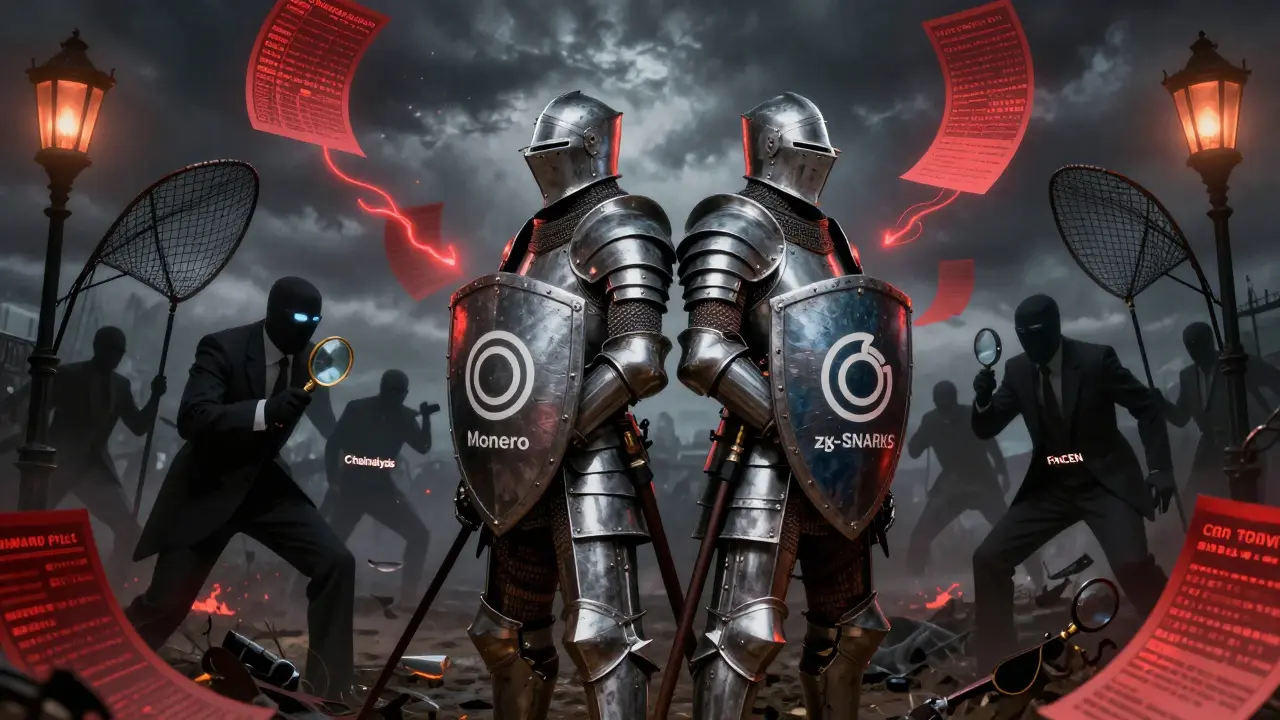
Privacy-focused cryptocurrencies didn’t appear out of nowhere. They were built because Bitcoin’s transparency became a liability. If your address gets linked to your real name - say, through an exchange that requires ID - every past and future transaction tied to that address is exposed. That’s not freedom. That’s surveillance. Monero stepped in with a radical idea: hide everything. It uses ring signatures to mix your transaction with others, making it impossible to tell who actually sent the funds. Stealth addresses ensure the recipient can’t be tracked. RingCT hides the amount. No one sees the sender, receiver, or value. It’s not just obfuscated - it’s cryptographically sealed. Zcash took a different route. Instead of hiding all data, it lets users choose. With zk-SNARKs, you can prove a transaction is valid without revealing any details. Think of it like showing a judge you paid your taxes without telling them how much you earned. The math checks out. The numbers stay secret. Then there are mixers and tumblers - third-party services that shuffle your coins with others’. Services like Wasabi Wallet and Samourai Wallet became popular for Bitcoin users who wanted to break the chain of traceability. These tools don’t change the blockchain. They change how you interact with it. These aren’t theoretical. Monero processes over 100,000 transactions daily. Zcash has over 30 million private transactions since 2016. These aren’t fringe tools. They’re functional, battle-tested, and used by real people who value financial privacy.Surveillance tech fights back harder
The crypto world didn’t stay quiet. Companies like Chainalysis, Elliptic, and CipherTrace built entire businesses around tracing what privacy tech tries to hide. They don’t crack encryption. They don’t need to. Instead, they use patterns. If you send 5 BTC from Address A to Address B, and later 5 BTC leaves Address B to go to a known exchange, they’ll link those addresses - even if the second transaction was sent through a mixer. They look at timing, volume, and behavior. If you always send coins to the same wallet every Friday, they’ll tag it as “likely yours.” Machine learning models now detect these patterns with 80%+ accuracy. Exchanges, under pressure from regulators, now block transactions from known privacy wallets. If you try to deposit Monero into Coinbase or Kraken, you’ll get rejected. Some exchanges even freeze accounts if they detect past use of mixers. In 2024, the U.S. Department of Justice arrested the founders of Samourai Wallet for “operating an unlicensed money service business.” The charge? Enabling privacy. It’s not just about crime. It’s about control. Regulators argue that without visibility, money laundering, sanctions evasion, and ransomware payments run wild. The numbers back this up - a 2023 report estimated that 0.3% of all crypto transactions involved illicit activity. That’s tiny. But the fear isn’t about the percentage. It’s about the potential.
Regulators draw lines - and cross them
Countries have responded in extremes. China banned all crypto. Qatar and Saudi Arabia followed. Russia tried to ban privacy coins specifically. Meanwhile, the U.S. walks a tightrope: crypto is legal, but privacy tech is suspect. The Financial Crimes Enforcement Network (FinCEN) now requires crypto exchanges to report transactions over $3,000 involving privacy coins. That’s not regulation. That’s a de facto ban. No exchange wants the paperwork, the audits, the legal risk. So they just delist Monero, Zcash, Dash. The result? Privacy coins are now harder to buy, harder to trade, harder to use. You can’t get them on most apps. You have to use decentralized exchanges, peer-to-peer platforms, or over-the-counter brokers. The average user doesn’t want that friction. So adoption stagnates. But here’s the irony: the same tools that help criminals also help dissidents in authoritarian regimes, journalists under threat, and ordinary people in places where banks freeze accounts for political reasons. In Venezuela, Nigeria, and Ukraine, privacy coins have become lifelines. Not for crime. For survival.Smart contracts and the new battleground
The next phase isn’t just about sending coins. It’s about what happens behind the scenes. DeFi protocols, NFT marketplaces, and enterprise blockchains all need to balance transparency with confidentiality. Imagine a company using Ethereum to pay suppliers. They don’t want competitors to know how much they’re spending. Or a hospital using a blockchain to store patient payment records. They need to prove payment was made - but not reveal the amount or identity. New tools are emerging. Zero-knowledge rollups (ZK-Rollups) let Ethereum scale while keeping transaction data private. Projects like Tornado Cash (now banned in the U.S.) showed how this could work for individuals. But the legal backlash was brutal. Now, developers are building “compliant privacy” - systems that allow regulators to view data with a key, while hiding it from everyone else. That’s the new frontier: privacy with a backdoor. Is that still privacy? Or just control dressed up as compliance?
The future isn’t about winning - it’s about coexistence
Quantum computing looms. It could break today’s encryption - both the privacy kind and the surveillance kind. That means today’s arms race might be obsolete in 10 years. But the conflict won’t vanish. It’ll just change shape. Privacy advocates say: financial privacy is a human right. You don’t need a reason to keep your money private. Just like you don’t need a reason to keep your diary locked. Regulators say: without visibility, crime thrives. We need to see the money to stop the bad actors. Edward Snowden put it simply: “Privacy is not about having something to hide. It’s about having something to protect.” The truth? Both sides are right. And both sides are wrong. You can’t have a financial system where every transaction is invisible. But you also can’t have one where every dollar is tracked. The answer isn’t to ban Monero. It’s not to force everyone into transparency. It’s to build systems that let people choose - without being punished for choosing privacy. Right now, the system punishes privacy. That’s not justice. It’s fear.What’s next for users?
If you care about privacy in crypto:- Use Monero or Zcash for sensitive transfers - but know they’re harder to access.
- Avoid centralized exchanges for privacy coins. Use decentralized ones like Bisq or Hodl Hodl.
- Don’t mix coins from a known exchange wallet - it creates a trail.
- Understand that using a mixer might get your account flagged - even if you did nothing illegal.
- Support projects building privacy without backdoors. Push for open-source, auditable tools.
Are privacy coins illegal?
No, privacy coins like Monero and Zcash are not illegal in most countries. But many exchanges and financial institutions block them due to regulatory pressure. In the U.S., using them isn’t against the law, but failing to report transactions involving them can trigger penalties. Some countries, like China and Qatar, have banned all cryptocurrencies, including privacy coins.
Can the government track Monero transactions?
Not with current technology. Monero’s ring signatures, stealth addresses, and RingCT make it mathematically impossible to trace sender, receiver, or amount. Even advanced blockchain analysis firms like Chainalysis admit they cannot de-anonymize Monero transactions. That’s why regulators target exchanges and wallet providers instead - they can’t break the crypto, so they try to break access to it.
Why do exchanges delist privacy coins?
Exchanges delist privacy coins because they’re seen as high-risk for regulatory violations. If a user sends Monero to an exchange, regulators may hold the exchange responsible if that coin was ever used in illicit activity - even if the exchange had no way to know. To avoid fines, audits, and legal action, exchanges remove them entirely. It’s not about the tech. It’s about liability.
Is Zcash truly anonymous?
Zcash offers optional privacy. You can send shielded transactions (using zk-SNARKs) that hide all details. But you can also send transparent ones - just like Bitcoin. Most Zcash users don’t use privacy mode regularly, so many transactions are still visible. That makes Zcash less private than Monero, which hides everything by default.
Can AI improve privacy or surveillance more?
AI helps both sides. Surveillance firms use AI to detect patterns in blockchain data - like identifying mixer usage or linking wallets across chains. On the privacy side, AI is being used to generate fake transaction footprints, confuse analysis tools, and optimize coin mixing. The better the AI gets, the harder it becomes for either side to gain a permanent advantage.
This is one of those topics where I feel like everyone’s screaming but no one’s listening. Privacy isn’t about hiding crime-it’s about protecting dignity. I’ve got friends in Ukraine using Monero to get paid when their banks froze accounts for no reason. That’s not laundering. That’s surviving. Why are we punishing people for wanting to keep their financial life private? It’s like banning locks because thieves exist.
Stop romanticizing criminals. Monero is a drug dealer’s best friend. If you can’t track it, it’s useless for society. You want privacy? Use cash. Not crypto that’s designed to evade law enforcement. This isn’t a civil rights issue-it’s a public safety emergency.
Wait-so you’re saying that because some people use privacy tech for bad things, we should eliminate it for everyone? That’s like banning knives because someone used one to stab a guy… and then saying, ‘But what about chefs?!’-but no, we’re just gonna ban all knives. That’s not logic. That’s fear-driven policy. And it’s gonna backfire.
It’s funny how the same people who scream ‘freedom!’ when it’s about guns or speech suddenly turn into surveillance fanatics when money’s involved. You want to know what’s really scary? Not that criminals use privacy tools… but that we’re okay with letting the state control every dollar we touch. That’s not safety. That’s totalitarianism with a UI.
Y’all are overthinking this. 😅 Privacy tech isn’t evil. Surveillance tech isn’t evil. It’s the people using them that are. Let’s build better tools, not ban them. Also-Zcash is kinda meh if most people don’t use shielded mode. Monero’s the real MVP. 🚀
As a dev who’s worked on ZK-Rollups, I can tell you: the tech is *already* here. The problem isn’t the tech-it’s the fear. Regulators don’t understand crypto. They see ‘anonymous’ and panic. We need better education, not bans. Also-Tornado Cash was a brilliant idea. They killed it because it worked too well.
ok so like… i just wanna send money to my cousin in nigeriia without the bank freezing my account for ‘suspicious activity’… is that too much to ask? i dont care if some drug lord uses monero too… i’m not him. why do i get punished for his crimes? also typo sorry lol
so like… if i pay my rent in btc and someone later sees that address and links it to me… that’s just how it is. but if i use monero… suddenly i’m a criminal? nah. it’s not the tool. it’s the rules. and the rules are messed up. chill out.
Let’s be real: if you’re using a mixer and you’re not a drug dealer, you’re probably just a person who doesn’t want Big Brother knowing you bought a laptop from a crypto vendor. And that’s… kinda normal? 🤷♀️ Also, why do we let exchanges decide what’s ‘safe’? They’re not cops. They’re just scared of lawyers.
OH MY GOD YOU’RE ALL SUCH NAIVE LIBERALS 😭 Monero is literally used by ransomware gangs to extort hospitals. I’m not even mad-I’m just disappointed. You people would rather let kids die than give up your ‘privacy fantasy’. 🤡
Privacy coins are a threat to American sovereignty. We built the global financial system. We don’t need some anarchist’s crypto experiment undermining our control. If you want to use Monero, move to Venezuela. Here, we follow the law. And the law says: transparency wins.
This isn’t about money. It’s about power. Who gets to decide what’s private? The state? The banks? Or the individual? If you believe in freedom, then you believe in the right to be unseen. Not because you’re hiding something… but because you’re human. And humans deserve silence sometimes.
India banned crypto but still people use it. Same here. Privacy coins will survive because people need them. No law can stop demand. Only bad policy makes things worse.
While I acknowledge the philosophical underpinnings of financial privacy, the regulatory imperative to mitigate illicit finance cannot be overstated. The Financial Action Task Force has unequivocally delineated the risks associated with privacy-enhanced cryptocurrencies, and compliance is not optional-it is a fiduciary obligation. One cannot, in good conscience, champion anonymity without confronting the collateral consequences.
There is a middle ground. We can design systems that preserve user privacy while allowing authorized, judicially supervised access under strict legal frameworks. This is not a backdoor-it’s a warrant. The technology exists. What’s missing is political will. We must move beyond binary thinking: either total transparency or total anonymity. Neither is sustainable.
idk man i think its all kinda dumb. like who even cares. crypto is just digital glitter anyway. also typo. oops.