
For years, the phrase "RBI crypto ban" cast a long shadow over India's digital asset market. If you were trading Bitcoin or Ethereum in India between 2018 and 2020, you likely felt the ground shift beneath your feet. Banks froze accounts, exchanges shut down, and the entire ecosystem seemed to be suffocating under regulatory pressure. But then, something unexpected happened. The Supreme Court of India stepped in, overturned the ban, and fundamentally changed the rules of the game.
If you are wondering what actually changed after the RBI banking ban reversal is the landmark legal decision that restored banking services to cryptocurrency businesses in India, you are not alone. Many investors and traders still operate with the lingering fear that the door could close again. Understanding this pivotal moment is crucial for anyone navigating the Indian crypto landscape today. It wasn't just about getting bank accounts back; it was about establishing a legal precedent that protects the right to trade digital assets.
The 2018 Circular: How the Freeze Started
To understand the reversal, we first need to look at how restrictive things got. On April 6, 2018, the Reserve Bank of India (RBI) is India's central banking institution responsible for regulating monetary policy and financial stability issued a circular that effectively killed the domestic crypto economy overnight. This directive prohibited all entities regulated by the RBI-including nationalized banks, cooperative banks, non-banking financial companies (NBFCs), and payment system operators-from dealing with any person or entity involved in virtual currencies.
This didn't technically ban you from holding Bitcoin. However, it severed the lifeline every exchange needed to survive: banking infrastructure. Without the ability to move rupees into and out of crypto platforms, peer-to-peer trading became incredibly difficult, and major exchanges like WazirX and ZebPay had to halt fiat on-ramps. The message from the regulator was clear: if you want to stay in business, you can't touch crypto.
The rationale behind this move stemmed from concerns raised as early as 2013. The RBI warned about the high volatility of assets like Bitcoin, the lack of intrinsic value, and security vulnerabilities such as hacking attacks. By 2018, these concerns had escalated into a full-blown prohibition, driven by fears that cryptocurrencies would undermine monetary sovereignty and facilitate capital flight.
The Supreme Court Judgment: A Turning Point
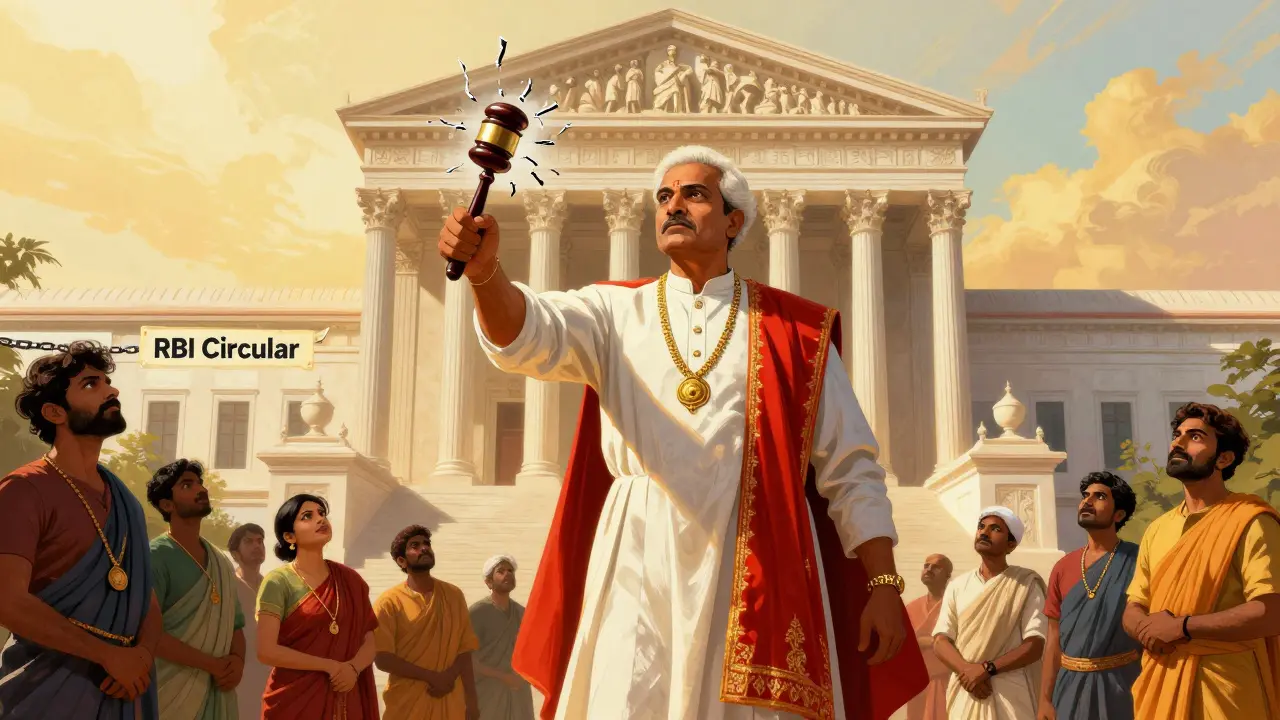
The tide turned dramatically on March 4, 2020. In the case of Internet and Mobile Association of India v. Reserve Bank of India, the Supreme Court delivered a unanimous verdict that struck down the 2018 circular. This wasn't just a minor legal adjustment; it was a fundamental assertion of constitutional rights against regulatory overreach.
The Court ruled that the RBI's circular violated Article 19(1)(g) of the Constitution of India, which guarantees citizens the fundamental right to practice any profession, trade, or business. Justice Rohinton Fali Nariman, writing for the bench, emphasized a critical concept known as the "test of proportionality." The judges argued that while the RBI had legitimate concerns about protecting financial institutions, an outright ban was disproportionate. They noted that the RBI failed to demonstrate that any specific financial institution had suffered measurable damage from providing services to virtual currency exchanges.
This judgment established a powerful precedent: regulators cannot impose blanket prohibitions on emerging technologies without exploring less intrusive alternatives first. For the crypto community, this was a victory for due process. It meant that innovation couldn't be stifled simply because regulators feared potential risks that hadn't materialized into concrete harm.
Immediate Impact on the Crypto Ecosystem
The aftermath of the March 2020 ruling was immediate and electric. Exchanges that had been forced to suspend operations or significantly curtail their services quickly resumed full functionality. Trading volumes surged as users rushed back to platforms they had abandoned during the freeze. New startups entered the market, sensing that the regulatory fog had lifted, even if only temporarily.
Beyond direct trading platforms, the reversal had a ripple effect across the broader fintech sector. Many blockchain-based solutions and distributed ledger technology (DLT) projects had stalled because they couldn't access basic banking services. With the ban lifted, these companies could once again open corporate accounts, pay salaries, and operate legally. This collateral benefit highlighted how broad regulatory bans often punish legitimate innovation alongside speculative trading.
However, the joy was tempered by caution. While banking access was restored, the legal status of cryptocurrencies remained ambiguous. The Supreme Court did not declare Bitcoin or Ethereum as legal tender. Instead, it protected the right to trade them. This distinction is vital: you could buy and sell crypto, but you couldn't use it to pay for groceries or settle official debts.
The Regulatory Vacuum and Future Legislation
Following the court's decision, the Indian government attempted to fill the regulatory void with new legislation. In 2021, a draft bill titled the Cryptocurrency and Regulation of Official Digital Currency Bill is a proposed legislative framework aimed at banning private cryptocurrencies while enabling a Central Bank Digital Currency was circulated. This bill sought to prohibit private cryptocurrencies entirely while paving the way for a Central Bank Digital Currency (CBDC) issued by the RBI.
The rationale behind this approach mirrored the RBI's original concerns: volatility, speculation, and potential misuse for illicit activities. The proposed penalties were severe, including imprisonment for mining, holding, or trading private cryptocurrencies. Yet, despite intense debate, this bill was never formally introduced in Parliament. As of 2025, no comprehensive law specifically governing cryptocurrencies exists in India.
This absence of legislation creates a complex environment. On one hand, the Supreme Court's 2020 ruling remains the governing legal principle, ensuring that crypto businesses can operate with banking access. On the other hand, the lack of clear statutory guidelines means that regulations are often enforced through tax laws and anti-money laundering (AML) directives rather than dedicated crypto policy.
Current Status: Legal but Taxed Heavily
So, where do we stand today? Cryptocurrency is legal in India. You can trade, hold, and invest in digital assets without fear of criminal prosecution for the act itself. However, the government has made it financially expensive to do so. In the 2022 budget, Finance Minister Nirmala Sitharaman announced a 30% tax on profits from Virtual Digital Assets (VDAs) and a 1% Tax Deducted at Source (TDS) on transactions above a certain threshold.
This taxation strategy serves two purposes. First, it generates revenue from a booming market. Second, it acts as a deterrent, discouraging casual speculation by reducing net returns. For serious investors, this means careful record-keeping is essential. Every transaction must be tracked to calculate gains accurately, as losses from one VDA cannot be offset against gains from another.
The RBI continues to express skepticism about cryptocurrencies. Former Governor Shaktikanta Das has repeatedly warned that widespread adoption could disrupt the traditional financial system and weaken the rupee. Despite this, the central bank has also moved forward with its own digital currency project, the e-Rupee, signaling a desire to control the narrative around digital money rather than cede it entirely to private actors.
| Period | Regulatory Stance | Banking Access | Market Impact |
|---|---|---|---|
| 2013-2018 | Warnings Issued | Available but Risky | Growth Amid Caution |
| 2018-2020 | Complete Ban (RBI Circular) | Blocked | Exchanges Shut Down, Volume Plunge |
| 2020-Present | Legal but Unregulated | Restored | Resurgence, High Taxes, Uncertainty |

What This Means for Traders and Businesses
For individual traders, the key takeaway is clarity mixed with complexity. You have the right to trade, but you must navigate a heavy tax burden. Ensure your exchange is registered with the Financial Intelligence Unit (FIU) to comply with AML norms. Keep detailed records of all transactions, as the Income Tax Department actively monitors VDA trades through TDS data.
For businesses, the restoration of banking access is a lifeline, but compliance costs have risen. You need robust KYC (Know Your Customer) and AML procedures to satisfy both banks and regulators. The threat of future legislation looms large, so flexibility in your operational model is crucial. Diversifying your tech stack and maintaining transparent communication with financial partners can help mitigate risks.
The RBI's stance suggests that while they may not ban crypto again due to the Supreme Court's precedent, they will continue to apply pressure through indirect measures. Expect tighter scrutiny on cross-border transactions and stricter enforcement of reporting requirements. The goal seems to be containment rather than elimination.
Looking Ahead: The Path to Clarity
The journey from the 2018 ban to the current landscape highlights the tension between innovation and regulation. The Supreme Court's intervention saved the industry from extinction, but the lack of a dedicated regulatory framework leaves everyone guessing. Industry bodies like the Internet and Mobile Association of India (IMAI) continue to advocate for balanced policies that protect consumers without stifling growth.
As global standards evolve, India may eventually adopt a more structured approach. Other jurisdictions have shown that clear rules can foster innovation while managing risks. Until then, participants in the Indian crypto market must remain vigilant, informed, and adaptable. The ban may be reversed, but the regulatory watchfulness remains.
Is cryptocurrency legal in India after the RBI ban reversal?
Yes, cryptocurrency is legal to trade and hold in India following the Supreme Court's 2020 judgment that overturned the RBI's 2018 banking ban. However, it is not recognized as legal tender, meaning it cannot be used for official payments or settlements.
Can I use my bank account for crypto transactions now?
Yes, banks are allowed to provide services to cryptocurrency businesses and individuals again. However, some banks may still exercise caution due to internal risk policies or regulatory pressure, so it is advisable to confirm with your specific bank before initiating large transactions.
What taxes apply to crypto profits in India?
Profits from Virtual Digital Assets (VDAs) are taxed at a flat rate of 30%. Additionally, a 1% Tax Deducted at Source (TDS) applies to transactions exceeding specified thresholds. Losses from one VDA cannot be set off against gains from another.
Why did the Supreme Court overturn the RBI's ban?
The Court ruled that the ban violated the fundamental right to carry on any trade or business under Article 19(1)(g) of the Constitution. It found the RBI's measure disproportionate because the regulator failed to prove that financial institutions had suffered actual harm from servicing crypto exchanges.
Will the RBI ban crypto again in the future?
While the RBI remains skeptical of cryptocurrencies, a direct ban is unlikely due to the Supreme Court's precedent requiring proportionality. Instead, the regulator may use indirect measures like strict compliance requirements, taxation, and promoting the e-Rupee to limit crypto's impact.
What is the status of the 2021 Crypto Bill?
The draft Cryptocurrency and Regulation of Official Digital Currency Bill from 2021 was never formally introduced in Parliament. As of 2025, there is no comprehensive legislation specifically governing private cryptocurrencies, leaving the sector regulated primarily by tax laws and the Supreme Court's 2020 ruling.