Imagine a world where your wearable health tracker pays you in cryptocurrency for sharing data, and you can consult with a doctor in another country instantly via video call. That was the bold promise of MDsquare, a project that aimed to merge telemedicine services with blockchain technology.
But here we are in mid-2026, and the landscape has shifted dramatically. If you are looking at the ticker symbol TMED on your screen right now, you might be confused by the zeros in the price column or the lack of recent news. Is it dead? Is it dormant? Or is there still value hidden in this healthcare-focused ecosystem?
This guide cuts through the noise. We will break down what MDsquare actually is, how its unique dual-token system works, why the market data looks so strange today, and whether it holds any relevance in the current digital health era.
The Core Concept: Telemedicine Meets Blockchain
At its heart, MDsquare is not just a coin; it is an ecosystem. Launched by a South Korean team around 2018, the project sought to solve two major problems in healthcare: accessibility and data monetization. Traditional telemedicine platforms often struggle with high costs, fragmented records, and a lack of incentive for patients to share their health data securely.
MDsquare proposed a solution built on the Ethereum blockchain. By issuing the TMED token as an ERC-20 token, they created a standardized asset that could interact with existing wallets and exchanges. The platform’s design encourages a "virtuous economic circle." Here is how it theoretically works:
- Patients register their health information from wearable devices (like smartwatches or home monitors) onto the platform.
- Doctors provide remote consultations, monitoring services, and medical content.
- Rewards are distributed in TMED tokens to both parties for their participation.
- Payments for actual services are handled through a secondary stable mechanism to avoid crypto volatility.
The goal was to create a global network where language barriers were removed by 24/7 interpretation services, and trust was established through immutable blockchain records. It sounded revolutionary on paper. But execution is always harder than theory.
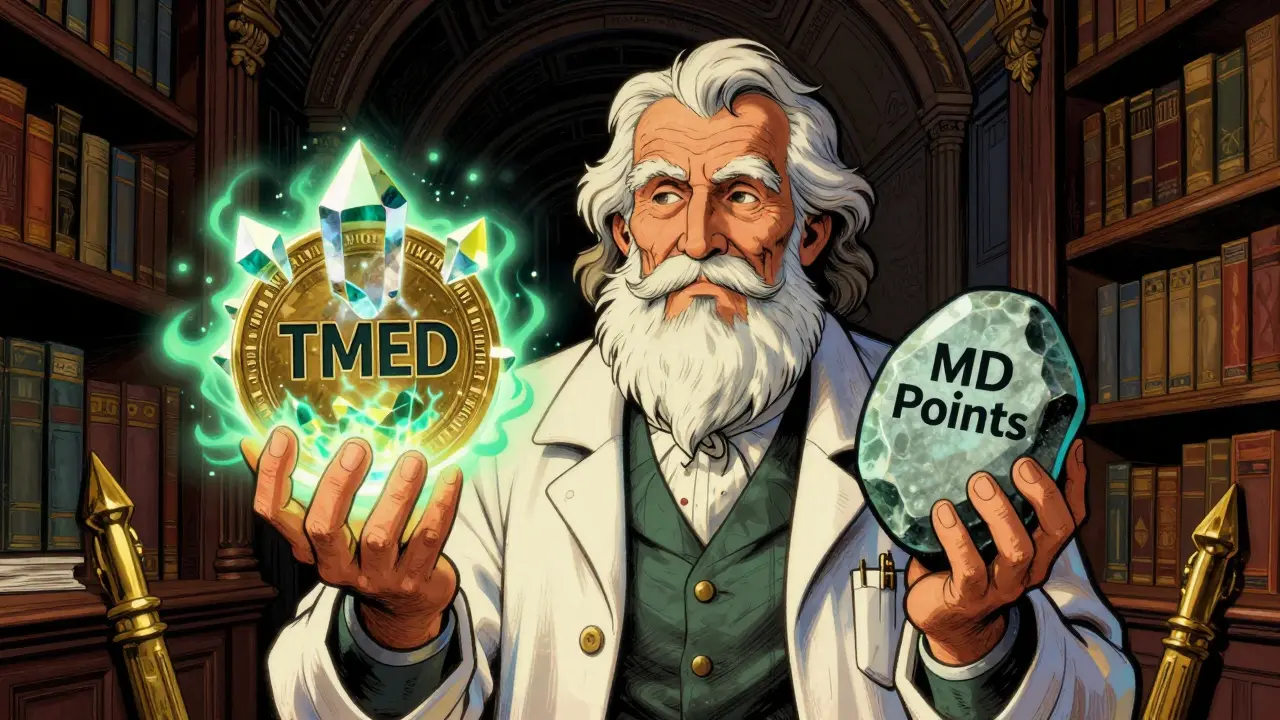
Understanding the Dual-Token System: TMED vs. MD Points
One of the most confusing aspects for new users is the existence of two different units of value within the MDsquare ecosystem. This is a critical distinction that separates MDsquare from many other single-token projects.
| Feature | TMED Token | MD Points (MDP) |
|---|---|---|
| Type | Cryptocurrency (ERC-20) | Stable Internal Credit |
| Purpose | Rewards, speculation, governance | Paying for medical services |
| Volatility | High (market-dependent) | Low (pegged to USD) |
| Acquisition | Earned via activity or bought on exchanges | Bought with fiat or exchanged from TMED |
| Liquidity | Tradeable on external exchanges | Non-tradeable, internal use only |
Why did they do this? Because doctors and hospitals need stability. No clinic wants to accept payment in a currency that could drop 20% in value before they can convert it to local fiat. So, MDsquare introduced MD Points. You buy these points with US Dollars, Korean Won, or even TMED tokens. When you book a doctor, you pay in MDP. This shields the healthcare providers from the wild swings of the crypto market while still allowing them to benefit from the broader ecosystem if they choose to hold some TMED.
Tokenomics: Supply and Circulation Reality Check
If you dig into the numbers, the picture becomes clearer-and perhaps more concerning for potential investors. Let's look at the hard data available as of early 2026.
The total supply of TMED is fixed at 28 billion tokens. This is a massive number, typical of tokens launched during the 2017-2018 ICO boom. However, the circulating supply reported by major trackers like CoinMarketCap and Yahoo Finance is consistently listed as 0 TMED.
Does this mean there are no tokens left? Not necessarily. It usually means one of two things:
- The tokens are locked in private wallets or development funds and not actively trading on public order books.
- The liquidity is so thin that tracking algorithms cannot detect a reliable circulating volume, effectively treating it as zero.
When we look at pricing data, the discrepancies are stark. On CoinMarketCap, the price might show as $0.00000000 with $0 trading volume. Meanwhile, smaller aggregators like P2P.Army might show a microscopic price of around $0.000009 with minimal daily volume (under $1,000). This indicates that TMED is currently a micro-cap or dormant asset. There is no active liquid market for it on major exchanges like Binance or Coinbase.
Technical Architecture and Security
From a technical standpoint, MDsquare relies on the Ethereum network. This choice offers broad compatibility-you can store TMED in MetaMask, Trust Wallet, or any standard Ethereum wallet. However, it also exposes the project to Ethereum’s gas fees and network congestion issues, which can make small transactions expensive.
The platform’s whitepaper highlights several key technological components:
- Smart Contracts: Used to automate reward distribution when patients upload data or doctors complete consultations.
- Encryption Protocols: Essential for protecting sensitive health data (PHI) in compliance with standards like HIPAA (in the US) or GDPR (in Europe).
- AI Chatbots: Integrated to provide preliminary triage and support, reducing the load on human doctors.
However, a significant gap exists in public documentation regarding recent security audits. In the world of healthcare crypto, trust is everything. Without visible, third-party audit reports from firms like CertiK or SlowMist, it is difficult to verify the current security posture of the smart contracts handling user data and funds.
Current Status: Is MDsquare Still Active?
Let’s address the elephant in the room. As of June 2026, MDsquare appears to be largely inactive in the public eye. The official social media channels, such as X (formerly Twitter), have not shown significant engagement since the initial hype cycle around 2018-2019. There are no major partnerships announced in recent years, nor are there updates on app stores indicating active user growth.
Compare this to competitors in the space. Projects like MediBloc or Near Protocol’s health initiatives have continued to iterate, publish updates, and build communities. MDsquare, by contrast, seems to have stalled. The low market ranking (often below #7000) and near-zero volume suggest that the ecosystem has not achieved the network effect required to sustain itself.
This doesn't mean the code is broken, but it does mean the momentum is gone. For a platform that relies on network effects-where value increases as more doctors and patients join-a lack of new users creates a death spiral. Fewer doctors mean fewer services, which means fewer patients, which leads to fewer rewards.

Risks and Considerations for Users
If you are holding TMED or considering buying it, you must understand the risks involved. This is not a mainstream investment vehicle.
Is MDsquare a scam?
There is no definitive evidence labeling MDsquare as a fraudulent scheme. It was a legitimate project with a working prototype and clear utility goals. However, "not a scam" does not mean "safe investment." The lack of development, liquidity, and transparency poses significant financial risk.
Can I still use the MDsquare app?
The availability of the app is uncertain. While the website may still exist, the lack of recent updates suggests the mobile applications may no longer be supported on iOS or Android. Even if accessible, finding active doctors on the platform would be extremely difficult given the low user base.
Why is the circulating supply zero?
A circulating supply of zero typically indicates that tokens are not being traded on tracked exchanges. They may be held in cold storage by the team or early investors, or simply abandoned by holders who moved to more active assets. It reflects illiquidity rather than non-existence.
How does TMED compare to other health coins?
Compared to active projects like MediBloc or Fetch.ai (which has health use cases), TMED lacks liquidity, community engagement, and recent development. Most major health-focused blockchains have pivoted to broader DeFi or AI narratives, leaving niche telemedicine tokens behind.
What happened to the MD Points?
MD Points were designed as a stable currency for payments. With the decline in platform activity, the ability to exchange TMED for MDP or use MDP for services is likely suspended or non-functional. There is no public mechanism to redeem these points for fiat currency currently.
Final Thoughts: The Legacy of MDsquare
MDsquare represents an important chapter in the history of blockchain healthcare. It was one of the early attempts to tokenize patient data and create a decentralized telemedicine network. The concept of rewarding users for health data sharing is now widely accepted, seen in modern Web3 health apps and AI training datasets.
However, as a live product and investment opportunity in 2026, MDsquare (TMED) carries substantial caution flags. The absence of liquidity, the stagnant development cycle, and the regulatory complexities of cross-border medical advice make it a high-risk proposition. For those interested in blockchain healthcare, it may be more fruitful to explore newer, actively maintained protocols that have adapted to the evolving regulatory and technological landscape.
Always do your own research (DYOR). Check the latest contract addresses, verify any official announcements directly from primary sources, and never invest more than you can afford to lose in dormant assets.